Updated 25 October 2026 - for UK restaurants, cafes, pubs, takeaways and other small catering businesses
No law gives a list of food safety records or says how to file them. The law asks for food safety procedures based on HACCP, with records that fit your business, and for a way to trace where your food came from. The free pack for your nation shows which records to keep. This guide puts them in one folder, in one order, with a free map to print.
Law in all four nations No law gives a list of food safety records, or says how to file them. The law asks every food business to put in place food safety procedures based on HACCP, with "documents and records commensurate with the nature and size of the food business" (Article 5 of Regulation 852/2004). That duty is the same in England, Wales, Scotland and Northern Ireland.
Guidance GOV.UK puts it simply: keep "records of your food safety systems, checks and how you've put things right".
Law in all four nations One rule comes closer to naming a record: you must be able to say who supplied each food, and which businesses you supplied, if any (Article 18 of Regulation 178/2002). Section 5 covers it.
The rest of a usual list is how the free packs and councils suggest you show the law is being met: fridge readings, cooking and cooling checks, opening and closing checks, cleaning, probe checks, training and pest visits. How much you keep depends on your size and what you cook.
Guidance in England, Wales and Northern Ireland GOV.UK says that if a business's processes are very simple, it may be able to meet the law by following good hygiene practice. Ask your council's food safety team if you think that applies to you.
Law in England, Wales and Scotland You may hear "due diligence". It is a defence in court: a business can argue it "took all reasonable precautions and exercised all due diligence" to avoid an offence. In England this is in regulation 12 of the Food Safety and Hygiene (England) Regulations 2013; the Food Safety Act 1990 has the same defence in England, Wales and Scotland. Records written at the time are the usual way to show what you did. Whether a defence works is for a court, not a folder or an app.
Our advice Think of the folder in three parts. Our food safety management system guide explains each one.
Guidance in England and Wales The FSA pack says it "should always be available at the business." Guidance in Northern Ireland Safe Catering says staff "should be able to produce it when requested by an inspecting Environmental Health Officer."
Our advice No law sets this layout. It is our way of filing what each pack asks for, in the order a kitchen uses it. Use dividers, and put the newest pages at the front of each section.
Where each section comes from
Download the kitchen folder map (PDF, one page). It is free to print and use in your kitchen.
Guidance Each pack keeps the daily records in its own way. Only Safe Catering numbers its forms. The FSA pack has no daily fridge, cooking or cooling log: its minimum is the diary, with a "Prove it: Records" sheet for the checks you write down, and it says "you may need to keep more records" depending on your business. Safe Catering's SC8 and CookSafe's All-in-One Record can be used instead of the separate delivery and temperature forms.
| Record | England and Wales: FSA pack | Northern Ireland: Safe Catering | Scotland: CookSafe |
|---|---|---|---|
| Opening and closing checks | The opening and closing checks, ticked and signed in the diary | No daily form. SC5 Hygiene Inspection Checklist for regular premises checks | No daily form. Weekly Record for weekly checks |
| Fridge and freezer temperatures | The diary, the "Prove it" records, or your own record | SC2 (or SC8) | Cold Food Record |
| Cooking | The cooking safely safe method; "Prove it: Records" | SC3 | Hot Temperature Record |
| Cooling | The chilling down hot food safe method; "Prove it: Records" | SC3 | Hot Temperature Record |
| Reheating | The reheating safe method; "Prove it: Records" | SC3 | Hot Temperature Record |
| Hot holding | The hot holding safe method; "Prove it: Records" | SC4 | Hot Holding Record |
| Deliveries | Stock control, and suppliers and contractors; problems in the diary | SC1 | Delivery Record |
| Food you send out (deliveries to customers, outside catering) | No separate form; the hot holding safe method covers food deliveries | SC9 Customer Delivery Record | Off Site Temperature Record |
| Stock and use-by checks | Stock control safe method; the closing check "Food on its Use By date has been thrown away" | SC5 Hygiene Inspection Checklist (date codes and stock rotation) | House Rules: Stock control; Weekly Record |
| What went wrong and what you did | The diary: "Any problems or changes - what did you do?" | The corrective action on each form | "Corrective actions taken" on the Weekly Record |
Law in all four nations Article 5 asks for corrective actions and for records of them. Guidance in Northern Ireland Safe Catering: "you must also record what you have done about it (corrective actions)".
Our advice Write the reading when you take it, and write what you did on the same line. A record filled in at the end of the week is worth little.
Law in all four nations The law on tracing food is Article 18 of Regulation 178/2002, and the rule is the same in England, Wales, Scotland and Northern Ireland. It asks for two things.
Guidance in England and Wales The law does not say how to keep these records. The FSA pack says the easiest way is to keep all your invoices and receipts. It calls a record of "what food products you have bought, who you bought them from, the quantity, the date" a legal requirement, and adds that, ideally, you keep them "until you are sure that the food they refer to has been consumed without any problems".
Guidance in Northern Ireland Safe Catering asks for a supplier list, and for batch codes on food of animal origin, such as meat, fish and dairy.
No law requires an "approved supplier list". Our delivery checks guide covers what to check when food arrives.
Law in all four nations The law asks that allergen information for the food you serve is available to customers, and that staff are trained on allergens. It does not require a matrix. Our free allergen matrix is ready to print if you want one.
Guidance in England, Wales and Northern Ireland GOV.UK's allergen guidance for food businesses says allergen ingredient information should be recorded in writing (on product specification sheets, in recipes) and kept up to date. A matrix is one common way: the FSA pack gives it as an example.
Guidance in Scotland See Food Standards Scotland and CookSafe's Allergen Management house rules.
Our advice Keep the allergen information for every dish in this section of the folder, and update it the day a recipe or a supplier changes.
Law in all four nations No law sets a number. The law says to keep records "for an appropriate period". The packs word it differently:
Our advice Keep everything at least until after your next inspection, and ask your council if you are unsure. Our food safety management system guide has the full wording.
No law says your records must be on paper: each nation's pack allows records to be kept electronically, and in all four nations an inspector can look at records "in whatever form they are held". What each nation says, what makes a record believable and what to do if an inspector asks for paper: our digital food safety records guide.
Our advice Many kitchens use both: the plan and documents in a folder, the daily records on a phone. Make sure the folder says where the daily records are.
Guidance in England, Wales and Northern Ireland There is no published list of what an inspector will ask to see. GOV.UK says: "All your records need to be kept up-to-date and be available for inspections at all times."
Our advice Expect to be asked for your plan and for the records that show you follow it. Expect questions to the people on shift as well. Our EHO inspection guide lists the records to have ready.
Paper works. In ChefsRecords, an iPhone app, you can keep many of the daily records:
The Inspection Pack puts temperatures, checklists and incidents for the dates you choose into one PDF. On Pro, each person's staff file can hold their training certificates and right to work dates, with reminders.
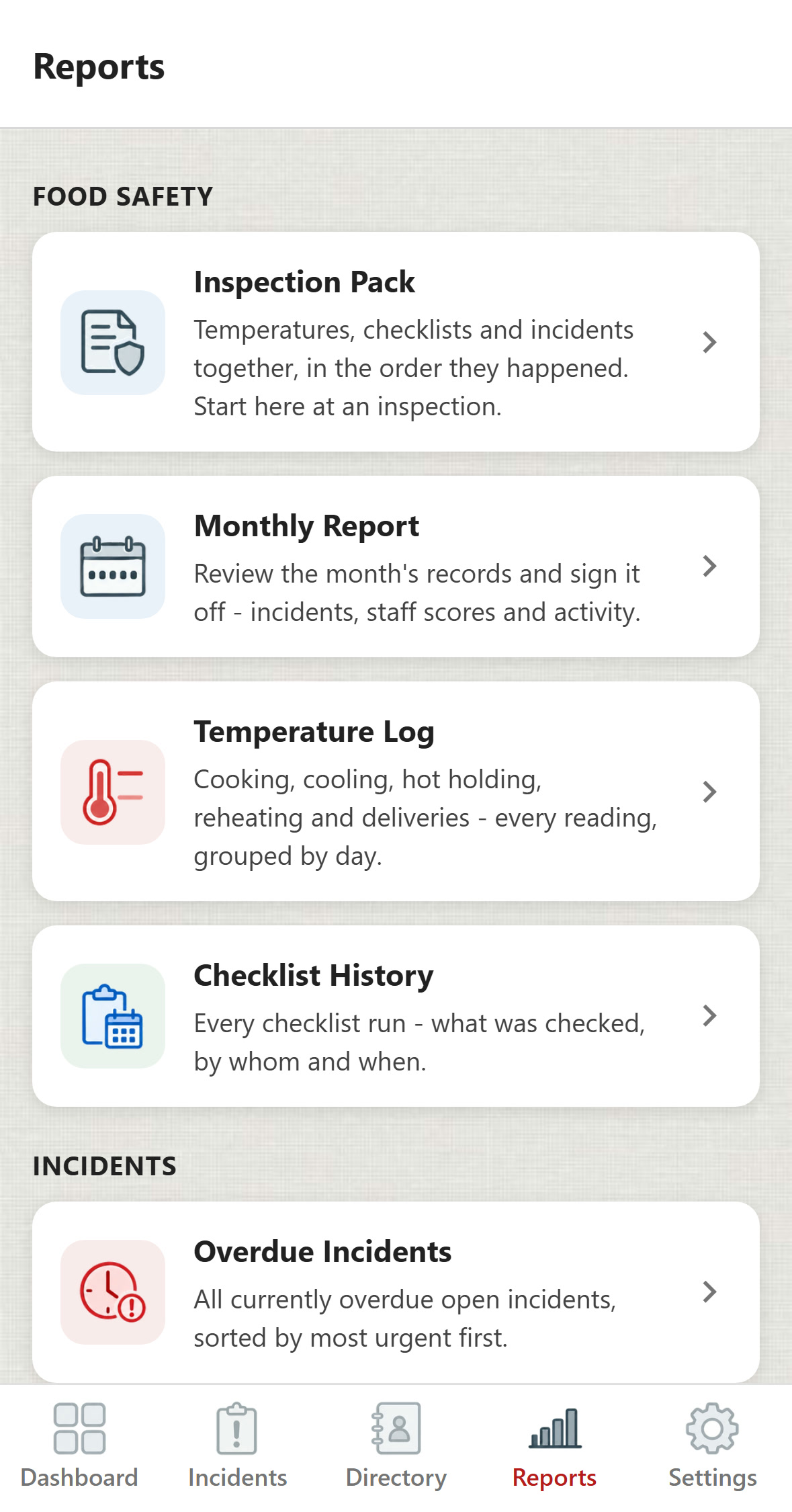
The Reports screen: the daily records, ready to show or print.
The app holds records, not documents. Your plan, allergen information, pest contractor reports, invoices and copies of certificates stay in the folder. It does not write, check or replace your plan.
Which plan. Recording cooking, cooling, hot holding, reheating and delivery temperatures is included on every plan. After the 14-day trial, the free plan keeps them for one login, the kitchen's billing Manager. Checklists, stock, reports and the Inspection Pack come with Standard and Pro and are open in the 14-day trial. Training and right to work records are part of Pro and are not in the trial. Reports look back 12 months on Standard and 24 months on Pro. A Manager can export the records to a spreadsheet on any plan.
Get ChefsRecords on the App Store (iPhone) ›
14 days free. No card required.
This is general guidance for UK kitchens, written from the public sources below as published on 23 October 2026. It is not legal advice and does not replace your own food safety management system. Which records are enough, and how long to keep them, are for your own council. ChefsRecords is not part of, or endorsed by, the Food Standards Agency, Food Standards Scotland or your local council. If you are unsure, ask your local authority's food safety team.
Some papers belong in the office rather than the kitchen folder. Inside food hygiene law:
Outside food hygiene law, see GOV.UK:
No law gives a list. The law asks for food safety procedures based on HACCP, with records that fit "the nature and size of the food business", and for a way to say who supplied each food and which businesses you supplied, if any. The free pack for your nation shows which records to keep.
Our map has eleven sections: the plan, daily records, cleaning schedule, probe checks, staff sickness and fitness to work, pest control, training, suppliers and traceability, allergen information, review and old records. No law sets this layout; it is our way of filing what each pack asks for.
The law asks for procedures based on HACCP, not a "HACCP plan" by that name. The FSA pack, Safe Catering and CookSafe are all based on HACCP. For most small caterers a pack, filled in properly, is the simplest way. Your council may advise a fuller HACCP plan for a larger or higher-risk business.
No law sets a number: "for an appropriate period". GOV.UK says to keep the FSA diary pages until your next visit from a food safety officer, Safe Catering recommends at least 12 months, and CookSafe says your Enforcement Officer can advise.
No law says records must be on paper, and each nation's pack allows records to be kept electronically. Keep them up to date and make sure they can be shown at the business when an inspector asks. More in our digital food safety records guide.
There is no published list. Expect to be asked for your plan and the records that show you follow it, and expect questions to the people on shift. Our EHO inspection guide lists the records to have ready.
No law requires an "approved supplier list". The law asks that you can say who supplied each food. A supplier list and your invoices are how the packs suggest you do it.
The law asks that you can trace who supplied each food, not how. The FSA pack says the easiest way is to keep all your invoices and receipts, ideally until the food has been eaten without any problems.
Only for other businesses. The law asks that you can identify the businesses you supplied. If you sell only to the public, there is no forward record to keep.
The law asks that allergen information is available to customers and that staff are trained on allergens. It does not require a matrix. GOV.UK says the information should be recorded in writing and kept up to date; a matrix is one common way.
It is a defence in court: a business can argue it took all reasonable precautions and exercised all due diligence to avoid an offence. Records written at the time are the usual way to show what you did. Whether a defence works is for a court.
At the business. The FSA pack says it "should always be available at the business", and Safe Catering says staff should be able to produce it when an inspector asks.
The food safety management system guide, the food safety diary guide, the EHO inspection guide, the first food hygiene inspection guide, the opening and closing checks guide, the fridge temperature log guide, the delivery checks guide, the digital food safety records guide, the probe check guide and the near miss guide.