Updated 25 October 2026 - for UK restaurants, cafes, pubs, takeaways, carveries and other catering businesses
A cleaning schedule is a written list of what gets cleaned, how, with which product, and how often. Here is what the sources say, nation by nation.
Law in all four nations No UK law uses the words "cleaning schedule". The law says your kitchen and everything food touches must be kept clean and, where necessary, disinfected, often enough to avoid any risk of contamination. It also says your food safety procedures must be written down and kept up to date, with records that fit the size of your business, and you must be able to show them to your council. A written cleaning schedule is the usual way to do that.
The wording comes from Regulation (EC) 852/2004 as it applies in the UK. Annex II says premises are "kept clean and maintained in good repair and condition". It says articles, fittings and equipment that food touches are "effectively cleaned and, where necessary, disinfected", at "a frequency sufficient to avoid any risk of contamination". Article 5 asks for HACCP-based procedures and "documents and records commensurate with the nature and size of the food business". The regulations for England, Wales, Northern Ireland and Scotland enforce it. We found no extra cleaning rule in any of them.
Guidance in England, Wales and Northern Ireland GOV.UK is more direct. It says "You must be able to prove that you're cleaning effectively", "Set up a cleaning schedule and record", and "The cleaning schedule must cover what needs to be cleaned or disinfected, how often, and which products to use." Those are guidance written with a "must". They are not the text of a law. GOV.UK adds that "Not cleaning thoroughly is one of the most common reasons why food businesses are prosecuted."
So, in short: no law names a cleaning schedule, but GOV.UK tells you to set one up, and your inspector may ask to see it. If you are unsure what your council expects, ask its food safety team.
The FSA pack says: "It is important to write down how you do your cleaning, so you can show what you do." For each item it asks for how you clean it, what chemicals you use and how to use them, what equipment you use and how often you clean it. The FSA pack says that if you already have a cleaning schedule, you can continue to use it. CookSafe says the schedule "needs to be written to reflect how you manage the cleaning in your business". The columns below follow those sources. The last two are our own advice.
| Column | What to write | Where it comes from |
|---|---|---|
| What | The item or area: for example the prep surface, the slicer, the walk-in fridge, the floor. | Guidance FSA pack and CookSafe |
| How | The method, step by step. Add the equipment (cloth type, brush, colour) and any precautions, such as gloves or goggles. | Guidance FSA pack and CookSafe |
| Product | The product you use for the job, and where the label shows BS EN 1276 or BS EN 13697. | Guidance GOV.UK ("which products to use"), FSA pack |
| Dilution | How much product to how much water, as the maker says. Too much or too little water and the chemical might not work effectively. | Guidance FSA pack, CookSafe |
| Contact time | How long the disinfectant stays on the surface. Copy it from the product label. | Guidance FSA pack, CookSafe |
| How often | After use, every shift, daily, weekly or other. | Guidance FSA pack form, GOV.UK |
| Who | The person or role responsible. Neither the FSA form nor CookSafe has this column, but the FSA pack says to train staff "so they know what they have to do, and when". | Our advice |
| Sign-off | How you show it was done, and who checks. The schedule says what to do. The record shows it was done. | Our advice Built on GOV.UK ("schedule and record") and the FSA diary |
The FSA pack's own examples, grouped:
You do not need to disinfect everything, says the FSA pack. Concentrate on what touches food and on frequently touched items such as door and appliance handles. Items that do not touch food are not as high a priority, but they should still be cleaned effectively.
Guidance The FSA pack says "you may wish to put your cleaning schedule on the wall", and to train staff on it and supervise the cleaning. Our opening and closing checks guide shows how the schedule, the daily checks and the 4-weekly review fit together.
Our advice No source sets a daily, weekly or monthly list. The FSA pack's form has five frequency columns: "After use", "Every shift", "Daily", "Weekly" and "Other". CookSafe's example uses "After each use" and "As and when required". None of the packs we read says "monthly". The split below is ours, built from the items in those sources. Move jobs between columns to suit your kitchen.
Weekly jobs. The FSA pack calls these "extra checks", less frequent than the daily opening and closing checks. Its 4-weekly review asks whether they were "completed and recorded weekly". It says to clean and disinfect fridges "at a time when they do not contain much food". Its dishwasher example reads "Remove internal parts and deep clean."
Monthly. Nothing official uses the word. We use it for the jobs that do not need doing every week, and for the review of the schedule itself. The FSA pack's 4-weekly review asks "Does the cleaning schedule require updating?"
No rule sets it. Our advice Spread the deep clean across the weeks so every area gets done, rather than one huge day that never happens. The FSA pack treats a deep clean as an extra check that you note in the diary when it is done, and reviews it every 4 weeks.
For equipment or areas that are hard to clean, the FSA pack says you may wish to employ a contract cleaner. If you use one, keep their record with your own.
Two-stage cleaning means clean first, then disinfect. Every nation's guidance describes it, and the FSA pack's worked example for a work surface breaks it into six steps. Which disinfectant to use, and how to read its label: our disinfectants guide.
The six steps, animated. They are written out below.
Contact time is how long a cleaning chemical needs to be left on the item you are cleaning. The time on the product label is the one that counts. This guide does not give a number, because it depends on the product.
When to use both stages. The FSA pack says to clean and then disinfect surfaces or items that have been touched by raw food, or by leaks or spills from it. GOV.UK says: "Always clean and disinfect food areas and equipment after they've come into contact with raw food."
"'Clear and clean as you go' is the recommended way of keeping your kitchen clean as you work", says the FSA pack. Guidance in England and Wales In practice, from the pack:
Clean as you go does not replace the schedule. It is what keeps the schedule's jobs small.
Heat. A dishwasher washes items thoroughly at a high temperature, which the FSA pack calls "a good way to clean equipment and kill bacteria (disinfect) and remove allergens". CookSafe asks for evidence that the dishwasher is capable of providing adequate heat disinfection. Neither source we read gives a rinse temperature, so we do not give one.
GOV.UK says: "Make sure you check the labels of cleaning products. Not all kill bacteria and viruses."
Store cleaning products away from food: that part is law, since cleaning agents and disinfectants are not to be stored where food is handled. What the numbers mean, sanitiser or disinfectant, contact time, wipes, and what to do when the number is not on the label: our disinfectants guide.
The FSA pack: "Cloths can be one of the top causes of cross-contamination in the kitchen." Guidance in England and Wales
CookSafe says single-use cloths are a reliable way of making sure cleaning and disinfection does not cause cross-contamination, and that dishcloths must be kept clean and should be laundered at a suitably high temperature. GOV.UK lists dish cloths, sponges and tea towels among the things you must regularly clean.
Colour coding is guidance, not law. Guidance in Scotland CookSafe says colour coding of cleaning materials is recommended, and that separate materials and equipment must be used for cleaning and disinfecting raw food handling areas. Our advice Keep raw-area cloths and equipment apart from the rest, in colours your team knows.
Which chopping board colour is for which food, and a free wall chart to print: our chopping board colours guide.
Guidance in England and Wales From the FSA pack:
Guidance in Scotland CookSafe says a dishwasher is "the only acceptable method" for cleaning and disinfecting equipment used only for raw food and equipment used only for ready-to-eat food together, and only "where there is evidence that the dishwasher can achieve an appropriate level of heat disinfection". In a twin sink, "The sink must always be disinfected after use with raw food equipment and utensils and/or before being used for any other purpose."
Law in all four nations The law asks for adequate facilities, where necessary, for cleaning, disinfecting and storing utensils and equipment, with hot and cold water, and for sinks used for washing food to be kept clean and, where necessary, disinfected.
Keep separate machines for raw and ready-to-eat food. If you ever change one over, take it apart, clean and disinfect every part first.
Guidance The FSA pack says: "Always use separate equipment, such as vacuum packers, slicers or mincers, for raw and ready-to-eat food." It says this equipment is very difficult to clean sufficiently unless it is taken apart. Vacuum packing machines need a specialist to do that. GOV.UK's E. coli guidance for England, Wales and Northern Ireland says complex equipment such as these "shouldn't be used for both raw and ready-to-eat food during a normal business day". If you change a machine from raw to ready-to-eat, it says the machines need to be dismantled and all surfaces cleaned and effectively disinfected.
CookSafe says it is particularly dangerous to use this kind of equipment for both. Some specialist equipment has its own instructions for dismantling and cleaning. Follow them.
A slicer is not safe to share just because you wiped it down. Put the machine, the way you clean it, and the product in your schedule.
Law in all four nations The law asks for records that fit the size of your business, documents that are up to date at all times, and records kept "for an appropriate period". It sets no number of months.
Guidance In the FSA pack, the opening and closing checks each ask whether cleaning has been carried out according to the cleaning schedule. The manager signs the diary each day to say "Our safe methods were followed and effectively supervised today." Extra checks, such as a deep clean, are noted in the diary when they are done. CookSafe says records of monitoring and the corrective action taken should be kept for an appropriate period of time. In Scotland, problems go in the Weekly Record.
Our advice A cleaning record that works:
The FSA pack says what to do if an item in your kitchen is not properly clean:
CookSafe says a breakdown with a cross-contamination risk must be considered a serious incident, and the corrective action would be to dispose of the food. The problem and the action go in the Weekly Record. Our near miss guide shows how to write it down.
The hygiene law underneath (Regulation 852/2004) is the same in all four nations. The schedules and forms differ.
There is no published list. These are questions we would expect, drawn from GOV.UK, the FSA pack's own questions and CookSafe. In England, Wales and Northern Ireland, the Food Hygiene Rating Scheme guidance says the officer looks at how hygienically food is handled, the physical condition of the business including cleanliness, and how you manage keeping food safe.
Our EHO inspection guide covers the rest of the visit.
This is our own wording, a starting point to adapt to your kitchen. It is not a legal list and it is not the FSA's list. It is a list of jobs. Your written schedule still needs the method, product, dilution and contact time for each one.
Free forms: the FSA pack's cleaning schedule form (England and Wales) and CookSafe's house rules for cleaning and schedule template (Scotland).
Paper works: the FSA pack (England and Wales) and CookSafe (Scotland) both have a free cleaning schedule form.
Why kitchens move off paper:
For cleaning, the written schedule stays where staff can see it: what to clean, how, with which product, its dilution and its contact time. The app does not replace it. In ChefsRecords you can start from a ready-made daily cleaning checklist and change any line. You can put the product and contact time in a line's name, so it prints on the record. Weekly Checks carry the deep-clean jobs, and the Monthly Review asks whether your cleaning schedule is still right. Each checklist has its own reminder time, and on Pro you can give it to one person. A daily checklist is one run a day. A finished checklist is saved with who completed it and when, a day left unfinished stays on the record as not finished, and a manager or supervisor signs each day off from the next day. The app records that the cleaning was done. Your written schedule says how.
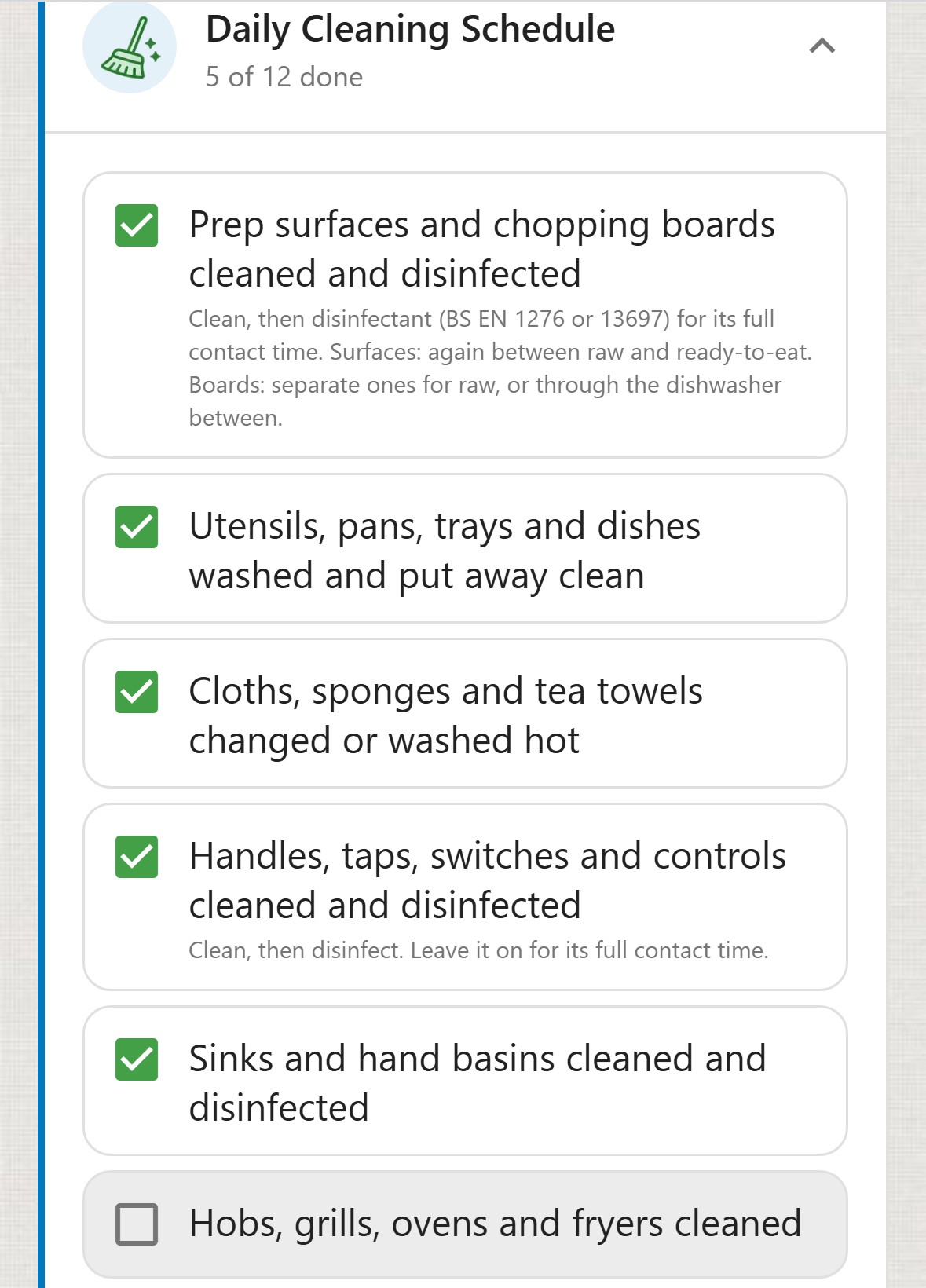
The day's cleaning, ticked off. The checklist is where the day's cleaning is ticked off. The method, product and contact time stay in your written schedule.
Checklists are part of the Standard and Pro plans. Giving a checklist to one person needs Pro. See what else it does.
Get ChefsRecords on the App Store (iPhone) ›
14 days free. No card required.
This is general guidance for UK kitchens, written from the public sources below as published on 19 October 2026. It is not legal advice and does not replace your own food safety management system. If you are unsure, ask your local authority's food safety team. ChefsRecords is not part of, or endorsed by, the Food Standards Agency, Food Standards Scotland or your local council.
No law names one. The law says food premises and equipment must be effectively cleaned and, where necessary, disinfected, often enough to avoid any risk of contamination, and that your procedures and records fit the size of your business. GOV.UK tells you to set up a cleaning schedule and record, and your inspector may ask to see it. If you are unsure what your council expects, ask its food safety team.
What is cleaned, how, with which product, its dilution and contact time, how often, who does it, and how it is signed off. GOV.UK says it must cover what needs to be cleaned or disinfected, how often, and which products to use.
No source sets these lists, so this is our advice. After use: prep surfaces, boards, knives and spills. Daily: touch points, sinks, hobs, floors and bins. Weekly: fridges, behind equipment, the dishwasher's inside, extraction filters and drains. Monthly: walls, ceilings, freezers and the review of the schedule itself.
No rule sets it. Spread it across the weeks so every area gets done. The FSA pack treats it as an extra check that is recorded when done, and reviews it every 4 weeks. Hard-to-clean areas can go to a contract cleaner.
Clean first with hot soapy water or a cleaning product, to remove visible dirt and grease. Then disinfect, following the maker's instructions and leaving it on for the contact time. Disinfectants only work on a clean surface.
Cleaning removes visible dirt and grease. Disinfecting kills bacteria. A sanitiser is a two-in-one product, used twice: once to clean, once to disinfect.
How long a cleaning chemical needs to be left on the item you are cleaning. The time on the product label is the one that counts.
Cleaning as you work instead of leaving it all for the end: wipe spills straight away, wash surfaces between tasks, clear away dirty equipment and keep sinks clear. The FSA pack calls it the recommended way of keeping your kitchen clean as you work.
BS EN 1276 or BS EN 13697. Guidance in every nation names them, and CookSafe in Scotland says "must", but no law does. Check the label for dilution, contact time and whether a rinse is needed. More in our disinfectants guide.
Use disposable cloths where possible. Reusable cloths are washed, disinfected and dried between tasks. The FSA pack says a hot machine cycle of 90°C gives a suitably high temperature. By hand, wash and then use boiling water or a suitable disinfectant. Bleach is not a suitable disinfectant for cloths.
Keep separate machines for raw and ready-to-eat food. If you ever change one over, take it apart, clean and disinfect every part first.
Our advice: the person who cleaned signs or initials each job when it is done, and a manager checks it and signs. The FSA pack asks the manager to sign the diary each day. That is good practice, not a legal requirement.
Yes. The FSA pack has a free cleaning schedule form for England and Wales, and CookSafe has a free template for Scotland. Both are linked above. There is also a list of jobs to copy on this page.
There is no published list. Your inspector may ask for your cleaning schedule, which product you use and its dilution and contact time, where your disinfectant standard is written down, how you clean between raw and ready-to-eat food, and who ticked the records and when. They may also look at the places a daily wipe misses.
Your food safety plan should describe what your kitchen really does, and your cleaning schedule belongs with it. The free food safety plan builder takes you through safe methods based on the FSA pack, so you can write them in your own words, then prints your plan or saves it as a PDF. For small restaurants, cafes, pubs and takeaways in England and Wales.
The opening and closing checks guide, the probe check guide (which covers cleaning the probe), the fridge temperature log guide, the near miss guide and the EHO inspection guide. And our 4Cs of food hygiene guide, which brings the basics together. More guides: the disinfectants guide, the cross-contamination guide, the pest control guide, the hand wash basins guide and the chopping board colours guide.