Updated 25 October 2026 - for UK restaurants, cafes, pubs, takeaways, carveries and other catering businesses
No UK law tells you how to rotate stock. The law says food past its use-by date counts as unsafe, and it is an offence to sell or serve unsafe food. First in, first out, day dots and how long to keep opened food are guidance and good practice, not law. Here is what the sources say.
Stock rotation is using food in the right order, so that nothing sits at the back of the fridge until it is out of date. Older stock goes to the front and is used first. New stock goes behind it. Food you open, make or decant gets a label so everyone knows what it is and when it must go.
It protects the people who eat your food, and it cuts waste. The FSA pack says following "first in, first out" "helps to avoid waste".
Law in all four nations No UK law tells you how to rotate stock. Here is what the law does say.
First in, first out, day dots and how long to keep opened food are guidance and good practice. They are not law. Your council inspects you, so if you are unsure, ask it.
Guidance in England and Wales Guidance in Scotland The FSA pack says to "follow the 'first in, first out' system of stock rotation, so that older stock is used first". CookSafe says stock "should be rotated on a first-in-first-out basis and damaged stock removed from the main storage area". Our advice The steps below are our own, built from both.
Our advice A worked example. Saturday's milk has a use-by date of Wednesday. Monday's milk, delivered today, has a use-by date of Thursday. Monday's goes behind Saturday's, and Saturday's is used first.
FIFO means first in, first out. It is the system the FSA pack and CookSafe describe. FEFO means first expired, first out: use whatever runs out of date first, even if it came in later.
Our advice No official UK source we read uses the word FEFO, so this is ours. If a newer pack has a shorter date, use it first. That fits the FSA pack, which says to "make sure they know in what order to use foods". Most of the time the oldest stock has the earliest date, so FIFO and FEFO give the same answer. The date on the pack decides.
Both dates sit on the label, and they do not mean the same thing. Use-by is about safety. Best before is about quality.
| Question | Use-by | Best before |
|---|---|---|
| Safety or quality? | Guidance Food safety. Food Standards Scotland says use-by "concerns food safety". GOV.UK says it tells you when the food is no longer safe to eat. | Guidance Food quality. Food Standards Scotland says it "concerns food quality rather than food safety". GOV.UK says it tells you when food might start to reduce in quality. |
| Law or your choice? | Law in all four nations After the date, food counts as unsafe in law, however it looks or smells. | Law in all four nations Using food past the date is not an offence by itself. It must still be safe and in good condition. Whether to use it is your call. |
| On the date itself | Guidance in Scotland The last day. Food "may be consumed up to and on the date on the label but not after". Guidance in England and Wales The FSA pack says food on its use-by date has been thrown away at closing. | Guidance After the date the food is usually safe but may not be the same quality, says GOV.UK. Check its condition. |
| Freezing | Guidance Freeze it before the use-by date, and note the date you froze it. | Guidance in Scotland Food Standards Scotland says best-before dates are most often found on frozen, tinned and dried foods. Follow the label. |
| The sniff test | Law in all four nations Not a test. Past its use-by date, food counts as unsafe in law even if it looks and smells fine, so it goes in the bin. | Guidance GOV.UK says you can use sight, taste or smell to decide whether the food is still good. |
Strict. Past the date the food counts as unsafe in law, however it looks or smells. There is no sniff test for a use-by date. The label may also carry storage conditions, such as "keep refrigerated", and Food Standards Scotland says these "must be followed to keep the food safe".
GOV.UK says use-by dates "must be shown on foods that go off quickly, such as meat products and ready-to-eat salads". Food Standards Scotland says best-before dates "are most often found on frozen foods, tinned foods and dried foods". Some foods carry no date at all. Regulation 1169/2011 (Annex X) lists them, and they include fresh whole uncut fruit and vegetables, wines, drinks of 10% alcohol or more, bakers' wares normally eaten within 24 hours, vinegar, cooking salt and solid sugar.
Law in all four nations Using food past its best-before date is not an offence by itself. It must still be safe and in good condition. WRAP, working with the FSA and Defra, has said all food with a best-before date "can be sold, redistributed and consumed after that date" as long as it is of good quality. The Food Safety Act 1990 (in Northern Ireland, the Food Safety (Northern Ireland) Order 1991) also makes it an offence to sell food that is not of the nature, substance or quality the customer demands. Our advice Look at it, smell it, and ask whether you would serve it to your own family. If you are in any doubt, throw it away.
Guidance in England, Wales and Northern Ireland Eggs are the exception. The FSA's egg advice for caterers says "do not use eggs beyond their best before date", and, in England and Wales, the FSA pack says "Use eggs within the 'best before' date". Guidance in Scotland Food Standards Scotland gives caterers the same advice. Guidance in Northern Ireland Safe Catering says "Do not use eggs after the 'best before' date."
More in our eggs guide.
Guidance in Scotland Yes, on the day. The use-by date is the last day. Food Standards Scotland says food "may be consumed up to and on the date on the label but not after".
Guidance in England and Wales The FSA pack's closing checks ask: "Food on its Use By date has been thrown away." Its chilled storage page says to "make sure you use food before its 'use by' date". So the safe reading is: use it that day, and at close throw away what is left. Throwing it away at close on the date is guidance. It is not a rule you will find in the regulations.
Our advice Do not plan to use food the next morning because it "was fine last night". The date is the last day.
Guidance GOV.UK's advice to businesses is to "freeze fresh food before its use-by date and note the date you froze it", and to label everything you freeze. The FSA pack says to freeze fresh food as soon as it has been delivered or prepared: "The longer you wait before freezing food, the greater the chance of harmful bacteria growing."
The label comes first. Many packs say "once opened, use within" a number of days. GOV.UK says the label "will tell you how to properly store the food", including what to do after you open the packaging. If there is no instruction, the guidance differs by nation.
Guidance in England and Wales Guidance in Scotland Guidance in Northern Ireland Food you cook or prepare has no maker's date, so your kitchen sets one and labels it: the FSA pack asks for "stickers, or another method of labelling", CookSafe for "an appropriate 'use by' date", and Safe Catering for high risk food to be date-coded, "including food which is prepared on the premises". How long it keeps, how to count the days and what to write on the label are in our guide to how long food you make keeps.
Guidance No law requires day dots: the FSA pack asks for "stickers, or another method of labelling", and coloured day dots are one method. Our advice A written label says more than a colour, and what to put on it is in our guide to how long food you make keeps.
Dry goods mostly carry best-before dates, so the question is quality, not safety. Rotate them the same way: new behind old, oldest used first.
Guidance in England and Wales The FSA pack says to "carry out regular stock checks and throw away any food that has passed its 'use by' date", and to "record stock checks in the diary". Guidance in Scotland CookSafe says to keep a record of the monitoring you carry out, and gives a Weekly Record. It says that when something goes wrong, "you must make a record of the problem you have identified and the action you have taken to correct it". Neither source sets how often.
Our advice Throw away use-by food at close every day, as part of your closing checks. Then do a full check of every fridge, freezer and shelf on delivery days and again before the weekend. Write down:
The FSA pack's advice when things go wrong is to throw food away immediately if it has passed its use-by date, and to "review your stock rotation system".
Write how you rotate and check stock into your food safety plan. The free food safety plan builder takes you through the FSA pack's stock control safe method in your own words, then prints your plan or saves it as a PDF. It is for small restaurants, cafes, pubs and takeaways in England and Wales. In Scotland, use CookSafe, and in Northern Ireland, Safe Catering.
There is no published procedure, so this is our reading of the law and the guidance. Law in all four nations An officer can tell you in writing that food is not to be used for human consumption, or seize it. A court (a justice of the peace, or in Scotland a sheriff or magistrate) can order it destroyed at the owner's cost. That is section 9 of the Food Safety Act 1990 in England, Wales and Scotland, and Article 8 of the Food Safety (Northern Ireland) Order 1991.
Our advice In practice, expect to be asked to throw it away there and then. It may count against you in the rating. In England, Wales and Northern Ireland the Food Hygiene Rating Scheme guidance looks at how hygienically food is handled, which includes storage, and at how you manage keeping food safe. Serious or repeated cases can lead to formal action. Scotland runs a different scheme, the Food Hygiene Information Scheme, and gives no star score. We cannot promise what a council will do. Our EHO inspection guide covers the rest of the visit.
Our advice Our own list, built from the FSA pack and CookSafe. Copy it into your own checks.
Paper works: a date check on your closing list and a note in the diary is what the FSA pack asks for. In ChefsRecords, add an item with where it is kept and its date, and choose when you want a reminder. The stock list is sorted by date: red on the day and after it, amber when it is coming up. Anything out of date shows on everyone's Dashboard as "do not use it, throw it away", and a reminder arrives on the phone at 9 in the morning on the day you chose. When it is used or binned, tap Used up or Thrown away, and the app keeps who did it and when. The Stock Check and Dry Store Check templates turn "Oldest stock at the front and used first" and "Anything past its use-by date thrown away" into ticks with a name and a time.
Why kitchens move off paper:
The Stock Tracker and checklists come with Standard and Pro, and are open during the 14-day trial.
What it does not do: The app has one date per item, which it treats as a use-by date. So a best-before item past its date also shows as "Do not use". Check its condition before you throw it away. It does not print labels or day dots, record when a pack was opened, or link stock to a delivery. You type in the date to use it by. A reminder is sent once per item. If you add an item inside its reminder window there is no reminder, and there is no reminder on the web version. There is no reminder on the day it goes out of date unless you choose "On the date", and none if notifications are off. The Dashboard shows only items someone has added. Stock and what was thrown away are not in the Inspection Pack PDF or any other report. Export records has a Stock sheet.
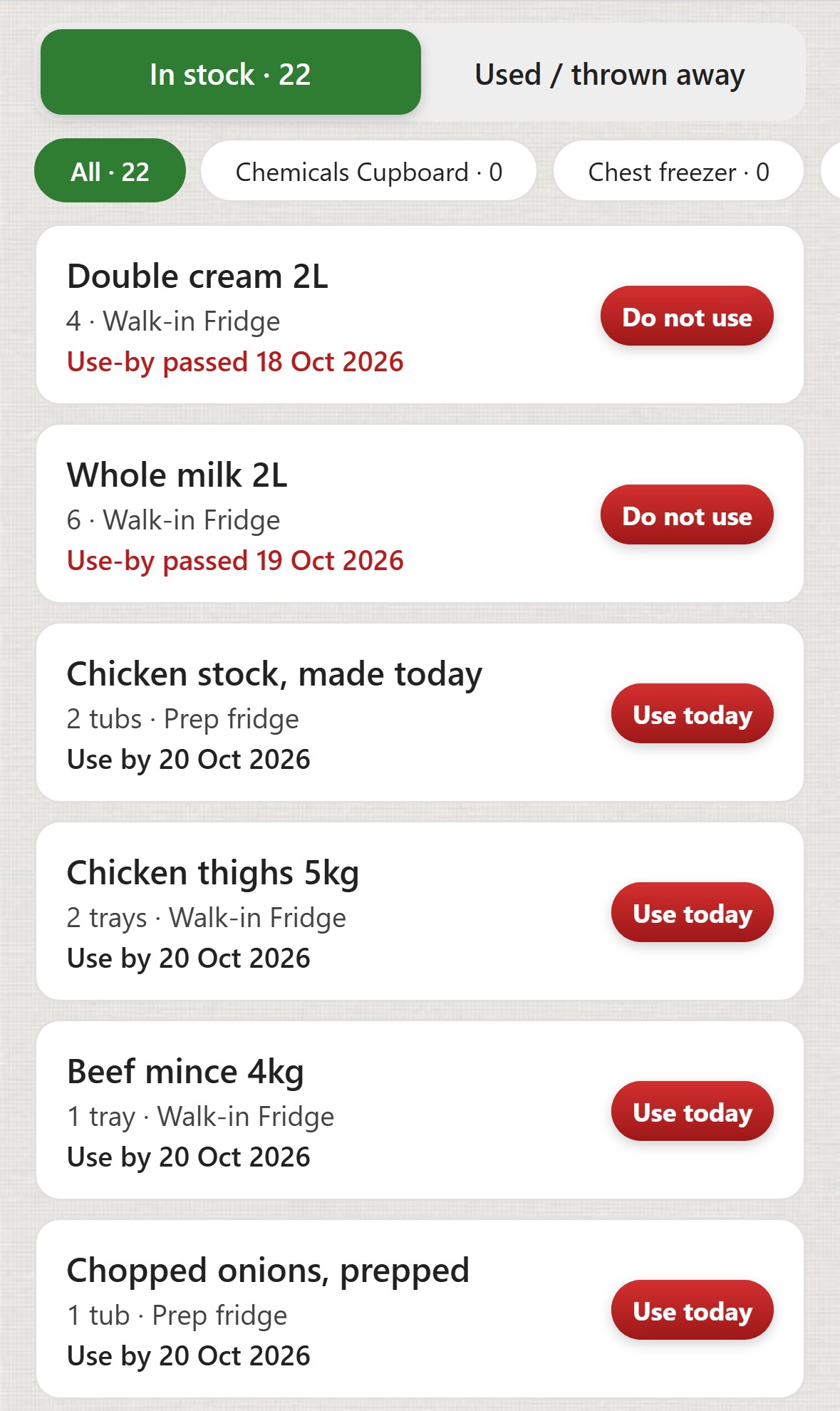
Sorted by date. Double cream and whole milk are past their use-by dates and marked "Do not use". The chicken stock, chicken thighs, beef mince and chopped onions reach their use-by date today and are marked "Use today".
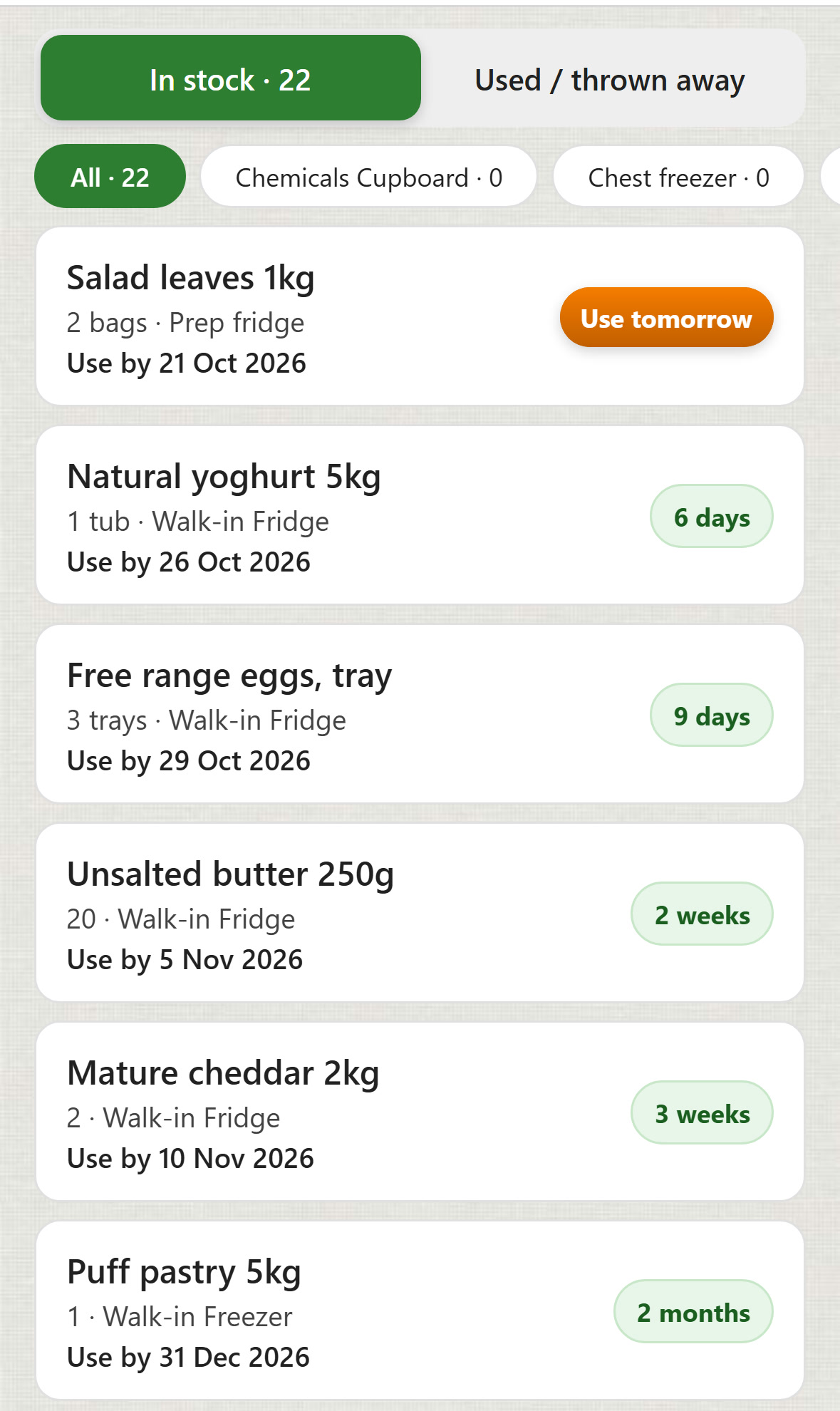
Further down the list. Salad leaves are marked "Use tomorrow". After that the label counts down in days, then weeks, then months, so food that will keep is easy to tell apart from food that needs using.
Get ChefsRecords on the App Store (iPhone) ›
14 days free. No card required.
This is general guidance for UK kitchens, written from the public sources below as published on 24 October 2026. It is not legal advice and does not replace your own food safety management system. If you are unsure, ask your local authority's food safety team. ChefsRecords is not part of, or endorsed by, the Food Standards Agency, Food Standards Scotland or your local council.
First in, first out. Older stock goes to the front and is used first, and new stock goes behind it. The FSA pack and CookSafe both describe it. It is guidance and good practice, not a legal requirement.
Check dates on delivery, put new stock behind or under old, use from the front, label anything you decant, make or open, check dates on set days, and throw away anything past its use-by date and write it down. For dried food, never top up a container. The full steps are above. They are ours, built from the FSA pack and CookSafe.
FIFO is the system the official guidance describes. FEFO, first expired first out, is our advice for when a newer delivery has a shorter date: use it first. Look at the date on the pack.
Use-by is about safety. After the date, food counts as unsafe in law. Best before is about quality. After the date the food is usually safe but may not be the same quality. Using it is not an offence by itself, but it must still be safe and in good condition.
Strict. After the use-by date, food counts as unsafe in law, however it looks or smells, and it is an offence to sell or serve unsafe food. Follow any storage conditions on the label as well.
Yes, on the day. Food Standards Scotland says food "may be consumed up to and on the date on the label but not after". The FSA pack's closing checks ask whether food on its use-by date has been thrown away, so use it that day and throw away what is left at close. That is guidance.
GOV.UK's advice to businesses is to freeze fresh food before its use-by date, and to note the date you froze it. Its consumer page also allows food frozen on the date. Freeze as early as you can, not on the last day. Freezing pauses the clock; it does not reset it. After defrosting, GOV.UK's consumer advice is to use food within 24 hours, and Safe Catering, for Northern Ireland, says within one day.
Follow the label first. Never go past the use-by date. With no instruction, the FSA pack says high risk ready to eat food should be kept for a maximum of 3 days in total (day of cook or opening plus 2) unless you have evidence it is safe for longer. That is guidance for England and Wales, not law. CookSafe, for Scotland, says to base it on the manufacturer's instructions.
It is not an offence by itself. The food must still be safe and in good condition. Check how it looks, smells and tastes before you use it, and throw it away if you have any doubt. Eggs are the exception: egg guidance in every nation says not to use them past their best-before date.
An officer can tell you not to use it, or seize it, and a court can order it destroyed. In practice, expect to be asked to throw it away there and then. It can count against you in your hygiene rating (in Scotland, your inspection result), and serious or repeated cases can lead to formal action. That is our reading, not a published procedure.
The food delivery checks guide, the opening and closing checks guide, the fridge temperature log guide, the cooling food guide, the EHO inspection guide, the food shelf life guide, the pest control guide, the eggs guide and the danger zone guide.