
Updated 25 October 2026 - for UK restaurants, cafes, pubs, takeaways, carveries and other catering businesses
Scotland is the only nation that sets a reheating temperature. Food Hygiene (Scotland) Regulations 2006, Schedule 4, paragraph 3, says:
"Food which in the course of a commercial operation has been heated and which is thereafter reheated before being served for immediate consumption or exposed for sale shall, on being reheated, be raised to a temperature of not less than 82°C."
It is an offence not to. There is a defence: the business can show that the food "could not have been raised to a temperature of not less than 82°C without a deterioration of its qualities". The business has to be able to show it.
CookSafe, section 3: "All food that has previously been heated and is to be re-heated, must be raised to a temperature of 82°C". Where 82°C would spoil the food, it says a suitable time and temperature combination can be used, "for example; reaching a core temperature of 70°C for 2 minutes". That 70°C for 2 minutes is CookSafe's example, not the wording of the regulation. Write down the dish and why you used it.
CookSafe's reheating chart in section 2 gives no number. It says "your specified reheating temperature", so use section 3 for the 82°C.
Two questions the regulation does not answer, and we cannot tell you: whether paragraph 3 covers bought-in food that a manufacturer has heated and your kitchen reheats, and whether reheated food going into a bain-marie is "exposed for sale". CookSafe says all reheated food must be raised to 82°C. The cautious course is to reheat it all to 82°C. If you are unsure, ask Food Standards Scotland or your local authority's food safety team.
No law in England, Wales or Northern Ireland sets a reheating temperature. Schedule 4 of each nation's food hygiene regulations mentions reheated food in three places: the chill exemption (food that "has been cooked or reheated"), the 63°C hot holding offence for food that "has been cooked or reheated", and the defences to it. Regulation (EC) 852/2004, Annex II, Chapter IX, does not mention reheating at all. It says food is not to be kept at temperatures that might result in a risk to health.
The rule is the general one: food must not be kept in a way that is a risk to health. Once reheated food is kept hot, the 63°C hot holding law applies. Your own food safety procedures (Article 5 of 852/2004) should say how you reheat and how you check it, and an inspector may look at whether you follow them.
What there is, is guidance. GOV.UK's business page: "Reheating means cooking food again, not just warming it up." "Reheat food until it is steaming hot all the way through." "You can only reheat food once." The FSA pack says the same in its Reheating safe method: reheat food thoroughly until it reaches a safe temperature in the centre.
Guidance in Northern Ireland Safe Catering, from the FSA in Northern Ireland, does give a figure. Its Reheating step says to "Reheat food thoroughly to kill food poisoning bacteria", for example to "75°C or hotter", measured with a probe in "the thickest part of the food". If it is not hot enough: "Continue reheating the food for longer until the thickest part reaches 75°C." It puts no hold time on the 75°C. Its advice: "Reheating means cooking again, not just warming up. Always reheat food until it is piping hot all the way through (you should only do this once)." Reheated food should be "piping hot (steaming) all the way through", and liquids should "bubble rapidly when stirred". Readings go on its SC3 Cooking/Cooling/Reheating Records, which note "Core temperature above 75°C". That is guidance, not law.
No UK law outside Scotland sets a reheating temperature. The FSA pack does not give a separate reheating figure either. Its Reheating safe method says reheating means cooking again, so food must reach a safe temperature in the centre, and it points you to the "Prove it" box in Cooking safely. That lists the same time and temperature pairs as cooking:
| Core temperature | For at least |
|---|---|
| 80°C | 6 seconds |
| 75°C | 30 seconds |
| 70°C | 2 minutes |
| 65°C | 10 minutes |
| 60°C | 45 minutes |
GOV.UK calls 70°C for 2 minutes the "standard advice" for cooking. 75°C for 30 seconds and 80°C for 6 seconds are on the same list. 75°C is a common target, which is why you see it everywhere. It is a safe target, not a legal one. In Scotland the law is 82°C.
One reading at 70°C does not show 2 minutes. Probe, keep the food hot, and probe again after 2 minutes, or take it to 75°C.
If you have seen 165°F, that is the American Food Code: 74°C for 15 seconds. 70°C is Ireland's home advice for leftovers. Neither is UK law. In the UK, Scotland's 82°C is the only legal figure.
The Food Code also asks for microwaved food to be rotated or stirred, covered and left to stand covered for 2 minutes. That is American too. No UK source we read gives a standing time, so follow the maker's.
No UK source gives a reheating time. Reheat as fast as your equipment allows, and use smaller portions to speed it up. The packs' advice:
"Serve reheated food immediately, unless it is going straight into hot holding." If it is not served at once, the temperature will drop and harmful bacteria could grow.
The FSA pack: "Hot holding equipment is for hot holding only. It should not be used to cook or reheat food." "Food must be cooked thoroughly and steaming hot before hot holding begins." And in the Reheating method: "Do not put food into hot holding without reheating it properly first."
CookSafe's version: hot-hold in a pre-heated bain-marie or hot cabinet as soon as possible after reheating or cooking. Our hot holding guide has the rest.
| Source | What it says | Status |
|---|---|---|
| GOV.UK, businesses | "You can only reheat food once." | Guidance (England, Wales and Northern Ireland) |
| FSA pack, Reheating | "You should only reheat once." | Guidance (England, Wales) |
| FSA pack, Hot holding | Reheat and put back "(you should only do this once)" | Guidance |
| CookSafe | "Reheat the finished dish only once" | Guidance (Scotland) |
| Safe Catering, Reheating | "It is recommended that the finished dish is reheated only once." | Guidance (Northern Ireland) |
No law in any nation says it. Reheat once is guidance from the FSA and Food Standards Scotland, not law. But every UK guidance pack says it, so expect an inspector to ask about it. In practice: reheat only what you need, and anything reheated and not used is thrown away, not chilled for another go.
The FSA pack: "Rice can contain spores of a type of harmful bacteria that may not be killed by cooking or reheating. If cooked rice is left at room temperature, spores can multiply and produce toxins that cause food poisoning. Reheating will not get rid of these". Reheating makes properly cooled rice hot. It does not make badly cooled rice safe.
Reheat rice only if it was cooled fast and kept in the fridge. Reheat it once, until steaming hot. If you are not sure how it was cooled, throw it away. The FSA's Indian cuisine pack says "If cooked rice has not been kept very hot or properly chilled, throw the rice away." The one-hour cooling figure, the 24 hours in the fridge and how to tray it out are in the rice section of our cooling guide.
We found no separate UK reheating rule for chicken. The same applies as for any dish: steaming hot all the way through, probed at the centre or the thickest part, and once. For a whole bird, the FSA pack's cooking check is to probe "in the thickest area which is between the leg and the breast". We have not invented a chicken reheating temperature, because the packs do not give one.
In England, Wales and Northern Ireland, food that has been "cooked or reheated" and is kept hot for service or display must be held at 63°C or above, unless a defence applies (Schedule 4, paragraph 6). In Scotland the hot holding rule is above 63°C.
The FSA pack: the food must be steaming hot before it goes in. If it drops, reheat it and put it back (only once), or chill it, or throw it away. Food taken out of hot holding for display for more than 2 hours is thrown away. The detail is in our hot holding guide.
No law requires a reheating log. The law (Regulation 852/2004, Article 5) asks for food safety procedures based on HACCP principles, with records that fit the nature and size of the business. The FSA pack works by exception: "Write down what went wrong and what you did about it in your diary." It adds: "You may also wish to record some of your temperature checks in the diary pages." CookSafe's chart says to check that your specified reheating temperature is reached and to complete a hot temperature record. CookSafe also says not all monitoring needs to be recorded. A good entry answers:
| Record | Why it matters |
|---|---|
| The dish (and batch, if it was cooled earlier) | Links it to how it was cooled. |
| Date and time of the probe reading | When it reached temperature. |
| Core temperature, probed (and the 2 minutes, if working to 70°C) | A number, not a tick. |
| Who took it | So questions can be answered later. |
| Where it went: served, or into hot holding | Hot holding then needs its own checks. |
| If it did not get hot enough: what was done | Heated longer, smaller portions, thrown away, and why. |
| Manager review | Someone responsible has looked at the records. |
If something goes wrong, food law gives a defence to a business that took all reasonable precautions and exercised all due diligence (England: regulation 12; Food Safety Act 1990, section 21). Written records of your checks, and of what you did when one failed, help you show that.
Neither pack says to bin food for being slow to heat. Throwing it away is a fair choice, for rice, for food that has already been reheated once, or when the equipment is down, but it is the kitchen's choice, not a rule.
In Scotland, if 82°C would spoil the dish, CookSafe's alternative is another time and temperature, for example 70°C for 2 minutes. Write down the dish and why. The business has to be able to show the defence.
We know of no published list of what an officer will ask about reheating, but these are fair questions to be ready for:
A short, honest record with the actions written in is worth more than a perfect-looking sheet.
For the whole visit, from who inspects to appeals and re-rating, see our EHO inspection guide.
Paper works. The FSA pack's diary suits a kitchen that only writes down what went wrong, and Safe Catering's SC3 sheet is titled cooking, cooling and reheating records. An app helps when several people take readings, readings are taken in the middle of service, or a manager is not always on site.
Why kitchens move off paper:
In ChefsRecords, reheating is its own record. Type what you reheated, probe the centre and save. Outside Scotland the app starts at 75°C, its own target taken from the cooking time and temperature pairs, not a legal limit, and you can set your own in Temperature limits. In Scotland it uses the law's 82°C. If the reading is under your target, the app does not save a fail: it tells you to keep reheating and probe again. If the food will not get there, you record it as thrown away. In Scotland, if 82°C would spoil the dish, you can record the reading and say why. Every reading is saved with the time and who took it, even without signal, and appears in the Temperature Log.
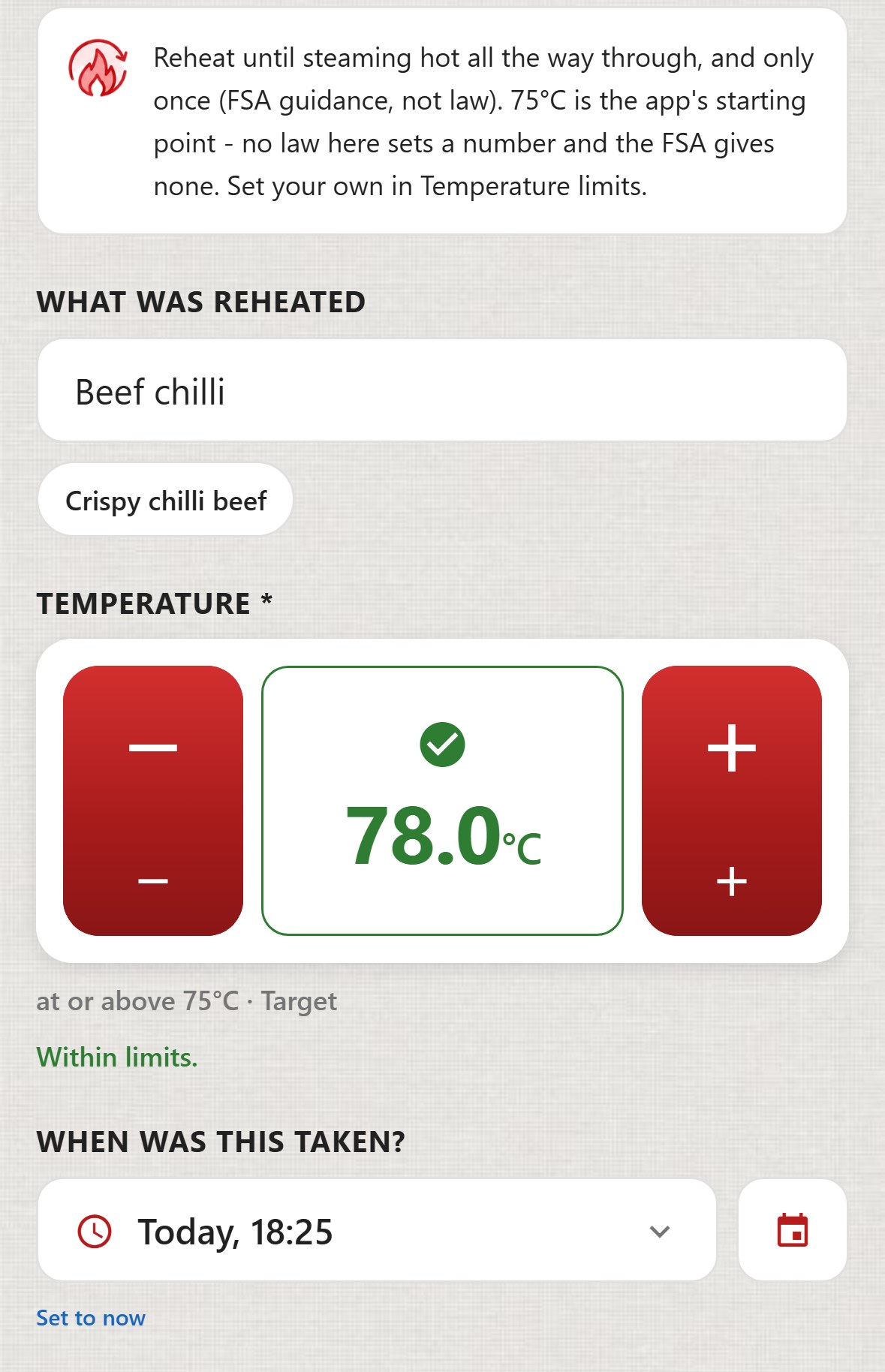
Probe the centre and save. Type what you reheated and the reading. At 78.0°C, above the 75°C starting point, it says within limits and the record can be saved. 75°C is the app's own starting point, not a legal limit, and you can set your own in Temperature limits.
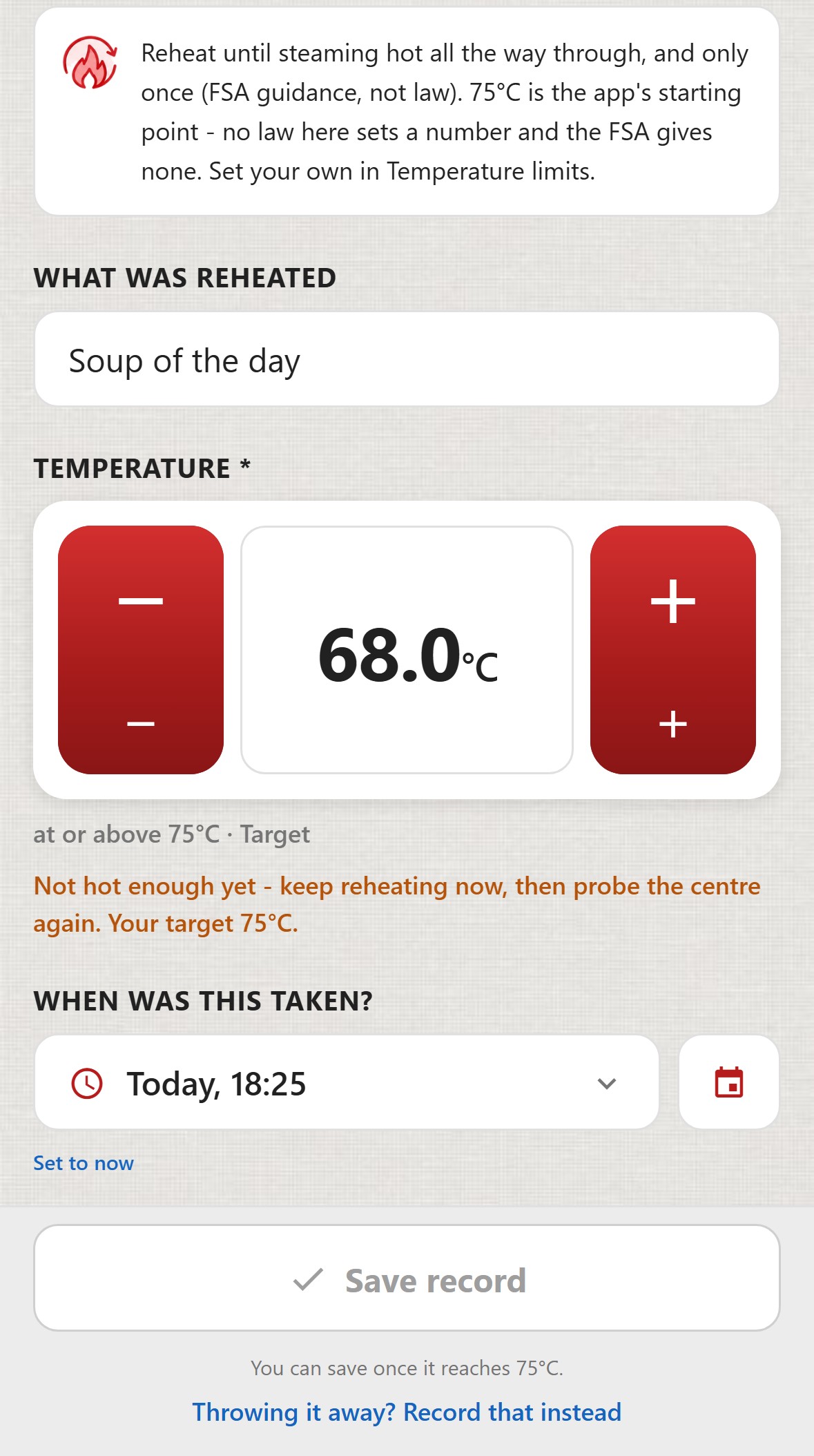
Not hot enough yet. At 68.0°C the app does not save a fail. It tells you to keep reheating and probe again, and Save stays off until the reading reaches the target. If the food will not get there, you record it as thrown away.
Recording reheating is included on every plan. After the 14-day trial, the free plan keeps it for one login, the kitchen's billing Manager. The Temperature Log report is part of the Standard and Pro plans, and open during the trial. See what else it does.
Get ChefsRecords on the App Store (iPhone) ›
14 days free. No card required.
This is general guidance for UK kitchens, written from the public sources below as published on 16 October 2026. It is not legal advice and does not replace your own food safety management system. If you are unsure, ask your local authority's food safety team. ChefsRecords is not part of, or endorsed by, the Food Standards Agency, Food Standards Scotland or your local council.
In Scotland, 82°C is the law, unless the business can show the food would spoil at that heat. In England, Wales and Northern Ireland no law sets a number. The guidance is steaming hot all the way through, checked with the same time and temperature pairs as cooking. Northern Ireland's Safe Catering gives 75°C or hotter as its example, with no hold time. 75°C is a common target, and GOV.UK calls 70°C for 2 minutes the standard advice for cooking.
No. No law in England, Wales or Northern Ireland sets a reheating temperature. In England and Wales the FSA pack gives no separate reheating figure: 75°C for 30 seconds is one of the cooking pairs it points to. In Northern Ireland, Safe Catering gives "75°C or hotter" as its example. Either way it is a safe target, not a legal one.
The law says not less than 82°C, with a defence if the food could not be raised to that without a deterioration of its qualities. The law sets no hold time. CookSafe gives 70°C for 2 minutes as an example of an alternative where 82°C would spoil the food.
Once. That is guidance from the FSA and Food Standards Scotland, not law. Reheat only what you need, and throw away reheated food you do not use.
Only rice that was cooled fast and kept in the fridge. Reheat it once, until steaming hot. Reheating does not remove the toxins, so if you are not sure how it was cooled, throw it away.
There is no separate UK rule. Reheat it until steaming hot all the way through, probe the centre or thickest part, and do it once.
No. The FSA pack says hot holding equipment is for hot holding only and should not be used to cook or reheat food.
Follow the maker's instructions. The FSA pack says standing and stirring are part of reheating in a microwave. No UK source we read gives a standing time. The 2 minutes you may see online is from the American Food Code.
No law names one. You must have food safety procedures based on HACCP principles, with records that fit your business. The FSA pack works by exception: write down what went wrong and what you did about it.
That is the American Food Code: 74°C for 15 seconds. It is not UK law or UK guidance.
The FSA pack says to reheat the dish for longer, then test it again, and to use smaller portions. CookSafe says to continue heating until your specified reheating temperature is reached. Then write down what went wrong and what you did. You do not have to throw it away just because it is slow, but do not serve it until it reaches your target. If it will not get there, throw it away and write that down.
Your food safety plan should say how you reheat food, how you check it and what you do when it does not get hot enough. The free food safety plan builder takes you through the FSA's "Reheating" safe method in your own words, then prints your plan or saves it as a PDF. For small restaurants, cafes, pubs and takeaways in England and Wales.
Our cooling guide covers rice and how to chill food down before it is reheated, our hot holding guide covers the 63°C rule once the food is back in service, and our danger zone guide shows where reheating sits among the other food temperatures. Our fridge temperature log guide covers the cold end, and our opening and closing checks guide puts the daily checks together. Our cooking temperatures guide covers the time and temperature pairs for cooking food the first time, food by food. And our 4Cs of food hygiene guide, which brings the basics together. More guides: the probe check guide and the Christmas kitchen guide.