
Updated 25 October 2026 - for UK restaurants, cafes, pubs, takeaways, carveries and other catering businesses
No UK law says a food hygiene certificate expires, and no law says a food handler must hold one. The law says staff must be trained for the work they do. A certificate is the usual way to show it, and a training record is how you show it day to day. Here is what the sources say.
Law in all four nations No UK law says a food hygiene certificate expires, and no law says a food handler must hold one. In all four nations the law says food handlers must be "supervised and instructed and/or trained in food hygiene matters commensurate with their work activity", and whoever develops and keeps your HACCP-based procedures must have had adequate training in the HACCP principles. How you show that is up to you. A certificate is the most common way, and a training record is how you show it day to day.
The wording comes from Regulation (EC) 852/2004, Annex II, Chapter XII, as it applies in the UK. The full text says food business operators are to ensure "that food handlers are supervised and instructed and/or trained in food hygiene matters commensurate with their work activity", and "that those responsible for the development and maintenance of the procedure referred to in Article 5(1) of this Regulation or for the operation of relevant guides have received adequate training in the application of the HACCP principles". It also says to comply with any requirements of United Kingdom law on training programmes for persons working in certain food sectors. Each nation's food hygiene regulations make it an offence not to comply: Schedule 2 lists Article 4(2) of the Regulation, which brings in Annex II.
The law does not say: certificate, Level 2, refresher, expiry, induction or training record. The HACCP duty names no level either, so "managers need Level 3 by law" is not true.
The training is not optional. The certificate is. GOV.UK says: "Food handlers do not have to hold a food hygiene certificate." It also says: "You must be able to show that your staff have the right skills and up-to-date training for their role." Those skills can come from courses provided or recommended by your local authority, training on the job, self-study or relevant previous experience.
A food hygiene certificate does not expire in law. Three years is a common recommendation: some councils advise refresher training at least every three years, one suggests five, and many course providers print a renewal date. The FSA and Food Standards Scotland ask you to refresh training when it is needed and to retrain after anything goes wrong. Pick a period that fits each job, write it in your plan, and check with your council if you are unsure.
Guidance from some councils It comes from council advice and from course providers, not from the law and not from the FSA or Food Standards Scotland. No FSA or Food Standards Scotland page we read sets an interval.
So the advice differs from one council to the next. Your own council is the one that inspects you. If it publishes a period, use it.
Our advice Do not write "certificates last 3 years" in your plan. Write the period you have chosen for each job, who chose it and why. Then a date on a certificate is the start of your decision, not the end of it.
Guidance No. GOV.UK says: "Food handlers do not have to hold a food hygiene certificate." CookSafe, from Food Standards Scotland, says "the Regulations do not require attendance on external training courses." It also says that food handlers "do not have to take additional hygiene training if their vocational course has provided appropriate training."
What you do need is training that fits the job, and a way to show it. For many kitchens a recognised course is the simplest way to do both. If you want a certificate, GOV.UK says to ask your local authority for information.
Guidance in Scotland CookSafe adds: "Not all staff will need the same level of instruction, training or supervision." It also says "All staff must be properly supervised."
Level 1, Level 2 and Level 3 are names of qualifications, not tiers in the law. The Ofqual register lists them as separate qualifications, such as a Level 2 Award in Food Safety in Catering and a Level 3 Award in Supervising Food Safety in Catering. You can search the register yourself. It shows no validity period for them. We do not name course providers or recommend any.
Level 1 is an introductory award. We found no official source that says you must do Level 1 before Level 2.
| Who | What is usually expected | Where it comes from |
|---|---|---|
| Front of house serving only wrapped or low-risk food | Instruction and allergen training for their role. A course may not be needed. | Guidance GOV.UK says staff must be trained to manage allergies. Guidance in Scotland CookSafe calls allergy awareness training for all staff good practice. Our advice That a course may not be needed is ours. |
| Food handlers: chefs and cooks handling open high-risk food | A Level 2 food safety award is the usual expectation, within 3 months of starting. In Scotland, CookSafe recommends its own Basic course (about 1 day, with an exam) for staff handling high-risk food, "ideally within 3 months of starting work". | Guidance from some councils Anglesey and Conwy: Level 2 within 3 months of starting, for staff handling open high-risk food. Guidance in Scotland CookSafe. Our advice "Usual expectation" is ours. |
| Supervisors | A Level 3 food safety award. In Scotland, CookSafe's Intermediate (2 to 3 days) or Advanced (5 days) courses, which it says are "usually for managers/supervisors with food handling staff responsibilities". | Guidance from some councils Anglesey and Conwy call a higher level of training, such as Level 3, good practice for supervisors who handle open high-risk food. Guidance in Scotland CookSafe, as quoted. |
| Head chef, sous chef, whoever owns the plan | Level 3 plus HACCP training. The law asks for "adequate training in the application of the HACCP principles" and names no level. | Law in all four nations The HACCP duty. Our advice Level 3 plus HACCP training is ours. |
Guidance in Scotland CookSafe says it is recommended that staff handling high risk food do the Basic training, "ideally within 3 months of starting work (subject to training course availability)". That is a recommendation, not the law. Guidance from some councils Anglesey and Conwy advise Level 2 within 3 months of starting work for staff handling open, high-risk food. Guidance in Scotland For HACCP training, CookSafe says waiting and bar staff need "an awareness" of your HACCP-based system, and cooks, chefs, supervisors and kitchen assistants need "a working knowledge" of it.
A course takes time to book. The first shift cannot wait. The sources are clear about what happens first.
Guidance in England and Wales The FSA pack says: "Make sure you know what training each member of staff has received and, where necessary, provide refresher training regularly." Its four-weekly review asks "Do any existing staff require safe method refresher training?" When something goes wrong, it says to train them again. It also says: "Make a note on the Staff training record in the diary every time you train a member of staff."
Guidance in Scotland CookSafe says: "It is vital that your staff do not forget what they have learned." After a failure, "the staff involved must be retrained and/or given new instructions". It says keeping a record of refresher training will become part of your HACCP documentation.
Our advice Besides the date, retrain after:
Write the reason on the record. "Retrained after a cooling failure" tells an inspector more than a date.
The sources use different words, so we quote each as it stands. Guidance GOV.UK's training page says: "Staff must be trained to manage allergies." Its allergies page says: "You should make sure all staff are given appropriate training to manage allergens in their role." Guidance in England, Wales and Northern Ireland The FSA's allergen guidance for food businesses says: "Food businesses must make sure that staff receive training on allergens." Guidance in Scotland Food Standards Scotland says: "Food businesses must make sure that their staff are trained on managing allergens." CookSafe says it is "good practice to train all your staff (food handling and service staff) in allergy awareness".
Our advice A certificate from an online course does not prove someone can handle an allergy question on a busy Saturday. Ask them, and watch them do it.
Guidance GOV.UK says: "Keep a record of any training staff have completed so you can show this during an inspection." No law names a training record, but the law requires the training, and the record is how you show it. The FSA pack, CookSafe and Safe Catering in Northern Ireland each publish a free staff training record. The list below is our own, built from the three.
Our advice For each person:
No food law sets how long to keep a training record after someone leaves. Guidance in Scotland CookSafe recommends keeping records of training and copies of training certificates "for the duration of employment", and says records of monitoring and corrective action, which is usually retraining, should be kept "for an appropriate period of time". Our advice Keep it for a while after they go, in case an inspection or a complaint looks back at a time they worked for you, and write the period in your plan. A training record is personal data, so do not keep it longer than you need it. If you are unsure, ask your council about the food side and the Information Commission (the ICO) about personal data. Guidance in Northern Ireland Safe Catering's training record form says copies of any certificates should be kept with the form.
There is no published list. These are questions we would expect, Our advice built from what GOV.UK and the Food Hygiene Rating Scheme guidance (England, Wales and Northern Ireland) say. GOV.UK says to keep a training record "so you can show this during an inspection", and the rating scheme guidance says inspectors look at your "processes, training, and systems".
An inspector may also ask a chef questions directly: what is the probe check, what is the fridge limit, what do you do about illness. A certificate in a drawer does not answer those. Our EHO inspection guide covers the rest of the visit.
Your food safety plan should say how you train and supervise staff. The free food safety plan builder takes you through the FSA pack's training and supervision safe method in your own words, then prints your plan or saves it as a PDF. It is for small restaurants, cafes, pubs and takeaways in England and Wales. In Scotland, use CookSafe, and in Northern Ireland, Safe Catering.
Paper works: the FSA pack, CookSafe and Safe Catering each have a free staff training record. ChefsRecords does not sell or run training courses, and it does not recommend any.
Why kitchens move off paper:
On the Pro plan, a manager can turn on training records in each person's staff file and add their certificates: the type (for example Level 2 Food Hygiene, Level 3 Food Safety or Allergen Awareness), who provided it, the date completed and, if you want one, a date to renew or review it. The staff file shows each one in green, amber within 60 days of that date, and red once it has passed, and the Dashboard counts any that are within 60 days or have passed. Keep the certificates themselves, and your in-house training sign-off sheet, alongside: the app records the details, not a copy.
What it does not do: it does not hold a photo or scan of the certificate, it does not record who trained someone or the person's signature, it does not log in-house training topic by topic, and it does not check that a certificate is genuine. The date is one you type in yourself and it is optional. The Inspection Pack PDF does not include certificates. Reminders come to the manager's iPhone, not to the staff member, and there are none on the web version.
Training and certificate records, right to work and return-to-work interviews are part of Pro. They are not in the 14-day trial.
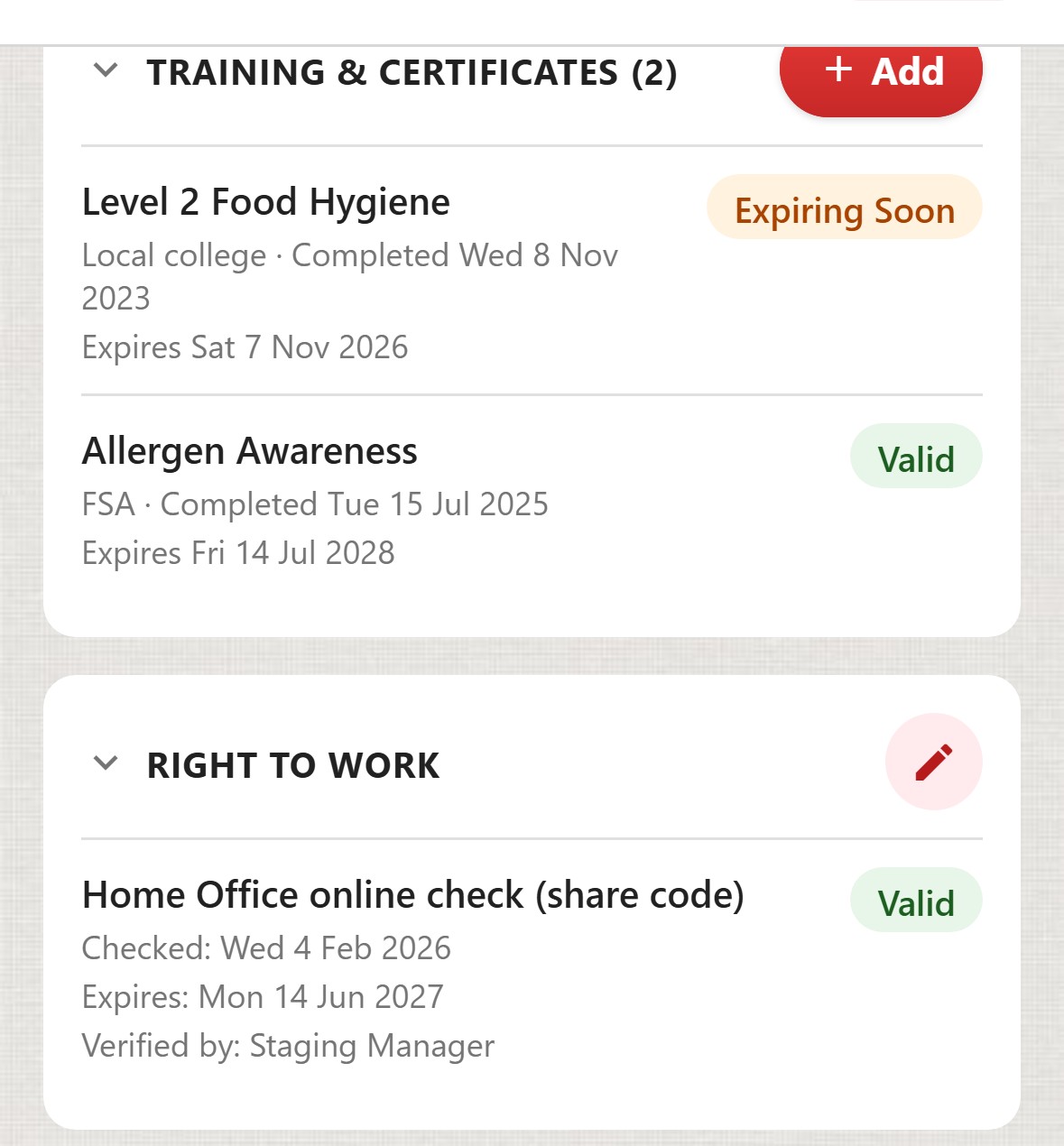
Dates in one place. Each certificate shows the date it was completed and the date you set to review it, in green, amber within 60 days, and red once it has passed. The app calls it an expiry date. It is the date you chose to renew or review, not a legal expiry.
Get ChefsRecords on the App Store (iPhone) ›
14 days free. No card required.
This is general guidance for UK kitchens, written from the public sources below as published on 20 October 2026. It is not legal advice and does not replace your own food safety management system. If you are unsure, ask your local authority's food safety team. ChefsRecords is not part of, or endorsed by, the Food Standards Agency, Food Standards Scotland or your local council.
It does not expire in law. Three years is a common recommendation: some councils advise a refresher at least every three years, one suggests five, and many course providers print a renewal date. The FSA and Food Standards Scotland ask you to refresh training when it is needed. Pick a period that fits each job and write it in your plan.
No UK law gives a certificate an expiry date. Mid Devon council says a certificate "does not technically expire". The date printed on yours is the provider's advice, and your council may have its own view, so ask it if you are unsure.
No. GOV.UK says: "Food handlers do not have to hold a food hygiene certificate." The law requires training that fits the work. A certificate is one way to show it.
Not by law. Some councils recommend Level 2 within 3 months of starting for staff handling open high-risk food. In Scotland, CookSafe recommends its Basic course, ideally within 3 months. We think a Level 2 food safety award is the usual expectation for chefs, but that is our advice. Ask your council.
For supervisors and managers. CookSafe says its Intermediate and Advanced courses are usually for managers and supervisors, and some councils call Level 3 good practice. For the person who owns your plan, the law asks for adequate HACCP training and names no level. Level 3 plus HACCP training is our advice.
We found no official source that says so. Level 1 is an introductory award.
No law sets an interval. The FSA pack says to provide refresher training regularly where necessary, and CookSafe says to plan when you think it will be needed. Some councils advise at least every three years. Also retrain after a failed check, an incident, a new menu, a long absence or a change of role.
The law requires training. It does not name a training record. GOV.UK says to keep a record of any training so you can show it during an inspection, and CookSafe says a record of refresher training becomes part of your HACCP documentation.
Name, job title, dates, who supervises them, induction, each topic trained with the date and trainer, the person's signature or initials, courses with a copy of the certificate, allergen training, refreshers with the reason, and the date the next refresher is due. The full list is above. It is ours, built from the FSA pack, CookSafe and Safe Catering.
The FSA pack says to train staff on good personal hygiene on their first day. CookSafe says it is good practice to give written or verbal instruction before they start, and that all staff must be properly supervised. GOV.UK says staff with diarrhoea or vomiting must not return to work until they have had no symptoms for 48 hours.
Yes. The FSA provides free online food allergy training, and Food Standards Scotland offers free standard and advanced online allergen courses. The FSA course's own site says completing it is not an accreditation or approval.
They may. GOV.UK says to keep a record of training so you can show it during an inspection, and the Food Hygiene Rating Scheme guidance (England, Wales and Northern Ireland) says inspectors look at your processes, training and systems. An inspector may also ask staff questions directly.
The EHO inspection guide, the first food hygiene inspection guide, the opening and closing checks guide, the near miss guide, the probe check guide, the staff sickness guide, the allergen matrix guide, the 4Cs of food hygiene guide and the food safety management system guide.