ChefsRecords
ChefsRecords

EHO inspection: what inspectors look for in a UK kitchen

Updated 25 October 2026 - for UK restaurants, cafes, pubs, takeaways, carveries and other catering businesses

The short answer

  • A food safety officer from your local council inspects your kitchen. Usually you are not told the day.
  • Three things are looked at: how food is handled, the physical condition of the business, and how you manage keeping food safe.
  • In England, Wales and Northern Ireland the result is a rating from 0 to 5. There is no pass mark. Only Scotland uses the word "Pass".
  • Showing the rating is law in Wales and Northern Ireland. In England it is your choice.
  • How often you are inspected depends on the risk your business poses to public health.
  • The rating is a snapshot of the day. In England, Wales and Northern Ireland you are told in writing, at the visit or within 14 days.
  • If you disagree or you improve, there is an appeal, a right to reply and a re-rating visit. They are three different things.
  • There is nothing to cram. Keep your plan true to what the kitchen does, keep records as you go, and write down what went wrong and what you did.

Print the one-page inspection checklist (PDF) › 38 things to check before a visit, from these guides.

The three things an inspector scores

In England, Wales and Northern Ireland, GOV.UK says the Food Hygiene Rating Scheme looks at three things:

  1. "How hygienically the food is handled - how it is prepared, cooked, re-heated, cooled and stored."
  2. "The physical condition of your business - including cleanliness, layout, lighting, ventilation, pest control"
  3. "How you manage ways of keeping food safe, looking at processes, training, and systems"

Some councils name them food handling, structure, and "confidence in management". The rating is "a snapshot of the standards of food hygiene found in your business at the time of inspection".

The rest of this guide takes each one in turn, then the records to have ready, then what happens after the visit.

Back to sections

Who inspects and how often

GOV.UK: "A food safety officer from the local authority inspects your business." Both environmental health officers (EHOs) and food safety officers inspect. We say "inspector" from here. "All inspectors must follow the Food Law Code of Practice" for their nation.

How often. GOV.UK: "How often you're inspected depends on the risk your business poses to public health." It is risk-based: from every few months for the highest-risk businesses to every few years for the lowest. "You might not be inspected as often if you're a member of a recognised assurance scheme."

Notice. "Usually, you will not be told an inspection is going to happen." The exception is a place used only as a private home. In all four nations an officer must give 24 hours' notice before they can insist on entry. For home kitchens, your council's food safety team can tell you the rest.

Scotland. Scottish councils use a different scheme for deciding how often to visit, the Food Law Rating Scheme.

Back to sections

Registering before you open

Register your food business at least 28 days before you start trading. It is the same in England, Wales, Northern Ireland and Scotland, and registration is free. Some businesses that supply others with meat, fish, egg or dairy need approval instead, so ask your council.

A new business usually shows as awaiting inspection until its first visit. What happens from registering to that first visit: our first food hygiene inspection guide.

Back to sections

What happens on the day

  • Usually unannounced. Officers can enter at all reasonable hours, and must show their authority if you ask.
  • Records. In England the regulations let an officer inspect your records "in whatever form they are held", and get at the computers that hold them. They can take records needed as evidence, and ask for electronic records in a form they can take away. Scotland, Wales and Northern Ireland give officers the same powers in their own regulations.
  • Samples and photos. GOV.UK: "Food samples can be taken as well as photographed."
  • Obstruction. It is an offence to obstruct an officer.
  • The result. You are told in writing what your rating is and why, at the visit or within 14 days.

Most visits end with a conversation and a letter. Notices are for serious problems, and closure is for an imminent risk to health.

Back to sections

Food handling

This covers how food is prepared, cooked, reheated, cooled and stored. Temperatures come up most. We keep each to one line here, because the detail is in the guides.

Temperatures at a glanceLaw or guidance, and where to read more
FridgesLaw in England, Wales and Northern Ireland8°C is the legal limit in England, Wales and Northern Ireland. 5°C is guidance. Scotland's law sets no number. See the fridge temperature log guide.
Hot holdingLaw in England, Wales and Northern Ireland Law in Scotland63°C or above in England, Wales and Northern Ireland. Above 63°C in Scotland. See the hot holding guide.
Cooking: 70°C for 2 minutesGuidance in England, Wales and Northern Ireland Guidance in ScotlandGOV.UK's standard advice: a core of 70°C for 2 minutes, or an equivalent such as 75°C for 30 seconds. In Scotland, CookSafe gives 75°C or above as an example. No UK law sets a cooking temperature. See the danger zone guide.
Reheating: 82°C or above in ScotlandLaw in ScotlandIn Scotland the law says reheated food must reach 82°C or above, unless that would spoil it. In England, Wales and Northern Ireland no law sets a reheating number: the guidance is steaming hot all the way through. See the reheating guide.
Cooling downHas its own guide: the cooling guide.
Each guide says what is law and what is guidance in each nation.

Other things an inspector may look at

  • Cross-contamination. Raw and ready-to-eat food kept apart. Complex equipment such as vacuum packers, slicers and mincers not shared in a normal business day. Disinfectants that meet officially recognised standards. This is GOV.UK's E. coli cross-contamination guidance for England, Wales and Northern Ireland, on how to meet the law. Scotland has its own.
  • Handwashing. "Using a recognised technique". Gels and gloves do not replace it. That is guidance.
  • Ill staff. Food handlers must report symptoms, and must not handle food where there is a likelihood of contamination. That is law.
  • Clothing. Suitable and clean, and protective where necessary. Law.
  • A checked probe. The test in the FSA's Safer Food, Better Business pack: in iced water it should read -1 to 1°C, in boiling water 99 to 101°C. That is guidance. Our probe check guide covers the steps and the record.

Back to sections

Cleanliness and the building

  • Clean and in good repair. The layout should allow cleaning and pest control. Law.
  • Handwash basins. "Designated for cleaning hands", with "hot and cold running water, materials for cleaning hands and for hygienic drying", and separate from food washing where necessary. Law. Food vans, stalls and homes have a shorter rule: see our hand wash basins guide.
  • Pests. "Adequate procedures are to be in place to control pests". That is law. A pest contract is not required by law.

Back to sections

Confidence in management: your plan and records

This is how you manage keeping food safe: processes, training and systems.

  • A food safety management system. GOV.UK: "You must put in place food safety management procedures based on the principles of" HACCP. If processes are very simple, GOV.UK says a business may meet the law by following "good hygiene practice". No particular pack is required.
  • Records. GOV.UK says they should be "kept up-to-date and be available for inspections at all times". The law asks for records that fit the size of the business. The law also says you must be able to name who supplied your food and show it on request: Regulation 178/2002, Article 18.
  • Training and supervision. The law says food handlers must be "supervised and instructed and/or trained ... commensurate with their work activity". GOV.UK says to train all your staff. A training certificate is not a legal requirement. Some councils, such as Isle of Anglesey and Conwy, advise Level 2 within 3 months of starting for staff handling open high-risk food. In Scotland, CookSafe recommends its Basic course "ideally within 3 months of starting work". That is guidance, not law.
  • Allergens. GOV.UK (England, Wales and Northern Ireland): "Food businesses must make sure that staff receive training on allergens." For food that is not pre-packed, information on the 14 allergens may be given by word of mouth "with a written notice placed in a clearly visible position". The FSA says written information, supported by a conversation, works best.

Which pack?

Any of them, or your own HACCP plan. England and Wales have the FSA pack, Safer Food, Better Business for caterers. Northern Ireland has Safe Catering. Scotland has CookSafe from Food Standards Scotland. None of them is UK-wide.

Some councils say a business that has not documented its food safety system can score badly on management, and that can hold the whole rating down.

Back to sections

Records to have ready

There is no published list of what an officer will ask to see. These are the records a kitchen can fairly expect to be asked about:

  • Your written plan (the FSA pack, Safe Catering, CookSafe or your own HACCP plan). Our food safety diary guide covers the FSA pack's diary and 4-weekly review.
  • Temperature records.
  • Cooling, cooking and reheating checks.
  • Opening and closing checks. Our opening and closing checks guide shows what to cover and what to write down.
  • The cleaning schedule. Our kitchen cleaning schedule guide shows what it should list and how to show the cleaning was done.
  • Probe checks.
  • Delivery checks and the supplier list.
  • Allergen information (a matrix, and labels for food you pre-pack for direct sale, if you make it).
  • Training records.
  • Pest contractor reports, if you have a contract.
  • What went wrong and what you did about it. Our near miss guide shows how to write it down.

There is nothing to cram. Inspectors judge what they find on the day and what your records show over time. Keep your plan where staff can find it. Make sure it describes what your kitchen actually does. Keep records as you go, not the night before. Where a check was missed or a reading was wrong, write down what happened and what you did. A record with an honest gap explained is worth more than a perfect-looking sheet. Have the people on shift know the basics: handwashing, what to do with a warm fridge, who to tell if they are ill, and where the allergen information is.

Print the one-page inspection checklist (PDF) › 38 things to check before a visit, from these guides.

Back to sections

Is there a pass?

Not in England, Wales or Northern Ireland. There is no pass mark. The rating runs from 0 to 5, and GOV.UK describes it from "5 - hygiene standards are very good" to "0 - urgent improvement is necessary". Only Scotland uses "Pass".

So the honest answer to "how do I pass?" is: here is what moves the score. The three areas above are scored together. Good paperwork on its own is not enough, and one weak area can pull the whole rating down, because, as councils publish it, each rating has a cap on the highest score in any one area. GOV.UK: "To get the top rating, you must do well in all three elements." We cannot promise any rating, and neither can anyone else.

Back to sections

Ratings in England, Wales and Northern Ireland

  • The scheme. The Food Hygiene Rating Scheme gives a rating from 0 to 5. In Wales (Food Hygiene Rating (Wales) Act 2013) and Northern Ireland (Food Hygiene Rating Act (Northern Ireland) 2016) it is set in law.
  • Display. Law in Wales and Northern Ireland (section 7 of each Act). GOV.UK says at or near each customer entrance. In Wales that starts once the 21-day appeal period is over, or any appeal is decided. In England it is voluntary: "You can display".
  • Exempt. Some businesses are inspected but not rated: low-risk businesses not seen as food businesses (such as newsagents, chemists and visitor centres selling pre-wrapped goods) and childminders.
  • When it goes online. A 5 is published as soon as it is uploaded. Ratings 0 to 4 are published 3 to 5 weeks after the visit, to allow for appeals. In England and Wales you can ask for early publication.

Back to sections

Scotland: Pass or Improvement Required

Scotland does not use 0 to 5. Food Standards Scotland runs the Food Hygiene Information Scheme (FHIS). The outcomes are Pass, Improvement Required, Exempt Premises and Awaiting Inspection.

  • Display. Food Standards Scotland's page says the certificate or sticker is "to display", and that some businesses "may choose not to". It is not required by law in Scotland, as far as Food Standards Scotland's guidance shows.
  • Appeal. 14 days, including weekends and public holidays. FHIS shows "Awaiting publication" during an appeal.
  • Revisit. Free at the moment, one between inspections, and you cannot set the date.
  • Right to reply. In writing to the officer. It is published online.
  • Your pack. CookSafe.

Back to sections

The four nations side by side

Ratings by nationScheme, display, appeal, re-rating, right to reply
EnglandWalesNorthern IrelandScotland
SchemeRating 0 to 5Rating 0 to 5, in law (Act 2013)Rating 0 to 5, in law (Act 2016)Pass or Improvement Required
DisplayVoluntaryLaw: at or near each customer entrance, once the 21-day appeal period is overLaw: at or near each customer entranceNot required by law, as far as Food Standards Scotland's guidance shows
Rating appeal21 days, in writing to the council21 days, in writing to the council21 days, in writing to the council14 days, to the council's lead officer for food
Re-rating visitSome councils charge. If free: one between planned inspections, not usually in the first 3 monthsAll councils charge. Visit within 3 monthsAll councils charge. Visit within 3 monthsFree at the moment. One revisit between inspections. You cannot set the date
Right to replyAny time until the next inspectionAny time until the next inspectionAny time until the next inspectionIn writing to the officer. Published online
Re-rating fees are set by each council. This page prints no figure because there is no national price.

Back to sections

After the visit: the letter, notices, right to reply, appeal and re-rating

The letter

GOV.UK: "You'll be told in writing what your food hygiene rating is and why you were given this rating ... either at the time of inspection or within 14 days." "If you're given a low rating, the letter will confirm any improvements you need to make and by when."

Right to reply, appeal and re-rating are three different things

  • Right to reply. You can add your comments, or say what you have done since. In England, Wales and Northern Ireland that is at any time until the next inspection. In Scotland it is in writing to the officer.
  • Rating appeal. You say the rating was wrong on the day. 21 days in England, Wales and Northern Ireland. 14 days in Scotland.
  • Re-rating visit. You say you have improved since. It costs money in Wales, Northern Ireland and some English councils. It is free in Scotland at the moment.

A rating appeal is not the same as an appeal against a hygiene improvement notice. That one goes to the court (below).

Hygiene improvement notice

An officer can serve one where they have "reasonable grounds for believing" the business is failing to comply with the law. It states the failures and the measures needed, and gives a period "not being less than 14 days". "Any person who fails to comply with a hygiene improvement notice commits an offence." You can appeal to the magistrates' court (England) or the sheriff (Scotland), within one month, or within the notice's own period if that is shorter. Your business may be revisited to check the improvements in the notice have been made.

Hygiene emergency prohibition notice

This is for an "imminent risk of injury" to health. It can ban a process, a piece of equipment or the premises. It stops unless the council applies to court within 3 days. It is lifted by a council certificate that "sufficient measures" have been taken, and the council must decide within 14 days of an application.

Prohibition orders and prosecution go through the court.

Back to sections

Myths

  • "The EHO has to give notice." Not usually. For a business run from home, the council usually arranges the visit.
  • "There is a pass mark." Only Scotland uses "Pass". England, Wales and Northern Ireland give a rating from 0 to 5.
  • "Displaying the rating is law everywhere." Only in Wales and Northern Ireland.
  • "Scotland gets 0 to 5." Scotland uses Pass or Improvement Required.
  • "You need a Level 2 certificate by law." The law says staff must be supervised and instructed and/or trained for their work. It does not name a certificate.
  • "Fridges must be 5°C by law." The legal limit is 8°C in England, Wales and Northern Ireland. 5°C is guidance.
  • "Cooked food must reach 75°C by law." It is guidance. Scotland's 82°C is for reheating.
  • "Good paperwork alone is enough." There are three areas, and one weak area can pull the whole rating down.
  • "The rating is stuck until the next planned visit." Re-rating visits exist.
  • "Re-rating is free." It is not in Wales, Northern Ireland or some English councils.
  • "An appeal and a re-rating are the same thing." An appeal says the rating was wrong on the day. A re-rating says you have improved since.
  • "The inspector needs a specific pack." No particular pack is required. Your system must be based on HACCP, and only very simple processes may meet the law through good hygiene practice alone.
  • "A perfect-looking sheet is what counts." A short, honest record with the actions written in is worth more.

Back to sections

Paper or ChefsRecords App?

Paper works. An app helps when several people take readings, readings are taken in the middle of service, or a manager is not always on site.

Why kitchens move off paper:

  • It warns you while you record. A reading outside your limit is flagged as you enter it (in red when it breaks a legal or critical limit), and the app asks what was done about it. A paper sheet takes whatever number is written on it.
  • The manager sees it without finding the book. Every finished check shows on the Dashboard with who did it and when. Checklists still to do, records left open and readings that still need an answer are listed there too, so a missed check shows up the same day.
  • Nothing to get wet, dirty or lost. Paper by the pass gets splashed, greasy, torn or goes missing. Each record in the app is saved with the time and the name, even without signal. Once it has synced, it goes into the Inspection Pack: one PDF for the dates an inspector asks for, back 12 months on Standard and 24 months on Pro (and in the 14-day trial).
  • Made to be quick. Your common foods are one tap away, the reading is a big number to tap or type, and the time is filled in for you.

In ChefsRecords, the Inspection Pack puts your temperature records, checklists and incidents for any dates into one PDF, newest first. Every reading shows when it was taken and who took it. Anything that needs a look is listed on the front page. Every failed check shows what was done about it, or says that nothing was recorded. It does not hold your written plan, training records, allergen matrix, supplier list or pest contractor reports, so keep those to hand as well.
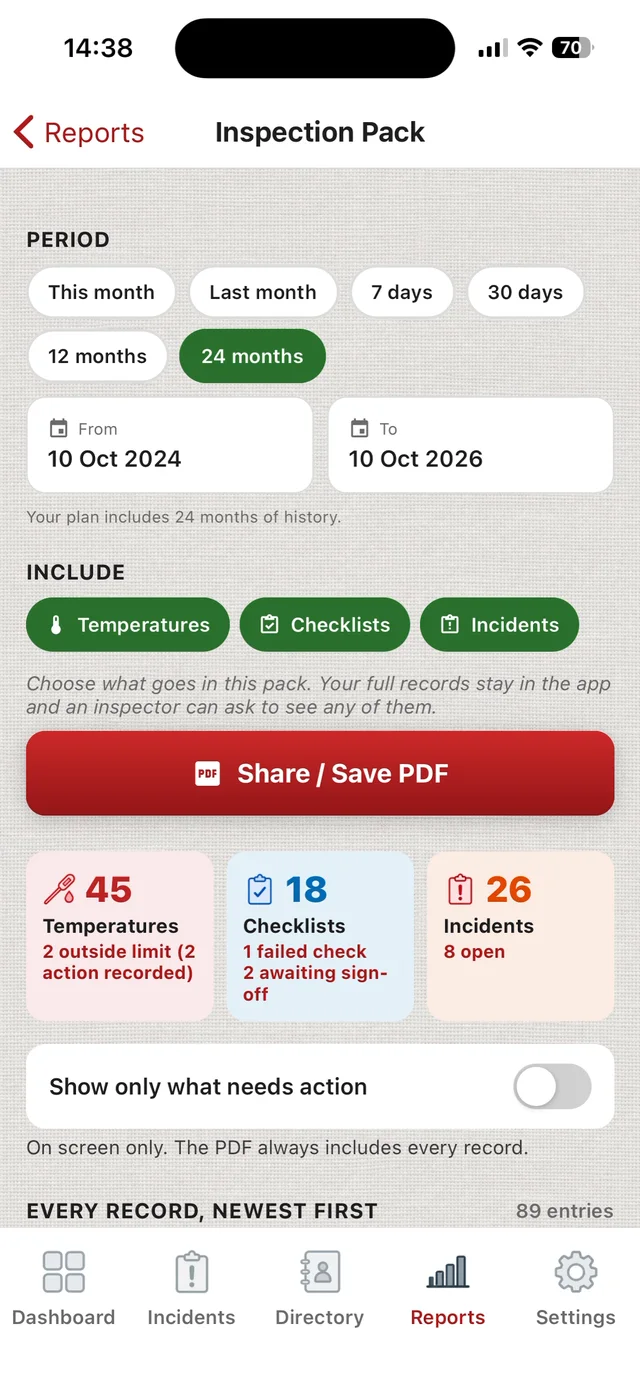
ChefsRecords Inspection Pack screen. Period buttons for This month, Last month, 7 days, 30 days, 12 months and 24 months, with From and To dates. Include: Temperatures, Checklists and Incidents are all switched on. A red Share / Save PDF button, then counts for temperatures, checklists and incidents, and the start of the list headed Every record, newest first.

Choose the dates and what goes in. Pick the period, switch on Temperatures, Checklists and Incidents, then share or save the PDF.

A real screen from the ChefsRecords app on an iPhone.

Reports and the Inspection Pack are part of the Standard and Pro plans, and open during the 14-day trial. See what else it does.

Get ChefsRecords on the App Store (iPhone) ›
14 days free. No card required.

This is general guidance for UK kitchens, written from the public sources below as published on 18 October 2026. It is not legal advice and does not replace your own food safety management system. If you are unsure, ask your local authority's food safety team. ChefsRecords is not part of, or endorsed by, the Food Standards Agency, Food Standards Scotland or your local council.

Back to sections

Questions people ask

What is an EHO inspection?

A visit from a food safety officer at your local council to check how food is handled, the condition of the premises and how you manage food safety. Usually you are not told in advance.

What does EHO stand for?

Environmental Health Officer. Both EHOs and food safety officers inspect food businesses for the council.

How often are food hygiene inspections?

It depends on the risk your business poses to public health. It is risk-based: from every few months for the highest-risk businesses to every few years for the lowest. In Scotland the councils use the Food Law Rating Scheme.

Do EHOs give notice?

Usually not. A place used only as a private home must get 24 hours' notice before an officer can insist on entry, in all four nations. For a business run from home, GOV.UK (England, Wales and Northern Ireland) says the council will arrange the visit. More in our first food hygiene inspection guide.

How do you pass an EHO inspection?

There is no pass mark in England, Wales or Northern Ireland. You get a rating from 0 to 5, and only Scotland uses "Pass". The three areas are scored together: how food is handled, the building, and how you manage food safety. We cannot promise a rating.

Do I have to display my rating?

In Wales and Northern Ireland, yes, it is law. In England it is voluntary. In Scotland it is not required by law, as far as Food Standards Scotland's guidance shows.

How is the rating worked out?

The three areas are each scored, and one weak area can pull the whole rating down, because, as councils publish it, each rating has a cap on the highest score in any one area. GOV.UK: "To get the top rating, you must do well in all three elements."

What records does an EHO want to see?

There is no published list. Have your written plan, temperature records, cleaning, probe checks, delivery and supplier records, allergen information, training records and a note of what went wrong and what you did.

Do staff need a food hygiene certificate?

The law says handlers must be supervised and instructed and/or trained for their work. It does not name a certificate. Some councils, such as Isle of Anglesey and Conwy, advise Level 2 within 3 months of starting, and in Scotland CookSafe recommends its Basic course within 3 months. That is guidance, not law. Our food hygiene certificate guide has more.

How do I appeal my rating?

In England, Wales and Northern Ireland you have 21 days to appeal in writing to the council. The lead officer for food or a deputy decides it, not the officer who inspected you. Wales uses a standard form. In Scotland you have 14 days. An appeal against a hygiene improvement notice goes to the court and is a different thing.

How do I get re-rated, and does it cost?

Once you have improved, ask in writing to the officer who inspected you. In Wales and Northern Ireland councils charge a fee, and some English councils do. In Scotland it is free at the moment. Each council sets its own amount.

What is the right to reply?

Your comments, or what you have done since, shown with your rating. In England, Wales and Northern Ireland you can add it at any time until the next inspection. In Scotland, write to the officer.

What is a hygiene improvement notice?

A written notice that says what is failing and what to do, with a period of not less than 14 days. Failing to comply is an offence. You can appeal to the court within one month, or the notice's own period if shorter.

How is Scotland different?

Scotland uses the Food Hygiene Information Scheme: Pass or Improvement Required. The appeal window is 14 days, and a revisit is free at the moment. Its pack is CookSafe.

Back to sections

Put it in your food safety plan

Your food safety plan should describe what your kitchen really does. The free food safety plan builder takes you through safe methods based on the FSA pack, so you can write them in your own words, then prints your plan or saves it as a PDF. For small restaurants, cafes, pubs and takeaways in England and Wales.

Related guides

The temperature guides go deeper on what an inspector may ask: the fridge temperature log guide, the hot holding guide, the cooling guide, the reheating guide and the danger zone guide. Just registered? Our first food hygiene inspection guide covers the wait for the first visit. Our food safety management system guide covers the written plan, the records and the review, and our food safety records guide shows how to file them in one folder. Our near miss guide shows how to write down what went wrong, and our food hygiene certificate guide covers staff training and the records an inspector may ask to see. More guides: the pest control guide, the kitchen cleaning schedule guide, the hand wash basins guide and the digital food safety records guide.

Sources