Updated 25 October 2026 - for UK restaurants, cafes, pubs, takeaways and other small catering businesses
A food safety management system is your written way of keeping food safe: what you do, the records that show you do it, and regular checks that it works. GOV.UK says every food business needs one. How much you write depends on your size and what you cook. England and Wales, Northern Ireland and Scotland each have a free pack to help you write it.
Guidance GOV.UK's page on food safety management systems says: "A food safety management system is a written set of processes, checks, rules and records." It says a system "usually includes things like": "rules for cleaning and hygiene", "safe cooking and storage procedures", "allergen controls", "staff training" and "temperature checks".
In a small kitchen, that means things like how you cook chicken, how you cool a stock, how you stop raw meat touching ready-to-eat food, how you clean, how you deal with allergens, and what you check each morning. The system writes those down, says what you do when something goes wrong, and keeps a record that you did it.
Guidance GOV.UK also says: "If your business is involved in a food safety incident, you will need to show your records as evidence of how you keep food safe."
Guidance It names three main types of food hazard: "microbiological", "chemical - including cleaning chemicals, allergens and other contamination" and "physical". A hazard is "anything that could make food unsafe to eat."
Law in all four nations Yes. The rules are in Regulation (EC) 852/2004, Article 5. The HACCP duty in Article 5 is the same in England, Wales, Scotland and Northern Ireland. (Northern Ireland applies the EU version of the regulation.)
Law in all four nations Not having food safety procedures based on HACCP can be an offence. Each nation's Food Hygiene Regulations list Article 5 in their Schedule 2. They are linked in the sources below.
Guidance GOV.UK says: "If you run a food business, you need to have a food safety management system to make sure your food is safe to eat."
Guidance in England and Wales The FSA pack puts it plainly: "The law says you must write down what you do to make sure food is safe."
Is there any flexibility for small kitchens?
Law in all four nations Some. The regulation's introduction says the rules should have "sufficient flexibility to be applicable in all situations, including in small businesses", and that record keeping "needs to be flexible in order to avoid undue burdens for very small businesses". That is the introduction, not a rule.
Guidance in England, Wales and Northern Ireland GOV.UK's Managing food safety page says: "Food safety procedures may not be necessary if processes in your business are very simple. In this case, you can comply with the legal requirement by following good hygiene practice. For more information, contact your local authority."
Our advice "Very simple" means very simple. Small kitchens are not exempt. Whether your business is simple enough is for your council to say. A kitchen that cooks, cools, reheats or hot holds food should expect to need written procedures and records.
Our advice There is no list of "three points" in the law or the packs. A simple way to think of it is in three parts. Those match what Article 5 asks for.
| Part | What the law asks (Article 5) | Where it is in the packs |
|---|---|---|
| The plan | Procedures based on the HACCP principles, with documents kept up to date | FSA pack: the safe methods. Safe Catering and CookSafe: your HACCP plan, built step by step. |
| The records | Records that fit "the nature and size of the food business", including what was done when a check failed | FSA pack: the diary, signed each day. Safe Catering: record forms. CookSafe: its record sheets. |
| The review | Checks "carried out regularly" that it works, and a review when anything changes | FSA pack: the 4-weekly review. Safe Catering: at least yearly. CookSafe: ideally every six months. |
Guidance in England and Wales The FSA pack says the safe methods "must be completed before you start food operations", and on records: "as a minimum, you need to fill in the diary each day. Depending on the size and nature of your business you may need to keep more records". Those are the pack's words, not the law's. Our food safety diary guide covers the diary and the review.
Guidance HACCP stands for Hazard Analysis and Critical Control Point. GOV.UK says: "Your food safety management system must meet the Hazard Analysis and Critical Control Point (HACCP) principles." It lists them like this:
Law in all four nations Article 5(2) has the same seven points in a slightly different order: it puts "corrective actions" before the checks that the system works.
An example from a kitchen
Guidance in England and Wales The FSA pack is based on HACCP, but it leaves the jargon out: "you will not find words such as 'HACCP' or 'hazard' in the pack because we have cut out all the jargon."
England and Wales, Northern Ireland and Scotland each have a free pack, written for small catering businesses. None of them is UK-wide. GOV.UK's first step is: "Contact your local food safety team."
| Where you are | The free pack | What it says about itself |
|---|---|---|
| England and Wales | The FSA's Safer Food, Better Business pack for caterers | GOV.UK: "Applies to England and Wales". The pack is "for small catering businesses such as restaurants, cafés and takeaways" and "can be adapted to suit the size and nature of your business". |
| Northern Ireland | Safe Catering, from the FSA in Northern Ireland | "our food safety management guide for Northern Ireland". GOV.UK: "If your business is in Northern Ireland, use the Safe Catering guidance instead." |
| Scotland | CookSafe, from Food Standards Scotland | "CookSafe helps catering businesses in Scotland understand and implement HACCP-based systems". |
| Your own plan | A HACCP plan you write, with a template, the FSA's MyHACCP tool or a consultant | GOV.UK: "An HACCP plan is a more detailed part of food safety management". MyHACCP is "aimed at small food manufacturing businesses". |
Can I write my own plan?
Law in all four nations Yes. No law names a pack. The law says whoever develops and keeps your procedures based on HACCP must have had "adequate training in the application of the HACCP principles".
Guidance in England and Wales The FSA pack mentions "Other options as well as designing your own".
Guidance in Scotland CookSafe says it "is easily adapted to fit in with the system you use or one you design to suit your particular business."
Guidance GOV.UK says your local food safety team "might advise that you need an HACCP plan if your business is larger or higher-risk."
Our advice A plan you write yourself still has to meet Article 5, and your council judges it. For most small kitchens, your nation's free pack, filled in properly in your own words, is the simplest start.
Yes. The free templates are the packs themselves:
Our free plan builder (England and Wales)
Our free food safety plan builder helps you write the plan part of your system: your safe methods, in your own words, based on the FSA's Safer Food, Better Business pack for caterers. It is for small restaurants, cafes, pubs and takeaways in England and Wales only. It is not for Northern Ireland or Scotland, or for care homes, childminders, shops, manufacturers, or processes such as vacuum packing or sous vide.
You print your plan or save it as a PDF, with a review record to fill in each time you update it. It does not check your answers, and your answers stay on your device. It does not make diary pages or daily records. ChefsRecords is not part of, or endorsed by, the Food Standards Agency.
Law in all four nations No law sets how often to review. Article 5 asks for checks "carried out regularly" that your system works, and says: "When any modification is made in the product, process, or any step, food business operators shall review the procedure".
Guidance GOV.UK says: "Check, review and update your system regularly, and whenever you change your food processes or suppliers."
The packs differ:
Our advice Review straight away when something changes: a new dish, a new supplier, new equipment, a new way of cooling, new staff. A plan that no longer matches what your kitchen does cannot show that your food is safe, and an inspector looks at how you manage food safety, not just what is on paper.
Law in all four nations Article 5(4)(c) says to keep records "for an appropriate period". It gives no number.
Our advice If in doubt, ask your council. Keep records at least until after your next inspection.
Guidance in England, Wales and Northern Ireland Under the Food Hygiene Rating Scheme, GOV.UK says the officer checks "how the business manages ways of keeping food safe, looking at processes, training and systems to ensure good hygiene is maintained." That lets the officer "assess the level of confidence in standards being maintained in the future". A rating is "a snapshot of the standards of food hygiene found at the time of inspection."
Guidance from some councils Sheffield City Council says inspectors "will also want to see a written, step-by-step, food safety management system (FSMS)." Reigate and Banstead gives an example of a business scored "20 for confidence in management as they have not yet documented their food safety management system".
Guidance in England, Wales and Northern Ireland GOV.UK says: "All your records need to be kept up-to-date and be available for inspections at all times." The FSA pack says it "should always be available at the business." Safe Catering says staff "should be able to produce it when requested by an inspecting Environmental Health Officer."
Guidance in Scotland Scotland has the Food Hygiene Information Scheme instead of the Food Hygiene Rating Scheme. Food Standards Scotland says you "may be covered" by it if you serve or supply food direct to the public.
Our advice Make sure whoever is on shift can find the plan and the records, on paper or on a device. Our EHO inspection guide covers the visit itself.
Law in all four nations Whoever develops and keeps your procedures based on HACCP must have had "adequate training in the application of the HACCP principles". Food handlers must be supervised and instructed or trained in food hygiene to suit their work. No law requires a particular certificate or level. Our food hygiene certificate guide has the detail.
Guidance in England, Wales and Northern Ireland GOV.UK: "It is a good idea to keep a record of any training".
Guidance in England and Wales The FSA pack says: "You must register your food business with the Environmental Health Team at your local council, at least 28 days before you start food operations."
Registration is free. What happens next: our first food hygiene inspection guide.
Guidance GOV.UK calls the 4Cs of food hygiene (cleaning, cooking, chilling and avoiding cross-contamination) best practice. Our advice They are a good way to remember the basics, but not a food safety management system on their own. Each C, the figures for each nation, whether there is a fifth C and a free staff poster: our 4Cs of food hygiene guide.
Our advice GOV.UK lists allergens as a food hazard and "allergen controls" as part of a system, so cover them in your plan as well.
No law says your records must be on paper: each nation's pack allows records to be kept electronically, and in all four nations an inspector can look at records "in whatever form they are held". What each nation says, what makes a record believable and what to do if an inspector asks for paper: our digital food safety records guide.
A plan says what you do. Your records show that you do it. ChefsRecords is an iPhone app for keeping many of those daily records: temperature checks, with what was done when a reading was out of range; daily checklists; incidents, with who logged them and what was done; staff records; and a sign-off for each day by a Manager or Supervisor. It keeps records. It does not write, check or replace your plan, and it is not HACCP software. You do not need it: the FSA's paper diary, or any other system you keep up to date, works too.
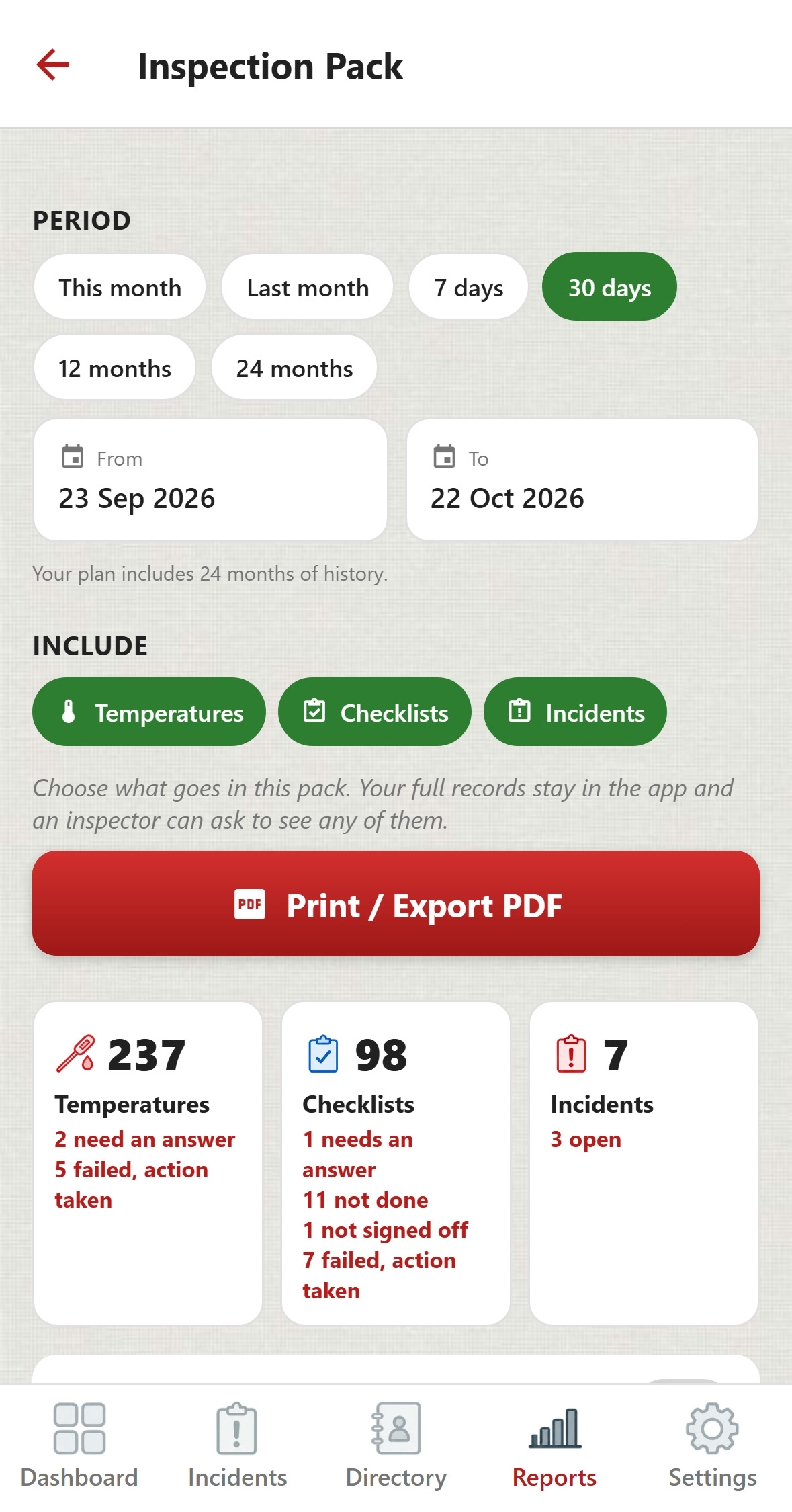
The Inspection Pack puts the temperatures, checklists and incidents for a period together, and shows what still needs an answer.
Why kitchens move their records off paper:
The plan part. In England and Wales, our free food safety plan builder helps you write your safe methods. See section 6 for what it does and does not do.
Which plan. The Inspection Pack and the other reports come with the Standard and Pro plans and are open in the 14-day trial. Reports look back 12 months on Standard and 24 months on Pro.
What it does not do.
Get ChefsRecords on the App Store (iPhone) ›
14 days free. No card required.
This is general guidance for UK kitchens, written from the public sources below as published on 22 October 2026. It is not legal advice and does not replace your own food safety management system. Whether your system and records are enough is for your own council. ChefsRecords is not part of, or endorsed by, the Food Standards Agency, Food Standards Scotland or your local council. If you are unsure, ask your local authority's food safety team.
GOV.UK says: "A food safety management system is a written set of processes, checks, rules and records." It usually covers cleaning and hygiene, safe cooking and storage, allergens, staff training and temperature checks.
Yes. The law says every food business must put in place, and keep up, food safety procedures based on the principles of HACCP, with documents and records that fit "the nature and size of the food business". That is Article 5 of Regulation 852/2004, and the duty is the same in all four nations. GOV.UK says that if a business's processes are very simple, it may be able to meet the law by following good hygiene practice. Ask your council's food safety team if you think that applies to you.
There is no list of "three points" in the law or the packs. A simple way to think of it: the plan (what you do to keep food safe, and what you do when something goes wrong), the records (proof that you do it, and what you did about problems) and the review (regular checks that it works, and updating the plan when things change). Those match what Article 5 asks for.
No law names a pack. The FSA pack is written for small caterers in England and Wales. Northern Ireland has Safe Catering and Scotland has CookSafe. You can also write your own plan based on HACCP, and your council judges whether it works for what you do.
Yes. The law says whoever develops and keeps your procedures based on HACCP must have had "adequate training in the application of the HACCP principles". GOV.UK points to the FSA's HACCP templates, the MyHACCP tool and independent consultants. Your council's food safety team will judge whether the plan works for what you do.
Yes: the packs themselves. The FSA pack (England and Wales), Safe Catering (Northern Ireland) and CookSafe (Scotland). There are also the FSA's HACCP templates on GOV.UK and the MyHACCP tool. In England and Wales, our free plan builder helps you write your safe methods in your own words.
No law says records must be on paper, and each nation's pack allows records to be kept electronically. Whatever you use, keep it up to date and make sure it can be shown at the business when an inspector asks. More in our digital food safety records guide.
No law sets how often. The law asks for regular checks, and a review whenever something changes. The FSA pack's diary has a 4-weekly review, Safe Catering recommends "a minimum of a yearly review", and CookSafe says "ideally every six months".
The law says "for an appropriate period" and gives no number. GOV.UK says to keep the FSA diary pages "until your next visit from a local authority food safety officer". Safe Catering recommends at least 12 months. CookSafe says your Enforcement Officer can advise. If in doubt, ask your council.
The FSA and Food Standards Scotland talk about the 4Cs: cleaning, cooking, chilling and avoiding cross-contamination. We could not find a fifth C from either agency. See our 4Cs of food hygiene guide.
GOV.UK and the FSA do not recommend any app, and the law does not require one. Paper, a computer or an app should all do the same job: record who did each check, when, the reading, what went wrong, what was done about it, and who checked it. Our advice: choose one your staff will use every shift, that shows who made each record and keeps the original when a record is corrected, and that you can show or print when an inspector asks. What to look for: our digital food safety records guide. We make ChefsRecords, so we are not neutral.
The legal duty is the same in all four nations: procedures based on HACCP, with records that fit your business. The guidance differs. Scotland has CookSafe from Food Standards Scotland. Northern Ireland has Safe Catering from the FSA in Northern Ireland. England and Wales have the FSA pack.
The food safety records guide (with a printable kitchen folder map), the food safety diary guide, the EHO inspection guide, the first food hygiene inspection guide, the opening and closing checks guide, the cooking temperatures guide, the kitchen cleaning schedule guide, the probe check guide and the food hygiene certificate guide. More guides: the digital food safety records guide and the 4Cs of food hygiene guide.