Updated 25 October 2026 - for UK restaurants, cafes, pubs, takeaways, carveries and other catering businesses
The law says staff with diarrhoea, or any illness that could pass through food, must not handle food or go into food areas, and must tell the business straight away. The law does not set a number of hours. The 48-hour rule is guidance: staff with diarrhoea or vomiting stay away from food work until 48 hours after the symptoms stop. Here is what each source says.
Law in all four nations The rule is in Regulation (EC) 852/2004, Annex II, Chapter VIII, paragraph 2. It reads:
"No person suffering from, or being a carrier of a disease likely to be transmitted through food or afflicted, for example, with infected wounds, skin infections, sores or diarrhoea is to be permitted to handle food or enter any food-handling area in any capacity if there is any likelihood of direct or indirect contamination. Any person so affected and employed in a food business and who is likely to come into contact with food is to report immediately the illness or symptoms, and if possible their causes, to the food business operator."
The same text applies in England, Wales, Scotland and Northern Ireland. (In Northern Ireland the EU regulation applies directly.) Paragraph 1 of the same chapter adds that everyone working in a food-handling area is "to maintain a high degree of personal cleanliness and is to wear suitable, clean and, where necessary, protective clothing".
Our advice No law we found requires a written illness record, a return-to-work form or a doctor's note. Keeping them is good practice, and the guidance below asks for them in different words.
Guidance in England, Wales and Northern Ireland The FSA says managers must exclude staff with these symptoms from working with or around open food, "normally for 48 hours from when symptoms stop naturally". GOV.UK says staff with diarrhoea or vomiting must not return to work until they have had no symptoms for 48 hours. Guidance in England and Wales The FSA's Safer Food, Better Business pack (the FSA pack) says the same.
Law in all four nations The ban on handling food or entering a food-handling area applies "in any capacity". The duty to report applies to anyone employed in a food business who is likely to come into contact with food. Guidance GOV.UK says: "Staff must tell their manager if they are not feeling well."
Guidance in Scotland Food Standards Scotland defines a food handler widely. It includes staff "employed directly by the business or through an agency", contract maintenance workers, and "a visitor to a food handling area e.g. enforcement officer or delivery personnel".
Our advice Put the rule in your induction and on the staff board: tell me straight away, before you come in, if you have diarrhoea, vomiting or an infected wound. Make it easy to ring in, and make sure nobody is made to feel bad for doing it.
Guidance in England, Wales and Northern Ireland The FSA's fitness to work guidance says staff should report "any illness symptoms to management immediately including":
Guidance in Scotland Food Standards Scotland also asks staff to report if they were "ill whilst on holiday in another country or shortly after returning". It says diarrhoea and vomiting at home "does not always require exclusion", but staff should still tell the manager. If someone at home has been diagnosed with a serious stomach infection, for example STEC (E. coli O157 and non-O157), Food Standards Scotland says exclusion "will be necessary". CookSafe, from Food Standards Scotland, calls reporting illness at home "good practice".
Our advice Ask the question. On the day someone rings in or comes back, ask: is anyone at home ill, and have you been abroad? You decide with the person, and you can ask your council if you are unsure.
Guidance in England and Wales The FSA pack says anyone with diarrhoea or vomiting "should report it to their manager immediately and either stay at home or go home straight away". If things go wrong, it says to "move them out of food handling areas or send them home. Throw away any unwrapped foods they have handled." Then: "Write down what went wrong and what you did about it in your diary."
Guidance in England, Wales and Northern Ireland The FSA's fitness to work guidance adds that if people have been to work while suffering certain infections, "it is important to ensure that areas that they have come into contact with have been cleaned effectively".
Our advice Do not keep the unwrapped food they prepped before they went home, and do not leave the cleaning to the next shift. Make the diary note while you still remember the details. Guidance in Scotland Food Standards Scotland says cleaning should be done "as soon as possible" after anyone has been sick on the premises.
Law in all four nations The law names "infected wounds, skin infections, sores" alongside diarrhoea. A person with one must not handle food or enter a food-handling area if there is any likelihood of contamination.
The FSA pack says coloured waterproof dressings "can be seen more easily if they drop into food". Our advice Keep a supply of them, and check the dressing is still on during the shift.
The 48 hours is the usual minimum, not a test for every illness. Some infections need more, and that decision is made by the council or the health protection team, not by the kitchen. We cannot tell you which illness someone has.
Law in all four nations No law we found requires a doctor's note before a food handler goes back to work after diarrhoea or vomiting. Guidance The FSA pack, GOV.UK, Safe Catering and CookSafe all ask for 48 hours without symptoms. They do not ask for a note. Guidance in Scotland Food Standards Scotland says pre-employment health checks on food handlers "are not required by law".
Medical clearance is different. It is needed for the named infections above, and it is decided by the doctor, the council or the health protection team. A fit note (sick note) is different. It is about time off work and pay, not food safety. Acas says a worker needs one after more than 7 calendar days off sick, or if the employer asks for one. For pay or contract questions, see Acas or speak to a human resources (HR) adviser.
Our advice No law requires a return-to-work form. It is how you can show you checked. Food Standards Scotland says managers should interview all staff on return to work, and CookSafe and Safe Catering have their own forms. This list is ours, built from those three. Copy it into your own checks. Both you and the person sign and date it.
Health details are sensitive personal information (special category data under UK GDPR). Ask only what you need to decide whether the person can safely handle food, and write down the answers, not a diagnosis. Keep the signed check locked away, or somewhere only managers can open. The shared kitchen diary needs only the food-safety facts: who was sent home, when, and what you did with the food and the cleaning.
The list is for the manager's judgement, not a replacement for advice. If the answer to any question worries you, keep the person away from food work and ask your council or a doctor. A problem that keeps coming back may be a long-term health condition. Decide on the food-safety risk today, and take HR advice before changing anyone's duties, hours or pay because of it.
Guidance in England, Wales and Northern Ireland The FSA's fitness to work guidance says: "Penalising staff for being ill, for example by not paying them when they are excluded from work, could lead to them working whilst ill and may lead to food safety problems." It adds: "Incentives to take fewer sick days can have a similar effect." The same FSA guidance says: "Staff excluded for longer periods because of more serious infectious diseases may also be able to receive financial support from their local authority."
Pay, sick pay and contracts are employment matters, and we cannot advise on them. For the rules, see GOV.UK: Statutory Sick Pay and Acas: Statutory Sick Pay. For a contract question or a dispute, speak to Acas, an HR adviser or an employment solicitor.
Our advice There is no published list. From the law and the guidance above, expect questions like these. Do staff know to tell you about diarrhoea, vomiting or an infected wound before they come in? Is the rule written in your food safety plan? Is there a diary note when someone was sent home? Did you check they were 48 hours clear before they came back? Was the unwrapped food they handled thrown away and the area cleaned? Guidance in England and Wales The FSA pack says to "Make a note in your diary of when you have trained staff on this safe method."
The free food safety plan builder takes you through the FSA pack's personal hygiene and fitness to work safe method in your own words, then prints your plan or saves it as a PDF. For small restaurants, cafes, pubs and takeaways in England and Wales. In Scotland, CookSafe's House Rules cover it. In Northern Ireland, Safe Catering does. Our EHO inspection guide covers the rest of the visit.
Paper works: a diary note when someone is sent home, and a return-to-work form signed by both of you. In ChefsRecords, the Opening Checks template has the tick "No one at work within 48 hours of vomiting or diarrhoea", saved with who ticked it and when. On Pro, a Manager can record a return-to-work interview on the staff member's page: first day of absence, date of return, the reason, whether they confirmed they are fit to return, and their signature if they sign. The app does not work out the 48 hours or ask the food-safety questions on the FSA, CookSafe or Safe Catering forms, so keep one of those forms too.
Why kitchens move off paper:
When you set up Opening Checks, choose "Start with ready-made checklists". The template has two lines for this: "Staff fit for work, in clean workwear, cuts covered", and the 48-hour tick above. Change any line to suit your kitchen. For a return-to-work interview, a Manager goes to Directory, opens the staff member, taps "Log 1-to-1 Meeting" and chooses the "Return to Work" chip. The form asks for the first day of absence, the date of return, working days absent and an absence reason, then "Fitness confirmed", with adjustments or follow-up, and an optional signature. When you pick a sickness reason, the form shows a notice that this is health-related information, treated as special-category data under UK GDPR, and asks you to avoid recording diagnostic detail unless it is directly relevant to fitness for work. Tap "Save Interview" and the app confirms "Return to Work interview saved".
The Opening Checks template comes with Standard and Pro and is open in the 14-day trial. Return-to-work interviews are part of Pro and are not in the trial.
What it does not do: the app does not track illness or exclusion, and it does not work out the 48 hours. There is no place to log that someone reported sick, or the date and time symptoms stopped, and no reminder. Staff cannot report sickness in the app. "Employee confirmed fit to return" is the employee's statement, and the form has no questions about medicine, someone ill at home, travel or skin, so the check list above still has a job to do. Return-to-work interviews are for Managers only. They are not in the Inspection Pack. A Manager can export them in the Staff Report (Reports, then Staff), which shows the dates, the reason and "Fit to return: Yes" or "No". "No" also means the box was not ticked. The app helps you keep the record. It does not stop anyone working.
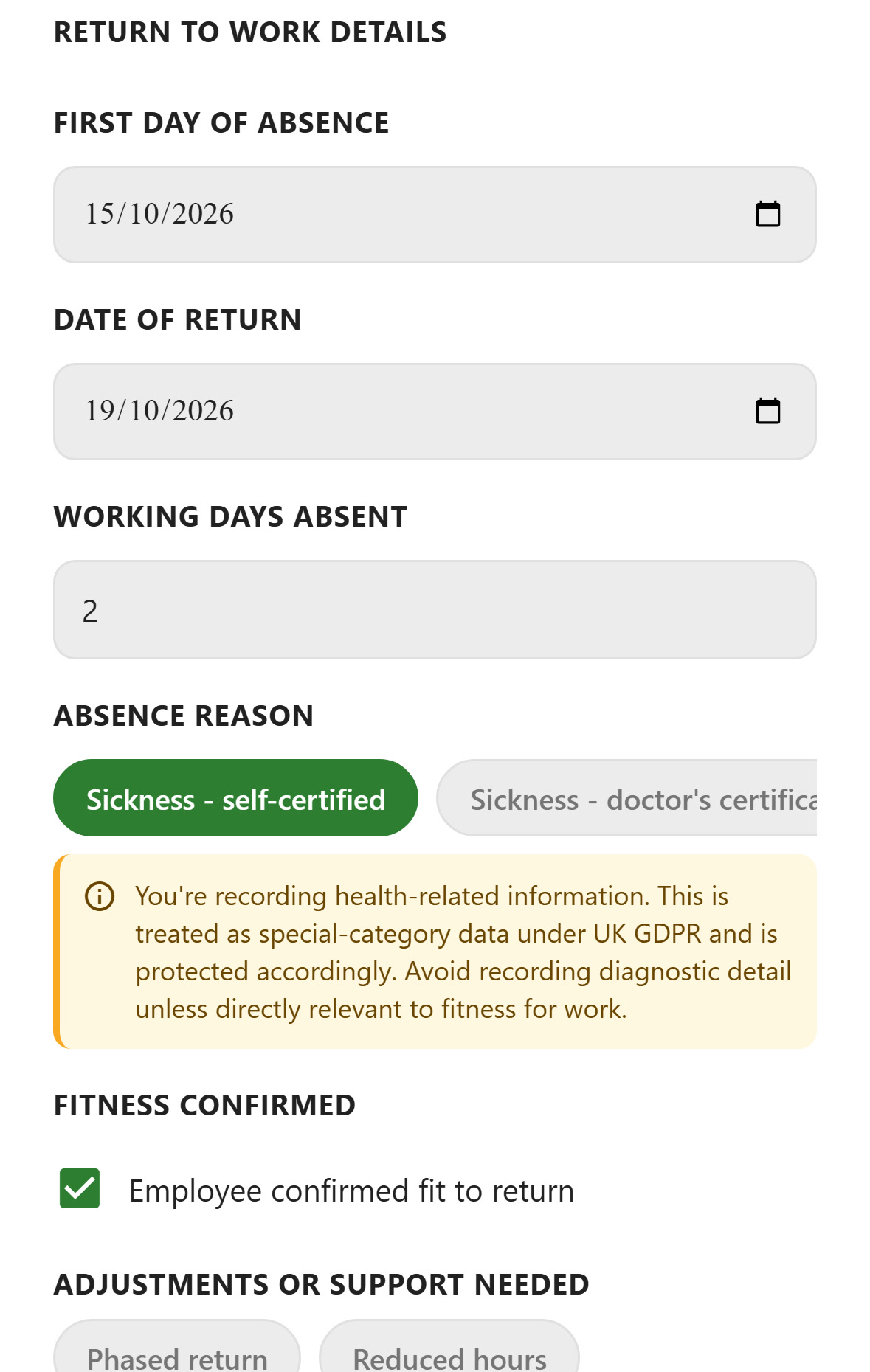
A return-to-work interview in ChefsRecords (Pro, Managers only). It records the dates, the reason and that the employee says they are fit to return. It does not count the 48 hours or ask the food-safety questions, so use the check list above as well.
Get ChefsRecords on the App Store (iPhone) ›
14 days free. No card required.
This is general guidance for UK kitchens, written from the public sources below as published on 20 October 2026. It is not legal, medical or HR advice and does not replace your own food safety management system. ChefsRecords is not part of, or endorsed by, the Food Standards Agency, Food Standards Scotland, the UK Health Security Agency or your local council. If you are unsure, ask your local authority's food safety team. ChefsRecords is not part of, or endorsed by, the Food Standards Agency, Food Standards Scotland or your local council.
It is guidance, not a law. Staff with diarrhoea or vomiting stay away from food work until 48 hours after the symptoms stop. The FSA says "normally for 48 hours from when symptoms stop naturally". The law only says that ill staff must not handle food and must report it.
When they stop. Food Standards Scotland's example: symptoms end at 5pm on Monday, so the person can resume work from 5pm on Wednesday. "Naturally" means not held back by medicine.
Not around food. The law says a person with diarrhoea must not handle food or enter a food-handling area if there is any likelihood of contamination, and must report it immediately. The FSA says managers must exclude staff with these symptoms from working with or around open food.
Normally 48 hours after the vomiting stops, with no other symptoms, and after your return-to-work check. If a doctor, the council or the health protection team has told you something different, follow that.
No law we found requires one for sickness or diarrhoea. Medical clearance is needed only for named infections, and it is decided by the doctor, the council or the health protection team. A fit note is about time off and pay, not food safety. See Acas for the rules.
Tell your manager. The FSA says to report "someone living with you with diarrhoea or vomiting". Food Standards Scotland says it "does not always require exclusion", but exclusion will be necessary if someone at home has been diagnosed with a serious infection such as STEC. Your manager decides, and can ask the council.
We cannot diagnose anyone. For norovirus, the UKHSA guidance for councils and health protection teams says: "A minimum of 48 hours after symptoms have stopped/no loose stools". That is a minimum. If the council or health protection team is involved, follow what they tell you.
Usually, if it is completely covered. The FSA pack says cuts and sores should be completely covered with a brightly coloured waterproof dressing. An infected area that cannot be covered should be kept away from food until it has healed. If it might be infected, ask your manager or the council.
Food Standards Scotland says not until you have been symptom-free for at least 48 hours after stopping the medication. We cannot give medical advice, so ask a pharmacist or doctor about the medicine.
Yes. The law keeps anyone who is ill away from food "in any capacity", and the 48-hour guidance applies to them the same way. Food Standards Scotland counts staff through an agency, contract maintenance workers and visitors to a food handling area. Tell them your rule before they start.
No. The law is about reporting and keeping ill people away from food, and it sets no number of hours. The 48 hours comes from guidance by the FSA, GOV.UK, Food Standards Scotland and Safe Catering.
The law is the same in all four nations. The guidance differs by source. England and Wales have the FSA pack, and the FSA's fitness to work guidance covers England, Wales and Northern Ireland. Scotland has CookSafe and the Food Standards Scotland fitness to work guidance, with a return to work questionnaire. Northern Ireland has Safe Catering, with its SC7 fitness to work assessment form. All use 48 hours.
A short record of the checks you made before someone handles food again: when the symptoms stopped, that 48 hours have passed, and the other questions in the list above. No law requires one. Food Standards Scotland, CookSafe and Safe Catering each publish a form. Keep one in the staff file, where only managers can see it.
The opening and closing checks guide, the food hygiene certificate guide, the EHO inspection guide, the kitchen cleaning schedule guide, the hand wash basins guide, the 4Cs of food hygiene guide, the near miss guide, the Christmas kitchen guide and the cross-contamination guide.