Updated 25 October 2026 - for UK restaurants, cafes, pubs, takeaways and other small catering businesses
An allergen matrix is a grid showing which of the 14 allergens are in each dish. No law requires one. The law requires that allergen information for the food you sell loose is available to customers, and many kitchens use a matrix to keep that information in one place. Ours is free to print. Fill it in from your recipes and labels, and change it the same day a recipe or ingredient changes.
Download the allergen matrix (PDF, A4 landscape, two pages): colour or black and white
Our free allergen matrix is two A4 landscape pages. The front is the grid: one row for each dish, one column for each of the 14 allergens, with a wide column to write which cereal, room to name any tree nut beside the dish, and lines for who checked it and when. The back explains what each column covers, how to fill it in and when to change it.
Download the allergen matrix (PDF): colour, with each allergen in its own light shade, or black and white, for any printer. Print as many front pages as you need. It is free to print and use in your kitchen. No sign-up.
Our advice Why the colour version helps. On a busy sheet with 14 narrow columns, it is easy to put a C one column across, against the wrong allergen. In the colour version each allergen has its own shade, from the heading all the way down its column, and each family shares a colour: blue for fish, crustaceans and molluscs, yellow for eggs and milk, and so on. Your eye and pen stay in the right column. With the black and white version, run a finger or a ruler down the column as you write, and let the second check catch any slip.

Our advice The FSA and Food Standards Scotland also offer free matrices (section 12). Use whichever your team finds easiest. What matters is that it is complete, checked and kept up to date.
Law in all four nations The 14 allergens are listed in Annex II of Regulation (EU) 1169/2011, as it applies in the UK. They are the same in England, Wales, Scotland and Northern Ireland. GOV.UK lists them with examples:
Three to watch: peanuts are not tree nuts, so a "nuts" column does not cover them. "Shellfish" is not one of the 14: crustaceans and molluscs are separate. Sulphites only count above 10 milligrams per kilogram or per litre, which a kitchen cannot measure, so go by the label.
Law in all four nations If any of the 14 allergens is an ingredient in food you sell loose - meals, takeaway, deli or bakery counter food - the law says you must make that information available to customers before they buy. You can give it in writing or by word of mouth. If your staff give it by word of mouth, you must have a notice, menu, ticket or label, where customers choose their food, telling them they can ask staff for allergen details. Food you pack yourself before a customer orders it (prepacked for direct sale) needs a label with the name of the food and a full ingredients list, with the allergens emphasised. The rules for food sold loose have applied since 13 December 2014, and the label rules for prepacked for direct sale food since 1 October 2021, in England, Wales, Scotland and Northern Ireland. Breaking them is an offence, enforced by your council. No law says you must keep an allergen matrix.
Guidance in England, Wales and Northern Ireland GOV.UK's allergen guidance for food businesses says: "If you provide non-prepacked foods, you must supply allergen information for every item that contains any of the 14 allergens." The FSA's advice is that written allergen information, supported by a conversation, works best for customers. It says this is best practice: "You are not required by law to follow best practice guidance."
Guidance in Scotland Food Standards Scotland says allergen information for loose food "may be provided on a menu, chalkboard, shelf label or provided verbally by a member of staff." It consulted in 2026 on written allergen information. Until it says otherwise, those are the ways it lists.
An allergen matrix is a grid: one row for each dish, one column for each of the 14 allergens. It turns your recipes and ingredient labels into one page your team can check in seconds. You can also use it to show customers allergen information in writing.
Guidance in England, Wales and Northern Ireland The FSA says food businesses "could choose to use an allergen matrix to provide allergen information in writing".
It is not required by law. It is not a label for food you pack before sale. It is not a "free from" promise. It does not replace your recipes, your ingredient labels, training or a conversation with the customer. It does not make a dish safe for someone with an allergy.
Our advice Our method, built from the FSA's and Food Standards Scotland's guidance:
Our matrix uses two marks, in letters rather than ticks, so they cannot be misread on a black and white printout, and a blank box:
Guidance in England, Wales and Northern Ireland GOV.UK's precautionary allergen labelling page says: "You should not use general statements such as 'may contain allergens'." It says to pass on a supplier's "may contain" warning to customers, unless your own risk assessment supersedes it, and to review these warnings when suppliers or processes change.
Guidance in Scotland CookSafe says "may contain" statements "should only be used after a meaningful risk assessment".
Our advice "May contain" is never a substitute for cleaning and keeping foods apart. Only say a dish is "free from" an allergen if you can be sure, because that is a promise.
Our advice Update the matrix, and tell the team, the same day you: add a dish or a special; change a recipe; change a supplier or brand; accept a substitute in a delivery; find a new "may contain" on a label; or get an updated specification sheet. Check it against your labels at least once a month as well. When a line changes, cross it out, write the dish again on a new line with the date, and keep the old sheet. Then you can show what customers were told on any day.
Guidance in Scotland CookSafe: "Any substitution or change in ingredients must be recorded with ingredient and allergen information reviewed and updated accordingly." Guidance in England, Wales and Northern Ireland The FSA's best practice includes "regularly checking whether ingredients in products have changed".
Guidance in England, Wales and Northern Ireland GOV.UK says allergen information should be recorded on product specification sheets and in recipes, and kept up to date.
Guidance in Scotland CookSafe says your supplier "must provide you with all necessary ingredient and allergen information", and that you should not accept a delivery unless you are confident you have the right information.
Guidance in Northern Ireland Safe Catering says to keep a copy of the ingredient information for any ready-made food you use.
Our advice Keep one sheet or label per product, newest on top, with the date you received it. No law sets how long to keep them. Keep old ones at least until after your next inspection. Our delivery checks guide covers what to check when food arrives, and our food safety records guide shows where this goes in your folder.
Our advice Allergens are not removed by cooking. Keep allergen ingredients in sealed, labelled containers. Clean surfaces and equipment, and wash hands, before making a dish for someone with an allergy. Do not cook it in oil used for other foods. If you make a mistake, start again: taking the nuts off does not make a dish safe.
Guidance in England, Wales and Northern Ireland GOV.UK: "If you can't avoid cross-contamination in food preparation, you should inform customers that you can't provide an allergen-free dish."
Guidance in Scotland CookSafe: "Always be honest with the customer. If you do not know, admit it!"
Law in all four nations Food you pack on site before a customer orders it - a sandwich in a box on the counter, a salad pot in the fridge - is prepacked for direct sale. It needs a label with the name of the food and a full ingredients list, with the allergens emphasised. This is often called Natasha's Law, and it has applied in England, Wales, Scotland and Northern Ireland since 1 October 2021.
A matrix, a menu or a conversation does not replace that label. Food you pack after the customer orders is not prepacked for direct sale: the rules for loose food apply.
Guidance in England, Wales and Northern Ireland GOV.UK says: "Food businesses must make sure that staff receive training on allergens." Guidance in Scotland Food Standards Scotland says the same.
No law requires an allergen certificate. The FSA and Food Standards Scotland both run free online allergen training. Write down who was trained, in what, and when. Front of house needs it as much as the kitchen. Our food hygiene certificate guide covers training records.
Our advice There is no published list. Drawn from the FSA's allergen checklist, an inspector may ask: who is responsible for allergens on this shift; where staff find allergen information; how the information for today's special was worked out; what happens when a supplier sends a substitute; how a dish is made for someone with a milk allergy; and what allergen training front of house has had. Our EHO inspection guide lists the records to have ready.
Does ChefsRecords have an allergen matrix? Not yet. Keep your matrix on paper or in the free FSA or Food Standards Scotland tools. Here is what the app does for allergens today:
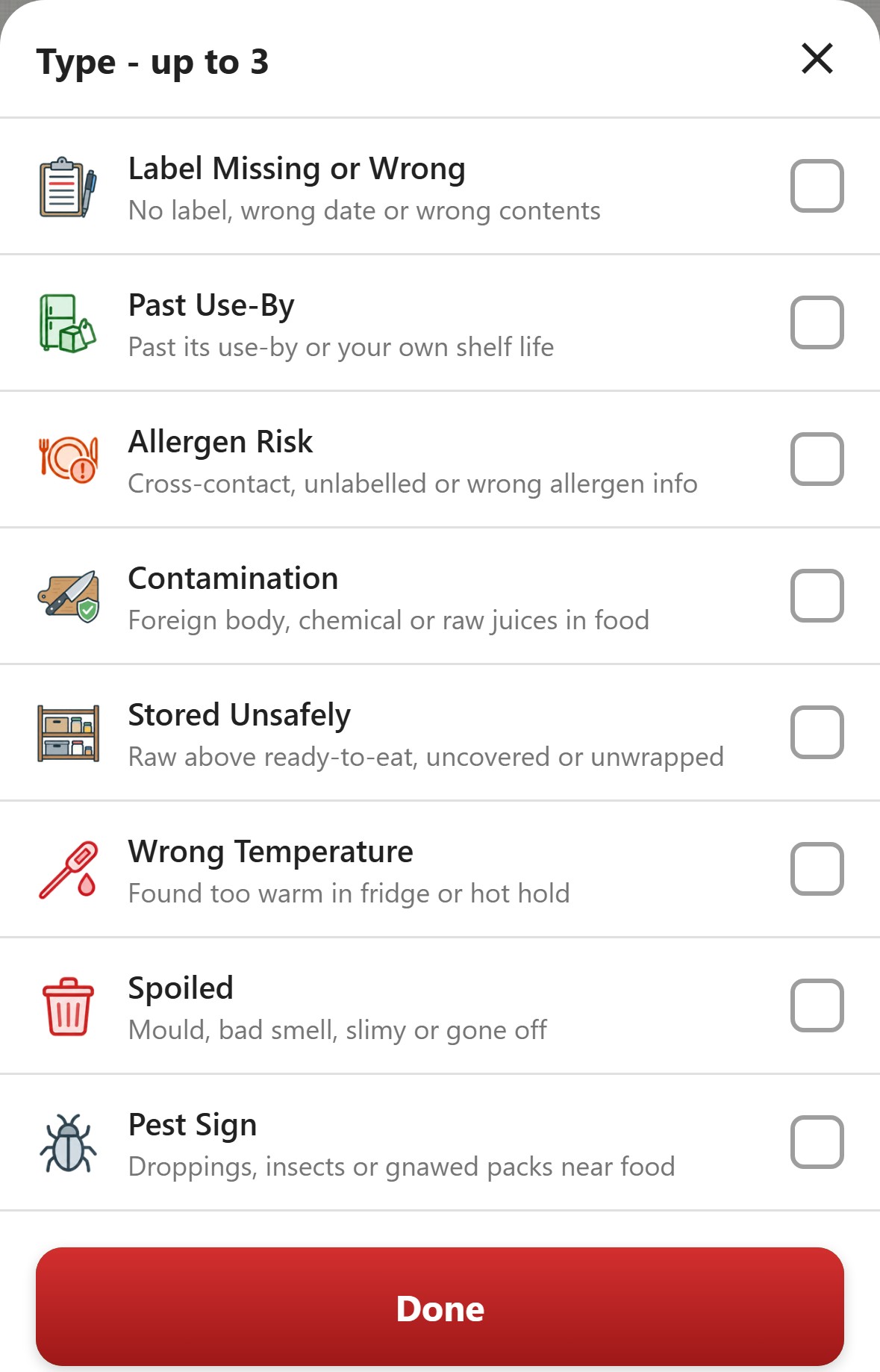
"Allergen Risk" is one of the food incident types, for cross-contact, unlabelled food or wrong allergen information.
Which plan. Incidents are on every plan. Checklists and the Inspection Pack come with Standard and Pro and are open in the 14-day trial. Training records are part of Pro and are not in the trial.
Would you use an allergen matrix in the app? Tell us. Every reply helps us decide what to build next.
Get ChefsRecords on the App Store (iPhone) ›
14 days free. No card required.
This page explains the law in plain words, from the public sources below as published on 23 October 2026. It is not legal advice. Your council's food team can answer questions about your own kitchen. ChefsRecords is not part of, or endorsed by, the Food Standards Agency, Food Standards Scotland or your local council.
No. The law asks that allergen information for food you sell loose is available to customers. GOV.UK and Food Standards Scotland also say staff must be trained on allergens. A matrix is one common way to keep and show that information.
Celery, cereals containing gluten (such as wheat, rye, barley and oats), crustaceans, eggs, fish, lupin, milk, molluscs, mustard, peanuts, sesame, soybeans, sulphur dioxide and sulphites, and tree nuts. They are the same in England, Wales, Scotland and Northern Ireland.
Yes, the law allows it, but you must have a notice, menu or label where customers choose their food saying they can ask staff. In England, Wales and Northern Ireland the FSA's advice is that written information, supported by a conversation, works best. That advice is best practice, not law.
Yes, in practice. The FSA's best practice guidance says the specific nut or cereal should be given, so our matrix asks you to write which cereal in its column, for example wheat, and to name the nut beside the dish, for example almond. Peanuts have their own column: they are not tree nuts.
Only where there is a real risk: a supplier's label warns of it, or your own check finds a risk you cannot remove. Name the allergen. "May contain allergens" is not enough, and "may contain" is never a substitute for cleaning and keeping foods apart.
No. Food you pack before sale (prepacked for direct sale) needs a label with the name of the food and a full ingredients list, with the allergens emphasised. This is Natasha's Law, in all four nations since 1 October 2021.
The same day you add a dish, change a recipe, change a supplier or accept a substitute. Check it against your labels at least once a month as well.
Yes. The FSA says a matrix can be used to give allergen information in writing. If you show it, keep it accurate, keep the key with it, and keep your "ask our staff" notice up too.
No. It means the allergen is not an ingredient. Cross-contact can still happen. Only say a dish is "free from" an allergen if you can be sure, because that is a promise.
The rules are the same, in Scotland's own regulations. The guidance is from Food Standards Scotland and CookSafe, not GOV.UK. Food Standards Scotland consulted on written allergen information in 2026, so check its website for any update.
Your food safety plan should describe what your kitchen really does. The free food safety plan builder takes you through safe methods based on the FSA pack, so you can write them in your own words, then prints your plan or saves it as a PDF. For small restaurants, cafes, pubs and takeaways in England and Wales.
The delivery checks guide, the food safety records guide, the EHO inspection guide, the food hygiene certificate guide, the near miss guide, the opening and closing checks guide, the cross-contamination guide, the chopping board colours guide, the Christmas kitchen guide and the food safety management system guide.