Updated 25 October 2026 - for UK restaurants, cafes, pubs, takeaways, carveries and other catering businesses
Check every delivery before you sign for it and before it goes into storage. Probe chilled and frozen food, look at the packs and dates, and reject what is not right. Here is what the sources say, nation by nation. This guide is about goods coming in.
Law in all four nations No single UK law is called "delivery checks". The law says you must not accept food you know, or should expect, to be contaminated. The cold chain must not be broken. You must be able to say who supplied every food, and food past its use-by date counts as unsafe.
The wording comes from Regulation (EC) 852/2004 as it applies in the UK. Annex II, Chapter IX says a food business is not to accept raw materials or ingredients "known to be, or might reasonably be expected to be" contaminated with parasites, pathogenic microorganisms or toxic, decomposed or foreign substances to such an extent that the final product would be unfit to eat, even after normal sorting and preparation. It also says foods that support the growth of pathogens "are not to be kept at temperatures that might result in a risk to health. The cold chain is not to be interrupted." It allows "limited periods outside temperature control" for the practicalities of handling, transport, storage, display and service, as long as that does not result in a risk to health.
Regulation 178/2002 Article 18 says you must "be able to identify any person from whom they have been supplied with a food", and have systems that let you give that information to your council on request. Regulation 1169/2011 Article 24 says that after the use-by date "a food shall be deemed to be unsafe".
Chapter IV covers the vehicle. It must be clean and in good repair, keep products separate where necessary, and be able to hold foods at the right temperatures and allow those temperatures to be monitored. That is the supplier's duty. It is also what you can see at the back of the van.
Law in England, Wales and Northern Ireland Schedule 4 of the hygiene regulations makes it an offence to keep food that could support the growth of pathogens at a temperature above 8°C. There are exemptions, for example for food that can safely be kept at ambient temperature for its shelf life, and for some raw food that will be cooked before it is eaten. That is not a reason to accept a warm delivery: the cold chain rule above applies to all food, and the FSA pack says to reject food that has not been kept cold enough. There are also defences. The one that fits a delivery is the transfer defence: food being moved to or from a vehicle used for a food business. The "less than four hours" defence in the same Schedule is for food kept for service or on display. It is not a delivery allowance.
Law in Scotland Scotland's Schedule 4 says food is kept "in a refrigerator or refrigerating chamber or in a cool ventilated place". There is no number, no vehicle defence and no fixed period. GOV.UK says 8°C is recommended in Scotland. CookSafe's example is to accept chilled food at 5°C or below.
The UK has no "2 hour / 4 hour rule" for deliveries. The 4 hours in the law of England, Wales and Northern Ireland is about food on display or for service.
The FSA pack says: "Check all stock when it is delivered." It lists use-by dates, whether the food has been kept cold enough, whether it has gone off, and whether the stock is clean and not damaged. The list below adds the other points from the sources. Where a line is ours, it says so.
| Check | What to look for | Where it comes from |
|---|---|---|
| Temperature | Chilled and frozen food, probed between packs. | Law in all four nations Guidance Annex II Chapter IX (cold chain), Schedule 4 (8°C, England, Wales and Northern Ireland), FSA pack ("kept cold enough"), CookSafe |
| Use-by date | Never accept one that has passed. Our advice Also check there is enough life left to use it. | Law in all four nations Guidance Article 24, FSA pack, CookSafe |
| Best-before date | Your choice. CookSafe calls rejecting stock beyond it "good practice" that "you may also wish to consider". | Guidance in Scotland CookSafe |
| Packaging | No punctured vacuum packs, swollen or "blown" packs, badly dented cans or broken seals. Our advice Nothing wet, leaking or crushed. | Guidance FSA pack (Stock control), CookSafe |
| Pests | Gnawed packaging, insects such as beetles, droppings. | Guidance FSA pack (Pest control), CookSafe |
| Foreign objects | Anything in the food that should not be there. | Law in all four nations Guidance Annex II Chapter IX, FSA pack (Physical contamination) |
| Raw and ready-to-eat | Kept apart in the van and in the crates. No raw food leaking onto, or packed against, ready-to-eat food. | Guidance FSA pack (Separating foods), CookSafe |
| The van | Clean, with the chilled section cold. Ask for the driver's temperature printout if they have one. | Law in all four nations Guidance Chapter IV, CookSafe ("thermograph") |
| The right order | Right product, labels and allergen information present. A substitute checked for different allergens. | Guidance FSA pack, CookSafe |
| Frozen food | Hard, with no thawing or refrozen lumps. | Our advice Neither source lists signs of thawing |
| The delivery note | Matches the goods, so the record can be traced back to the supplier. | Law in all four nations Guidance Article 18, FSA pack ("fully referenced invoices") |
Law in England, Wales and Northern Ireland Chilled food must not be kept above 8°C. GOV.UK says: "Chilled food must be kept at 8°C or below. This is a legal requirement in England, Wales and Northern Ireland." GOV.UK also says to set your fridge to 5°C or below. The FSA pack adds that some foods need storage below 8°C, so always follow the maker's storage guidance on the label.
Law in Scotland There is no number in the law, only "in a refrigerator". Guidance in Scotland CookSafe says to accept chilled food at your specified temperature, for example 5°C or below. 8°C is not a legal limit in Scotland. GOV.UK says it is recommended there.
Your supplier specification. The FSA pack says to "have a written agreement with your supplier about your delivery requirements". CookSafe's "your specified temperature" is the same idea. If your agreement says 5°C, that is the number you hold the supplier to. It is not the law.
No food hygiene law in any of the four nations sets a frozen delivery temperature. The figures come from the rules on quick-frozen food: the Quick-frozen Foodstuffs Regulations, which are separate rules in England, Wales and Northern Ireland, with Scotland's 1990 Regulations as amended.
Law in all four nations The English, Welsh and Northern Ireland text says quick-frozen food must be -18°C or colder, and kept at no warmer than that, except for brief periods during transport, including local distribution, at a temperature warmer than -18°C but "not warmer than -15°C". Scotland's Quick-frozen Foodstuffs Regulations 1990, as amended, set the same -18°C and -15°C. In the English text, "local distribution" includes delivery to a mass caterer. The duty is on whoever places the quick-frozen food on the market, which here means your supplier.
So: -18°C is the standard. The rules allow brief rises during transport to no warmer than -15°C, and that rule is on your supplier. Common target, not law For the kitchen, rejecting anything warmer than -15°C is trade practice. You may see this called a "3°C tolerance". The law does not say that: it says "not warmer than -15°C", and only for brief periods in transport.
Guidance in Scotland CookSafe's example is to accept frozen food at your specified temperature, for example -18°C or below.
If you are unsure about a frozen delivery, reject it, or keep it apart and do not use it until you have spoken to your supplier. For questions about your own rules, ask your council's food safety team.
Dry goods, tins, bottles and other food that keeps at room temperature have no temperature to check. Check:
Our advice
To check the probe itself, see our probe check guide. Our advice A probe that reads low is the risky way round for deliveries: the food was warmer than it showed.
Guidance in England and Wales The FSA pack says to plan delivery times so that, if possible, raw foods arrive at a different time from other foods. If they arrive together, raw and ready-to-eat food must be kept separate. Make a note in the diary of when deliveries come.
Guidance in Scotland CookSafe says to arrange for raw foods to be delivered separately from ready-to-eat foods, to ensure raw foods are wrapped, packaged and stored separately in the vehicle, and to use the delivery vehicle thermograph where possible. It suggests a Temporary Raw Food Area where raw foods are taken on arrival.
Guidance in Northern Ireland Safe Catering says to keep raw and ready-to-eat food separate during delivery and to check the delivery vehicle is clean. "Deliveries should be unloaded in a clean, separate area. Delivery personnel should be discouraged from entering the kitchen." Remove outer packaging from food "before bringing it into the kitchen or storeroom".
You can see whether the van is clean, whether raw food is leaking onto other food and whether the chilled section is cold. If the van is not right, that is a reason to look harder at what is in it.
The sources above point to these reasons. Where a line is trade practice or ours, it says so.
The FSA pack says: "If you think that a food delivery has not been handled safely, reject the delivery." "It's only just over" is still over. Accepting it is a decision you should be able to explain.
The FSA pack says: "reject the delivery if possible. Do not use the food and contact your supplier immediately", and to write the details in the diary. The steps below build on that. The detail of steps 1 and 2 is our own advice.
Law in all four nations You must be able to identify your suppliers (Article 18), and your records must fit the size of your business and be kept "for an appropriate period" (Regulation 852/2004 Article 5). No law requires a delivery log as such. Guidance in England and Wales The FSA pack calls its purchase record, which covers what you bought, who you bought it from, the quantity and the date, "a legal requirement", and says keeping invoices is usually the easiest way. It says to use the diary to record any problems with deliveries. Guidance in Scotland CookSafe has a Delivery Record form, and says "you must make a record of the problem you have identified and the action you have taken". Guidance in Northern Ireland Safe Catering has its SC1 Food Delivery Record, says to "record the details" of a rejected delivery, and recommends keeping records "for at least 12 months". It also recommends keeping all invoices and receipts, and for food of animal origin, such as meat, fish and dairy, recording any batch codes.
Our advice For every delivery:
Rejections and supplier problems are records too. A log with no rejections all year can read as a log nobody fills in.
No law sets a number of minutes. Annex II Chapter IX allows "limited periods outside temperature control" for handling, and in England, Wales and Northern Ireland the transfer defence covers the move from the van. GOV.UK and the FSA pack say to put frozen food in the freezer as soon as it is delivered. The FSA pack's cash and carry advice is to put chilled and frozen food "straight into a fridge or freezer". Guidance in Northern Ireland Safe Catering says: "Put chilled food in the fridge and frozen food in the freezer as soon as it is delivered."
Our advice
Once it is in, our stock rotation guide covers putting new stock behind old and keeping track of use-by dates.
No law requires an "approved supplier list". The law requires you to be able to identify your suppliers. Guidance in England and Wales The FSA pack says to "choose suppliers very carefully". Its questions are a good basis:
The pack also says to check that the supplier has a food safety management system, and to carry out regular delivery time, temperature and quality spot checks. It has a free suppliers' list form. For an unknown supplier, it says to check with your local authority.
Guidance in Northern Ireland Safe Catering says to buy from a reputable supplier and keep a list of the suppliers you use, on its Suppliers List form. It suggests asking whether the supplier is registered with their District Council, has a food safety management system, supplies detailed invoices with batch codes or use-by dates, has any certification or quality assurance, and keeps raw and ready-to-eat food well separated. "It is a good idea to have a written agreement with your supplier about your delivery requirements."
Our advice For each supplier keep the contact, delivery days, what they supply, your agreed temperatures and when you last reviewed them. Review after any rejection.
There is no published list. These are questions we would expect, drawn from the FSA pack and CookSafe.
Our EHO inspection guide covers the rest of the visit.
Your food safety plan should say how you check deliveries and choose your suppliers. The free food safety plan builder takes you through the FSA pack's suppliers and contractors and stock control safe methods in your own words, then prints your plan or saves it as a PDF. It is for small restaurants, cafes, pubs and takeaways in England and Wales. In Scotland, use CookSafe, and in Northern Ireland, Safe Catering.
This is our own wording, a starting point to adapt to your kitchen. It is not a legal list and it is not the FSA's list.
Paper works: the FSA pack, CookSafe and Safe Catering all have free ways to record deliveries.
Why kitchens move off paper:
In ChefsRecords a delivery is one record. Tick what came - chilled, frozen, dry goods, or more than one - pick the supplier, and enter the delivery note number. If the note is coming by email, tick Number to follow and the Dashboard reminds you until a manager adds it. Probe each chilled and frozen part and type the reading: the app says straight away if it is outside the limit (over 8°C chilled, warmer than -15°C frozen). Dry goods get one question: packaging undamaged, in date, no signs of pests? A delivery that fails opens on "What was done about it?" with answers such as "Rejected - driver took it back" or "Some rejected, rest accepted", so the rejection is on the record with the reading, the time and the name. A manager or supervisor can log it as an incident against the supplier, with photos of the warm or damaged goods attached to the incident itself instead of sitting in someone's camera roll. The Supplier Report (Standard and Pro) shows each supplier's deliveries checked and failed, with the ones causing most problems first.
What it does not do: a delivery is judged against 8°C for chilled and -15°C for frozen, and you cannot set your own delivery limit, such as 5°C. A chilled or frozen record judges the temperature only, so note a damaged pack, a date or pests in Notes, or ask a manager or supervisor to log an incident. Photos go on the incident, not on the delivery record, and need a signal to upload; without one, the incident saves and you add the photos later.
Recording deliveries is included on every plan. After the 14-day trial, the free plan keeps it for one login, the kitchen's billing Manager. Delivery incidents and the Supplier Report need Standard or Pro after the 14-day trial. Photos per incident: 1 on the trial, 3 on Standard, 5 on Pro.
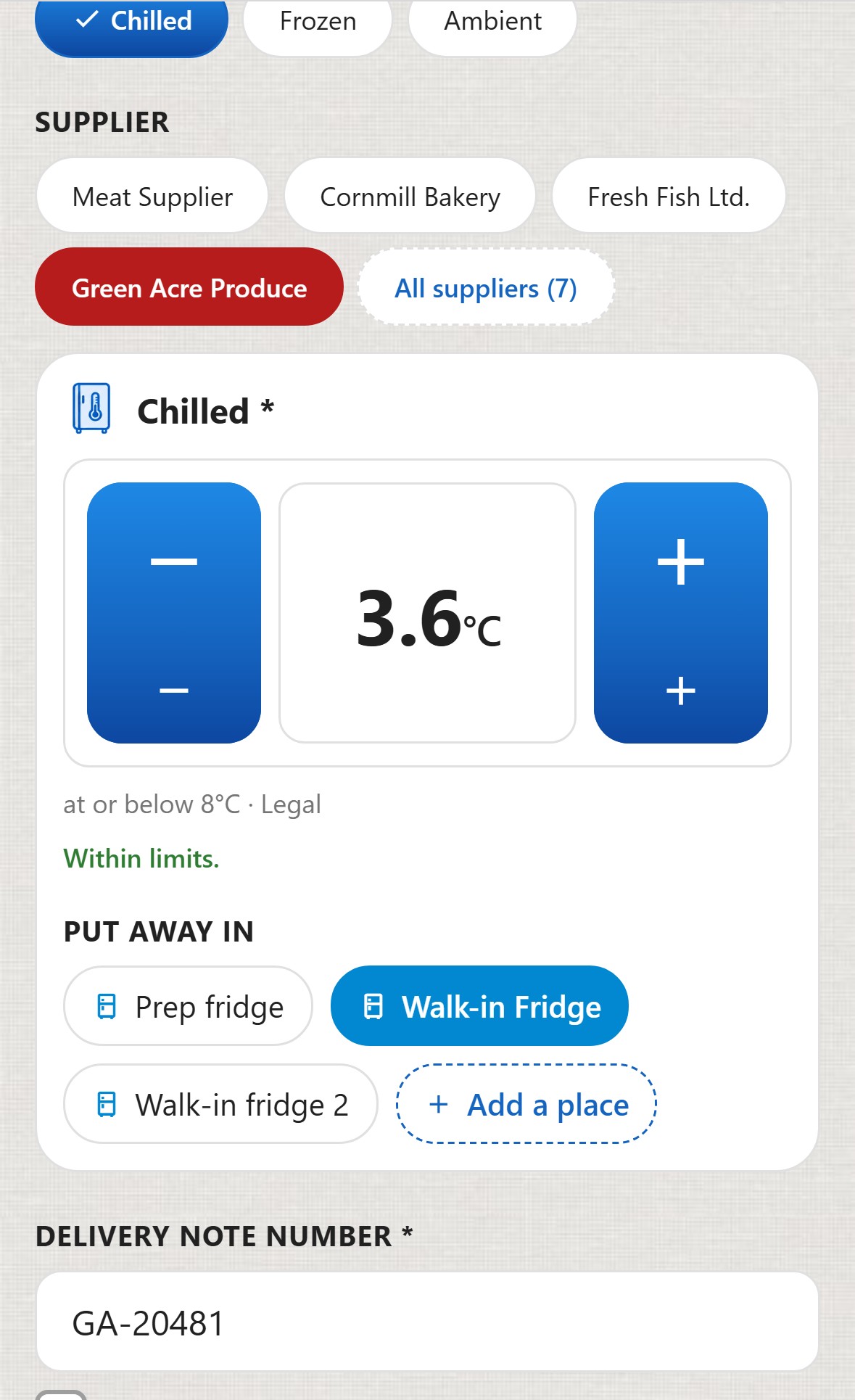
A chilled delivery that passed. The supplier, the reading, where it went and the delivery note number, in one record.
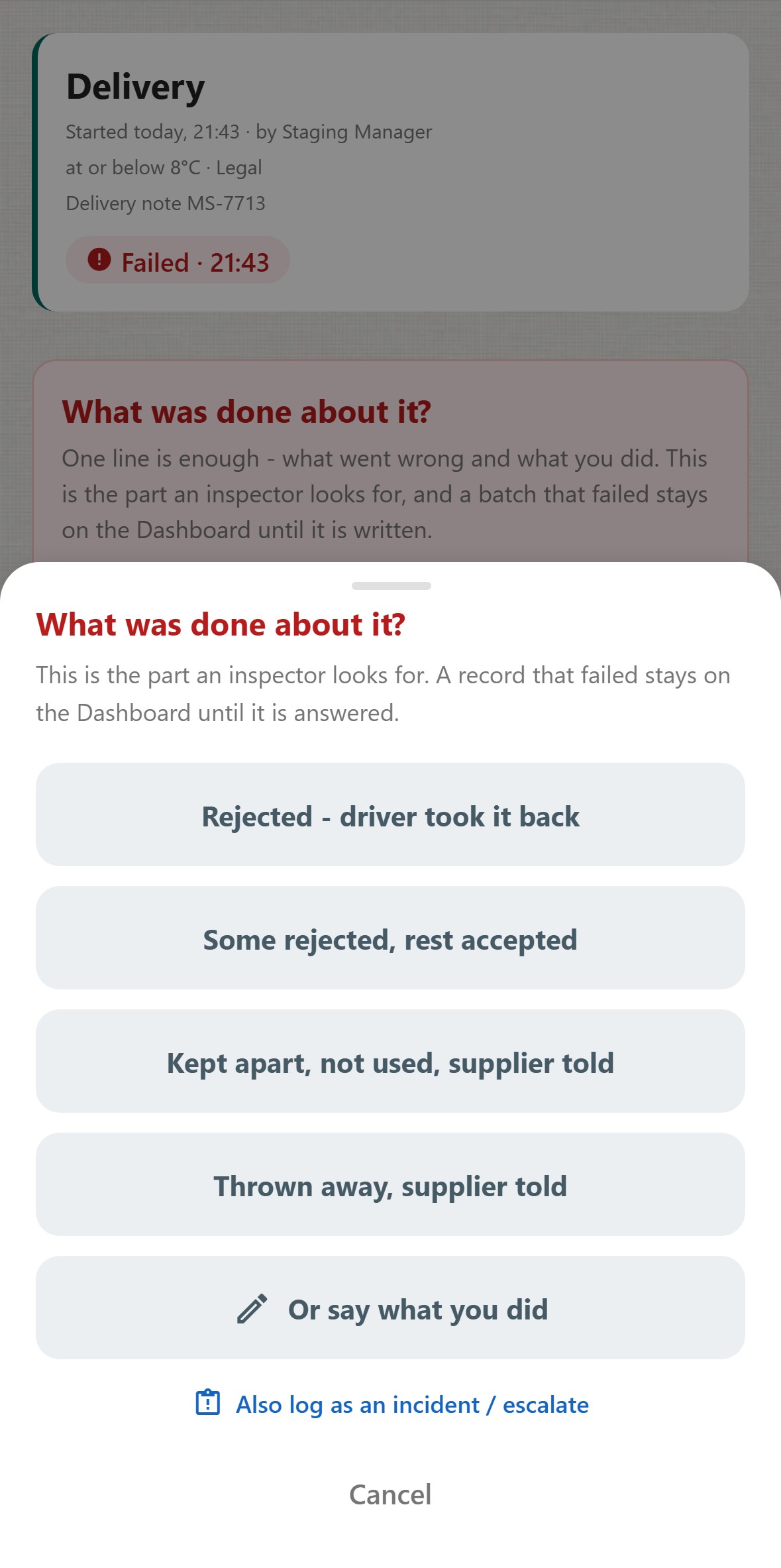
A warm delivery. At 9.4°C it fails, and the app asks what was done straight away, with one-tap answers. A manager or supervisor can also log it as an incident.
Get ChefsRecords on the App Store (iPhone) ›
14 days free. No card required.
This is general guidance for UK kitchens, written from the public sources below as published on 19 October 2026. It is not legal advice and does not replace your own food safety management system. If you are unsure, ask your local authority's food safety team. ChefsRecords is not part of, or endorsed by, the Food Standards Agency, Food Standards Scotland or your local council.
Temperature (chilled and frozen, probed between packs), use-by dates, packaging, signs of pests, foreign objects, raw kept apart from ready-to-eat, the state of the van, the right order with its allergen information, and a delivery note that matches the goods. Dry goods get everything except the temperature. The table near the top of this page sets out each check and its source.
In England, Wales and Northern Ireland the law sets 8°C as the maximum for chilled food, with exemptions and defences. GOV.UK also says to set your fridge to 5°C or below. Scotland's law gives no number. CookSafe's example is to accept chilled food at your specified temperature, such as 5°C or below. If your supplier agreement says 5°C, hold them to it.
-18°C is the standard. The rules on quick-frozen food allow brief rises in transport to no warmer than -15°C. That rule is on whoever sells it to you, not a hygiene law on your kitchen. Rejecting anything warmer than -15°C is trade practice.
No. Scotland's law says food is kept "in a refrigerator or refrigerating chamber or in a cool ventilated place", with no number. GOV.UK says 8°C is recommended in Scotland, and CookSafe recommends running fridges at 5°C or below.
No single law is called delivery checks. The law says you must not accept food you know, or should expect, to be contaminated, the cold chain must not be broken, you must be able to say who supplied every food, and food past its use-by date counts as unsafe. England, Wales and Northern Ireland add the 8°C limit for chilled food. The rest is guidance from the FSA pack, CookSafe and Safe Catering.
No. The UK has no 2 hour / 4 hour rule for deliveries. The 4 hours in the law of England, Wales and Northern Ireland is about food kept for service or on display. The defence that fits a delivery is the transfer between the vehicle and the premises.
Take the temperature from between two packs, as CookSafe says, wait for the display to settle, and clean and disinfect the probe before and after. An infra-red thermometer reads the surface only: if it reads high, confirm it with a probe.
Reject chilled food above 8°C (England, Wales and Northern Ireland) or above your agreed specification, frozen food warmer than -15°C or thawing, an expired use-by date, punctured, swollen or seriously damaged packs, signs of pests, foreign objects, raw food leaking onto ready-to-eat food, and anything with missing allergen information.
Do not sign for it as accepted. Send it back with the driver, with "rejected" and the reason on the delivery note. If the driver has gone, keep it apart and labelled, and do not use it. Contact the supplier immediately, then write down what went wrong and what you did.
Packaging undamaged, cans not badly dented, seals intact, use-by dates, signs of pests, foreign objects, and the right product with its allergen information.
The date and time, supplier, delivery note number, type, the temperature of each chilled and frozen part, the visual checks, whether it was accepted, part-rejected or rejected, what was done, who checked it and where it was put away. This is our advice, built from the FSA pack and CookSafe.
No law sets a number of minutes. Frozen food goes into the freezer as soon as it is delivered, and chilled food straight into the fridge. Check and put away chilled and frozen food first, then dry goods.
No law requires one. The law requires you to be able to identify your suppliers. The FSA pack gives questions for choosing suppliers and a free suppliers' list form, which is good practice.
Best-before is about quality, not safety, so it is not a reason in law to reject. CookSafe calls rejecting stock beyond it good practice you may also want to consider. A use-by date is different: never accept food past it.
There is no published list. Expect to be asked who checks deliveries, to see your delivery records and a rejection, where you probe, how you trace an item to an invoice, how you keep raw and ready-to-eat apart, and how you handle allergen information when a product is swapped.
The probe check guide, the danger zone guide, the fridge temperature log guide, the near miss guide, the EHO inspection guide, the stock rotation guide, the pest control guide, the eggs guide and the allergen matrix guide.