Updated 25 October 2026 - for UK restaurants, cafes, pubs, takeaways, carveries and other catering businesses
Opening and closing checks are a short routine at the start and end of the day. At opening you confirm the kitchen is ready and safe: fridges cold, equipment working, staff fit for work, surfaces clean and disinfected, basins stocked, no signs of pests, probe working, allergen information right. At close you confirm food is put away, cleaning is done and the waste is out.
No. Guidance None of the food hygiene rules for the UK nations name an opening or closing checklist. That includes Regulation 852/2004 and the regulations built on it in England, Scotland, Wales and Northern Ireland. The FSA pack calls the checks "essential". That is guidance.
What the law does ask for is HACCP-based procedures, "effective monitoring procedures" and corrective action when something goes wrong, and records "commensurate with the nature and size of the food business" (Regulation 852/2004, Article 5). A checklist is one way to show that.
The things the checks cover are law. Law in all four nations Annex II of Regulation 852/2004 asks for:
So the law says what must be true. The checklist is how you show it is done, every day. Liquid soap, paper towels and a pest control contract are guidance, not law. The law says "materials for cleaning hands and for hygienic drying" and "adequate procedures".
The FSA pack (England and Wales) says: "It is essential that you and your staff do certain checks every time you open and close." For opening it says: "You should do these checks at the beginning of the day. You can also add your own checks to the list." Its list covers fridges, chilled display and freezers, other equipment, staff, clean and disinfected prep areas, pests, handwashing and cleaning materials, hot water, the probe, allergen information and the cleaning schedule.
Here is each one in our own words, with what it rests on.
The FSA pack says: "You should do these checks at the end of the day." Its closing list covers food put away, use-by food thrown away, cleaning equipment, waste, clean and disinfected prep areas, washing up, floors, the "prove it" records and the cleaning schedule.
The law and the guidance above are the same for every type of kitchen. These are our practical notes on where each tends to need a different line. They are not new rules.
Cafes. Our advice Chilled display and prep fridges matter most at opening. Add any line your kitchen needs, such as cleaning the coffee machine at close.
Pub kitchens. Our advice Kitchens with more than one shift can hand over through the closing notes. The FSA pack says the diary "may need more than one signature" when there is more than one shift.
Takeaways. Our advice Raw and ready-to-eat food kept apart, and what happens to hot food at close, are the two lines to keep an eye on.
Your cleaning schedule says what gets cleaned, how, with which product and how often. Your opening and closing checks confirm it happened today. You need both, and an app checklist does not replace the schedule. Our kitchen cleaning schedule guide shows what to put in the schedule and how often to clean.
The FSA pack says: "It is important to write down how you do your cleaning, so you can show what you do." For each item the schedule says how you clean it, what chemicals you use and how to use them, what equipment you use and how often you clean it. CookSafe says your cleaning schedule "needs to be written to reflect how you manage the cleaning in your business".
| Document | What it does |
|---|---|
| Cleaning schedule | What to clean, how, with what, how often |
| Opening and closing checks | Confirm today's cleaning was done |
| Weekly and extra checks | Deep cleans, maintenance, dishwasher, probe, pest control |
| 4-weekly review | Is the schedule still right? |
The FSA pack's 4-weekly review asks: "Does the cleaning schedule require updating?" and "Are any extra opening or closing checks required?" Its extra checks are "less frequent than the daily opening and closing checks", and it says: "When you carry out an extra check, make a note of it in the diary."
You do not need to disinfect everything, says the FSA pack. Concentrate on what touches food and on frequently touched items such as door and appliance handles. "Clear and clean as you go" is the pack's recommended way of keeping your kitchen clean as you work.
Guidance Clean first, then disinfect, with a disinfectant that shows BS EN 1276 or BS EN 13697, left on for the contact time on its label. Thoroughly clean and disinfect surfaces and equipment after use for raw food, and before preparing ready-to-eat food.
The method step by step: our kitchen cleaning schedule guide. Which disinfectant to use and how to read its label: our disinfectants guide.
The FSA pack's pattern for every safe method is: put it right now, then "Write down what went wrong and what you did about it in your diary."
Do not just tick it. A ticked box with nothing written when something went wrong is the gap an inspector sees. If a check was not right, write what you found and what you did.
Our near miss guide shows how to write it down. If you retrained someone, our food hygiene certificate guide shows what to put on their training record.
Guidance The FSA pack asks the manager to sign the diary every day to say the opening and closing checks have been done and the safe methods followed. That is good practice, not a legal requirement. Our food safety diary guide covers the daily sign-off and the 4-weekly review.
How long to keep the records: no UK law gives a number of months. The law says records are kept "for an appropriate period" and should fit the nature and size of the business. CookSafe says "a reasonable period of time". Ask your local authority's food safety team if you are unsure. Guidance in Northern Ireland Safe Catering recommends keeping records "for at least 12 months", and says your Environmental Health Officer may ask you to keep them at least until the next inspection.
There is no single UK list of opening and closing checks. The hygiene law underneath (Regulation 852/2004) is the same in all four nations, but Scotland's temperature rules differ. The lists are guidance, and they differ.
There is no published list. These are typical questions, drawn from the FSA pack's own questions and CookSafe:
Our EHO inspection guide covers the rest of the visit.
This is our own wording, a starting point to adapt to your kitchen. It is not a legal list, and it is not the FSA's list. Add your own lines and take out what does not apply. In the ChefsRecords app, a finished checklist is saved with who did it and when. It sits alongside your cleaning schedule. It does not replace it.
Name: ______________________ Date: ______________ Signed: ______________________
Paper works. A sheet by the pass, signed each day, can be enough. An app helps when several people do the checks, or a manager is not always on site.
Why kitchens move off paper:
In ChefsRecords, a new kitchen can start from ready-made Opening Checks and Closing Checks and change any line. Each has two fridges and a freezer to read, plus most of the checks above. Fridge readings are checked against your limit as you type them. Over 8°C turns red, and someone has to say what was done before the checks can be signed off. Each checklist has a notes box for anything else, or for the next shift. A checklist left unfinished stays on the record as not finished; it cannot be ticked the next day. A manager or supervisor signs off the completed checks, and the reports show who completed them, who signed and when. The app does not replace your cleaning schedule or your food safety plan. It keeps the record that the checks were done.
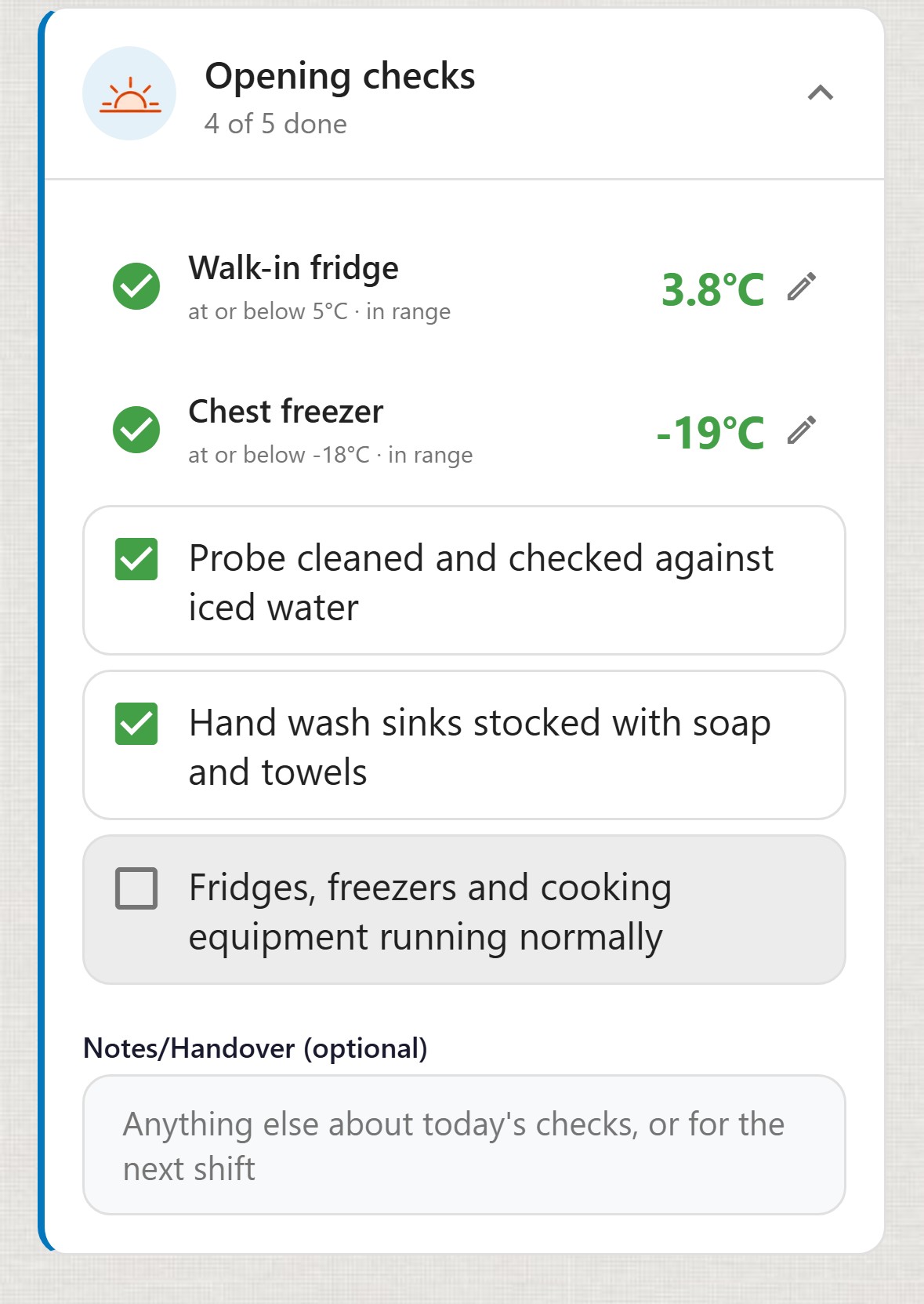
Opening checks, part done. The fridge and freezer readings are saved against their limits, two checks are ticked and one is still to do. This kitchen has one fridge and one freezer on its opening list; you set your own.
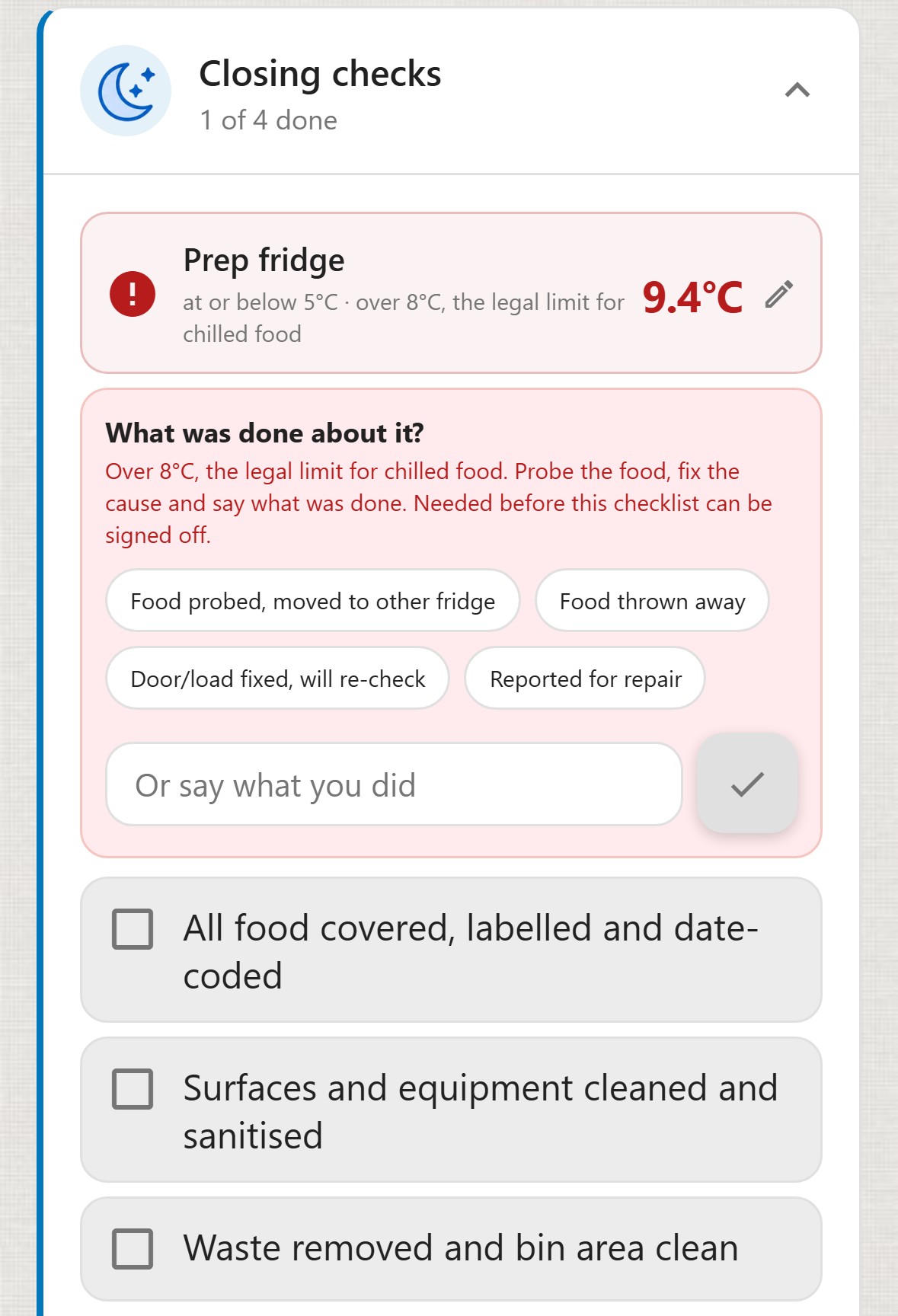
A check that is not right. A fridge at 9.4°C is over 8°C, the legal limit for chilled food in England, Wales and Northern Ireland. The app asks what was done about it, with quick answers, and the checklist cannot be signed off until it is answered.
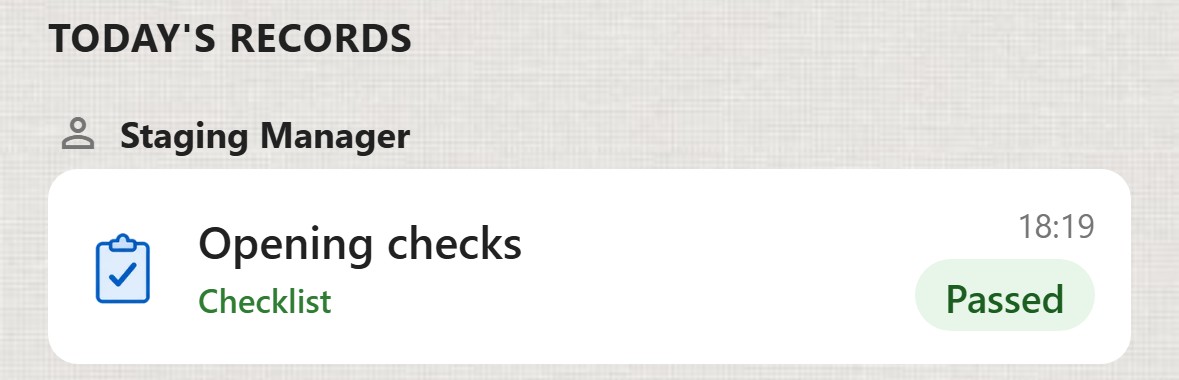
Who did it, and when. A finished checklist appears in Today's Records with the name of the person who completed it and the time.
Checklists and reports are part of the Standard and Pro plans, and open during the 14-day trial. See what else it does.
Get ChefsRecords on the App Store (iPhone) ›
14 days free. No card required.
This is general guidance for UK kitchens, written from the public sources below as published on 18 October 2026. It is not legal advice and does not replace your own food safety management system. If you are unsure, ask your local authority's food safety team. ChefsRecords is not part of, or endorsed by, the Food Standards Agency, Food Standards Scotland or your local council.
No. No UK law names one. The law asks for a clean kitchen, pest control, working food safety checks and records that fit your size. Opening and closing checks are how most kitchens show it.
Fridge, chilled display and freezer readings, equipment working, staff fit for work, clean and disinfected surfaces, no signs of pests, hot water, stocked hand basins, a working and clean probe, correct allergen information and last night's cleaning. There is a list to copy above.
Food covered, labelled and put away, use-by food thrown away, hot food dealt with, cooking and cooling records finished, surfaces and equipment cleaned and disinfected, washing up, floors, waste and the day's cleaning.
The FSA pack asks the manager to sign the diary each day. You can give the job to a member of staff when you are away, and more than one shift may mean more than one signature. It is good practice, not a legal requirement.
No UK law gives a number of months. The law says "an appropriate period", to fit the size of your business. Ask your local authority's food safety team if you are unsure.
No. The schedule says what to clean, how, with what and how often. The closing checklist confirms today's cleaning was done. You need both.
Cleaning removes visible dirt and grease. Disinfecting kills bacteria. The FSA pack does them in two stages, clean first, then disinfect for the contact time on the label.
BS EN 1276 or BS EN 13697. The FSA pack says "should" and CookSafe in Scotland says "must", but that is guidance, not law. Check the label for dilution and contact time. More in our disinfectants guide.
The law asks for adequate procedures to control pests, not a contract. The FSA pack says you could employ a pest control contractor. Either way, check regularly, and write down what you find and what you did.
Put it right, then write down what you found and what you did. Do not just tick it.
Our practical advice: use it up, throw it away, or take it off to cool straight away. Do not leave it in hot holding overnight.
No. CookSafe in Scotland has no daily opening and closing list, but has a cleaning schedule and a Weekly Record. Northern Ireland's Safe Catering has no opening and closing list either. It recommends checking fridges at least once a day, has a cleaning record that staff sign as they clean, and has a Hygiene Inspection Checklist the owner or manager does weekly, fortnightly or monthly.
Your food safety plan should describe what your kitchen really does. The free food safety plan builder takes you through safe methods based on the FSA pack, so you can write them in your own words, then prints your plan or saves it as a PDF. For small restaurants, cafes, pubs and takeaways in England and Wales.
The checks join up with these: the fridge temperature log guide, the probe check guide, the cooling guide, the hot holding guide, the kitchen cleaning schedule guide and the EHO inspection guide. More guides: the food safety diary guide, the food safety records guide, the pest control guide and the hand wash basins guide.