
Updated 14 October 2026 - for UK restaurants, cafes, pubs, takeaways, carveries and other catering businesses
For where cooling sits between 8°C and 63°C, see our danger zone guide. This guide is about the cooling itself.
Regulation (EC) 852/2004, Annex II, Chapter IX, paragraph 6, applies in England, Wales, Northern Ireland and Scotland. It says:
"Where foodstuffs are to be held or served at chilled temperatures they are to be cooled as quickly as possible following the heat-processing stage, or final preparation stage if no heat process is applied, to a temperature which does not result in a risk to health."
That is all it says. No time and no temperature. The same chapter says food is not to be kept at temperatures that might result in a risk to health, and that the cold chain is not to be interrupted.
The FSA and Food Standards Scotland's joint guidance on temperature control adds two things. A cooling period "would not be regarded as unacceptable merely because other equipment, not present at the business, could have cooled the food quicker". And: "The time taken to achieve cooling must be consistent with food safety. Cooling will always be a step that is critical to food safety." That guidance says it does not provide an authoritative interpretation of the law, so read it as guidance.
Schedule 4 of each nation's food hygiene regulations does not mention cooling. It makes it an offence to keep food that supports the growth of harmful bacteria above 8°C. The exemptions in the Schedule do not cover cooling. There is a defence for keeping food above 8°C "for an unavoidable reason", such as "to accommodate the practicalities of handling during and after processing or preparation", for "a limited period only and that period was consistent with food safety". If you rely on a defence, the business has to be able to show it.
The regulations do not say in terms that this defence covers cooling. "After ... preparation" is the natural reading, but we cannot tell you it is settled. If you want to be sure, ask your local authority's food safety team.
In Scotland, the rule that food must be kept in a fridge, a cool ventilated place or above 63°C does not apply to food which, "immediately following any process of cooking ... is being cooled under hygienic conditions as quickly as possible to a temperature which would not result in a risk to health" (Food Hygiene (Scotland) Regulations 2006, Schedule 4). So Scotland has no cooling time and no chilled number in law. 8°C is recommended there: the FSA pack's "Prove it" says it is "a legal requirement in England, Wales and Northern Ireland, and recommended in Scotland".
So, in all four nations: no cooling time is set in law. Every figure with a number in it is guidance or a kitchen's own target.
No UK law sets a cooling time, and neither does the FSA's Safer Food, Better Business pack or Food Standards Scotland's CookSafe. Both say as quickly as possible, and measure your own method. Northern Ireland's Safe Catering says to get cooked food into the fridge, blast chiller or freezer within two hours. Some councils' advice says "ideally within 90 minutes", and it is a common target in UK kitchens. Rice is the one food with a shorter figure: within an hour.
One example of the 90-minute advice is West Norfolk council's 2015 food safety factsheet: "cooled as quickly as possible (ideally within 90 minutes) and then refrigerated". It is a council's advice, written as guidance.
CookSafe says you could set a time limit on the cooling period. If you use 90 minutes, that is your own target. Write it into your food safety procedures and check against it.
You may see "135°F to 70°F in two hours, then to 41°F in four more". That is the US FDA Food Code, a US model code, which asks for 57°C to 21°C in two hours, then down to 5°C or below in the next four (six hours in all). No UK law or UK guidance uses it.
Do not mix it up with Northern Ireland's two hours either. Safe Catering's two hours is for getting the food into the fridge, blast chiller or freezer, not for reaching 8°C.
Cooling also comes up at the end of hot holding. GOV.UK says hot food can be kept below 63°C for up to 2 hours, and after that, cool it as quickly as possible to 8°C or below, or throw it away. The two-hour rule itself is in our hot holding guide.
The FSA pack's "Chilling down hot food" safe method says to chill food down as quickly as possible and then put it in the fridge. Its options:
West Norfolk council's advice: move sauces such as Bolognese into smaller, shallower containers. Put a tray of ice or cold water (an ice bath) underneath, for example for lasagne, soups and sauces. Place a metal tray in the freezer to use as a cooling plate. The FSA pack's version: stir, stand the pan in cold water, use ice.
The FSA pack says to cut joints of meat in half. Safe Catering says larger joints and whole birds, such as turkeys, may need a longer initial cooling period. West Norfolk's factsheet gives a maximum of 2.5 kg for meat joints. Whole joints and whole birds are large and solid, so they are among the slowest foods to cool.
The FSA pack: "Large quantities of food are more difficult to chill down quickly, especially solid food." And: "Smaller amounts of food chill down more quickly." It also says to avoid cooking large quantities of food in advance, unless you need to. A big stockpot, a deep tray and a whole joint all cool slowly for the same reason.
The FSA pack says a blast chiller "is specially designed to chill down hot foods quickly and safely", and that if you chill down lots of hot food you may wish to consider one. Nothing in the law or the guidance we read says you must have one. The joint guidance says a cooling period is not unacceptable merely because other equipment you do not have could have cooled the food quicker. The time taken still has to be consistent with food safety.
The UK packs say to chill hot food down as quickly as possible and then put it in the fridge. Two of them say more about the fridge itself:
That is guidance, not a law. And none of the packs says how cool food must be before it goes in. In Northern Ireland, Safe Catering's advice is to cool it as quickly as possible and then put it in the fridge or freezer within two hours. Our fridge temperature log guide covers the 8°C limit for chilled food, and how to check your fridge.
Rice can contain spores of a type of harmful bacteria (Bacillus cereus) that may not be killed by cooking or reheating. If cooked rice is left at room temperature, the spores can multiply and produce toxins that cause food poisoning. Reheating will not get rid of those toxins. That is why rice is the exception.
ChefsRecords' default cooling check is 90 minutes. That is a common target, not a rice time.
The FSA pack's "Prove it" safe method is the check that your method does what you think. For a cooling method, the "Chilling down hot food" safe method says to compare your options on the same food: "You will only need to do this once." But its Prove it record sheet says "You should regularly check that a method is safe", and the 4-weekly review asks: "Are prove it checks being completed regularly and recorded?"
No law requires a cooling log. The law (Regulation 852/2004, Article 5) asks for food safety procedures based on HACCP principles, with records that fit the nature and size of the business. The joint guidance says temperature monitoring and logging "may be helpful". The FSA pack works by exception: "Write down what went wrong and what you did about it in your diary". CookSafe's cooling chart says to "Check and record cooling times and final temperature", or to follow an "Established Cooling Practice" with occasional temperature checks. A good entry answers:
| Record | Why it matters |
|---|---|
| The food and the batch size | Size decides how fast it cools. |
| Time off the heat, and temperature | When the clock started. |
| The method (blast chiller, ice bath, trays) | Shows the method you checked. |
| Each check: time and core temperature | How fast it actually came down. |
| Time into the fridge or freezer | The key column on Safe Catering's SC3 record sheet. |
| Who took each reading | So questions can be answered later. |
| If it missed: what was done, by whom, when | Re-cooked or thrown away, and the cause. |
| Manager review | Someone responsible has looked at the records. |
Safe Catering says to keep its records for at least 12 months. If something goes wrong, food law gives a defence to a business that took all reasonable precautions and exercised all due diligence. Written records of your checks, and of what you did when one failed, help you show that.
Other packs are blunter. Safe Catering (Northern Ireland): "If food has not been cooled down safely throw it away." CookSafe's steps: check if the food is safe to use, dispose of it if necessary, and revise your cooling procedure.
We know of no published list of what an officer will ask about cooling, but these are fair questions to be ready for:
A short, honest record with the actions written in is worth more than a perfect-looking sheet.
Paper works. Safe Catering's SC3 record sheet is free to download, and the FSA pack's diary suits a kitchen that only writes down what went wrong. An app helps when several people take readings, the check falls due in the middle of service, or a manager is not always on site.
In ChefsRecords, cooling is its own record. Choose blast chiller or manual, probe the food and press Start. If it has been standing, set the start time to when it came off the heat - the clock runs from the time you enter. The first reading is recorded but never judged: the food is hot because it is cooling.
On iPhone, with notifications on, the app reminds you 10 minutes before your cooling time is up and again when it is (90 minutes unless your kitchen sets its own - a common target, not a UK rule). A check still above your target before time is up is marked as cooling and the record stays open. A check at or under target closes it as passed. A check over target after time is up fails the batch, and the app asks what was done. A check taken more than 5 minutes late is marked "Cooled - checked late", not passed.
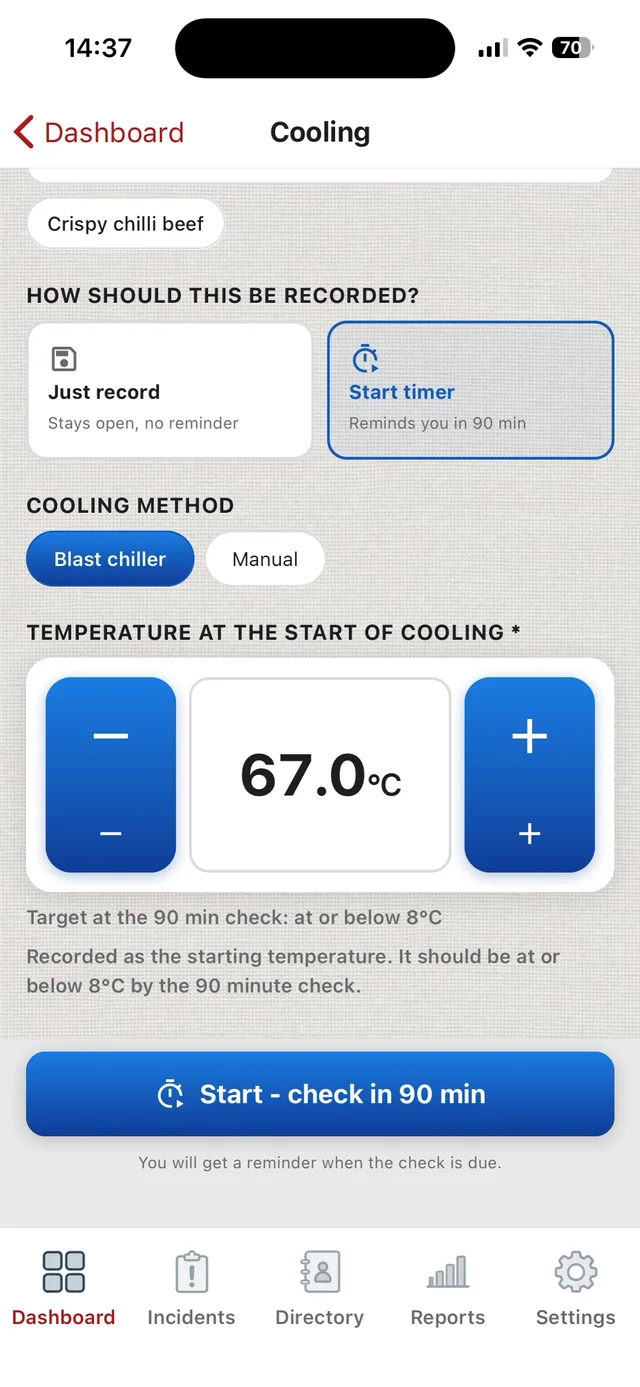
Start the cooling. Choose the method, probe the food and press Start. Here a batch at 67.0°C goes into the blast chiller, with the check in 90 minutes - the starting point unless your kitchen sets its own, a common target and not a UK rule.
Every reading is saved with the time and who took it, and appears in the Temperature Log and the Inspection Pack. Manual cooling is judged on the check before the fridge (below 25°C unless you set your own). The record stops at the fridge door, so your procedure should say how long the food takes to get fridge-cold.
Recording cooling is free on every plan, including after the 14-day trial. The Temperature Log report and the Inspection Pack PDF are part of the Standard and Pro plans, and open during the trial. See what else it does.
This is general guidance for UK kitchens, written from the public sources below as published on 14 October 2026. It is not legal advice and does not replace your own food safety management system. If you are unsure, ask your local authority's food safety team.
No law in any UK nation sets a cooling time. All four say cool it as quickly as possible. Some council advice says ideally within 90 minutes, Northern Ireland's Safe Catering says into the fridge, blast chiller or freezer within two hours, and rice should be chilled within one hour (the FSA's Indian cuisine pack). Those are guidance, and a kitchen can set its own target.
No. It is not in UK law, the FSA pack or CookSafe. It appears in some council advice and is a common target in UK kitchens.
The UK packs say to chill it down as quickly as possible and then put it in the fridge. CookSafe says to avoid placing hot food in refrigerators, and Safe Catering says food that is not sufficiently cooled can raise the fridge temperature and cause condensation. That is guidance, not a law.
No law sets a time. The FSA's Indian cuisine pack says to chill rice as quickly as possible, within one hour, and Safe Catering says ideally within an hour. Never leave it to cool in the cooker, steamer or pan. If it has not been kept very hot or properly chilled, throw it away.
Nothing in the law or the guidance we read says you must have one. The FSA pack says to consider one if you chill down lots of hot food. Without one, the time taken to cool still has to be consistent with food safety.
The FSA pack says to re-cook it, if appropriate, or throw it away. Rice must be thrown away. Safe Catering says to throw it away. Then write down what went wrong and what you did, and review the method.
No law names one. You must have food safety procedures based on HACCP principles, with records that fit your business. A record of times, temperatures and actions is the usual way to show what you did.
No UK law sets a time, and no pack says to leave hot food standing on the side. They say to chill it down as quickly as possible. The FSA pack's diary example is rice found cooling on the side for several hours: it was thrown away and the staff member retrained.
No. That is the US FDA Food Code. No UK law or UK guidance uses it.
Your food safety plan should say how you chill down hot food, how you check it and what you do when it does not cool in time. The free food safety plan builder takes you through the FSA's "Chilling down hot food" safe method in your own words, then prints your plan or saves it as a PDF. For small restaurants, cafes, pubs and takeaways in England and Wales.
Our danger zone guide shows where cooling sits among the other food temperatures, our hot holding guide covers what happens when hot food has been below 63°C for two hours, and our fridge temperature log guide covers the cold end.