Updated 25 October 2026 - for UK restaurants, cafes, pubs, takeaways and other small catering businesses
Yes, digital records can be accepted. No law in the UK says food safety records must be on paper, and each nation's free pack allows records to be kept electronically. What matters is what the records show: who did each check, when, the reading, what was done when something went wrong, and that you can show them when an inspector asks. Whether your records are enough for your kitchen is for your council's food team to judge. The FSA, Food Standards Scotland and GOV.UK do not recommend or endorse any app.
Law in all four nations Article 5 of Regulation 852/2004 asks for "documents and records commensurate with the nature and size of the food business". It does not say paper or electronic. An authorised officer "may inspect any records (in whatever form they are held)". They can get at the computer or phone that holds them and ask for help using it. For electronic records, they can ask for them "to be produced in a form in which they may be taken away", for example a printout or a file. These powers are in the Food Safety Act 1990 (England, Wales and Scotland), the Food Safety (Northern Ireland) Order 1991, and each nation's hygiene regulations.
Whether your records are enough for your kitchen is for your council's food team to judge.
Law in all four nations The law asks for monitoring, "corrective actions when monitoring indicates that a critical control point is not under control", regular checks that it all works, and records that show it.
Our advice On paper or on a phone:
A short record with honest gaps and actions written in is easier to believe than a page of identical perfect readings. The same goes for an app: a screen full of readings means little if nobody acted on the bad ones.
Law in all four nations The hygiene regulations in each nation make it an offence to knowingly or recklessly give an officer false or misleading information when they ask for it. In 2024, Ceredigion County Council prosecuted a business for nine food hygiene offences. The council said the two people running it "falsified records in a deliberate attempt to hide the wrongdoings", and the magistrates said this made a "bad situation worse". This is general information, not legal advice.
No law says records must be handwritten or on paper. An inspector may still ask how your system works, ask to see records in a form they can take away, or advise changes.
Our advice Ask what they need to see and why. Often it is evidence that someone looks at the readings and acts on problems. Offer a printout or a PDF.
Guidance from some councils East Suffolk Council says inspectors "must follow the Food Law Code of Practice" and must tell you "whether you need to do it to comply with the law", and if you are asked to take action, you must be given "the reasons in writing". If you disagree, "you should first tell the inspector", then the council.
In England, after the council's own complaint process, the FSA's Independent Business Appeals Panel can give "a second opinion" on written advice that "goes beyond what is legally required". It does not cover hygiene ratings or formal enforcement.
We could not find guidance from the FSA, Food Standards Scotland or GOV.UK on whether automatic temperature sensors replace manual checks. Law in all four nations The law asks for "effective monitoring procedures" and corrective action. It does not say whether a person or a sensor does the checking.
Our advice If you use sensors:
A fridge's display shows a number at that moment. It does not keep a record of who looked, when, or what they did about a high reading.
Our advice A built-in display shows air temperature. It is fine to use it day to day, but check regularly that it agrees with a fridge or probe thermometer, and probe the food when it matters. If your officer has told you a written fridge log is not needed, write that into your plan with the date, so the next officer can see why. Our fridge temperature log guide has more.
Our advice Keep everything at least until after your next inspection. More in our food safety records guide.
Guidance in England, Wales and Northern Ireland GOV.UK: "All your records need to be kept up-to-date and be available for inspections at all times."
Law in all four nations An officer can get at the computer or phone that holds your records and ask whoever runs it for "such assistance as the officer may reasonably require".
Our advice
Our advice GOV.UK and the FSA do not recommend any app, and the law does not require one. If you choose one, check that:
We make ChefsRecords, so we are not neutral. The next section says honestly which of these it does today.
Paper works, and so does your nation's pack kept on a device. ChefsRecords is an iPhone app for the daily records. What it does today:
What it does not do today: a record does not show when it was entered late, a Manager can still edit records under a signed day, and a Manager can delete an incident they logged, or a member of staff's file, without leaving a trace in the reports. Temperature records, checklists and day sign-offs have no delete, and a temperature reading cannot be corrected in the app, only a new check recorded. Would you use a "recorded late" mark and a change history on reports? Tell us.
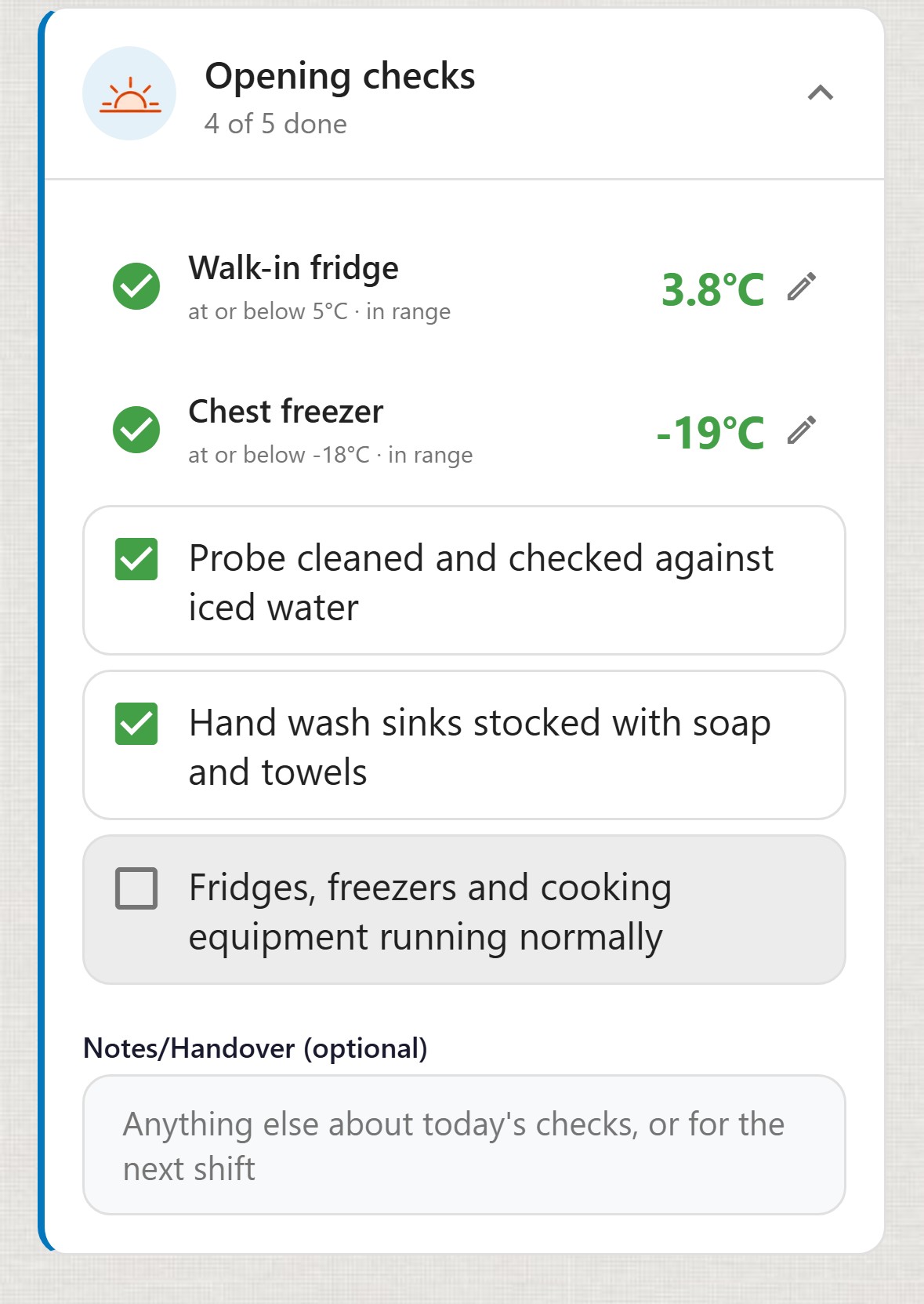
Opening checks, part done. Each reading is saved against its limit, under the name of the person signed in.
Which plan. Cooking, cooling, hot-holding, reheating and delivery records, and incidents and near misses, stay free after the trial for one login, the kitchen's billing Manager (up to 20 incidents on free). Checklists (where the fridge and freezer readings are), reports and the Inspection Pack come with Standard and Pro and are open in the 14-day trial.
Get ChefsRecords on the App Store (iPhone) ›
14 days free. No card required.
This page explains the law and guidance in plain words, from the public sources below as published on 24 October 2026. It is not legal advice. Your council's food team can answer questions about your own kitchen. ChefsRecords is not part of, or endorsed by, the Food Standards Agency, Food Standards Scotland or your local council.
No law says records must be on paper, and no law asks for both. Each nation's pack allows records to be kept electronically. An inspector may ask to see records in a form they can take away, such as a printout or a file, so make sure you can produce one. Whether your records are enough is for your council.
Yes, for the diary pages. In England and Wales, GOV.UK says the FSA diary can be downloaded, filled in and stored on your device, "electronically or with printed copies", and that an inspector may want to look at your diary pages as well as the pack. In Northern Ireland, Safe Catering allows your own forms "either in paper copy or electronically", and CookSafe in Scotland does too.
No law says records must be handwritten. An inspector can advise what they think your system needs, and should tell you whether it is needed to meet the law or is a recommendation. Ask what they need to see; often it is proof that someone checks the readings and acts on alarms. If you still disagree, tell the inspector, then the council. In England, the FSA's Independent Business Appeals Panel can give a second opinion afterwards.
No law forbids it. A notes app does not record who took each reading, and anyone with the phone can change an entry without a trace. CookSafe says your own forms "must contain the equivalent information" as its forms. Our advice: use your pack's forms, on paper or on a device, or a system that records who made each entry.
We cannot say what your inspector meant. No law sets how you check a fridge, and a display does not record that anyone looked. If you were told a written log is not needed, write that into your plan with the date. Our advice: keep a daily reading anyway, and check the display against a probe now and then.
No guidance we found covers this. Records are easier to believe when they show real life: real numbers, the odd reading outside its limit with what was done about it, and closed days marked. A page of identical readings in the same hand can lead to more questions, and so can staff who cannot explain the checks.
Never in advance: a check written before it is done is not a record. At the end of the night, write up only checks you really did, with the real times and readings, and add a note for any you missed. It is better to write each one when you do it. A council has prosecuted a business that falsified its records, and giving an officer information you know is false can be an offence in every UK nation.
GOV.UK says records should be "available for inspections at all times". Make sure more than one person can open the records, and keep a recent PDF or printout to hand.
No law says you must keep them printed. An officer can ask for electronic records in a form they can take away, so make sure you can print or send them when asked.
On paper, a crossing-out should leave the first entry readable. In ChefsRecords, every record carries the name of the person who made it, stamped by our server, a saved temperature reading cannot be edited, and a day's sign-off is timed by our server and can never be edited. But a Manager can still edit records under a signed day, the person recording a temperature can choose its time, and a Manager can delete an incident they logged, or a member of staff's file, without a trace in the reports.
The FSA, Food Standards Scotland and GOV.UK do not recommend or endorse any app, and the law does not require one. If your council suggests one, that is advice, not a legal requirement. Choose on what the records show and whether your team will use it every shift.
Your food safety plan should describe what your kitchen really does. The free food safety plan builder takes you through safe methods based on the FSA pack, so you can write them in your own words, then prints your plan or saves it as a PDF. For small restaurants, cafes, pubs and takeaways in England and Wales.
The food safety records guide, the food safety diary guide, the food safety management system guide, the EHO inspection guide, the first food hygiene inspection guide, the fridge temperature log guide, the opening and closing checks guide and the near miss guide.