
Updated 20 October 2026 - for UK restaurants, cafes, pubs, takeaways, carveries and other catering businesses
The law asks for "adequate procedures" to control pests. It does not say you must have a pest control contract. Good practice is to look for signs regularly, keep pests out, act at once when you find one, and write down what you found and what you did. Here is what each source says.
Law in all four nations The rules are in Regulation (EC) 852/2004, Annex II. The same text applies in England, Wales, Scotland and Northern Ireland. (In Northern Ireland the EU regulation applies directly.) Five places matter for pests:
Law in all four nations A food business that does not follow these rules commits an offence. In England, regulation 19(1) of the Food Safety and Hygiene (England) Regulations 2013 says "any person who contravenes or fails to comply with any of the specified EU provisions commits an offence", and Schedule 2 lists the Annex II rules. Wales, Scotland and Northern Ireland have the same offence in regulation 17 of their own Food Hygiene Regulations 2006. They are linked in the sources below.
Guidance in England, Wales and Northern Ireland GOV.UK says the Food Hygiene Rating Scheme looks at "The physical condition of your business - including cleanliness, layout, lighting, ventilation, pest control".
Guidance in Scotland In Scotland the scheme is the Food Hygiene Information Scheme.
Our EHO inspection guide covers the rest of the visit.
Law in all four nations No law we found says you must have one. The law asks for "adequate procedures". A contract is one way to have them. Your own regular checks are another part of it.
Guidance in England, Wales and Northern Ireland GOV.UK's "Starting a food business" page (updated 19 August 2026) names the pests to watch for: "rodents - rats and mice", "insects - cockroaches, beetles, ants and flies" and "birds - pigeons etc."
| Pest | Signs to look for | Where it comes from |
|---|---|---|
| Rats and mice | "Small footprints in dust, droppings, holes in walls and doors, nests, gnawed goods or packaging, grease or smear marks, urine stains on food packaging" | Guidance in England and Wales FSA pack (Pest control) |
| Flies and flying insects, for example moths | "Bodies of insects, live insects, webbing, nests, droning or buzzing, maggots" | Guidance in England and Wales FSA pack (Pest control) |
| Cockroaches | "Eggs and egg cases, moulted 'skins', the insects themselves, droppings" | Guidance in England and Wales FSA pack (Pest control) |
| Ants | "Small piles of sand or soil, the insects themselves, flying ants on hot days" | Guidance in England and Wales FSA pack (Pest control) |
| Birds | "Feathers, droppings, nests, noise, the birds themselves" | Guidance in England and Wales FSA pack (Pest control) |
| Beetles and weevils | "Moving insects, particularly in dry food, small maggots" | Guidance in England and Wales FSA pack (Pest control) |
Guidance in Scotland CookSafe lists "rodent droppings, smear marks, insect egg cases and dead insects", and "insects within cereals/grains".
Our advice Go through the list with the team, and tell staff to report a sign straight away. Guidance in England and Wales The FSA pack says to "encourage them to report problems immediately".
Pests come in through gaps, through open doors, in deliveries and from the bins. The list below follows the law and the guidance. Where a line is ours, it says so.
Guidance in England and Wales The FSA pack also says to make sure no food or dirty plates are left out when the business is closed. It calls them "a source of food for pests". Guidance in England, Wales and Northern Ireland GOV.UK says to get waste out "as quickly as possible", to avoid "it building up and attracting pests".
Our kitchen cleaning schedule guide and stock rotation guide cover the cleaning and the dry store side of this.
Law in all four nations The law does not set how often to check. It asks for "adequate procedures". These are the checks the guidance describes.
Guidance in England and Wales The FSA pack says: "If you see signs of a pest infestation, call a pest contractor immediately." Surfaces and equipment "touched by pests" should be "washed, disinfected and dried". And: "If you think food has been touched by pests in any way, throw it away." Then: "Write down what went wrong and what you did about it in your diary."
It can be. A council officer can close a kitchen straight away if they find an imminent risk to health. A serious pest problem can be one. Our advice We are not the council, and we cannot tell you whether your kitchen would be closed. That is for the officer.
If an officer serves a notice, or you are thinking of closing, speak to your council. We do not give legal advice on notices.
One pest law has a duty to report, and it is narrower than people think. In England, Wales and Scotland, section 3(1) of the Prevention of Damage by Pests Act 1949 says "the occupier of any land shall give to the local authority forthwith notice in writing if it comes to his knowledge that rats or mice are living on or resorting to the land in substantial numbers." Section 28 says "land" includes "any building or part of a building". Failing to give notice is an offence, with a fine "not exceeding level 1 on the standard scale".
Guidance in England and Wales The FSA pack says that if you have a contractor you should "keep a record of their contact details and visits in your diary, as well as any feedback or action points they recommend. Make a note of when you have carried these out." Guidance in Scotland CookSafe says to keep "pest control contractor reports and corrective actions taken". Guidance from some councils Plymouth City Council: "You should get a written report from any company that you use and should make sure you follow their advice."
Our advice There is no published list. From the law and the guidance above, expect questions like these. When did you last look for pests, and who did it? Do you have a pest contractor, and can I see the reports? Were the action points done, and when? What did you do the last time you found a sign? Are the bins closed and the bin store clean? Is dry food off the floor?
The free food safety plan builder takes you through the FSA pack's pest control safe method in your own words, including when you check for pests, whether you have a contractor and how you check deliveries. It then prints your plan or saves it as a PDF. For small restaurants, cafes, pubs and takeaways in England and Wales. In Scotland, CookSafe's House Rules cover pest control. Northern Ireland businesses should check Safe Catering or ask their council.
Paper works: a tick on your opening checks, a weekly walk round in the diary, and the contractor's reports in a folder. In ChefsRecords, the ready-made Opening Checks has "No signs of pests" and the Weekly Checks has "Pest check inside and out, including gaps and entry points", each saved with who did it and when. The optional Dry Store Check adds "No signs of pests in the dry store", and the Monthly Review can carry "Pest contractor visit report read, filed and actions done" if you have a contract. If you find something, do not tick the line: write it in the checklist notes and ask a manager or supervisor to log a Food incident, type Pest Sign, with photos, the area, what was done and who checked the fix worked. If Pest Sign is logged again in the same named area within 30 days, the app marks it as a repeat. Dry goods deliveries ask whether there are signs of pests. The app does not keep your contractor's reports or visit details, so keep those in your folder.
Why kitchens move off paper:
When you set up your checklists, choose "Start with ready-made checklists". Opening, Closing, Weekly and Monthly are ticked for you. The Dry Store Check, and the Monthly Review's "Pest contractor report" line, are optional extras under "Add if they apply to your kitchen", and they start unticked. Change any line to suit your kitchen. Checklist lines are tap on or off only. The one place for free text is "Notes/Handover (optional)".
To log a problem, a Manager or Supervisor opens Log Incident, chooses the Food category and the type Pest Sign ("Droppings, insects or gnawed packs near food"), and adds the area, how serious it is, what happened and photos. On the incident they then add the Action Taken, and "Verify and close" records who checked the fix worked. You can choose up to 3 types on one incident. The repeat check looks at the first type you choose, so pick Pest Sign first, and it needs a named area rather than your kitchen's own name. A Pest Sign incident appears in the Incident Log and in the Inspection Pack with its area, how serious it was, what was done, who checked and whether it is open or closed. The Pack does not show the photos. Staff logins cannot log an incident, so they need to tell a manager or supervisor.
The checklists come with Standard and Pro and are open in the 14-day trial. Incidents can be logged on every plan, with 1 photo each in the trial and on the free plan, 3 on Standard and 5 on Pro. The trial and the free plan keep up to 20 incidents. The Inspection Pack and the Incident Log are part of Standard and Pro and are open in the trial.
What it does not do: the app does not keep your contractor's reports or visit details. It has no contractor visit log, no report upload, no contractor contacts and no map of where traps or bait are. A checklist line cannot record "signs found", so write it in the notes and log an incident. Photos need a signal to upload: the incident saves without one and you add the photos later. The app helps you keep the record. It does not control pests. Chilled and frozen delivery records do not ask about pests, so note any sign in Notes, or ask a manager or supervisor to log an incident.
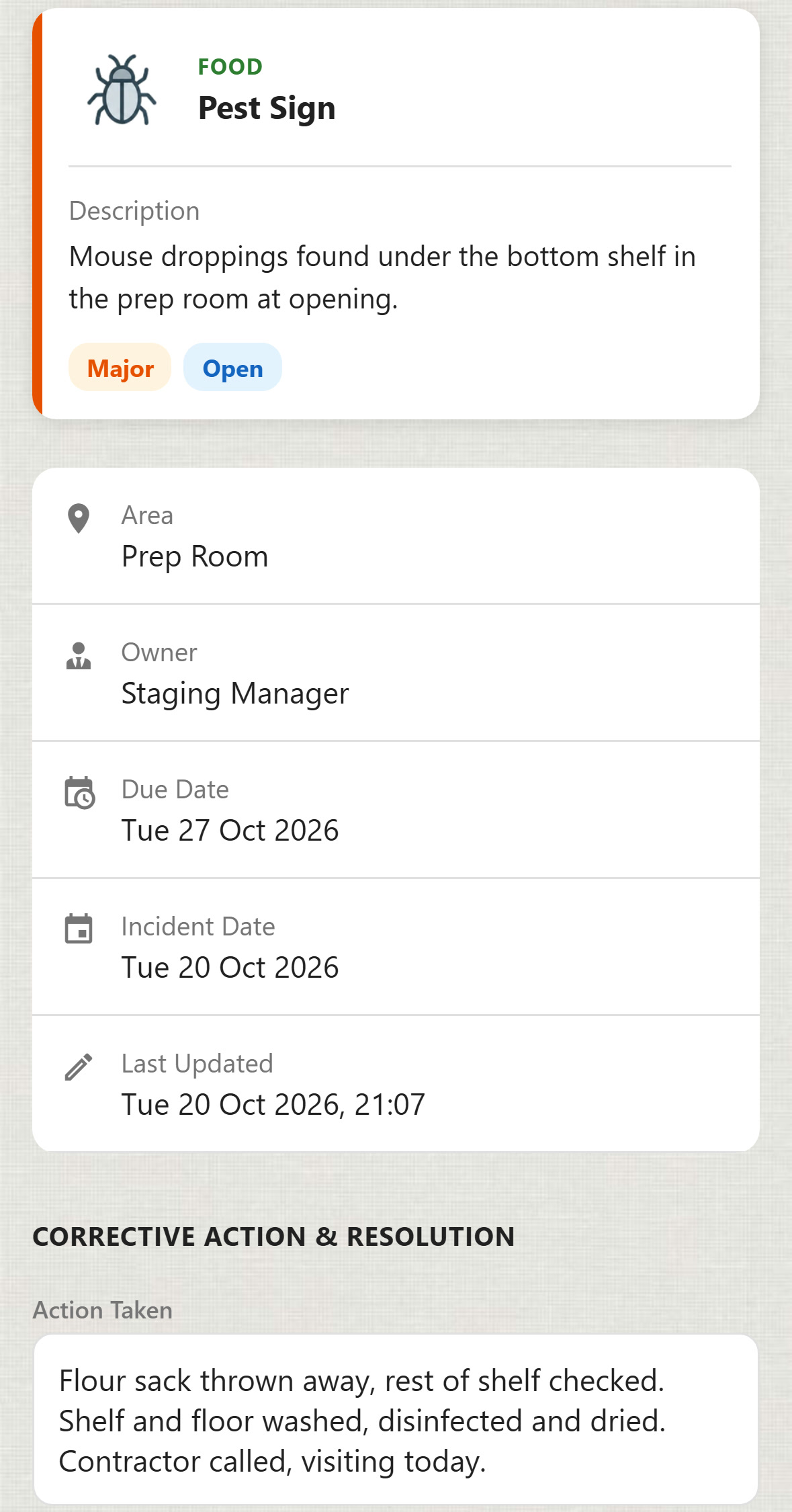
A Pest Sign incident: what was found, where, how serious, who logged it and when it is due. What was done goes in Action Taken, and Verify and close records who checked the fix worked.
Get ChefsRecords on the App Store (iPhone) ›
14 days free. No card required.
This is general guidance for UK kitchens, written from the public sources below as published on 20 October 2026. It is not legal or pest control advice and does not replace your own food safety management system. ChefsRecords is not part of, or endorsed by, the Food Standards Agency, Food Standards Scotland or your local council. If you are unsure, ask your local authority's food safety team.
The FSA pack lists, for rats and mice: "Small footprints in dust, droppings, holes in walls and doors, nests, gnawed goods or packaging, grease or smear marks, urine stains on food packaging". CookSafe lists "rodent droppings, smear marks, insect egg cases and dead insects". Check low down, behind stock and near doors.
No law we found says so. The law asks for "adequate procedures to control pests". The FSA pack says you could employ a pest control contractor, and some councils call a contract good practice. Your own checks still count either way.
Stop and protect the food, and call a pest contractor straight away. Throw away anything pests may have touched, and wash, disinfect and dry the surfaces. Then write down what you found and what you did, and check more often. If it is serious or not stopping, ask your council for advice.
A council officer can close a kitchen straight away if they find an imminent risk to health, and a serious pest problem can be one. The regulations do not name pests, so the officer decides. A business can also choose to close voluntarily. Speak to your council.
In England, Wales and Scotland, the Prevention of Damage by Pests Act 1949 asks the occupier to give the council written notice if rats or mice are living on the land in "substantial numbers". It does not define "substantial". We found no equivalent for Northern Ireland, and no food law that makes you report a single sighting. You can always ask your council for advice.
No law sets it. Follow your contract and ask your contractor how often they advise for your kitchen. Keep a report from each visit and do the action points.
There is no published list. Expect to be asked when you last checked for pests, who did it, whether you have a contractor and what their reports say, and what you did the last time you found a sign.
Treat it as a sign. The FSA pack lists droppings as a sign of pests. Stop, protect the food, call a pest contractor, throw away what may have been touched, and clean. Then check more often.
Do not put down glue traps for mice or rats. In England, Wales and Scotland that can be a crime. Leave rodent control to a professional. Sandwell Council says: "Laying of baits and poisons should be left to the professionals." The FSA pack says never to let bait or chemicals touch food, packaging, equipment or surfaces.
The law says windows that can be opened to the outside are, "where necessary", to be fitted with insect-proof screens that are easy to remove for cleaning. It does not say every window. CookSafe in Scotland says to screen windows into food rooms and kitchen doors that are opened for lengthy periods.
Follow the maker's advice. CookSafe says manufacturers will give advice on the location, cleaning and maintenance. Our advice: not over open food or a prep surface. Keep the maintenance record with your other documents.
The pest rules in the law are the same in all four nations. The 1949 Act covers England, Wales and Scotland, and we found no equivalent for Northern Ireland. Glue trap law differs by nation. England and Wales have the FSA pack, and Scotland has CookSafe. Northern Ireland businesses should check Safe Catering or ask their council.
The opening and closing checks guide, the kitchen cleaning schedule guide, the food delivery checks guide, the stock rotation guide, the EHO inspection guide, the near miss guide and the disinfectants guide.