Updated 12 October 2026 - for UK restaurants, cafes, pubs, takeaways and other catering businesses
The 8°C limit comes from each nation's food hygiene regulations: the Food Safety and Hygiene (England) Regulations 2013, the Food Hygiene (Wales) Regulations 2006 and the Food Hygiene Regulations (Northern Ireland) 2006. In each, it is an offence to keep chilled food that could support harmful bacteria above 8°C.
Two things are easy to miss. First, the limit is about the temperature of the food, not the air in the fridge. Second, the regulations allow some limited exceptions, for example food on display or for service for less than four hours, once only, or a short rise during handling, defrosting or a temporary breakdown. These are legal defences with conditions attached, not a general allowance to leave food out.
5°C is not the law. It is the recommended setting in SFBB, because a fridge that runs at 5°C has room to warm up a little when the door is busy without the food going over 8°C.
Scotland is different. The Food Hygiene (Scotland) Regulations 2006 do not set a number: food must be kept in a refrigerator, a refrigerating chamber or a cool ventilated place, and must never be kept at a temperature that could put health at risk. Food Standards Scotland's CookSafe guidance recommends running fridges at 5°C or below. Official guidance treats 8°C as recommended in Scotland, not a legal requirement.
Freezers: SFBB says frozen food should be kept at -18°C or below. Treat that as the guidance figure for your own freezer. There is also a legal -18°C rule for products sold as quick-frozen, which allows brief rises during transport and in shop display cabinets. Keeping your freezer at -18°C or below meets both.
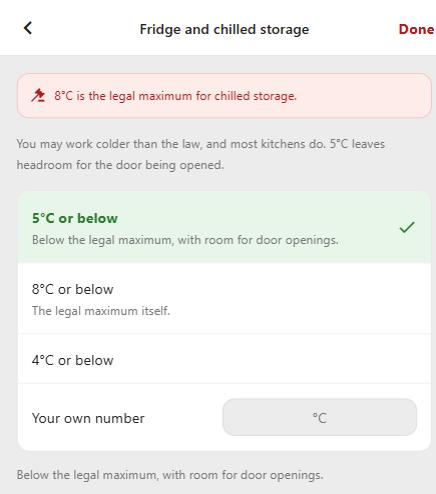
Your kitchen sets its own fridge limit. Choose 5°C, 8°C, 4°C or your own number. New fridge checks use it, and the app offers to update the ones you already have. In England, Wales and Northern Ireland it marks 8°C as the legal maximum.
No law says "record your fridge twice a day". What the law does say (Regulation 852/2004, Article 5) is that a food business must have food safety procedures based on HACCP principles, with documents and records that match the nature and size of the business.
In practice, the official guidance packs set the pattern:
That last point is why a fridge log matters. If something goes wrong, food law gives a defence to a business that took all reasonable precautions and exercised all due diligence. Written records of your checks, and of what you did when a check failed, are how you show that.
No law sets out what a fridge log must contain, and SFBB itself only asks for a daily signature and a note when something goes wrong. Recording more makes your records stronger. A good entry answers:
| Record | Why it matters |
|---|---|
| Date and time | Shows when the check was done, not when it was written up. |
| Which fridge or freezer | "Fridge 2" means nothing a month later if you have three. Use names everyone knows. |
| The reading | A number, not a tick. Say whether it is the display or a probe reading. |
| Who took it | So questions can be answered later. |
| In or out of limit | Against the limit your own procedures set, for example 5°C or below. |
| What you did, if it was out | The action, the outcome and a re-check reading: food moved, food thrown away, engineer called. |
| Manager check | A sign-off that someone responsible has looked at the day's records. |
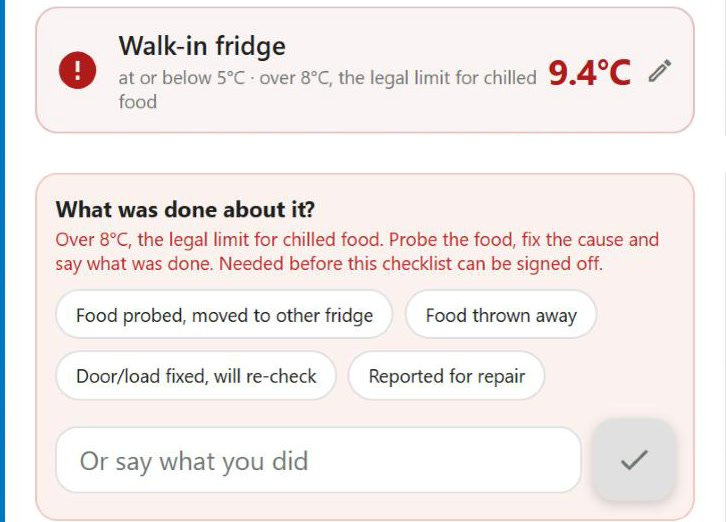
Over the limit. The reading turns red and the app asks what was done. An answer is needed before the checklist can be signed off.
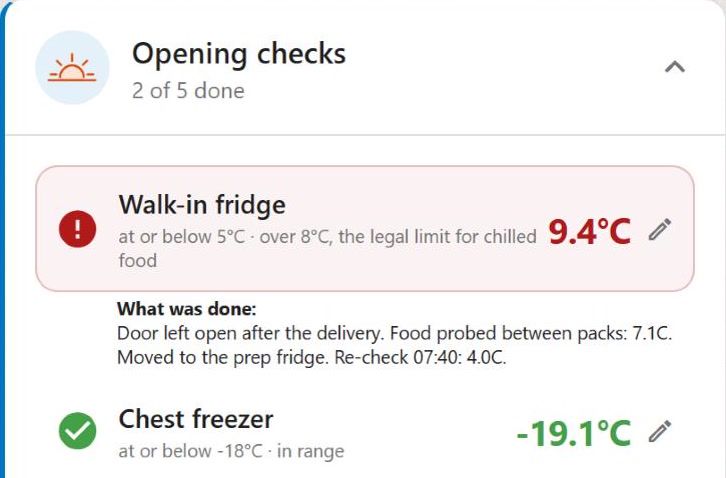
Answered. The action stays with the reading, and both appear in the Checklist History report and the Inspection Pack.
The law says records must be kept "for an appropriate period" but sets no number. Keep them as long as your own food safety procedures say, and long enough to show a pattern. If unsure, ask your local authority.
SFBB's "what to do if things go wrong" steps for chilled storage are:
For a freezer that fails, SFBB says food that is still hard and icy should go straight into another freezer. Food that has started to soften should finish defrosting safely, and fully defrosted food can be cooked until piping hot if that suits it, such as raw meat, or thrown away. Food that has to stay frozen, such as ice cream, cannot be re-frozen once it starts to defrost.
A high display reading taken just after the door has been open, or during a defrost, may be the air rather than the food. Check the food straight away with a clean probe, between packs or in an unwrapped item. If the food is over your limit, follow the steps above. Either way, write down both readings and what you did.
Under the Food Hygiene Rating Scheme (England, Wales and Northern Ireland; Scotland uses the Food Hygiene Information Scheme), officers look at, among other things, how you manage and record what you do to keep food safe. There is no published list of what an officer will check in a fridge log, but they may ask to see your records of checks, and what you did when a check failed. A short, honest record with the actions written in is worth more than a perfect-looking sheet.
Paper works, and the SFBB diary, the Safe Catering record sheets and CookSafe are free. An app helps when you have several fridges, several people taking readings, or a manager who is not always on site.
In ChefsRecords, fridge and freezer checks sit on your daily opening and closing checklists. Each reading is checked against its limit as it is entered: 5°C or below for fridges and -18°C or below for freezers by default, or the limit your kitchen sets, and in England, Wales and Northern Ireland a fridge reading over 8°C is always flagged. A reading over its limit needs an answer to "What was done about it?" before the day can be signed off. Every reading shows who took it and when, it saves without signal, and it appears in the Checklist History report and the Inspection Pack PDF.
Checklists are part of the Standard and Pro plans, and open during the 14-day trial. See what else it does.
This is general guidance for UK kitchens, written from the official sources below as published on 12 October 2026. It is not legal advice and does not replace your own food safety management system. If you are unsure, ask your local authority's food safety team.