Updated 25 October 2026 - for UK restaurants, cafes, pubs, takeaways, carveries and other catering businesses
This is a check. It takes a few minutes, and it shows whether a digital probe reads right at two fixed points: iced water and boiling water. It is how a kitchen finds a probe that is clearly wrong.
The FSA pack, in its section on checking your probe: "It is essential to know that your probe is working properly, so you can rely on its readings." And, in its maintenance section: "If your probe is not accurate, then it will not give a reliable measure of whether food is at a safe temperature." Its test is "a simple way to check a digital probe".
What is law and what is not. Guidance The ranges and the frequency are guidance. Regulation 852/2004, Article 5, asks for "effective monitoring procedures" and for procedures "to verify that the measures ... are working effectively". It does not name a thermometer. A probe you have checked is a good way to show those procedures work.
Where the "+/-1°C by law" claim comes from. It is Australian. Australia's Food Standards Code, Standard 3.2.2, asks businesses handling potentially hazardous food to have a thermometer "accurate to within 1°C". Some websites repeat it as if it applied here. It does not.
Many people say "calibrate" for the iced and boiling water test, and the FSA pack's 4-weekly review does too. It is worth knowing there are two different things.
| Kitchen accuracy check | Calibration | |
|---|---|---|
| Who does it | Anyone in the kitchen | An accredited lab (UKAS accredits calibration labs to ISO/IEC 17025) or the maker's service |
| What it is | Two fixed points. Finds a probe that is clearly wrong | A comparison against a reference traceable to national standards, with the error and its uncertainty stated |
| The proof | Your own record | A certificate. One maker describes it as "an official document to show the results of the calibration test". A "traceable" certificate and a "UKAS" certificate are not the same thing |
| Who asks for it | The FSA pack: as the maker says, or for example monthly. CookSafe: monthly | CookSafe's monthly record also has fields for the date and details of a yearly calibration, and the next one due. Some customers or contracts may ask for a certificate |
The test tells you the probe is close enough at 0°C and 100°C. If your probe fails it, the FSA pack says: "you should replace your probe or return it to the manufacturer to be calibrated."
Our advice For a cheap probe, replacing it is usually the sensible choice.
Nothing in UK guidance says to adjust a probe yourself. Do not "allow for the difference" in your head either. All thermometers are prone to drift over time, which is why the check is repeated.
The FSA pack says "put it in iced water". It gives no method beyond that, so these steps are practical advice, not guidance.
Too much water and too little ice reads high. That is the commonest reason for a bad result, so if the reading is out, test again with plenty of ice before you blame the probe. A laboratory packs the ice so it runs from top to bottom of the container, and uses distilled water. For a kitchen check to within 1°C, ordinary ice and tap water are fine. That is our judgement.
Again, the method is practical advice. The FSA pack says "put it in ... boiling water".
Safety. Boiling water scalds. Keep your hands and the probe body clear of the steam. Many probe bodies are not waterproof, so do not put the body under the water unless the maker says it can go in. Follow the maker's instructions.
High ground. Water boils a little lower on high ground and on very low-pressure days, roughly 1°C lower for every 300 metres. Most UK kitchens are low enough for this not to matter. If the iced test is fine and boiling reads just under 99°C, test again on a full boil and check the maker's instructions.
Where to put a probe in food is a different question. The reheating guide covers it, and the hot holding guide covers probing held food. Our cooking temperatures guide covers where to probe cooked food, such as between the leg and the breast of a whole bird.
The FSA pack also says, of equipment in general: "If you think that equipment might not be working properly, check it straight away."
No law sets how often. The FSA pack says the maker's instructions "should include details of how often a probe needs to be checked". "If instructions aren't available still ensure the probe is checked regularly, for example once a month." CookSafe's record is monthly. Guidance in Northern Ireland Safe Catering says "at least twice a year".
The FSA pack's 4-weekly review asks: "Have probes been calibrated in the last 4 weeks and results recorded?" Our food safety diary guide covers the rest of that review.
A line a head chef can fill in on a phone between services:
| Write down | Why |
|---|---|
| Date | When it was checked |
| Which probe | A kitchen has several. A name or number |
| Iced water reading | A number, not a tick |
| Boiling water reading | A number |
| In range or out | The answer at a glance |
| What you did, if out | Including food checked with that probe |
| Who checked | So someone can be asked |
| A manager's review | The FSA pack's 4-weekly review has a tick for it |
If you have probes calibrated each year, by a lab or the maker, add the date and the next one due. CookSafe's record has fields for both.
No law sets how long to keep it. The law says records are kept "for an appropriate period" and should fit the nature and size of the business. Ask your local authority's food safety team if you are unsure.
The same ranges appear in the FSA pack (England and Wales), CookSafe (Scotland) and Safe Catering (Northern Ireland). How often, and the boiling water method, differ. They are guidance, not law.
There is no published list. These are typical questions, drawn from the FSA pack's own questions and the temperature checks in our other guides:
Our EHO inspection guide covers the rest of the visit.
Paper works. A sheet by the pass with a row per probe is enough. An app helps when several people take readings, or a manager is not always on site.
Why kitchens move off paper:
In ChefsRecords, a probe check is its own kind of checklist line. List your probes once in Kitchen settings, Equipment, with a serial number if they have one. Pick a probe on the line and its name and serial number are saved with every reading. A probe set to Both gets two lines, iced water and boiling water. A reading outside -1 to 1°C or 99 to 101°C shows red as out of range. Someone has to say what was done (tested again, taken out of use, sent for calibration, food re-probed) before the day can be signed off. The Monthly Review starter checklist includes an iced water and a boiling water line. They do not name a probe, so if you have several, add a probe check line for each. Reports print "PROBE OUT OF RANGE" beside the reading. The app does not record which probe took a cooking, cooling, hot holding, reheating or delivery reading.
It is a kitchen accuracy check, not a calibration certificate.
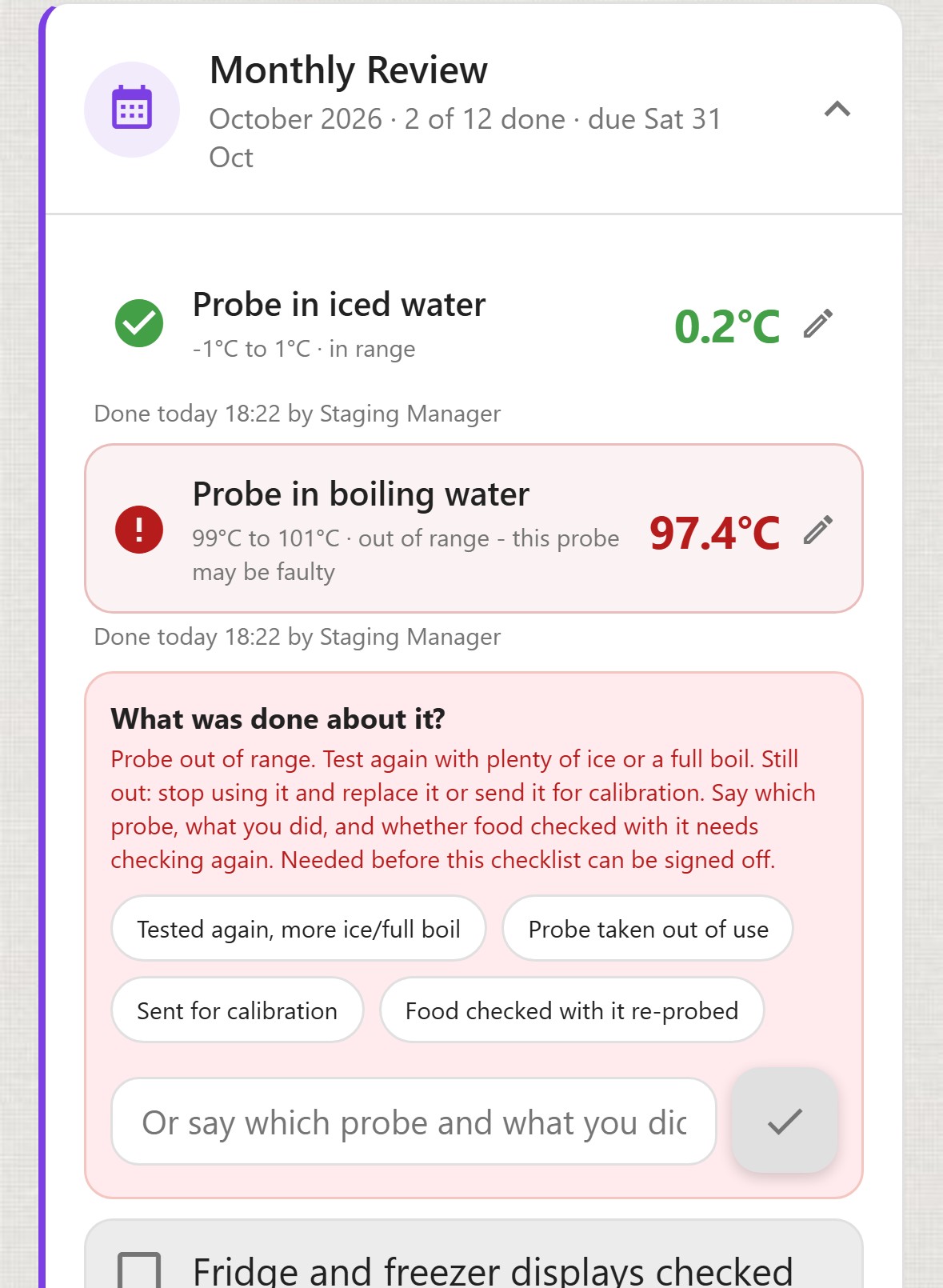
A probe that reads out of range. The iced water reading is in range. The boiling water reading, 97.4°C, is below 99°C to 101°C, so the app says the probe may be faulty and asks what was done. It is needed before the checklist can be signed off.
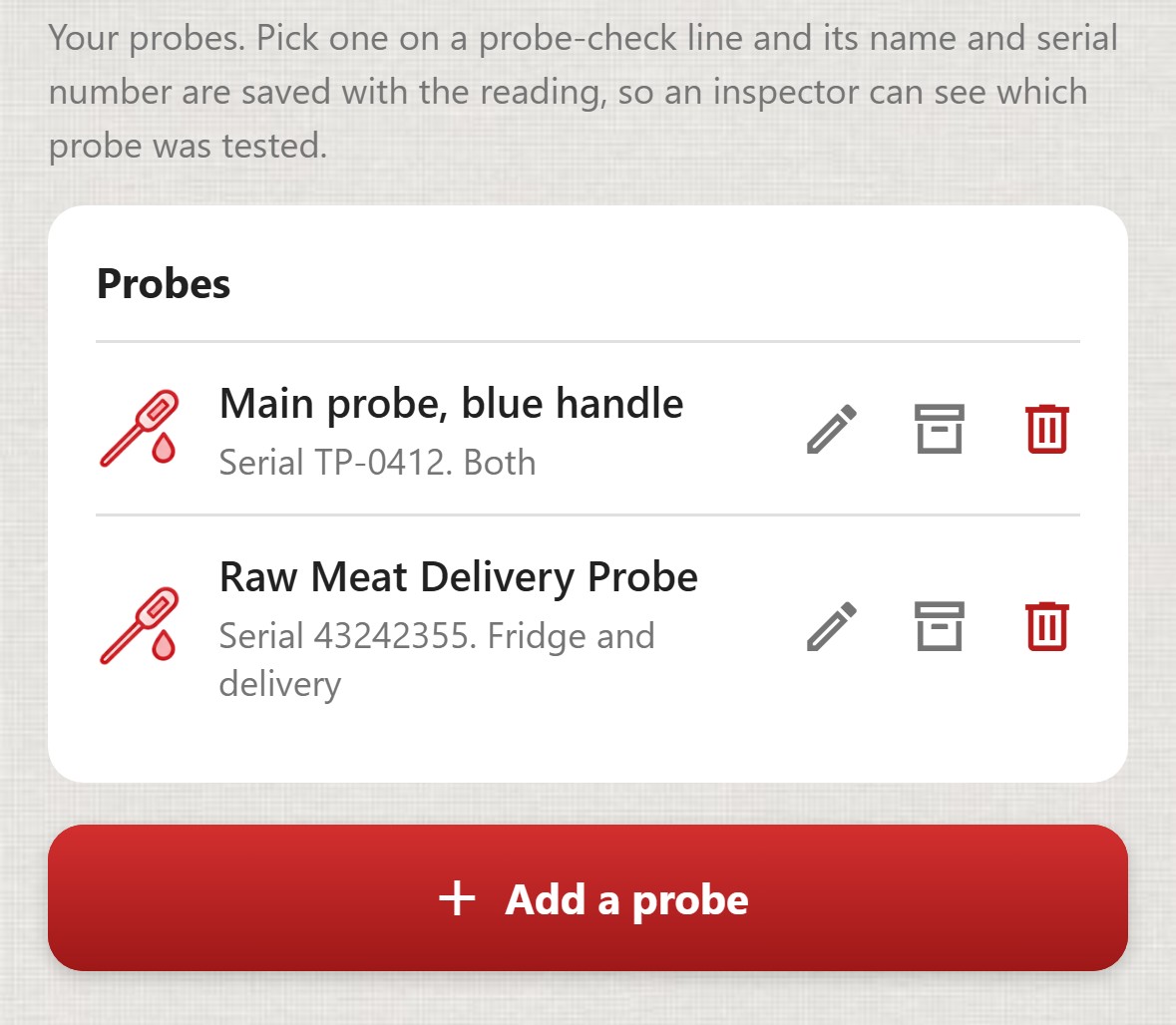
List your probes once. Each probe has a name and a serial number if it has one, and says which test it gets: iced water, boiling water or both.
Checklists and reports are part of the Standard and Pro plans, and open during the 14-day trial. See what else it does.
Get ChefsRecords on the App Store (iPhone) ›
14 days free. No card required.
This is general guidance for UK kitchens, written from the public sources below as published on 18 October 2026. It is not legal advice and does not replace your own food safety management system. If you are unsure, ask your local authority's food safety team. ChefsRecords is not part of, or endorsed by, the Food Standards Agency, Food Standards Scotland or your local council.
In a kitchen you check it. Put the probe in iced water and in boiling water. It should read -1°C to 1°C and 99°C to 101°C. If it does not, the FSA pack says to replace it or return it to the manufacturer. A lab or the maker does the strict version, against a reference, and it comes with a certificate.
Iced water: between -1°C and 1°C. Boiling water: between 99°C and 101°C. These are the ranges in the FSA pack, CookSafe and Safe Catering (Northern Ireland).
For the kitchen check, as the maker's instructions say. If there are none, regularly, for example once a month. No law sets a frequency.
No. No UK law requires a probe check or says how often. The law asks for food safety procedures that work, and keeping equipment that touches food clean. The ranges and the frequency are guidance.
Test again with plenty of ice or a full boil. If it is still out, stop using it and replace it or send it back to the maker. Think about food checked with it since the last good check, and write down what you did.
The FSA pack does not ask for one. CookSafe's record has fields for a yearly calibration, and some customers or contracts may ask. A certificate comes from a lab or the maker, not from the kitchen test.
Follow the maker's instructions. We found no UK guidance on checking one, and the iced and boiling water ranges are for a digital probe. Infra-red reads surfaces only.
Test again on a full rolling boil, with the tip clear of the pan. Water boils a little lower on high ground and on very low-pressure days. If it is still under 99°C, check the maker's instructions, and replace or return the probe.
The FSA pack asks the question, it does not make it a rule. What matters is cleaning and disinfecting the probe between uses.
The date, which probe, the iced and boiling water readings, in range or out, what you did if it was out, and who checked. If you have probes calibrated each year, by a lab or the maker, add the date and the next one due.
The FSA pack calls them a good way to clean and disinfect, as long as they have not dried out. Wipe visible food off first. Disinfectants should meet BS EN 1276 or BS EN 13697: our disinfectants guide explains what the numbers mean.
Your food safety plan should describe what your kitchen really does. The free food safety plan builder takes you through safe methods based on the FSA pack, so you can write them in your own words, then prints your plan or saves it as a PDF. For small restaurants, cafes, pubs and takeaways in England and Wales.
The probe is used in all of these: the fridge temperature log guide, the hot holding guide, the reheating guide, the cooling food guide and the EHO inspection guide. Our danger zone guide shows the temperatures you are checking against. More guides: the cooking temperatures guide, the food delivery checks guide and the Christmas kitchen guide.