
ChefsRecords
ChefsRecords

The food safety diary: daily sign-off and the 4-weekly review

Updated 25 October 2026 - for UK restaurants, cafes, pubs, takeaways, carveries and other catering businesses

The short answer

No law says you must keep a food safety diary, sign it every day or review it every 4 weeks. The law asks for food safety procedures based on HACCP, and for records that suit the size of your business. The diary and the 4-weekly review come from the Food Standards Agency's (FSA's) Safer Food, Better Business pack (the FSA pack). In England and Wales that is guidance. Here is what each source says.

  • Law, all four nations: Law in all four nations Regulation 852/2004, Article 5(1): "Food business operators shall put in place, implement and maintain a permanent procedure or procedures based on the HACCP principles." Article 5(2)(g) asks for "documents and records commensurate with the nature and size of the food business". It names no diary, no daily signature and no review every 4 weeks. Not having food safety procedures based on HACCP can be an offence.
  • England and Wales: Guidance in England and Wales The FSA pack says: "as a minimum, you need to fill in the diary each day." Its 4-weekly review says: "this review requires completion even if no problems have been found." GOV.UK says: "This pack must be completed for all your food operations". That "must" is the pack's wording, not the law's.
  • Scotland and Northern Ireland: Guidance in Scotland Guidance in Northern Ireland CookSafe in Scotland and Safe Catering in Northern Ireland have no diary and no daily signature line. Each has its own forms. See section 10.
  • Some councils: Guidance from some councils Sheffield City Council's inspection page says: "You'll need to complete a diary where opening and closing checks are recorded."
  • In ChefsRecords: A Manager or Supervisor signs off each day the next day. A Manager signs off the month. The app's review is once a calendar month, not every 4 weeks. Section 12 has the differences.
  • Our advice: Our advice Write a bad day down the same day. Never sign a day you did not check. Do the review yourself, and sign it even when nothing went wrong.

What the law says

Law in all four nations The rules are in Regulation (EC) 852/2004, Article 5. Article 5 reads the same in England, Wales, Scotland and Northern Ireland. (Northern Ireland applies the EU version of the regulation.) Seven points matter for the diary:

  • A written system, based on HACCP. Article 5(1): "Food business operators shall put in place, implement and maintain a permanent procedure or procedures based on the HACCP principles." HACCP stands for Hazard Analysis and Critical Control Points.
  • Regular checks that it works. Article 5(2)(f): "establishing procedures, which shall be carried out regularly, to verify that the measures outlined in subparagraphs (a) to (e) are working effectively;"
  • Records that fit the business. Article 5(2)(g): "establishing documents and records commensurate with the nature and size of the food business to demonstrate the effective application of the measures outlined in subparagraphs (a) to (f)."
  • A review when something changes. Article 5(2): "When any modification is made in the product, process, or any step, food business operators shall review the procedure". They then make the changes needed.
  • Evidence for the council. Article 5(4)(a): "provide the competent authority with evidence of their compliance with paragraph 1 in the manner that the competent authority requires, taking account of the nature and size of the food business;"
  • Keeping records. Article 5(4)(c): "retain any other documents and records for an appropriate period." The law gives no number.
  • Flexible for small kitchens. The regulation's introduction says: "They should provide sufficient flexibility to be applicable in all situations, including in small businesses." It also says "the requirement of retaining documents needs to be flexible in order to avoid undue burdens for very small businesses." That is the introduction, not a rule.

Law in all four nations The law does not name a diary, a daily signature or a review every 4 weeks. Not having food safety procedures based on HACCP can be an offence. In England, Schedule 2 of the Food Safety and Hygiene (England) Regulations 2013 lists Article 5(1), (2), (4)(a), (b) and (c). Wales, Scotland and Northern Ireland have their own Food Hygiene Regulations 2006, linked in the sources below.

Guidance GOV.UK's page on food safety management systems says: "A food safety management system is a written set of processes, checks, rules and records." It says to "put checks in place to make sure your system is working" and to "keep records of your food safety systems, checks and how you've put things right". And: "If your business is involved in a food safety incident, you will need to show your records as evidence of how you keep food safe."

Our advice A diary is one way to keep the records. It is the one the FSA pack uses. Whether your records are enough for your kitchen is for your own council to say.

Back to sections

What goes in the diary each day

Guidance in England and Wales The FSA pack's diary has a page for each week, headed "Week commencing". It says the diary "should take about one minute a day to complete, unless you have something special to write down." Here is what is on the page.

The FSA diary pageOne page for each week
  • Each day, two ticks: "Opening checks" and "Closing checks".
  • Each day, a name and a signature: "Name" and "Signed", with the line "Our safe methods were followed and effectively supervised today."
  • Each day, a prompt: "Any problems or changes - what did you do?"
  • Each week, an "EXTRA CHECKS" box: "We have performed the following extra checks this week", with Name and Signed.
From the diary pages in the FSA pack (England and Wales). The wording is the pack's.
  • Opening and closing checks. The pack's examples include: "Your fridges, chilled display equipment and freezers are working properly.", "Staff are fit for work and wearing clean work clothes.", "Food on its Use By date has been thrown away." and "'Prove it' checks have been recorded." Our opening and closing checks guide has the full list.
  • Extra checks. The pack says: "When you carry out an extra check, make a note of it in the diary on the day you completed it along with details of what you did."
  • Is it the only daily record? The pack asks: "DO I NEED TO KEEP LOTS OF DAILY RECORDS?" Its answer: "No, but as a minimum, you need to fill in the diary each day." It goes on: "Depending on the size and nature of your business you may need to keep more records to demonstrate that you are making food safely." Doncaster Council also says the diary is the only daily record the pack asks for.
  • Where it lives. The pack says: "This pack should always be available at the business."

Guidance in England and Wales GOV.UK says: "This pack must be completed for all your food operations". That is the pack's wording, not the law's.

Our free food safety plan builder helps you write your safe methods in your own words, then print your plan or save it as a PDF. It is for England and Wales only.

Back to sections

Who signs, and cover

Guidance in England and Wales The FSA pack puts the signature on the manager.

  • Who. "The manager should sign the diary every day to say that: the opening and closing checks have been done; your safe methods have been followed". And: "The diary should be filled in every day by the person responsible for running the business."
  • What the signature means. "Each day, write your name and sign to say that all the safe methods have been followed." And: "When you sign the diary you are confirming that you have supervised all the staff involved in making food that day."
  • Every day. "It is important that the diary is completed and signed every day."
  • When you are away. "If you are away from the business, you can give responsibility for the diary to a member of staff." The pack says to "Make a note in the diary of those members of staff who have been given this responsibility" and that "Staff must understand how the diary works."
  • More than one shift. The pack says there "may be more than one person responsible during the day", and that "in these cases the diary may need more than one signature."
  • The review stays with you. "You should still complete the 4-weekly review yourself." That applies even when the diary has been handed to a member of staff.

Our advice Decide cover before you go on holiday, or when someone is off sick. Name the person in charge and write their name in the diary. Sign a day only if you supervised it, or have checked with whoever did. In ChefsRecords, give your cover person the Supervisor role, because Staff cannot sign a day.

Back to sections

When something goes wrong

Guidance in England and Wales The FSA pack says: "If anything different happens, or if something goes wrong, you should make a note in the diary of what happened and what you did. This is so you can show that you have taken action to make sure that food is safe to eat." And: "Write down what went wrong and what you did about it in your diary." Its safe methods have two columns for this: "What to do if things go wrong" and "How to stop this happening again".

Our advice Write a bad day down the same day. Put in:

  • what happened
  • what you did with the food
  • what you did to put it right
  • who did it
  • how you will stop it happening again

An honest entry beats a blank day. An example: "Fridge 2 at 11°C at 14:00. Food moved to fridge 1, cream and cooked rice thrown away. Engineer booked Tuesday. Sam."

See also our near miss guide and probe check guide.

Back to sections

Missed and closed days

A day you missed

Our advice Never back-fill a day, and never sign a day you did not check. Write a note dated today saying which days were missed and why.

In ChefsRecords, days wait 14 days to be signed. After that, the Monthly Report shows them as not checked. Explain them in the monthly review.

A day you were closed

Guidance in England and Wales The FSA pack says nothing about days you are closed.

Our advice On paper, write "Closed" across the day. In ChefsRecords, set each checklist's open days. Days with no records do not come up for signing.

Back to sections

The 4-weekly review: what it asks

Guidance in England and Wales The FSA pack ends the diary with a 4-weekly review page. It says: "The 4-weekly review gives you the opportunity to look back at previous weeks and identify any persistent problems. Write down details of these and how you decide to tackle them. You might need to train staff again on certain safe methods and/or change how you do things."

  • Walk round. "Take some time to walk around the kitchen and observe whether safe methods are being followed. Write details of any problems below and what you did about it."
  • Read back. "Also look back over the past 4 weeks' diary entries. If you had a serious problem, or the same thing went wrong three times or more, make a note of it here, find out why and record what you did to resolve it."
  • Always complete it. "Please remember: this review requires completion even if no problems have been found."
  • The first question. "Did you observe any problems or did the same issue occur in the diary three times or more? Yes No", with the columns "DETAILS" and "WHAT DID YOU DO ABOUT IT?"
  • Then 12 questions, each answered Yes or No. They are in the table below.
  • The end of the page. "ADDITIONAL DETAILS", then "NAME" and "SIGNED".
  • What it is for. "Use the 4-weekly review in the diary to identify any problems with how staff are following safe methods and plan your training to address these."
The 12 questionsFrom the FSA pack, and whether the ChefsRecords Monthly Review starter has a matching line
The pack's questionMatching line in ChefsRecords?The line in the Monthly Review starter
1. "Have you reviewed your safe methods?"Yes"Food safety plan still matches what we do"
2. "Has allergen information been updated to reflect any menu or ingredient changes?"Yes"Allergen info updated for any menu or ingredient change"
3. "Have you changed any equipment or processes which change your safe methods?"YesThe same plan line. Its note under the line reads "New dishes, equipment or ways of working? Update the plan."
4. "Have any new suppliers been recorded with contact information?"Yes"New suppliers recorded with contact details"
5. "Does the cleaning schedule require updating?"Yes"Cleaning schedule still right"
6. "Have new staff (if applicable) been trained in all safe methods?"Yes"New staff trained; refresher training booked if needed"
7. "Do any existing staff require safe method refresher training?"YesThe same training line, which covers the refresher
8. "Are any extra opening or closing checks required?"NoNo matching line. Add one if you want the full list.
9. "If any food complaints have been received, have they been investigated and safe methods reviewed?"Yes"Any food complaints looked into". Reviewing the safe methods is the plan line in question 1.
10. "Have probes been calibrated in the last 4 weeks and results recorded?"YesThe two temperature lines, "Probe in iced water" and "Probe in boiling water"
11. "Have extra checks been completed and recorded weekly?"Yes"Weekly checks all done in the last 4 weeks"
12. "Are prove it checks being completed regularly and recorded?"NoNo matching line. Add one if you want the full list.
The 12 questions are word for word from the 4-weekly review page in the FSA pack. The two right-hand columns are our own match against the Monthly Review starter in ChefsRecords. Ten have a matching line. Two do not: extra opening or closing checks, and prove it checks.

The starter also has "Walked the kitchen: staff following our food safety methods", which goes with the pack's instruction to walk round the kitchen, and "Last 4 weeks' records checked for repeat or serious problems", which goes with the pack's first question.

How often: every 4 weeks, or once a month?

  • The law. Law in all four nations No law sets how often to review. Article 5(2)(f) asks for checks "carried out regularly". Article 5(2) asks for a review when something changes.
  • The FSA pack. Guidance in England and Wales The review is every 4 weeks. The pack mixes the two itself: it says "for example once a month" for probes, but its review asks about probes "calibrated in the last 4 weeks". It also says the pack "can be adapted to suit the size and nature of your business".
  • Safe Catering. Guidance in Northern Ireland The SC5 checklist has a "Review (4 weekly)" section, inside a checklist ticked "Weekly", "Fortnightly" or "Monthly".
  • CookSafe. Guidance in Scotland The Review is "ideally every six months or if any of the circumstances covered in the table below arise", and there is a separate Weekly Record.
  • Some councils. Guidance from some councils Doncaster Council: "You should also review your diary every 4 weeks and when operations change, such as style of cooking, use of new equipment."
  • The difference. Every 4 weeks is 13 reviews a year. Once a month is 12. Whether that matters is for your own council.
  • Our advice: Our advice Do it on a fixed day, and do it yourself. Walk the kitchen, then read back through the records. Look for anything serious and for the same problem three times or more. Sign it even when nothing went wrong.

Back to sections

How long to keep pages

  • The law. Law in all four nations Article 5(4)(c): "retain any other documents and records for an appropriate period." The law gives no number of months or years.
  • England and Wales. Guidance in England and Wales GOV.UK says: "Store all your completed diary pages safely until your next visit from a local authority food safety officer." It adds: "This can be done electronically or with printed copies."
  • Scotland. Guidance in Scotland CookSafe says records "must be kept for a reasonable period of time", and that for advice "you should contact your Enforcement Officer."
  • Northern Ireland. Guidance in Northern Ireland The Safe Catering guide says: "It is recommended that you keep records for at least 12 months." It adds: "Your legal advisors may recommend a longer period or your Environmental Health Officer may ask you to keep them at least until his/her next inspection of your premises."
  • Our advice: Our advice Keep pages at least until after your next inspection. If your plan's history in ChefsRecords is shorter than the time since your last visit, save the Monthly Report PDF each month. Reports look back 12 months on Standard and 24 months on Pro.

Back to sections

Paper, a computer or an app

Guidance in England and Wales GOV.UK says: "You have two options:" "keep an electronic diary - download the diary pages onto your device, fill them in and store them electronically" or "print the diary and fill it in". It also says: "You can print out the diary refill separately if you only need that part of the pack or require additional pages." The FSA's diary and 4-weekly review pages are on GOV.UK (PDF). We do not offer printable diary sheets of our own.

GOV.UK says the diary can be kept electronically or on paper. "Electronically" means the FSA's own pages kept on a device. It is not an endorsement of any app.

Our advice If you use an app, read its limits first. Section 12 sets out what ChefsRecords does and does not do.

Back to sections

What an inspector looks at

Guidance in England, Wales and Northern Ireland GOV.UK's page on the Food Hygiene Rating Scheme (updated 30 June 2026) says the officer checks "how the business manages ways of keeping food safe, looking at processes, training and systems", to "assess the level of confidence in standards being maintained in the future." It also says the rating is "a snapshot of the standards of food hygiene found at the time of inspection." In Scotland the scheme is the Food Hygiene Information Scheme.

That page does not say the diary is checked, so we cannot tell you what an inspector will ask for. These sources give the idea:

  • A written system. Guidance from some councils Sheffield City Council's inspection page says the inspecting officer will "also want to see a written, step-by-step, food safety management system (FSMS)."
  • Not having one written down. Guidance from some councils Reigate and Banstead Council gives an example of a business scored "20 for confidence in management as they have not yet documented their food safety management system".
  • Showing your records. Guidance GOV.UK: "If your business is involved in a food safety incident, you will need to show your records as evidence of how you keep food safe."
  • Close to hand. Guidance in England and Wales The FSA pack: "This pack should always be available at the business."

Our EHO inspection guide covers the rest of the visit. Our free one-page inspection checklist (PDF) lists things to check before a visit, and the free food safety plan builder (England and Wales only) helps with the written system. Neither comes from the FSA or your council.

Back to sections

Northern Ireland and Scotland

The diary is guidance in England and Wales. GOV.UK's page on the FSA pack says "Applies to England and Wales", and "For guidance in Northern Ireland refer to the safe catering guidance." It is not a UK-wide diary. Northern Ireland and Scotland have no diary and no daily signature line. Each has its own forms.

Northern Ireland: Safe Catering

  • What it is. Guidance in Northern Ireland GOV.UK describes Safe Catering as "a food safety management plan based on the Hazard Analysis Critical Control Points (HACCP) principles and keep appropriate records." The GOV.UK page was published on 25 June 2026 and says "Applies to Northern Ireland".
  • The manager's check. The SC1, SC2, SC3 and SC8 forms carry a "Manager/Supervisor check on" row with date boxes and "Initials". SC2 has five check boxes for the month. We do not take that as a rule about how often.
  • One daily form, if you want it. The SC8 All-In-One Record: "This form may be completed daily and used as an alternative to the individual records".
  • The checklist. The SC5 Hygiene Inspection Checklist is "Simple checks of the premises which should be carried out by the Proprietor or Manager regularly", ticked "Weekly", "Fortnightly" or "Monthly". It asks "Are all checks properly taken and recorded?", "Has appropriate corrective action been taken where necessary?" and "Are record sheets up-to-date, checked and verified?"
  • Its 4-weekly review. SC5 has a "Review (4 weekly)" section with three questions: has the suppliers list been updated, "Any new menu items and steps in Safe Catering updated?" and "Any new food handling methods or equipment and steps in Safe Catering updated?" It is signed with Name, Position, Signed and Date.
  • Keeping records and reviewing the plan. The main Safe Catering guide recommends keeping records "for at least 12 months". It says: "A minimum of a yearly review is recommended, however, you should also review your Safe Catering Plan if anything in your food operation changes". Your own record forms are allowed "either in paper copy or electronically".

Scotland: CookSafe

  • What it is. Guidance in Scotland Food Standards Scotland's CookSafe section 4 (8 April 2019) sets out the records. There is no diary and no daily signature line.
  • Weekly Record. The Weekly Record is "To record weekly management checks on all your House Rules and Records." It says "The following ongoing checks should be carried out by the Manager or Proprietor during each working week". Each section asks "Have the House Rules been followed?", with "HOUSE RULES DEVIATIONS OBSERVED" and "CORRECTIVE ACTIONS TAKEN", and is signed "Manager/Proprietor's Signature" with the date.
  • Review. The Review is "To record six monthly checks on your HACCP based procedures and to record any interim check." It says: "A review of your system must be carried out on a regular basis, ideally every six months or if any of the circumstances covered in the table below arise." The table includes "Introduction of any new dish with substantially different process", "Changes to premises layout", "A Local Authority inspection where deficiencies were noted", "Staff Changes" and "Customer Complaint".
  • All-in-One Record. The All-in-One Record is "To be completed daily", signed by the Manager or Proprietor.
  • Keeping records. They "must be kept for a reasonable period of time"; for advice, "you should contact your Enforcement Officer."
  • Your own forms. You may use your own, "either in paper copy or electronically", if they "contain the equivalent information as the 'CookSafe' Recording Forms."

Our advice If you are in Northern Ireland or Scotland, use the forms from your own scheme. Ask your council about anything the forms do not cover.

Back to sections

Mistakes to avoid

  1. Signing a day you did not supervise or check.
  2. Filling in missed days afterwards. Write a note dated today instead.
  3. Leaving "Any problems or changes - what did you do?" blank when something went wrong.
  4. Handing the diary to cover with no name written down. The pack says to note who has been given the job, and that staff must understand how the diary works.
  5. Leaving a gap for a closed day instead of writing "Closed".
  6. Skipping the 4-weekly review because nothing went wrong. The pack says it needs completing anyway.
  7. Handing the review to a member of staff. The pack says you should still complete it yourself.
  8. Doing the review at a desk. The pack says to walk around the kitchen.
  9. Telling staff the law says you must sign a diary. The diary is the FSA pack's guidance.
  10. Reviewing monthly but not noting it. If you use the FSA pack and review monthly, note in your pack that you review once a month.
  11. Throwing pages away early. GOV.UK says to keep them until your next visit from a food safety officer.
  12. Keeping the pack off site. The pack says it should always be available at the business.

Back to sections

Paper or ChefsRecords App?

Paper works: the FSA's diary pages, signed each day, and the 4-weekly review page. GOV.UK says the diary can be kept electronically or on paper. In ChefsRecords, a Manager or Supervisor signs off each day the next day, with the FSA diary's line. The signature covers that day's checklists, temperature records and incidents. A day with a failed reading that nobody has answered cannot be signed. The Monthly Review checklist and a Manager's monthly sign-off are the review in ChefsRecords, once a calendar month rather than every 4 weeks. Reports look back 12 months on Standard and 24 months on Pro.

The day sign-off

The FSA diary has a line to sign each day: "Our safe methods were followed and effectively supervised today." In ChefsRecords, a Manager or Supervisor signs off each day the next day, once the shift is over. The signature says "Our safe methods were followed and effectively supervised on" that day. It covers that day's checklists, temperature records and incidents.

If a reading broke a legal or critical limit, a fridge was over 8°C or a probe check was out of range, and nobody has said what was done, the day cannot be signed until someone does. Reports show "Day checked by" with the name and time. Problems are written against each record as you go, not in one box at the end of the day. There is one signature per day, and days wait 14 days to be signed. Sign a day only if you supervised it, or have checked with whoever did.

The Dashboard shows a "days to sign off" row. There is an optional note, "Anything else about this day? (optional)", up to 200 characters. The Monthly Report shows how many days with records were signed off by a manager or supervisor. The app's help text says the sign-off "is good practice, not a legal requirement", and that "A day's signature cannot be changed or undone."
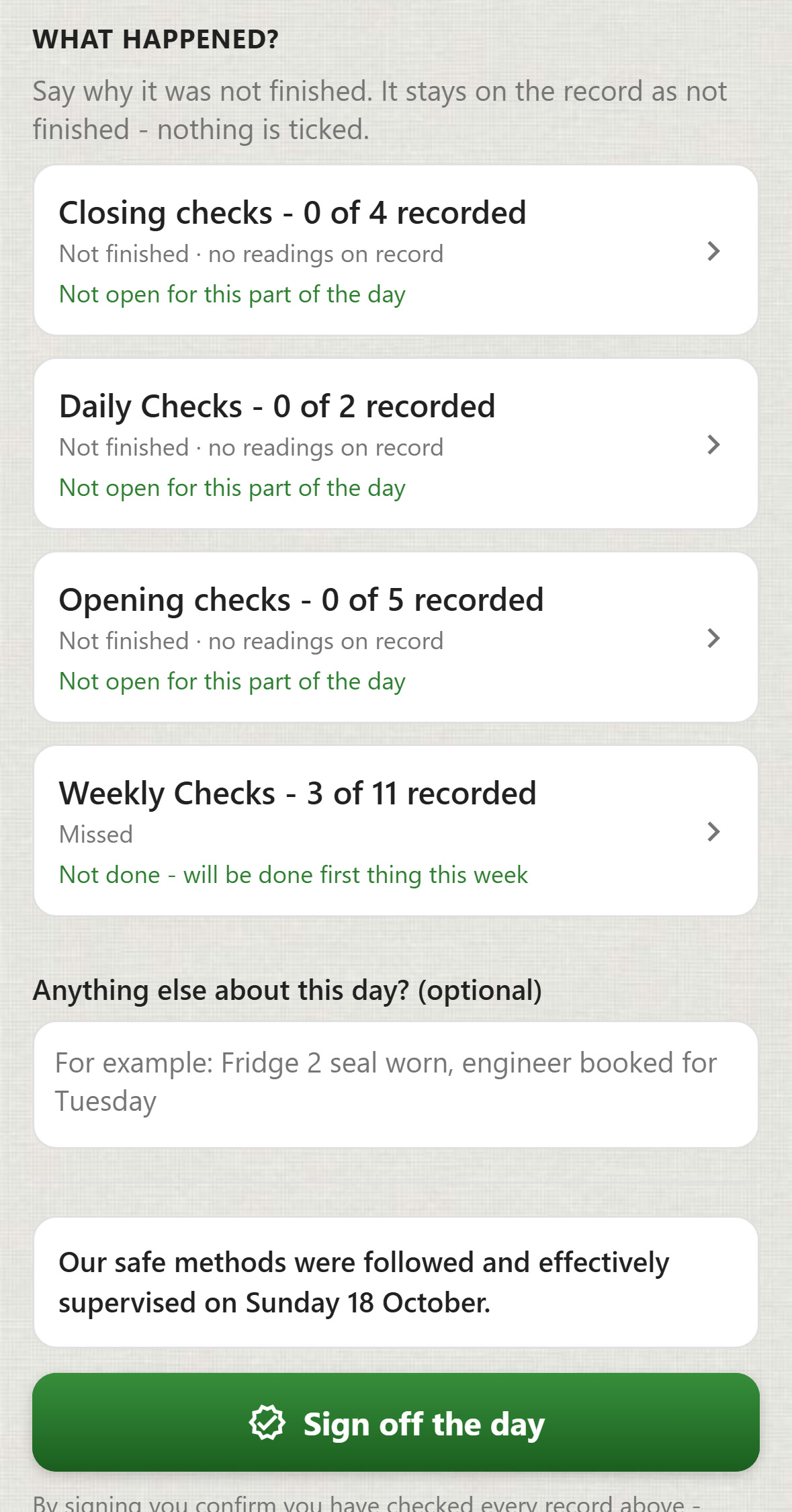
ChefsRecords day sign-off for Sunday 18 October. Under What happened?, three checklists not finished are each answered Not open for this part of the day, and the missed Weekly Checks Not done - will be done first thing this week. Then an optional box, Anything else about this day?, the statement Our safe methods were followed and effectively supervised on Sunday 18 October, and the button Sign off the day.

The day sign-off: each checklist not finished is answered before a Manager or Supervisor signs the day with the FSA diary's line.

A real screen from the ChefsRecords app on an iPhone-sized screen, in a test kitchen set up for these screenshots. The day and records are test data.

The monthly review

The FSA pack's review is every 4 weeks. The review in ChefsRecords is once a calendar month: a Monthly Review checklist that is open all month and due on its last day, then a Manager signs off the month on the Monthly Report, with any actions, even when nothing went wrong.

No law says how often to review. The law asks for regular checks that your system works, and a review when something changes. The packs differ: Safe Catering's checklist has a 4-weekly review section, and CookSafe's full review is ideally every six months. If you use the FSA pack and review monthly, note in your pack that you review once a month, so your plan matches what you do.

The Monthly Review starter covers most of the pack's questions. The pack also asks whether you need any extra opening or closing checks, and whether your temperature checks are being done and recorded. Add those two lines if you want the full list.

The Monthly Report prompts: "Look back over [month]: any problem that happened more than once, and what you will change. Then sign it off - even when nothing went wrong." The PDF prints "Reviewed by", the date and "Actions", plus "A sign-off cannot be changed afterwards." A month that is not yet signed prints blank boxes, so you can sign on paper.
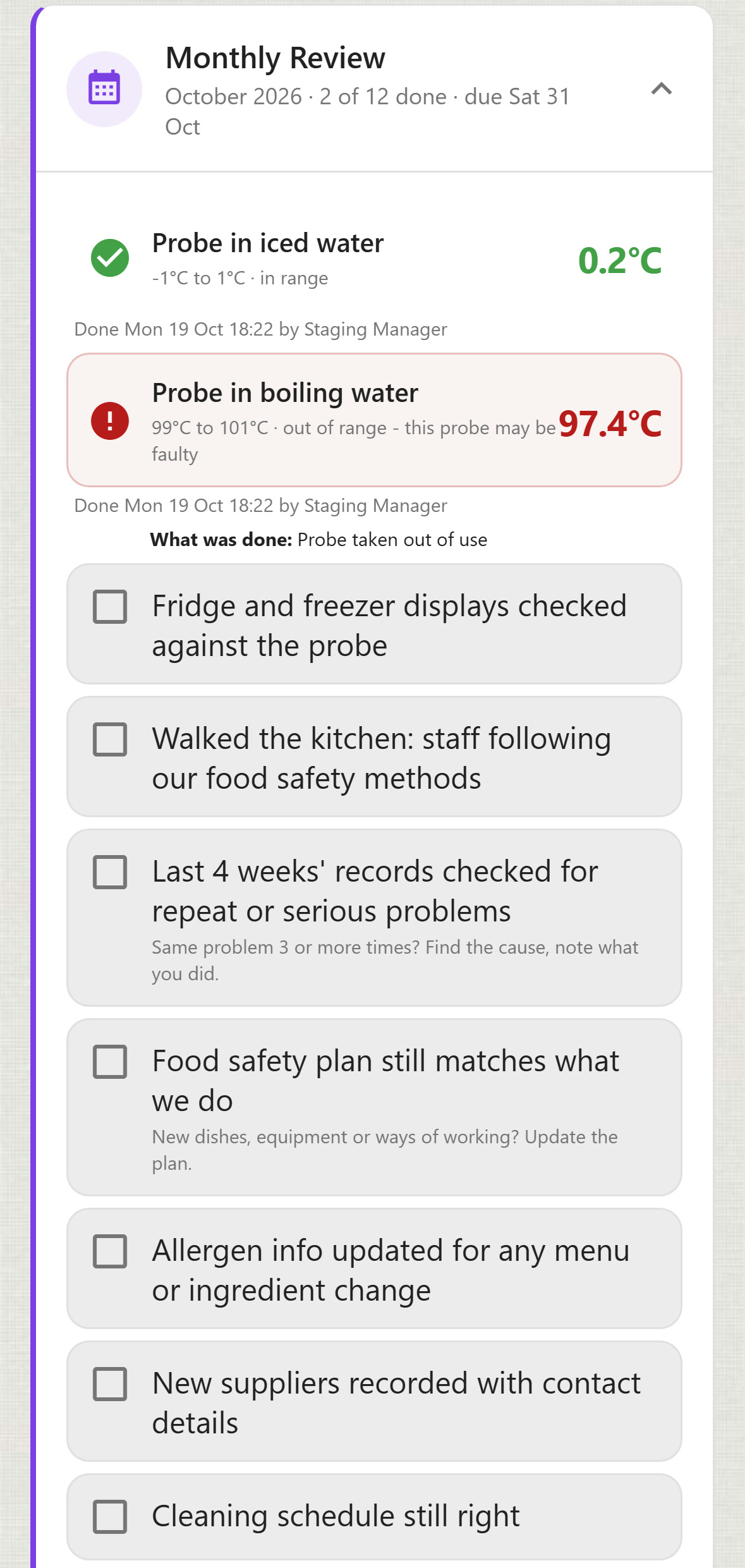
ChefsRecords Monthly Review checklist for October 2026. Probe in iced water reads 0.2°C, in range. Probe in boiling water reads 97.4°C, out of range, with What was done: Probe taken out of use. Below are tick lines for the look back, from fridge and freezer displays checked against the probe down to the cleaning schedule.

The Monthly Review checklist caught a probe reading out of range in boiling water and asked what was done about it.

A real screen from the ChefsRecords app on an iPhone-sized screen, in a test kitchen set up for these screenshots. The ticks and readings are test data.

Why kitchens move off paper:

  • The manager sees which days are waiting. The Dashboard shows how many days are waiting, and opens the list, oldest first.
  • A failed reading has to be answered. A reading over a legal or critical limit, a fridge over 8°C or a failed temperature record with no answer blocks the signature. A tick line on paper cannot do that.
  • The sign-off is on the report. Reports print "Day checked by" with the name and time, and the monthly PDF prints "Reviewed by" and the date.

Who can sign and which plan. Only a Manager or Supervisor can sign a day, and only a Manager signs off the month. Day sign-off and the checklists come with the Standard and Pro plans and are open in the 14-day trial. Signing a day needs a signal.

What it does not do.

  • It is not the FSA diary page. There is no single "problems or changes" box. Problems are recorded where they happen: an answer on each failed reading, incidents, checklist notes, the optional 200-character note at sign-off, and a reason for any checklist not finished. A tick line cannot record a problem.
  • There is one signature per day. The pack allows more than one when there are shifts.
  • Staff cannot sign. Give your cover people the Supervisor role.
  • Opening and closing checks are covered only if your kitchen uses those checklists.
  • Days with no records do not come up for signing, and there is no "closed" mark. Set each checklist's open days.
  • The signature cannot be changed or undone, but it does not lock the records under it: they can still be edited after the day is signed.
  • The Monthly Review starter has no line for extra opening or closing checks, or for prove it checks. Add them if you want the full list.
  • It is once a calendar month, not every 4 weeks.
  • The app helps you keep the record. It does not decide whether your records are enough, and it does not change what the law asks of you.

See what else it does.

Get ChefsRecords on the App Store (iPhone) ›
14 days free. No card required.

This is general guidance for UK kitchens, written from the public sources below as published on 21 October 2026. It is not legal advice and does not replace your own food safety management system. How often to review, how long to keep records and whether a record is enough are for your own council. ChefsRecords is not part of, or endorsed by, the Food Standards Agency, Food Standards Scotland or your local council. If you are unsure, ask your local authority's food safety team.

Back to sections

Questions people ask

Is a food safety diary a legal requirement?

No. The law does not name a diary. Regulation 852/2004 asks for food safety procedures based on HACCP, and for records that suit the nature and size of the food business. The diary comes from the Food Standards Agency's Safer Food, Better Business pack, which says: "as a minimum, you need to fill in the diary each day." That is the pack's wording, not the law's. Not having food safety procedures based on HACCP can be an offence.

Does the diary have to be signed every day?

The law does not say so. The FSA pack says: "It is important that the diary is completed and signed every day." That is the guidance in England and Wales. Scotland's CookSafe and Northern Ireland's Safe Catering have no daily signature line.

Who can sign it?

The FSA pack says: "The diary should be filled in every day by the person responsible for running the business." If you are away, you can give responsibility to a member of staff, and the pack says to make a note of who. In ChefsRecords, a Manager or Supervisor can sign a day, not Staff. Give cover people the Supervisor role. Sign a day only if you supervised it, or have checked with whoever did.

What do I write if something goes wrong?

The FSA pack says to make a note in the diary of what happened and what you did. Our advice: write it the same day. Say what happened, what you did with the food, what you did to put it right, who did it, and how you will stop it happening again. An honest entry beats a blank day.

What if we forgot to sign a day?

Our advice: never back-fill, and never sign a day you did not check. Write a note dated today saying which days were missed and why. In ChefsRecords, days wait 14 days to be signed. After that the Monthly Report shows them as not checked, so explain them in the monthly review.

What is the 4-weekly review?

It is a page in the FSA pack's diary. You look back over the past 4 weeks, walk round the kitchen, and answer 12 Yes or No questions. The pack says: "this review requires completion even if no problems have been found." You should still complete it yourself, even when the diary has been handed to a member of staff.

Can I do the review monthly?

No law says how often to review. The law asks for regular checks that your system works, and a review when something changes. The FSA pack's review is every 4 weeks. If you use the FSA pack and review monthly, note in your pack that you review once a month, so your plan matches what you do. Whether the difference matters is for your own council.

How long do I keep diary pages?

GOV.UK says: "Store all your completed diary pages safely until your next visit from a local authority food safety officer." The law says to keep records "for an appropriate period" and gives no number. Our advice: keep pages at least until after your next inspection.

Can I keep the diary on a phone or computer?

GOV.UK says the diary can be kept electronically or on paper. It means the FSA's own diary pages, downloaded, filled in and stored on your device. It is not an endorsement of any app. ChefsRecords is an app with a day sign-off and a Monthly Review. It works differently from the paper diary, and this guide says how. Whether an inspector accepts records on an app: our digital food safety records guide.

What do I write on days we are closed?

The FSA pack says nothing about closed days. Our advice: on paper, write "Closed" across the day. In ChefsRecords, set each checklist's open days.

Is it the same in Scotland and Northern Ireland?

No. The diary is guidance in England and Wales. Scotland uses CookSafe, with a Weekly Record, a Review and an All-in-One Record. Northern Ireland uses Safe Catering, with forms such as SC5 and SC8. Neither has a diary or a daily signature line. The law, Article 5 of Regulation 852/2004, reads the same in all four nations.

Back to sections

Sources