Updated 13 October 2026 - for UK restaurants, cafes, pubs, takeaways, carveries and other catering businesses
The 63°C rule comes from Schedule 4 of each nation's food hygiene regulations: the Food Safety and Hygiene (England) Regulations 2013, the Food Hygiene (Wales) Regulations 2006 and the Food Hygiene Regulations (Northern Ireland) 2006. In each, it is an offence to keep food below 63°C if it has been cooked or reheated, is for service or on display for sale, and needs to be kept at 63°C or above to control harmful bacteria or toxins.
Three details matter:
63°C is about 145°F. You will see 135°F (57°C) and 140°F (60°C) on American websites. Those are US figures and do not apply in the UK.
In England, Wales and Northern Ireland, it is a defence to show that food below 63°C had been kept for service or on display for sale for less than two hours, and had not been kept for service or on display before. In plain terms:
SFBB, the Food Standards Agency's pack for caterers, puts it like this: if you cannot keep food on display above 63°C, you can take it out of hot holding to display it for up to two hours, but you can only do this once. Food not used within two hours should be reheated until steaming hot and put back in hot holding, or chilled as quickly as possible to 8°C or below. If it has been out for more than two hours, throw it away. And do not mix new food with food already on display, or the older food ends up out for too long.
The Food Hygiene (Scotland) Regulations 2006 are written differently. Food must be kept in a fridge, a cool ventilated place, or at a temperature above 63°C, so food at exactly 63°C does not meet it. The regulations list some exemptions, for example food being prepared for sale and food on sale to customers, but there is no two-hour allowance anywhere in them. Whether an exemption covers food on your hot counter is a question for your local authority's food safety team.
Food Standards Scotland's CookSafe guidance is plain about the practice: food held hot before serving must be kept above 63°C, in a pre-heated bain-marie or hot cabinet. You must decide how often to check, and write it into your House Rules. You may also set a maximum time for food on display.
Scotland is also the only part of the UK where the law sets a reheating temperature: reheated food must reach 82°C, unless that would spoil it. Elsewhere, the guidance is to reheat until steaming hot all the way through.
No UK law sets a maximum time for food held at 63°C or above. Food that is safe can still dry out or spoil in quality, so you can set your own limit for each dish.
No law sets a frequency. You decide, and write it into your food safety procedures. CookSafe says this outright. Northern Ireland's Safe Catering record sheet for food held hot for more than two hours has columns for the time into hot holding and core temperatures after two, four and six hours, which suggests checking every two hours.
Checking at least every two hours makes sense for a simple reason: the longer the gap between checks, the longer food could have been below 63°C without anyone knowing. Check more often if your procedures, your equipment or the food call for it.
No law sets out what a hot holding record must contain. The law (Regulation 852/2004, Article 5) asks for food safety procedures based on HACCP principles, with records that fit the nature and size of the business. CookSafe adds that when something goes wrong, you must record the problem and the action you took. A good entry answers:
| Record | Why it matters |
|---|---|
| The food and the unit | "Chilli, bain-marie 2" says which food and which equipment. |
| Time of each check | Shows how long the food was held and how long between checks. |
| Core temperature | A number, probed in the food. Not a tick. |
| Who checked | So questions can be answered later. |
| If below 63°C: what was done | Reheated once, chilled, or thrown away, and the cause, such as a faulty unit or an overfull pan. |
| Time food came out, if you use the two hours | The two-hour defence depends on being able to show this. |
| Manager check | A sign-off that someone responsible has looked at the records. |
If something goes wrong, food law gives a defence to a business that took all reasonable precautions and exercised all due diligence. Written records of your checks, and of what you did when a check failed, help you show that.
Under the Food Hygiene Rating Scheme (England, Wales and Northern Ireland; Scotland uses the Food Hygiene Information Scheme), officers look at, among other things, how you manage and record what you do to keep food safe. There is no published list of what an officer will check in a hot holding record, but they may ask to see your records of checks, and what you did when food was not hot enough. A short, honest record with the actions written in is worth more than a perfect-looking sheet.
Paper works. SFBB, Safe Catering's hot hold record sheet and CookSafe's Hot Holding Record are all free. An app helps when several people take readings, service runs for hours, or a manager is not always on site.
In ChefsRecords, hot holding is its own temperature record. Type what is being held and probe it as service starts. If that first reading is under 63°C (in Scotland, 63°C or under), the app saves it as failed straight away, because food must be steaming hot before it goes in, and asks what was done.
Choose Start timer and the app reminds you to check again every two hours, as long as notifications are turned on for ChefsRecords. That is the app's routine, not a legal frequency: check more often if your procedures say so. Choose Just record and there is no reminder, but once two hours pass without a check, the Dashboard shows "No check" under In progress and in the things that need you.
Any check under your limit ends the hold as failed, stops the reminders and tells you to stop serving it: reheat it until steaming hot and start a new record, chill it quickly, or throw it away. Then it asks what was done. Every reading is saved with the time and who took it, even without signal, and appears in the Temperature Log and the Inspection Pack. Your kitchen can work hotter than 63°C, for example 65°C or 70°C, but the app will not let it go below the legal minimum. The app does not yet record food taken out of hot holding under the two-hour rule - note the time on the record or on paper.
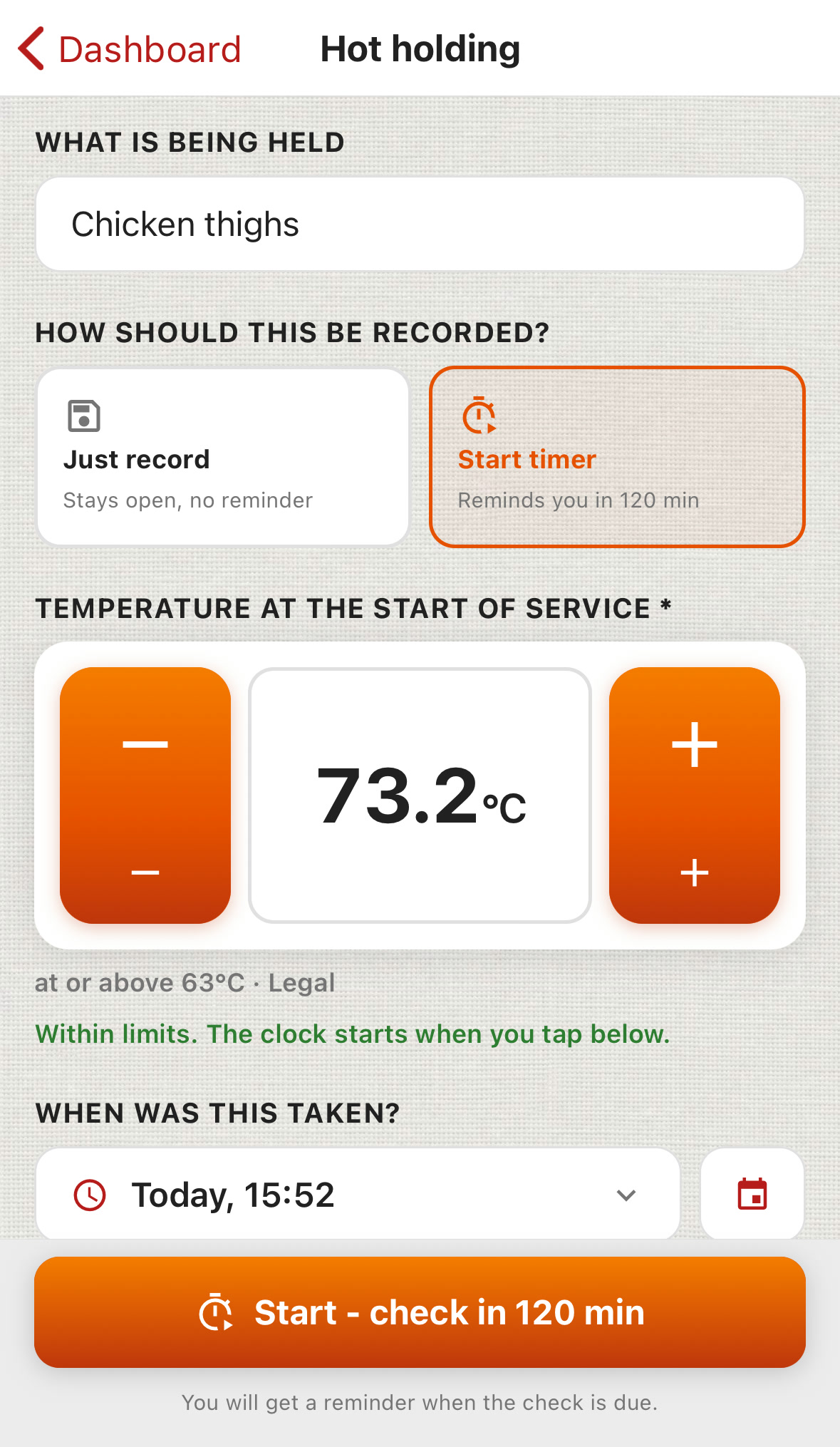
Start the hold. Say what is being held, probe it, and choose Just record or Start timer. The reading is judged against your kitchen's limit straight away - here 63°C, the legal minimum.
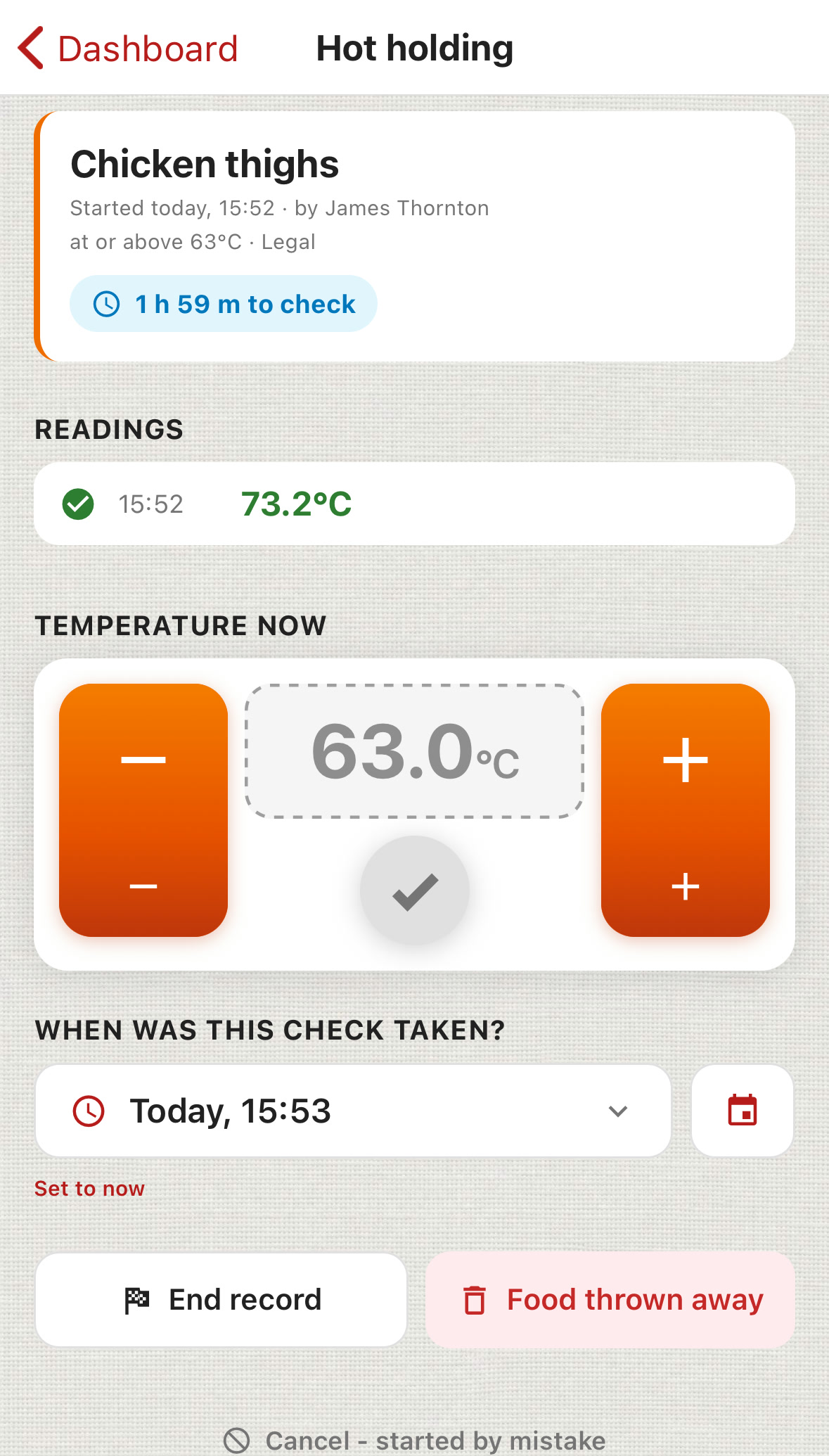
Every check on one record. The record shows who started it, and each reading is saved with its time and who took it. The countdown shows when the next check is due.
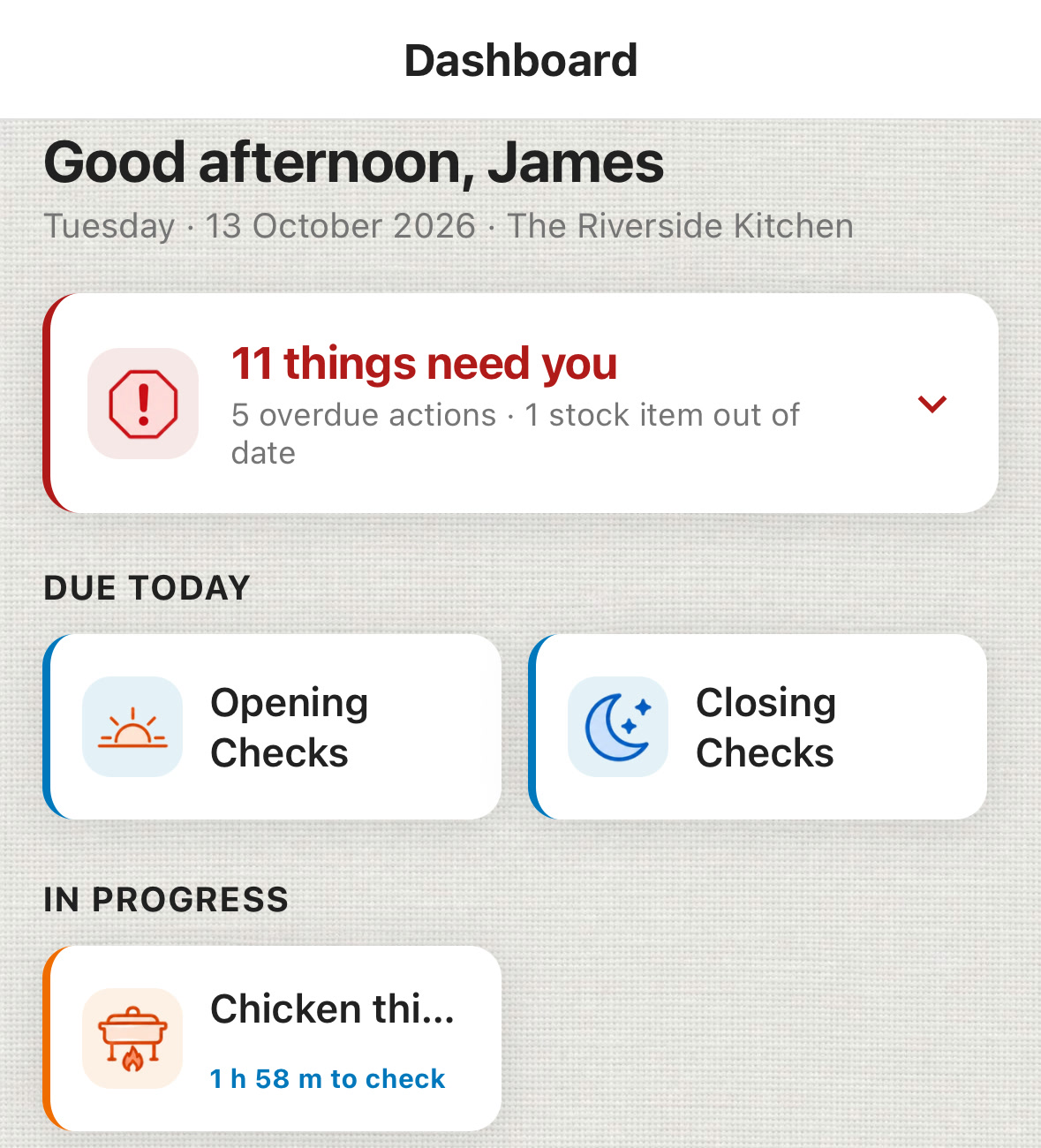
On the Dashboard while service runs. The hold stays under In progress with the time to its next check, so it is not forgotten mid-service.
Recording hot holding is free on every plan, including after the 14-day trial. The Temperature Log report and the Inspection Pack PDF are part of the Standard and Pro plans, and open during the trial. See what else it does.
This is general guidance for UK kitchens, written from the official sources below as published on 13 October 2026. It is not legal advice and does not replace your own food safety management system. If you are unsure, ask your local authority's food safety team.
At 63°C or above in England, Wales and Northern Ireland. That is the law for cooked or reheated food kept hot for service or display. In Scotland, the law says above 63°C, with some exemptions, and CookSafe says hot-held food must be kept above 63°C, so 63°C exactly is not enough.
No. It is below 63°C. In England, Wales and Northern Ireland, food below 63°C is only covered by a defence, such as less than two hours on service or display, once. 60°C and 57°C (140°F and 135°F) are US figures.
No law sets a frequency. You decide and write it into your food safety procedures. A common routine is to probe at least every two hours, because a longer gap means food could have been too cool for longer without anyone knowing.
No. SFBB says hot holding equipment is for hot holding only, not for cooking or reheating. Reheat until steaming hot first, then put it into a preheated unit.
No UK law sets a maximum time for food held at 63°C or above. Quality drops over time, so you can set your own limit for each dish. CookSafe says you may set a maximum time for food on display.
No law names a hot holding log. You must have food safety procedures with records that fit your business. A record of times, temperatures and actions is the usual way to show you kept food hot.