Updated 25 October 2026 - for new UK restaurants, cafes, pubs, takeaways, home caterers and street food businesses
Register your food business with your local council at least 28 days before you start trading. It is free. Once you are registered you can trade before your first inspection, unless your business needs approval. The first inspection may be weeks or several months away: your council decides when, by risk. Officers usually arrive without an appointment. For a business run from home, GOV.UK says the council arranges the visit. Start your records on your first trading day.
Law in all four nations If you sell, cook, store, handle, prepare or distribute food regularly, you must register with your local council. That includes businesses run from home, a van or a market stall, and food given away to the community on a regular and organised basis. Not registering is an offence in all four nations. Some businesses that supply other businesses with meat, fish, egg or dairy products need approval instead, so ask your council.
Register in England, Wales and Northern Ireland: Register a food business on GOV.UK. In Scotland: Food Standards Scotland: registering a food business.
Guidance from some councils Registration is not a licence, a certificate or a food hygiene rating. Your council adds you to its register. Some councils send a letter to say they have it. One says "You do not receive a Certificate of Registration." One council says you "do not have to re-register every year". Law in all four nations You must tell your council about any significant change in what you do, and if you close.
Guidance from some councils Register with the council where the van, trailer or stall is kept overnight, or where it returns to between trading. That council gives your rating. Councils where you trade may also inspect you.
Our advice Selling at a market what you make at home? Register with your home council. Check with it, and with the market, what else they need.
Guidance from some councils Yes, once you are registered. One council puts it plainly: "You do not need to wait for a visit." Another says you can carry on running your business while you wait.
Law in all four nations The registration rules set no inspection before you open. The exception is a business that needs approval, for example one making meat, fish, egg or dairy products for other businesses. It needs approval before it starts.
Your council decides, by risk.
Waiting is common, and it does not mean you have been missed. Not sure your registration went through? Ask your council.
Guidance in England, Wales and Northern Ireland Usually not. GOV.UK: officers "will usually arrive without making an appointment". They "must show you identification" before they start. For a business run from home, GOV.UK says the officer "will make arrangements to visit your home".
Guidance from some councils In Scotland, one council says "Most visits are unannounced, though some may be arranged".
Law in all four nations An officer must give 24 hours' notice before insisting on entry to premises used only as a private home. Ask your council how it handles businesses run from home.
The officer is usually a Food Safety Officer or an Environmental Health Officer from your council, not the Food Standards Agency.
Guidance in England, Wales and Northern Ireland The officer looks at three things: your premises, how hygienically you handle food, and your food safety management system. GOV.UK: "Inspectors are not visiting to find faults or to shut down your business." They give guidance and feedback, and you are usually given a reasonable time to make any changes, unless there is an immediate risk to health.
Guidance from some councils The officer may:
The hygiene rating does not cover the taste, quality or presentation of your food, or your customer service. No source gives how long a visit takes. It depends on the business and what the officer finds. More in our EHO inspection guide.
Law in all four nations The law has a section for homes where food is regularly made to sell. The kitchen must be kept clean and in good repair. Food must be kept safe from contamination, "in particular by animals and pests". Where needed, you must have somewhere to wash and dry your hands, hot or cold drinking water, and a way to keep food at the right temperature.
Guidance from some councils
Our advice Keep business food on its own shelf, or in its own fridge if you can.
Councils differ on hand washing. One says a basin in a downstairs bathroom can be enough for some businesses, and another says you need a basin in the kitchen for hand washing only. Ask your council what it expects for your kitchen. More in our hand wash basins guide.
Guidance in England, Wales and Northern Ireland GOV.UK says you also need "the appropriate permissions in place" to run a business from home.
Our advice You are not expected to have months of records on day one. Start on your first trading day and keep going. A few days of honest records, with any problem and what you did about it, show the officer your plan is in daily use.
Guidance in England, Wales and Northern Ireland England, Wales and Northern Ireland: you are told your rating in writing, at the visit or within 14 days. A 5 goes online once your council uploads it. A 0 to 4 goes online 3 to 5 weeks after the visit, to allow time for an appeal. You have 21 days to appeal, in writing. You can add a right to reply at any time until your next inspection. You can ask for a re-rating visit once you have accepted the rating and made the improvements. Some councils in England charge for it, and every council in Wales and Northern Ireland does.
Guidance from some councils Before the first inspection, some councils in England give new businesses an "awaiting inspection" sticker, or send one if you ask.
Guidance in Scotland Scotland: the result is Pass or Improvement Required. Before your first inspection you get a temporary certificate, and the website shows "Awaiting Inspection". You have 14 days to appeal, in writing to the council's Lead Officer for Food. One revisit is free at the moment, but you cannot choose the date.
Guidance in England, Wales and Northern Ireland GOV.UK says it is "a good idea to ask your local authority for advice" when you are choosing or changing premises. Your council's environmental health team can also advise on food hygiene law. Guidance from some councils Some councils sell an advice visit before you open. The price varies.
Our advice If you are nervous, autistic, or English is not your first language, say so at the start. Ask the officer to slow down, explain things or write them down. You can ask questions at any time. Read the letter afterwards, and ask the council about anything you do not understand.
Paper works, and so does your nation's pack kept on a device. ChefsRecords is an iPhone app for the daily records. Start your records on day one:
What it does not do today: your written food safety plan and allergen matrix are not in the app, it does not help you register, and there is no starter checklist for a business run from home. Would you use a home-kitchen starter checklist? Tell us.
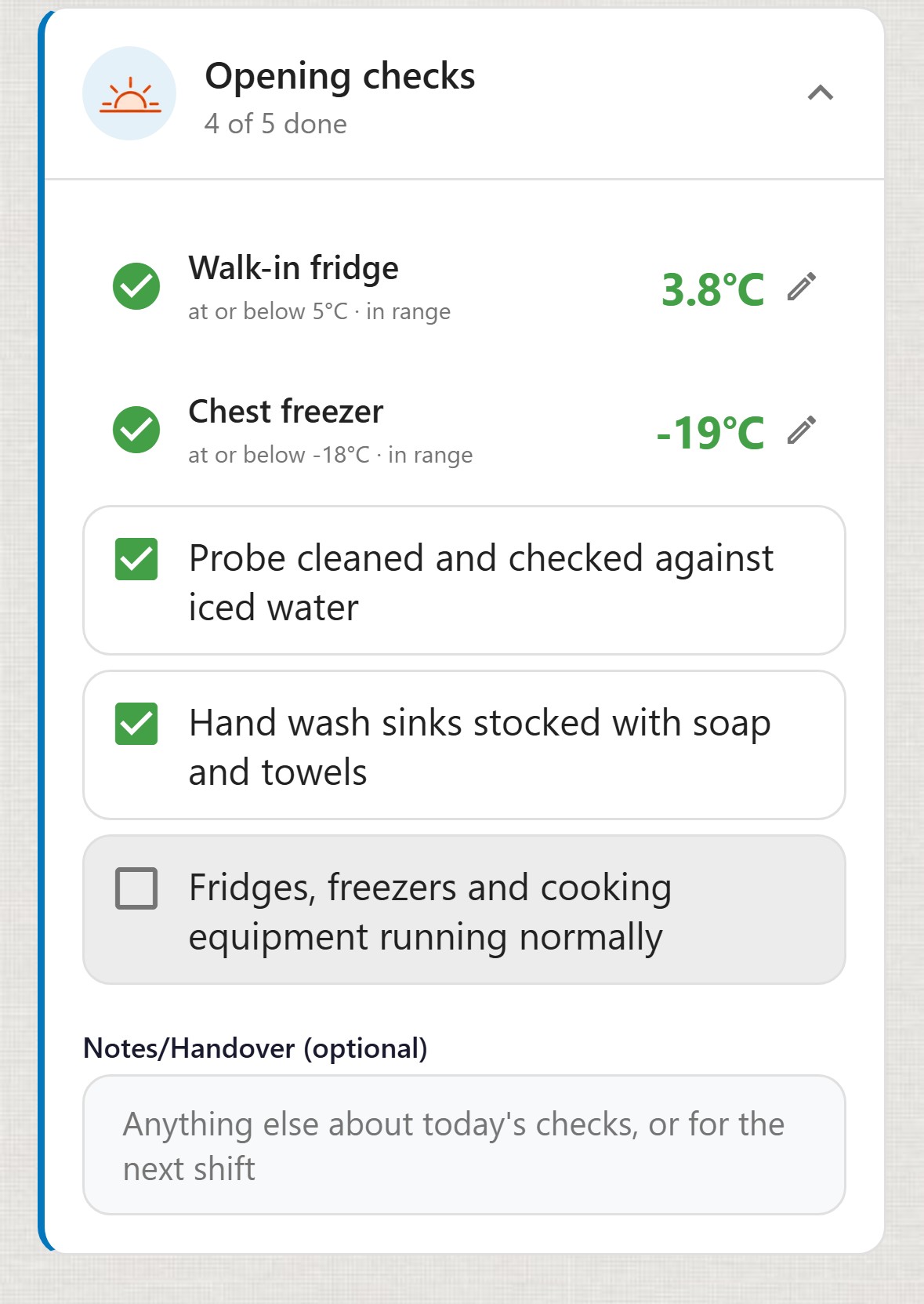
Opening checks, part done. A starter checklist after its lines were changed to fit the kitchen.
Which plan. The 14-day free trial opens checklists, reports and the Inspection Pack. Training and certificate records are part of Pro and are not in the trial. After the trial, cooking, cooling, hot-holding, reheating and delivery temperatures, and up to 20 incidents and near misses (not delivery problems), stay free for one login, the kitchen's billing Manager. Fridge and freezer checks are on checklists, so they need Standard or Pro, as do reports and the Inspection Pack.
Get ChefsRecords on the App Store (iPhone) ›
14 days free. No card required.
This page explains the law and guidance in plain words, from the public sources below as published on 24 October 2026. It is not legal advice. Your council's food team can answer questions about your own kitchen. ChefsRecords is not part of, or endorsed by, the Food Standards Agency, Food Standards Scotland or your local council.
Usually they just turn up during opening hours. For a business run from home, GOV.UK says the council will arrange the visit.
It is common. Councils go to higher-risk businesses first, and GOV.UK says it "may be several months". Keep trading safely and keep your records. If you are not sure your registration went through, ask your council.
GOV.UK and Food Standards Scotland ask you to register at least 28 days before you start trading, so plan for that. Already trading without registering? Register as soon as possible.
Some councils deal with low-risk businesses by phone, email or questionnaire first. Ask your council whether that was your first assessment, and whether a visit is planned.
Low risk can mean you are visited later, or that the council checks by phone or questionnaire. You still have to follow food law and keep your records.
They do not judge how your food tastes. They may watch you work, ask you to show how you do things, and probe food to check it is cooked or kept at a safe temperature. Our advice: carry on as normal.
They may look at whatever is used for the business. That can include the fridge you keep business food in, and where you wash your hands, which might be a bathroom basin. They may check that pets are kept out of the food area. Ask your council what it expects.
Start on day one. Have your written plan, supplier list and training ready. A few days of honest records are fine.
No source gives a time. It depends on the size of the business and what the officer finds.
Yes, you can ask your council for advice. Some councils offer a paid advice visit before you open.
In England, Wales and Northern Ireland, you are told in writing at the visit or within 14 days. Officers usually talk you through what they found before they leave.
Our advice: tell the officer at the start. Ask them to explain, slow down or put things in writing. The visit is meant to help you get it right.
You register where the van or stall is kept. That council gives your rating. Councils where you trade may also inspect you.
No. Registration puts you on the council's list, and some councils do not send a certificate at all. A food hygiene certificate is the result of a training course. Neither is a food hygiene rating.
The EHO inspection guide, the food safety records guide, the food safety management system guide, the food hygiene certificate guide, the digital food safety records guide, the hand wash basins guide, the pest control guide and the kitchen cleaning schedule guide.