Updated 25 October 2026 - for UK restaurants, cafes, pubs, takeaways, carveries and other catering businesses
The core is the centre of the food, the thickest part, the last place to get hot. Here is what the sources say, nation by nation.
No UK law sets a temperature that cooked food must reach. Not in England, Wales, Northern Ireland or Scotland. The law sets holding temperatures instead: 8°C for chilled food in England, Wales and Northern Ireland, and 63°C for hot food (above 63°C in Scotland). Scottish law also sets 82°C for reheating. That 82°C is not a cooking figure.
Law in all four nations For cooking, the law says you must have food safety procedures based on HACCP. You set your own "critical limits", watch them, and take corrective action when something is not under control. You also keep records that fit the size of your business. That is Article 5 of Regulation (EC) 852/2004.
That is why the number in your food safety plan matters. Once you write it down, it is the one you are held to.
The nearest the regulations come to a cooking figure a restaurant is likely to meet is a rule about parasites in fish meant to be eaten raw or almost raw. It is not about bacteria, and it is not a cooking target. See Fish and rare tuna below.
A core temperature works with a time. The hotter the core, the less time it needs. GOV.UK says: "Standard advice is to cook food until it has reached a core temperature of 70°C for 2 minutes." It then lists the other combinations. The FSA's Safer Food, Better Business pack lists the same pairs as "for at least" times, and Scotland's CookSafe has its own list.
Is 70°C for 2 minutes as good as 75°C? Yes. In England, Wales and Northern Ireland both are on the FSA's list, and GOV.UK calls 70°C for 2 minutes the standard advice. The difference is the time: 75°C needs 30 seconds, 70°C needs 2 minutes. In Scotland, CookSafe leads with 75°C or above and accepts 70°C held for at least 2 minutes.
Our advice Pick one target, write it in your food safety plan and use it every time. At 75°C the hold is only 30 seconds, so it is easier to check while the probe is still in. If you work to 70°C, the food must stay at 70°C or above for the full 2 minutes.
Guidance in Northern Ireland Safe Catering, from the FSA in Northern Ireland, says to "Cook food thoroughly to kill food poisoning bacteria", for example "Cook to 75°C or hotter", measured with a probe in the thickest part of the food. It puts no time on the 75°C and lists none of the other pairs. Its SC3 record notes "Core temperature above 75°C". Its other checks include poultry "fully cooked in thickest part of leg" with no pink or red meat or juices, and liquids that "bubble rapidly when stirred".
The pairs above are the same for every food that must be cooked through. What changes is which foods may be served pink, and where to put the probe.
| Food | How to cook it | Where to probe or look |
|---|---|---|
| Poultry: chicken, turkey, duck and other game birds | All the way through, no pink meat. Use one of the pairs above. In Scotland, CookSafe gives 75°C or above as its example. | The thickest part. For a whole bird, between the leg and the breast. Away from the bone: GOV.UK's advice for home cooks, and ours. |
| Pork | UK guidance treats pork like chicken: cooked all the way through, not pink, not rare. | The centre of the thickest part. |
| Minced meat, burgers, sausages, kebabs, meatballs, offal | All the way through, to the same pairs as chicken. Mincing or skewering carries germs from the surface into the middle. Liver and offal, including pate and parfait, are cooked through too. | The centre. Cut into the thickest part: the juices should run clear with no pink meat. |
| Rolled or stuffed joints | Rolled joints must be cooked all the way through. We would treat stuffed joints the same. | The centre of the joint. |
| Whole cuts of beef and lamb: steaks, chops, cutlets, roasting joints | You only need to cook (seal) the surface. The middle can be pink, because germs sit on the outside. Sear every outside surface. | Check that all the outside surfaces are fully cooked. CookSafe also says steaks cooked rare need not reach the core temperature. |
| Fish | The same pairs as other cooked food. The flesh should turn opaque and flake easily with a fork. | The centre, and the colour and texture. |
| Shellfish | Prawns turn from blue-grey to pink. Scallops are milky white and firm. If a mussel or clam shell has not opened during cooking, throw it away. | Look and feel. The FSA pack covers shellfish in more detail. |
| Eggs | Cook until steaming hot. For runny eggs, fresh mayonnaise or mousse, use pasteurised egg, or eggs with the British Lion mark or from the Laid in Britain scheme: the two schemes the FSA and Food Standards Scotland name. Cook duck, goose and quail eggs thoroughly. The FSA pack gives no temperature for eggs. Eggs in a kitchen. | Not applicable. |
| Rice | Cooking does not make rice safe for later. Spores can survive, and reheating will not remove the toxins. Keep it hot at 63°C or above, or cool it fast. | See the cooling guide. |
| Dried pulses such as beans | Follow the instructions on the packaging for soaking and cooking. | Not applicable. |
| Stews, curries, sauces, gravy, soups | Make sure liquid dishes are simmering and stir them often. The largest piece of meat should be cooked to a safe temperature in the centre. | The largest piece. For a large dish or batch, check in several places. |
GOV.UK: "You only need to cook (seal) the surface of whole cuts of beef and lamb, such as steaks, cutlets and roasting joints." Rolled joints, minced meat, burgers, sausages, kebabs, offal, pork, poultry, duck and other game birds are cooked all the way through. Duck and other game birds are cooked through like chicken, to one of the pairs above.
Our advice UK guidance names rolled, minced and skewered meat as cooked through. We would add stuffed, tenderised or injected meat too. Treat them like chicken.
A pink burger is not like a pink steak. Rare burgers are not banned in England, Wales and Northern Ireland, but a business may only serve them under strict extra controls. The FSA has guidance for "less than thoroughly cooked" beef burgers (22 May 2023). A business must tell its local authority before serving them, must have a HACCP-based food safety management system that covers them, and must follow strict supply and cooking controls. FSA guidance says they should not be on children's menus. In Scotland, speak to your council first. If that is not you, cook burgers all the way through.
Rare tuna, sushi and other raw or lightly cooked fish are a different matter. The risk is parasites as well as bacteria. If you serve fish raw or lightly cooked, ask your supplier whether it has been frozen to kill parasites, and check with your council. For rare tuna, the FSA pack also says to sear the outside fully. This page does not give a cooking temperature for that kind of fish.
60°C for 45 minutes is a real UK pair. But a sous vide or low-temperature method needs to be shown to be safe in your food safety plan. The FSA pack lists vacuum packing, sous vide and low-temperature cooking under foods that need extra care, and says to contact the environmental health team at your local council. Talk to your council before you rely on it.
Our advice A reading of 70°C shows the food got to 70°C. It does not show it stayed there. Keep it cooking and probe again after 2 full minutes. Or keep cooking until the centre is 75°C or above, and leave the probe in for 30 seconds to see that it stays there.
The pairs are a temperature held for a time. That is how the sources describe them: "for at least 2 minutes" in the FSA pack, "for a minimum of 2 minutes" in CookSafe.
No law names a cooking log. The law asks for records that fit the nature and size of your business. The FSA pack records by exception: "Write down what went wrong and what you did about it in your diary." CookSafe expects a written cooking record at the frequency you set. That is guidance, not law. A line a head chef can fill in on a phone between services:
| Write down | Why |
|---|---|
| The food or dish | What was checked |
| Type of food, if your targets differ by type | Shows which target applied |
| Core temperature, as a number | A number, not a tick |
| The hold, if you work to 70°C for 2 minutes | One reading does not show it |
| Date and time | When |
| Who took it | So someone can be asked later |
| If it did not reach temperature: what was done | Cooked longer, smaller batches, equipment fixed, thrown away |
| A manager's check | Someone reviews the records |
Many cooking charts online are American: 74°C (165°F) for chicken, 71°C (160°F) for minced meat, 63°C (145°F) with a 3 minute rest for pork, and 63°C (145°F) for fish. This is why American sites say pork can be pink. UK guidance does not. The "2 hour / 4 hour rule" is Australian. None of these is the UK standard. Check where a chart comes from before you put it on your wall.
Australia also uses a danger zone of 5°C to 60°C. The FSA's figures are 8°C and 63°C. Our danger zone guide has them.
There is no published list. These are questions we would expect, based on the sources above:
Our EHO inspection guide covers the rest of the visit.
Cooking is one step. Reheating means cooking food again, not just warming it up: see the reheating guide. Once food is cooked and kept hot, the hot holding guide covers 63°C. If it is going to be eaten later, the cooling guide covers cooling and rice.
Paper works: the FSA pack, Safe Catering and CookSafe are free.
Why kitchens move off paper:
In ChefsRecords, a cooking check is one record. Type what you cooked and the app suggests the type of food. You can change it. Poultry, pork, minced meat and fish start at 75°C, and you can choose 70°C held for 2 minutes instead in Temperature limits. On a 70°C target, a reading from 70°C to under 75°C needs you to tick that it was held at 70°C or above for 2 minutes. The tick is your word. The app does not time the 2 minutes. At 75°C or above, one reading is enough to save. The app does not time the 30 seconds either.
A steak, chop or joint of beef or lamb has its core temperature recorded but not judged, because it can be pink. The app does not record the sear.
If the reading is under your target, the app does not save it. The record shows the reading that passed, not the low one before it. It tells you to keep cooking and probe the thickest part again. If it will not get there, you can record it as thrown away. Every reading keeps the time and who took it, even without signal.
The app does not support rare burgers, sous vide, rare tuna or raw fish. Ask your council's food safety team about any of these.
When an inspector asks for your records, the Inspection Pack lists your cooking targets and whether your kitchen set each one. Recording is included on every plan. After the 14-day trial, the free plan keeps it for one login, the kitchen's billing Manager. Reports and PDFs need a plan.
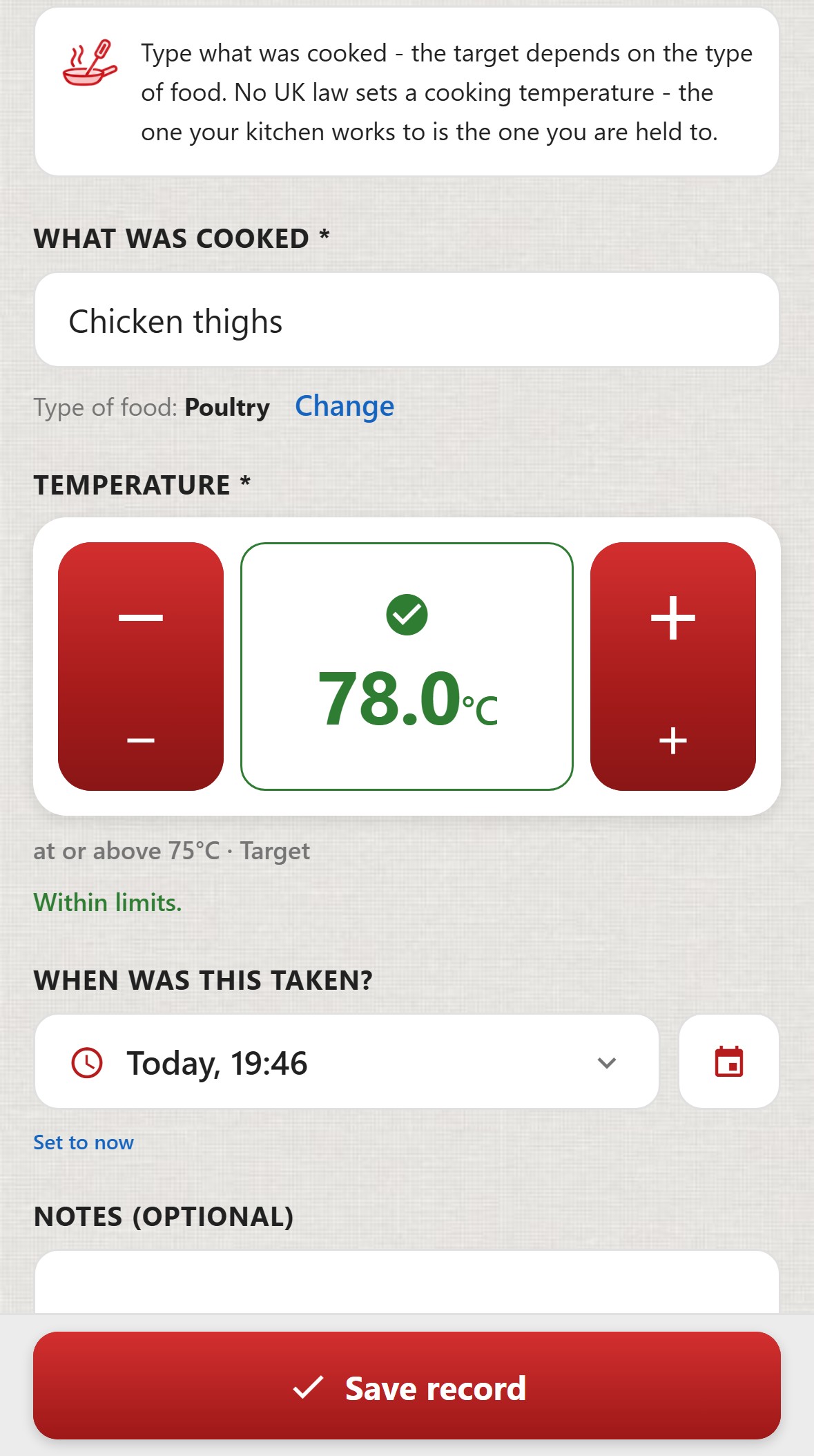
Probe the thickest part and save. Type what you cooked and the app suggests the type of food, here Poultry. At 78.0°C, above the 75°C target, it says within limits and the record can be saved.
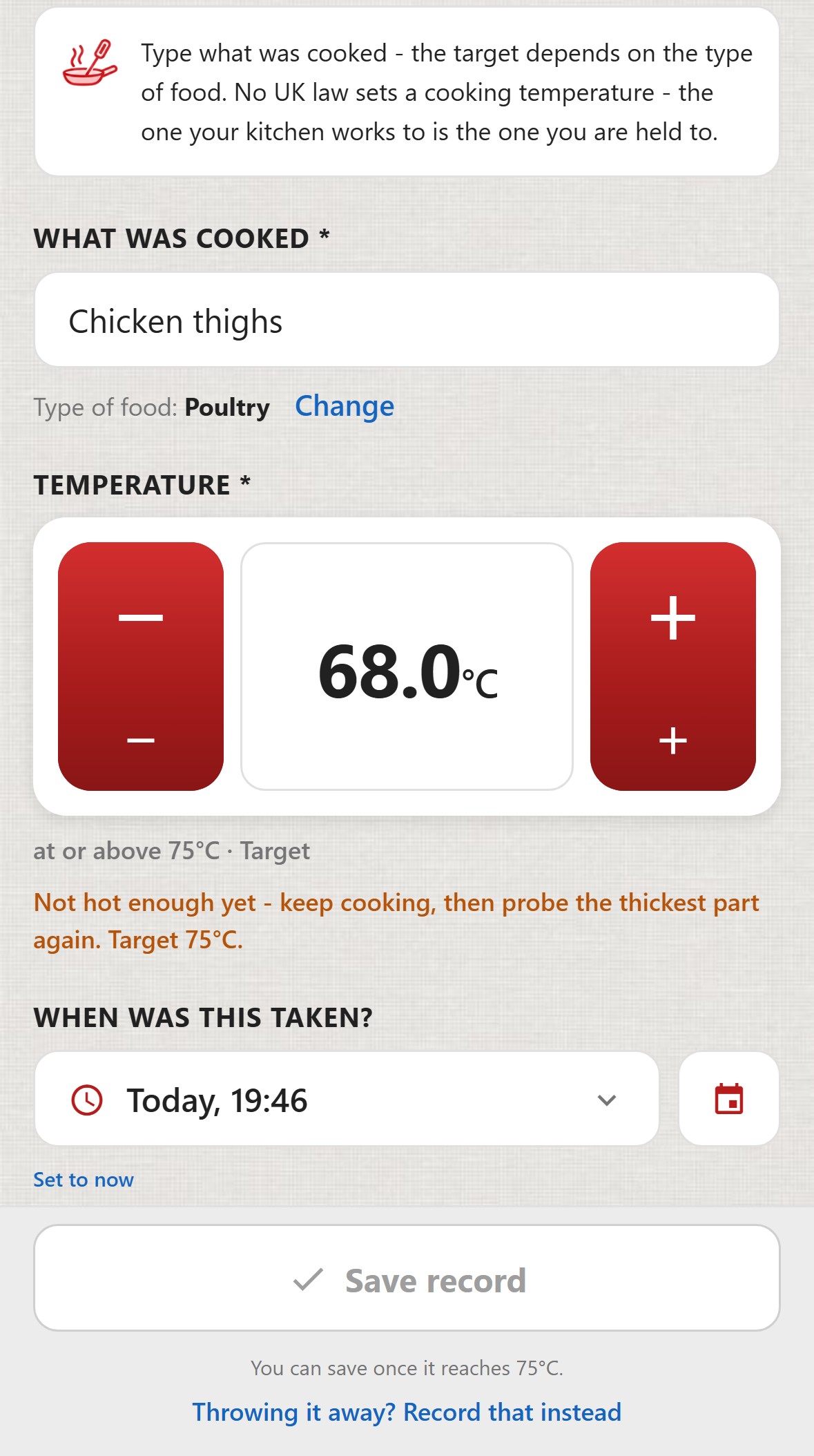
Not hot enough yet. At 68.0°C the app does not save the reading. It tells you to keep cooking and probe again, and Save stays off until the reading reaches the target. If the food will not get there, you can record it as thrown away.
Get ChefsRecords on the App Store (iPhone) ›
14 days free. No card required.
This is general guidance for UK kitchens, written from the public sources below as published on 19 October 2026. It is not legal advice and does not replace your own food safety management system. If you are unsure, ask your local authority's food safety team. ChefsRecords is not part of, or endorsed by, the Food Standards Agency, Food Standards Scotland or your local council.
No law sets one. FSA guidance for England, Wales and Northern Ireland: a core temperature of 70°C for 2 minutes, or 75°C for 30 seconds, 80°C for 6 seconds, 65°C for 10 minutes or 60°C for 45 minutes. In Scotland, CookSafe says 75°C or above, and accepts lower temperatures if held for the time.
Yes, in England, Wales and Northern Ireland. Both are on the FSA's list: 75°C for 30 seconds and 70°C for 2 minutes. GOV.UK calls 70°C for 2 minutes the standard advice.
Yes, if the thickest part stays at 70°C or above for 2 minutes. That is the FSA's standard advice in England, Wales and Northern Ireland, and one of CookSafe's pairs in Scotland. A quick reading of 70°C is not enough on its own. Keep cooking and probe again after 2 minutes, or take it to 75°C. If you have seen 74°C or 165°F, that is the American figure.
Not from one reading. In the UK, 60°C counts only if the centre stays at 60°C for 45 minutes. That is a low-temperature or sous vide method a kitchen has to show is safe in its plan. UK guidance says pork is cooked all the way through and not served pink or rare. The American advice of 63°C (145°F) with a 3 minute rest is not UK guidance.
All the way through, to the same pairs as chicken: for example 70°C for 2 minutes. Mincing and skewering carry germs from the surface into the middle. Cut into the thickest part to check that the juices run clear and there is no pink meat.
Whole cuts can: steaks, cutlets, chops and roasting joints, if every outside surface is sealed. Rolled joints, minced meat, burgers, sausages, kebabs and offal cannot. They are cooked all the way through.
In England, Wales and Northern Ireland only with strict extra controls. The business tells its council first, follows FSA guidance on supply and cooking, and has a HACCP-based plan that covers it. In Scotland, speak to your council first. If that is not you, cook burgers all the way through.
The same pairs as other cooked food, and the flesh should turn opaque and flake. For rare tuna, the FSA pack says the fish must have been frozen to kill parasites and fully seared on the outside. For raw fish such as sushi, ask your supplier whether it was frozen to kill parasites, and check with your council. The 63°C (145°F) figure for fish is American.
No law in any of the four nations sets one. On cooking, Scotland differs in two ways: CookSafe leads with 75°C or above, and Scottish law sets 82°C for reheating, which is not a cooking figure. Scotland's rules on chilled and hot food differ too: see the danger zone guide.
In the centre of the food, or the thickest part. Keep the tip away from bone: GOV.UK gives that advice to home cooks, and we give it too. For a whole bird, between the leg and the breast. For a large batch, check in several places. Use a clean probe.
It is Australian guidance, not a UK rule. It counts total time between 5°C and 60°C. The UK has its own rules. In England, Wales and Northern Ireland the law has two once-only defences for food on service or display: hot food kept below 63°C for less than 2 hours, and chilled food kept above 8°C for less than 4 hours. Each is a defence, not a permission. The business has to be able to show it. After 2 hours, GOV.UK says cool hot food as quickly as possible to 8°C or below, or throw it away. Chilled food out for more than 4 hours is thrown away (the FSA pack). Scotland has neither defence. Its law has different exemptions, and sets no fridge temperature. See the hot holding guide.
In a kitchen, no. Throw it away. We know of no UK guidance that allows cooked food to sit at room temperature for anything like 12 hours. In England, Wales and Northern Ireland, hot food can be below 63°C for less than 2 hours, once. Then cool it fast or throw it away. Reheating will not fix it: some bacteria, such as those in rice, leave toxins that heat does not destroy.
The food, the core temperature as a number, the date and time, and who took it. If it did not reach temperature, write down what you did. If you work to 70°C for 2 minutes, note the hold.
Your food safety plan should describe what your kitchen really does, including the cooking target you chose. The free food safety plan builder takes you through safe methods based on the FSA pack, so you can write them in your own words, then prints your plan or saves it as a PDF. For small restaurants, cafes, pubs and takeaways in England and Wales.
The reheating guide, the hot holding guide, the cooling food guide, the danger zone guide, the probe check guide and the EHO inspection guide. And our 4Cs of food hygiene guide, which brings the basics together. More guides: the eggs guide and the Christmas kitchen guide.