Updated 13 October 2026 - for UK restaurants, cafes, pubs, takeaways and other catering businesses
The Health and Safety Executive's guide to investigating accidents and incidents, HSG245, defines a near miss as "an event that, while not causing harm, has the potential to cause injury or ill health". An accident is an event that does cause injury or ill health.
The difference is often luck. HSG245 puts it this way: "It is often pure luck that determines whether an undesired circumstance translates into a near miss or accident." The same wet floor can cause a near miss on Monday and a broken wrist on Tuesday.
"Near miss" is a health and safety term, but kitchens use it just as much for food safety: a problem caught before food reached a customer. This guide covers both.
| Term | What it means |
|---|---|
| Near miss | Could have caused harm, but did not. Caught in time, or lucky. |
| Accident | Caused an injury or ill health. |
| Incident | In HSG245, the word for near misses and unsafe conditions. Many kitchens use "incident" for anything that went wrong. |
| Dangerous occurrence | One of a short list of serious events that must be reported under RIDDOR even if no one was hurt, such as a fire that stops work for more than 24 hours. |
Not in general. HSE says: "There is no legal requirement to record near misses; however, you do have a legal duty to protect the health and safety of your employees and members of the public who may be affected by work activities."
Three things still point towards writing them down:
| Near miss | What to do next |
|---|---|
| An allergen order caught at the pass with the wrong sauce or garnish | Remake it. Check how the order reached the kitchen and how it was marked. |
| Wrong allergen information given, corrected before the customer ate | Check the allergen matrix and recipe cards match what is being cooked. |
| A supplier substitution with a new allergen, found on the label | Update your allergen information before it is used. Tell the team. |
| Raw meat stored above ready-to-eat food | Move it. If raw juices could have reached the food below, throw that food away. Look at fridge layout. |
| Food past its use-by date found before use | Throw it away. Look at stock rotation and labels. |
| A fridge or hot hold reading out of range, caught before service | Follow your corrective action. Check the equipment. |
| Cooked food left out to cool for too long | If you cannot be sure it is safe, throw it away. Look at portion sizes and how you chill food. |
| Droppings or gnawed packs found | Remove affected food, clean, call pest control. |
| A foreign body (glass, plaster, wire) found during prep | Throw the food away. Find where it came from. |
| A chilled delivery arriving warm or damaged | Reject it and tell the supplier. |
| A cleaning spray used next to open food | Stop, decide whether the food is safe, keep chemicals away from food. |
The FSA's allergen checklist is a good prompt for allergen near misses. It asks how a customer's allergen-free order is recorded and passed to the kitchen, whether you have a spillage policy, what happens when a supplier substitutes an ingredient, and what staff should do if a customer has an allergic reaction.
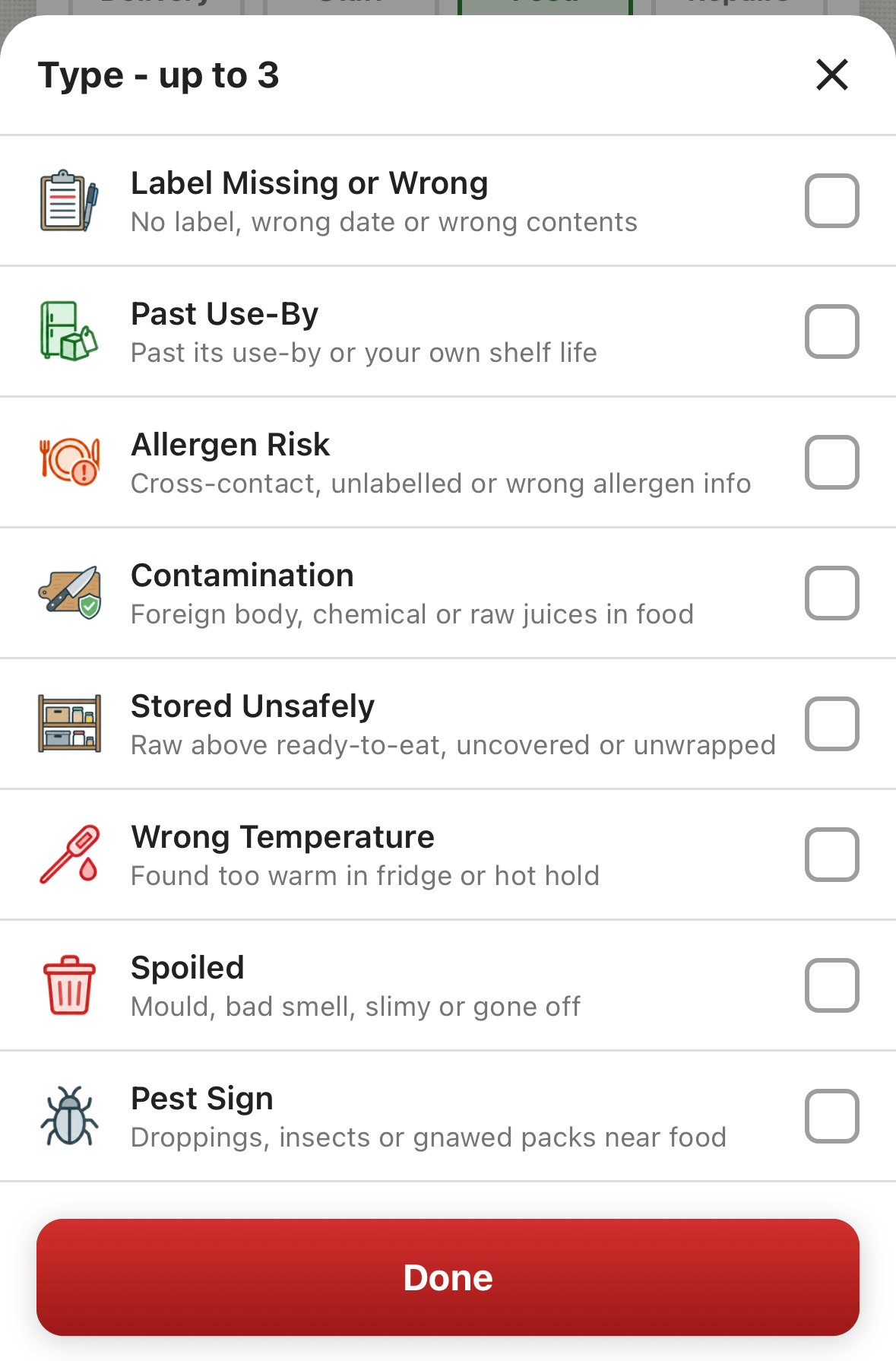
Food problems, ready to pick. In ChefsRecords, each category has its own list of types, so a near miss is quick to log and easy to count later.
HSE says slips and trips "remain the single most common cause of major injury in UK workplaces", and that spills from food or cooking are among the main causes of slips in kitchens. Knives, lifting and contact with cleaning products are the other common catering risks.
| Near miss | What to do next |
|---|---|
| Someone slips on a wet floor or spill but does not fall | Clean it up, find the source of the water or grease, check floor and footwear. |
| Boxes or a delivery left in a walkway | Clear it. Agree where deliveries go. |
| A knife left loose on a worktop or in a sink of water | Put it away safely. Remind the team how knives are stored and carried. |
| Fryer oil nearly spilled while emptying | Follow the maker's instructions for emptying, and look at the equipment used. |
| A hot pan or tray nearly knocked over | Look at where hot items are put down and how busy that spot is. |
| A heavy stock pot or delivery lifted badly | Split the load or use a trolley. Ask about aches and pains early. |
| A cleaning chemical decanted into an unlabelled bottle | If you know for certain what it is, label it. If not, do not guess: dispose of it as the product's safety data sheet says. Keep chemicals in the supplier's labelled containers. |
| A gas smell or a faulty appliance flame | Call your gas emergency number straight away and follow their advice. Do not use the appliance again until a Gas Safe registered engineer has checked it. |
| A fire exit blocked by stock | Clear it straight away. In England and Wales, fire law says exits must be kept clear at all times. Scotland and Northern Ireland have their own fire safety law. |
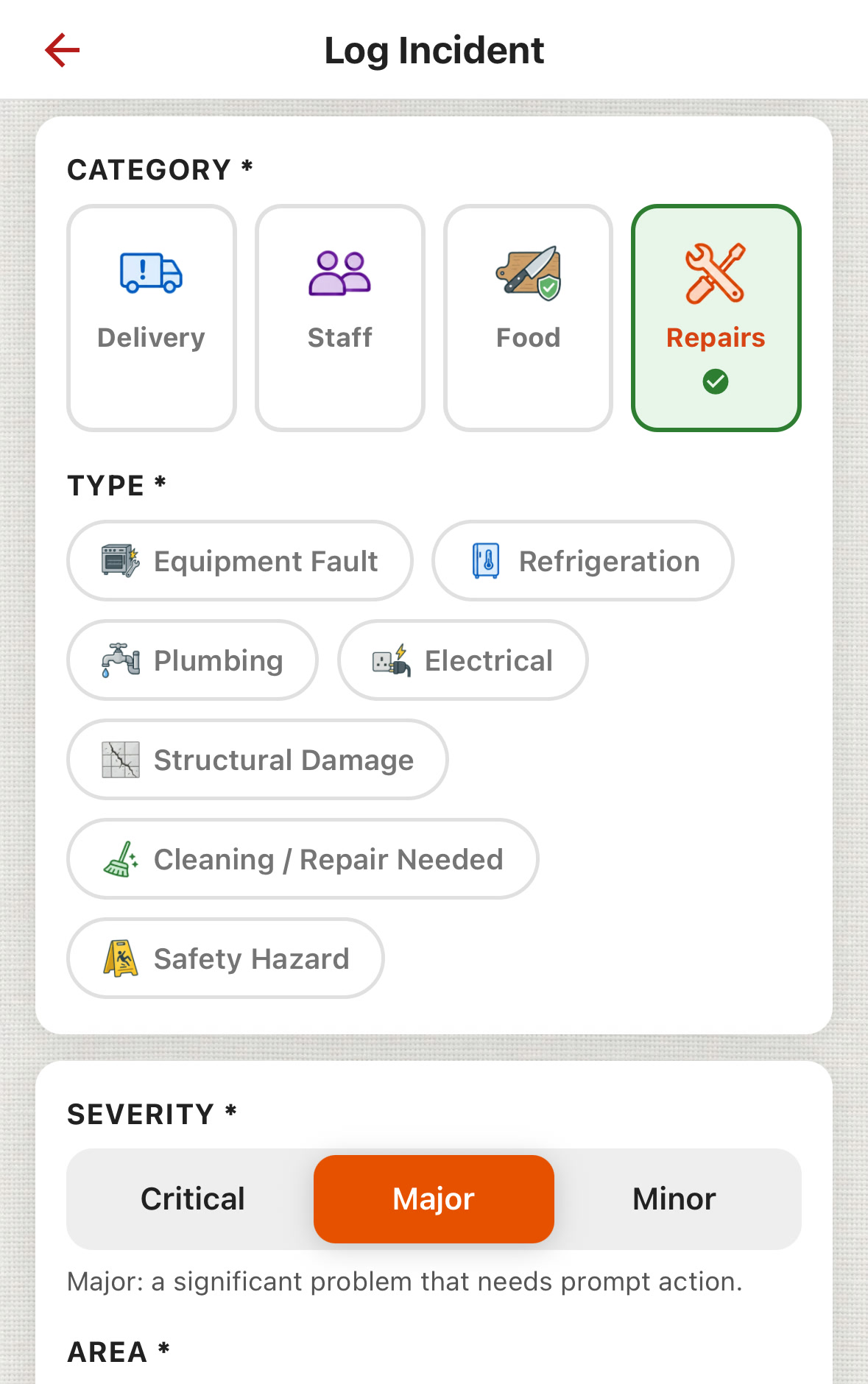
Equipment and hazards. Faults, leaks and safety hazards go under Repairs, with a severity that sets how soon it should be dealt with.
The Reporting of Injuries, Diseases and Dangerous Occurrences Regulations 2013 (RIDDOR) apply in Great Britain. The employer or the person in control of the premises reports, not the injured person. In a kitchen, these are the ones most likely to apply:
Most reports are made online on HSE's website. Injuries that keep a worker off normal work for more than three days in a row, but not more than seven, must be recorded but do not need to be reported. Keep RIDDOR records for at least three years. For most restaurants, cafes and pubs, the council's environmental health team is the enforcing authority for health and safety, so the same council that inspects your food hygiene may follow up.
Gas: RIDDOR's special gas reporting duties fall on gas suppliers and Gas Safe registered engineers, not on the restaurant. If someone is hurt, or a gas fire or explosion stops work for more than 24 hours, the normal rules above still apply. If you smell gas, call the gas emergency number straight away.
In Great Britain, an employer with 10 or more people normally employed at the same time at the same premises must keep an accident book, on paper or electronically, and keep each record for at least three years. It records injuries to employees, not near misses. Injury details are health information, so store them securely.
A near miss caught in the kitchen is your own record. Once unsafe food has left your control or may have harmed a customer, food law can require you to withdraw it and tell the authorities. If that happens, talk to your council's food team straight away.
Northern Ireland has its own RIDDOR (1997). The enforcing authority is HSENI or the local council, and HSENI accepts reports and passes them on where the council enforces. One real difference: over-three-day injuries are reported in Northern Ireland, not just recorded. HSENI calls dangerous occurrences "near miss accidents".
No law sets out a near-miss form. A useful record answers:
| Record | Why it matters |
|---|---|
| What happened, and what could have happened | The second part is the point of a near miss: how bad it could have been. |
| Date, time and place | "Pass, Saturday dinner" shows where and when the pressure was. |
| Who found it | So questions can be answered later. Name others only if you need to. |
| What was done straight away | Made safe, moved, thrown away, remade. |
| Why it happened | The cause, not the culprit: a crowded fridge, a missing label, a rushed handover. |
| What will stop it happening again, who, and by when | A near miss without an action is just a story. |
| Who checked the fix worked | Closes the loop. |
People only report near misses if it is safe to. HSE's guidance on human failure says investigations "should seek to identify why individuals have failed rather than stopping at 'operator error'". A chef who says "I nearly sent the wrong dish to table 6" is giving you free information. If that ends in a telling off, the next one will not be reported.
One near miss is a warning. Three of the same is a pattern. HSE's Near-miss Book says "A pattern of near misses provides an early warning that something needs attention." SFBB's 4-weekly review asks whether you had a serious problem, or the same thing went wrong three times or more, and if so to find out why and record what you did to resolve it. It should be done even when nothing has gone wrong.
Look at where near misses happen, which shift, and what kind they are. A cluster of allergen near misses on Saturday nights says more than any single report.
Paper works. HSE sells a Near-miss Book, and the SFBB diary is free. An app helps when several people report, the manager is not always on site, or you want to see patterns without reading every page.
In ChefsRecords, a near miss is logged on the same form as an incident. Tap Log Incident, choose Near Miss at the top, then pick the category and type, how bad it could have been, where it happened, and describe it. There is no separate time box, so put the time or shift in the description. Add a photo of the hazard if it helps. It saves even with no signal, and the app records who logged it and when.
It stays open, with a date to act by, until someone writes what was done and who checked the fix worked. Then it can be closed. Repeats of the same problem in the same named area within 30 days are flagged, and near misses appear, marked as near misses, in the Incident Log, the Near Miss report and the Inspection Pack.
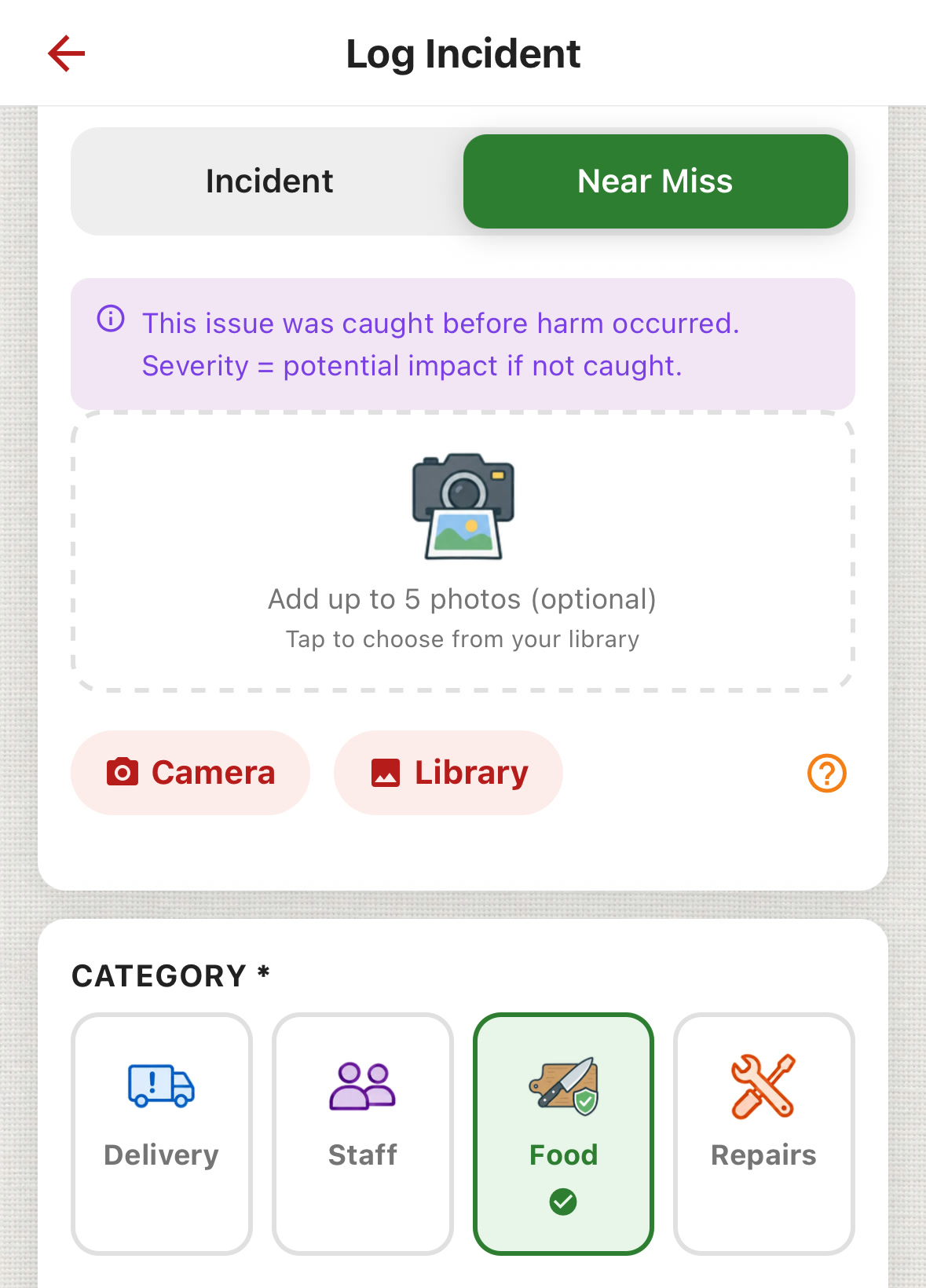
Choose Near Miss. The app reminds you that severity means how bad it could have been, not what happened.
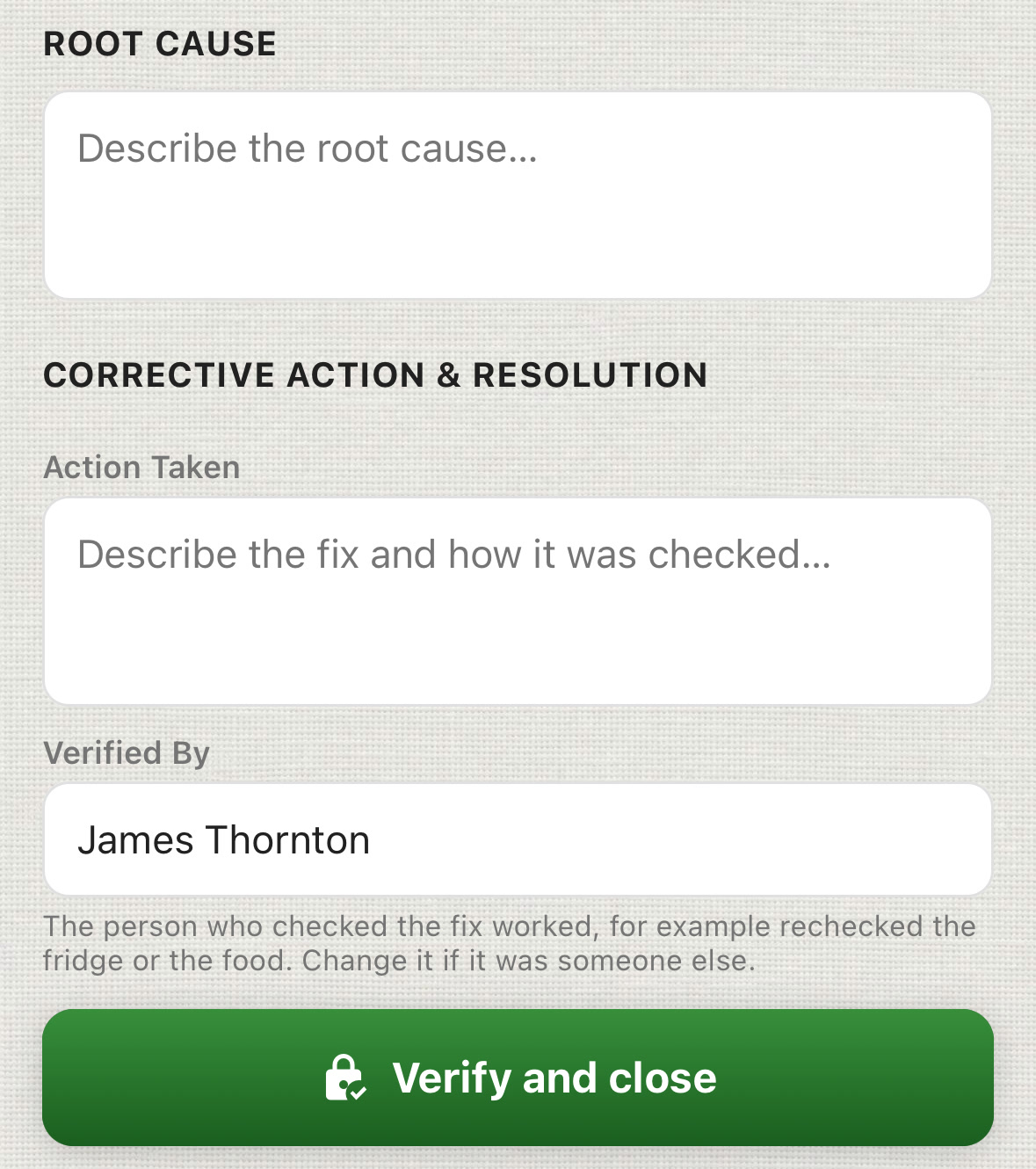
Closed only when it is fixed. Write what was done and who checked it worked, then verify and close. Staff records have a separate root cause box; on others, put the cause in the description or the action taken.
The app is not an accident book and does not report anything to HSE, your council or the FSA. Injuries still go in your accident book, and RIDDOR reports are made on HSE's website.
Logging incidents and near misses is on every plan, and the free plan keeps up to 20 records. Reports, including the Inspection Pack PDF, are part of the Standard and Pro plans, and open during the 14-day trial. See what else it does.
This is general guidance for UK kitchens, written from the official sources below as published on 13 October 2026. It is not legal advice. If you are unsure whether something must be reported, check HSE's RIDDOR pages or ask your local authority.
Something that could have hurt someone or made food unsafe, but was caught first. For example, an allergen dish stopped at the pass, or a slip on a wet floor without a fall.
Not in general. HSE says there is no legal requirement to record near misses, though you must protect staff and customers. A few serious events, called dangerous occurrences, must be reported under RIDDOR.
No. The accident book is for injuries. Keep near misses in a separate log or app.
Only if it is a dangerous occurrence on RIDDOR's list, such as a fire that stops work for more than 24 hours. Most kitchen near misses are not. In Northern Ireland, reports go to HSENI.
What happened and what could have happened, when and where, who found it, what was done straight away, why it happened, what will stop it again, and who checked the fix worked.
When unsafe food has left your control or may have harmed a customer. Talk to your council's food team. A problem caught in the kitchen is your own record.