
Updated 14 November 2026 - for UK restaurants, cafes, pubs, takeaways, carveries and other catering businesses
Once a month, walk your own kitchen the way an inspector may: the hand basin, every section and the serving area, fridges, cleaning, the raw section, equipment, the building and the store. Then read your records and ask the team a few questions. Anything that could make food unsafe is put right now, or stops being used until it is.
Print the one-page inspection checklist (PDF) › The same ground as 38 tick boxes, to take round with you.
Pick a day each month and walk the kitchen with fresh eyes, as if you had never worked there. Take the person who runs each section with you if you can: they know where the problems hide. Write down what you find as you go.
The stops, in order:
Our advice Once a month, and again after anything big changes: a new menu, new staff, building work, a new supplier. If you use the FSA pack, its 4-weekly review is a good day for it.
This is our list, not the council's. Inspectors may look at things that are not on it, and in a different order.
Chef Łukasz Babral, on what he has seen at inspections. His experience, not a rule: every officer works their own way.
Broadly, the stops on this page follow the order I have seen officers go round a kitchen. I have seen officers start with the paperwork, and others go straight to the hand basin. I have also seen the questions start from the moment they walked in.
Where an officer found something that worried them, I have seen them check the rest of the kitchen more closely. A walk-round of your own each month is how you find it before they do.
The visit as I have seen it, in short: what I have seen inspectors check, in order.
An inspector may ask for your records first, or walk into the kitchen and leave the paperwork for later. Be ready for both.
"Can I see your food safety plan?" or "Who is in charge today?"
Put the plan and the current records in one agreed place, and tell every shift where it is. If the plan no longer matches the menu, note what changed and update it this week.
More: our food safety management system guide and our food safety records guide.
An officer may wash their hands before anything else, so the basin may be the first thing they check.
Law in all four nations Basins kept for cleaning hands, with hot and cold running water, something to clean hands with and a hygienic way to dry them.
Whoever is near the basin: "When do you wash your hands, and how?"
Restock it and clear it now. If one basin has no hot water, report the fault straight away, write down the date, and make sure staff can reach another working basin until it is fixed. Our advice If there is no hot water anywhere in the kitchen, stop preparing food until it is back, and ask your council's food safety team if you are unsure.
More: our hand wash basins guide.
Walk each section in turn, then the pass and wherever food reaches the customer: the counter, the carvery, the bar if food goes out from it.
The cook on a section what they are doing and why, or how hot food on the pass is checked.
Clean, cover or move what you found. Give each section's clean-down a named person on the cleaning schedule.
More: our hot holding guide, our kitchen hygiene rules guide and our chopping board colours guide.
Open every fridge and pick up five things at random, as an officer might.
Chilled food at 8°C or below is the law in England, Wales and Northern Ireland, and 5°C or below is the guidance. In Scotland the law sets no number: CookSafe recommends 5°C or below. Our fridge temperature log guide has the detail for each nation.
"What is this, and when was it made?" about a tub with no label.
Anything past its use-by date, or that nobody can name or date, goes in the bin. Move raw food to the bottom. A fridge running warm: follow your plan for a warm fridge and write down what you did. If you have no plan for it, probe the food, move it to a working fridge, and write down the readings and what you did. If you are unsure whether food is still safe, throw it away. Write a warm-fridge plan this week.
More: our food shelf life guide and our stock rotation guide.
A kitchen cleaned for the day looks different from one cleaned every day. Look in the places a quick wipe misses.
To see the cleaning schedule, or which product you use on this surface and how long you leave it on.
Clean it now, then add it to the schedule by name with how often and who does it.
More: our kitchen cleaning schedule guide.
Wherever raw meat, fish or unwashed vegetables are handled. Ask: does it have everything it needs to keep raw food away from food that will not be cooked again?
Keeping complex equipment apart comes from GOV.UK's E. coli cross-contamination guidance for England, Wales and Northern Ireland. Scotland has its own version from Food Standards Scotland.
"How do you stop raw meat juices reaching cooked food?" or "Which board is for what?"
Separate it now. If you are short of boards, clean and then disinfect between raw and ready-to-eat work until new ones arrive. If a slicer or vacuum packer has been used for both, take it apart, clean and disinfect it, then keep it for one job only, raw or ready-to-eat, until you have a second one.
More: our cross-contamination guide and our BS EN 1276 disinfectants guide.
Is everything in good condition, and does it work?
The probe check in the FSA pack: -1 to 1°C in iced water, 99 to 101°C in boiling water.
"When was the probe last checked?"
Throw away broken small items. Take damaged equipment out of use, label it, and log the repair.
More: our probe check guide and our physical contamination guide.
Look up and along the walls. The question is not whether it looks old, but whether damage could reach food.
What is being done about the damage, and when it was reported.
Move or cover food under the damage, or stop using that spot. Report the repair in writing with the date and a photo. Signs of pests: stop using the area, throw away any food that may have been touched, and call a pest control contractor today. Where the building is not yours, the repair can be the landlord's or the client's job. Food law still holds the business running the kitchen responsible, whoever pays for the repair.
More: our physical contamination guide and our pest control guide.
Go to the back of every shelf in the dry store.
A jar of spice past its best-before date at the back of a shelf is an easy find. Best-before is about quality, not safety, so it is not an offence. It can still tell an officer that nobody is checking the stock. Use-by is different: food past its use-by date must not be used or sold.
About a jar they have just picked up from the back.
Bring older stock to the front, throw away anything past its use-by date, and decide whether anything past its best-before is still good enough to use. Next time, buy smaller packs of what moves slowly.
More: our stock rotation guide.
Read last month's records as a stranger would, in the kitchen or in the office.
"Show me last week's fridge readings" or "This one says 9°C. What did you do?"
Never fill in a missed reading from memory. Write that it was missed and why, and what changes so it is not missed again. An honest note of a missed check does more for you than a sheet with no gaps.
More: our food safety records guide, our near miss guide and our allergen matrix guide.
Ask two or three people on shift, not only the chef in charge. Whoever an officer asks needs to know the answer.
The dose and the time for each chemical, and for salad wash, are on its label. Staff should know them for what they use, and check the label when they are not sure.
Show them on the spot, using the label. Put the dilution and contact time next to each product, and go over one question at each briefing until everyone has it.
More: our disinfectants guide, our two-stage cleaning section and our staff sickness guide.
The walk-round works in all four nations. What changes is the result of the visit, the pack you follow and a few numbers.
| What | England, Wales and Northern Ireland | Scotland |
|---|---|---|
| Result of the visit | A food hygiene rating from 0 to 5. The weakest of the three scores can cap it. Showing it is law in Wales and Northern Ireland, a choice in England | Pass or Improvement Required, under the Food Hygiene Information Scheme |
| The pack most kitchens use | The FSA pack in England and Wales. Safe Catering in Northern Ireland, which has its own hygiene inspection checklist (SC5) | CookSafe |
| Fridges | 8°C or below (law). 5°C or below (guidance) | No number in law. CookSafe recommends 5°C or below |
| Hot holding | 63°C or above (law) | Above 63°C (law) |
| Reheating | Steaming hot all the way through (guidance) | 82°C or above, unless that would spoil the food (law) |
No checklist can promise a rating or a Pass. The officer decides on what they find on the day.
If the council has already visited, its letter says what to put right and by when. What happens after a visit, and how to ask for a re-rating, is in our EHO inspection guide.
The printed checklist and a pen work. An app helps when the walk-round has to happen every month whoever is on shift, and when what it finds has to be followed up.

A checklist on the phone. This one is the day's cleaning, 5 of 12 done. A monthly walk-round can be set up as a checklist in the same way.
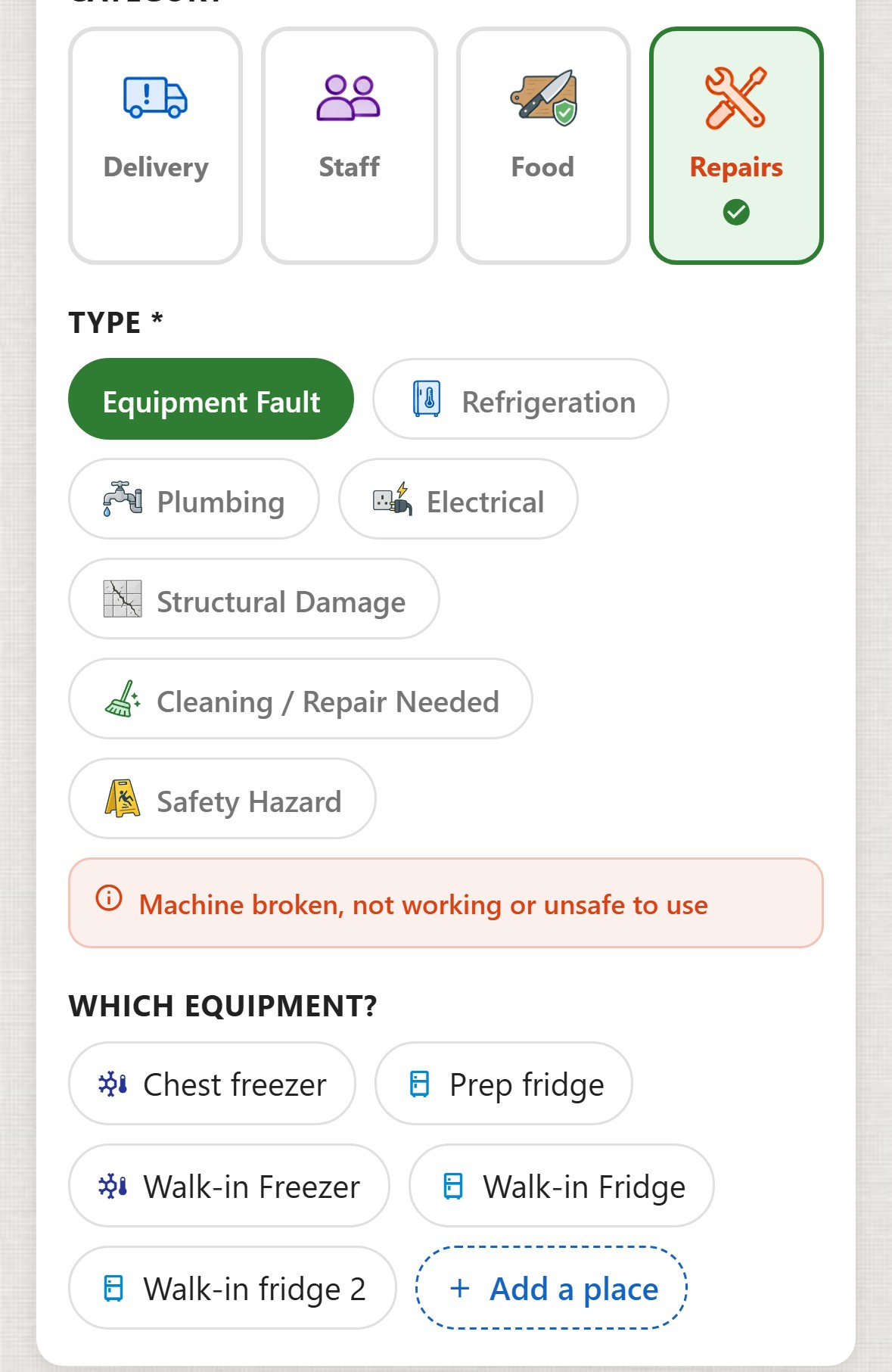
A repair, logged. Equipment faults and damage to the building go under Repairs, with the equipment named and photos added. It stays open until a Manager or Supervisor closes it.
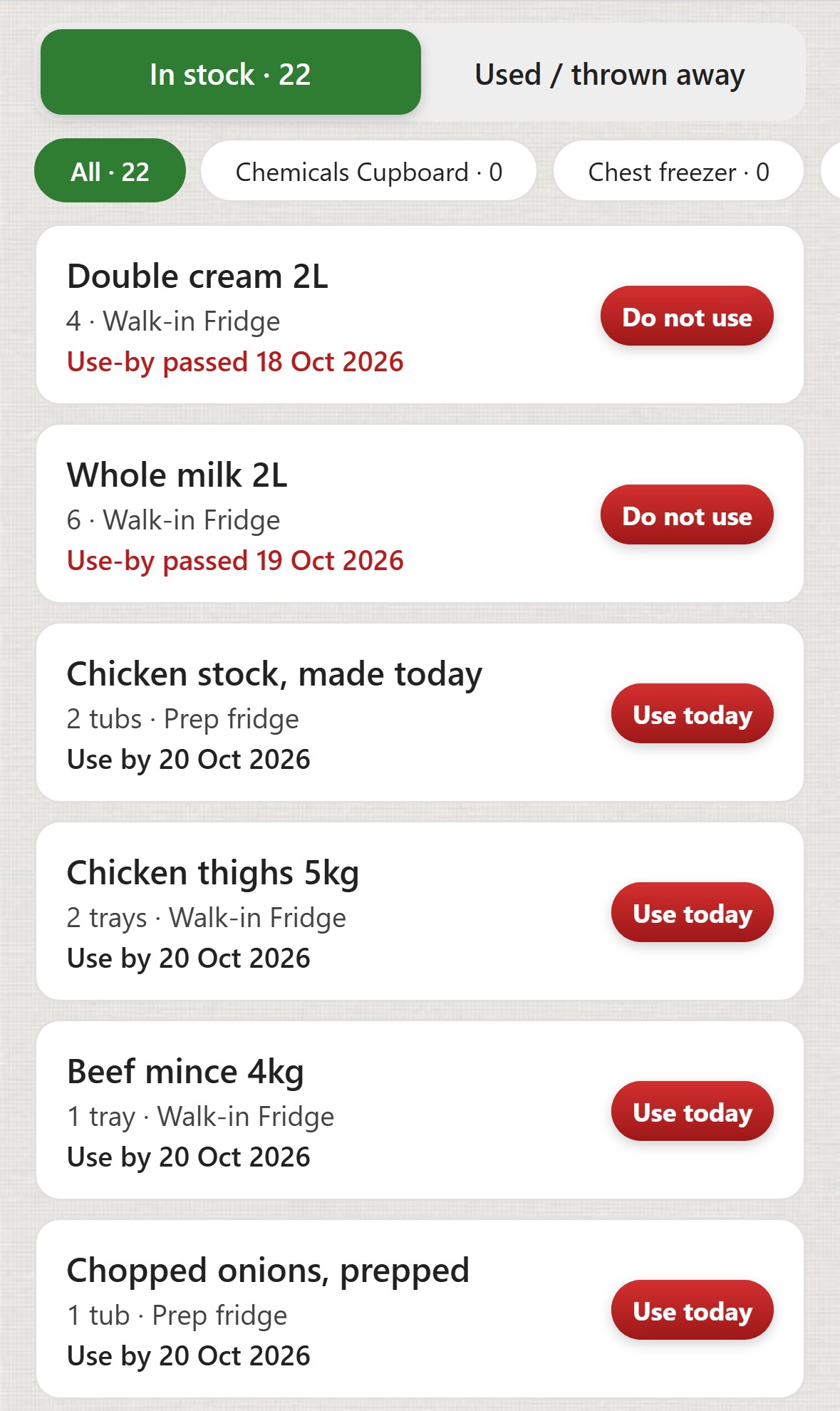
Stock with a date. Each item shows the date you typed in, marked "Use today" on the day and "Do not use" after it.
Your written plan and your pest contractor's reports stay in your own folder. See what else it does.
Get ChefsRecords on the App Store (iPhone) ›
14 days free. No card required.
Get ChefsRecords on Google Play (Android) ›
14 days free. No card required.
This is general guidance for UK kitchens, written from the public sources below as published on 14 November 2026. It is not legal advice and does not replace your own food safety management system. If you are unsure, ask your local authority's food safety team. ChefsRecords is not part of, or endorsed by, the Food Standards Agency, Food Standards Scotland or your local council.
Not one list for every kitchen. Officers follow the Food Law Code of Practice for their nation and judge what they find. Some councils and trade bodies publish their own lists. This page is ours, set out in the order an inspector may walk a kitchen.
There is no fixed order. Some ask for the records first and some go straight into the kitchen. In the kitchen, the hand basin can be one of the first things they see, because an officer may wash their hands before anything else.
Our advice is once a month, and again after a big change such as a new menu or new staff. No law sets how often. In England and Wales the FSA pack has a review every 4 weeks, which is a good day for the walk-round.
No checklist can promise a rating. In England, Wales and Northern Ireland a 5 needs a good score in all three areas: food handling, the building, and how you manage food safety. Our EHO inspection guide explains how the scores work.
Yes. The result in Scotland is Pass or Improvement Required, the pack is CookSafe and some temperatures differ, but what to look at on a walk-round is the same.
Yes: the one-page inspection checklist (PDF), 38 tick boxes covering the same ground.
For what happens on the day, how the rating is worked out and what happens after: our EHO inspection guide. Just registered? Our first food hygiene inspection guide. For the daily routine: our opening and closing checks guide. For the plan and its review: our food safety management system guide.
Pick a day this month, print the checklist or set it up in ChefsRecords, and go round stop by stop.
Get ChefsRecords on the App Store (iPhone) ›
14 days free. No card required.
Get ChefsRecords on Google Play (Android) ›
14 days free. No card required.
Separate offer for founding kitchens: Pro free for 3 months if you apply by 31 March 2027. See the offer.
Read next: EHO inspection: what inspectors check and how to prepare