
Updated 5 November 2026 - for restaurants, cafes, pubs, takeaways, canteens, care home and school kitchens, food vans and market stalls in England, Wales, Northern Ireland and Scotland
Physical contamination is a solid object in food that should not be there: a sliver of glass, a bolt from a mixer, a piece of hard plastic, a hair, a plaster, a staple, a stone, or a pest and its droppings. It can cut a mouth, break a tooth or choke someone, and it makes the food unfit to serve.
Physical contamination means a foreign body in food: a solid object that is not meant to be eaten. Some come from outside the food, such as glass, metal, plastic, a hair or a plaster. Others belong to the food but should have been taken out: a bone in a fillet sold as boneless, a piece of eggshell, a stone in lentils, a slug in a lettuce.
The harm is mostly physical: cuts to the mouth or throat, broken teeth and choking. Some foreign bodies carry bacteria as well. A mouse dropping, a hair, a used plaster or soil on a stone is a physical hazard and a biological one at the same time.
Law in all four nations Food law defines a hazard as a biological, chemical or physical agent in food.
"Physical hazard" is the term you will see in a HACCP (hazard analysis and critical control point) plan; "foreign body" and "foreign object" are the words most kitchens and councils use. They mean the same thing.
Level 2 and Level 3 food hygiene courses usually teach four types of contamination:
| Type | What it is | Kitchen example |
|---|---|---|
| Biological | Bacteria, viruses, moulds and parasites | Juices from raw chicken dripping onto a tray of salad |
| Chemical | Cleaning products, pest bait, machine oil and similar | Surface spray used next to an open tray of desserts |
| Physical | Foreign bodies, the subject of this guide | A chip of glass from a jar used as a scoop in the sugar |
| Allergenic | One of the 14 allergens getting into food meant to be free of it | Sesame seeds from a bun on the board used for an allergy order |
Guidance GOV.UK guidance groups hazards as three, not four: microbiological (or biological), chemical and physical, and counts allergens as a chemical hazard. CookSafe in Scotland also uses three types. Both ways cover the same risks, so use the one your course or your food safety plan uses. For allergens in a kitchen, see our allergen matrix guide.
Two words that are easy to mix up: cross-contamination is how a hazard moves from one thing to another, such as bacteria from raw meat to cooked food on a shared board. The 4 Cs (cleaning, cooking, chilling and avoiding cross-contamination) are a list of habits, not types of contamination.
Law in all four nations The main rules come from Regulations 178/2002 and 852/2004, as they apply in the UK:
Law in all four nations Selling food that is not of the nature, substance or quality the customer asked for, such as a sandwich with a piece of metal in it, is an offence: under section 14 of the Food Safety Act 1990 in England, Wales and Scotland, and Article 13 of the Food Safety (Northern Ireland) Order 1991. Section 21 of the Act and Article 20 of the Order give a defence if you can show you took all reasonable precautions and exercised all due diligence.
Your glass rules, delivery checks, repairs, training and records are how you show those precautions. They help you make the case; they cannot promise it will succeed.
These are the foreign bodies a working kitchen deals with, where they come from, and the control for each. Where the government packs name a control, the notes under the table say so. The rest is kitchen practice.
| Foreign body | How it gets in | How to stop it |
|---|---|---|
| Glass | A drinking glass used as a scoop or measure, glass jars, light bulbs and tubes over food, chipped plates and glasses, a glass broken in the pot wash | No glass in prep areas where you can avoid it. Plastic or steel containers and measures. Covered or shatterproof lights over open food. Chipped crockery and glassware thrown away. |
| Hard plastic | Cracked storage boxes and lids, scoops, measuring jugs, light covers, broken handles | Replace cracked plastic as soon as you see the crack, before it breaks. Look at boxes, lids and scoops as they are washed. |
| Packaging | String from joints of meat, cable ties, staples, clips, cardboard, label backing, plastic film, torn corners of vacuum packs | Unpack away from open food. Outer boxes off before stock goes into the kitchen or walk-in. String, ties and clips straight in the bin, never left on the bench. |
| Cling film and foil | Torn pieces left on food after unwrapping, film or foil used twice | Fresh film or foil each time. Look over the food after unwrapping it. |
| People | Hair, false nails, stones from rings, earring backs, buttons, pen lids, plasters | Hair tied back and covered, jewellery off, no false nails, nothing in top pockets, cuts covered with a bright, waterproof plaster. See our kitchen hygiene rules guide. |
| Equipment | Nuts and bolts from mixers and slicers, mincer plates, whisk wires, knife tips, probe tips, splinters from wooden spoons, rust, flaking non-stick coating | Check machines are whole before and after use. Report a loose or missing part at once and stop using the machine until it is fixed. Replace worn utensils. |
| Cans | Metal slivers from a worn can opener blade, grit on the can top | Wipe the top before opening. Keep the opener blade clean and replace it when it is worn. Tip the contents into a clean container. |
| Cleaning kit | Wire wool and wire scourer strands, brush bristles, cloth fibres | No wire wool or wire scourers on anything that touches food. Replace brushes and cloths before they shed. See our kitchen cleaning schedule guide. |
| Pests | Mouse and rat droppings, flies, cockroaches, insects in flour and grains, gnawed packs | Food in closed containers, off the floor. Gaps sealed. Regular checks, and a pest contractor if you need one. See our pest control guide. |
| The food itself | Bones, shell, stones and grit in pulses and rice, soil and slugs on vegetables, fruit stones, stalks | Pick over pulses and rice. Wash and check vegetables and salad. Check anything sold as boneless, shelled or stoned before it goes out. |
| The building | Flaking paint or plaster, rust from shelving, loose tiles, dust from vents, broken light fittings | Report and repair damage. No open food under a flaking ceiling or a dusty vent. Covered lights over food. |
Guidance in England and Wales The Food Standards Agency's Safer Food, Better Business pack (the FSA pack) calls banning glass from the kitchen a good idea. It also asks for damaged equipment, or equipment with loose parts, to be repaired or replaced, for packaging and string to go in the bin once they are off, for food to be kept covered, and for foil, film and freezer bags to be used once only.
Guidance in Northern Ireland Safe Catering asks kitchens to limit glass, cover light fittings over open food, use plastic or stainless steel in place of glass, take damaged glass out of use, and wash and check vegetables for stones and slugs. It names nuts, bolts, splinters, rust and paint as physical hazards.
Guidance in Scotland CookSafe warns that cracked or broken glassware and utensils can get into food, and asks for broken bulbs, tubes and light fittings to be replaced promptly.
Anything in the table not named in the notes above, such as can openers, wire wool, probe tips, pen lids and false nails, comes from kitchen practice.
None of the three government packs sets out a glass breakage procedure step by step. This one is ours, from kitchen practice. Write your own version into your food safety plan and show it to new starters, so nobody has to work it out while there is glass on the floor.
Our advice Do not set a fixed distance in metres for what to throw away. It depends on what broke, how high it fell and what was open nearby. Glass in an ice well or ice machine cannot be seen: empty it, let the ice melt, clean it and only then refill it. A glass broken in the pot wash sink means draining the sink before anyone reaches in.
Law in all four nations Do not accept ingredients you know, or could reasonably expect, to be contaminated, if your normal preparation would not make them safe.
Guidance in England and Wales The FSA pack says that if you find objects in delivered food, reject the delivery if you can, contact the supplier straight away and write the details in your diary. It also says to reject deliveries with gnawed packaging or insects. Guidance in Northern Ireland Safe Catering asks you to check that packaging is not damaged. Guidance in Scotland CookSafe says to reject seriously damaged packaging that could let contamination in.
Our advice At the door and in the stores:
Our food delivery checks guide covers when to reject a delivery and how to tell the supplier.
A chef finds a blue plaster in the coleslaw, a bolt in the mixer bowl or a shard of plastic in a tray of rice. The food has not gone out yet. This is what to do.
Guidance in England and Wales The FSA pack says food with objects such as glass, insects or coloured dressings in it should be thrown away. Guidance in Northern Ireland Safe Catering says the same for glass and insects.
Law in all four nations One unsafe portion means the batch is presumed unsafe unless you can show otherwise, which is why step 4 looks at the whole batch.
Our advice If a part is missing from a machine and you cannot find it, treat everything that went through the machine since it was last seen whole as affected. Never pick the object out and serve the rest.
Guidance in England and Wales The FSA pack's page on customer complaints counts finding something in food as a complaint and asks you to treat each one seriously. In kitchen terms: look in your diary and records for the same problem, walk the kitchen, ask the team, and hold back the rest of that batch while you check. If the problem may have started with your supplier, ring them. When you know the cause, change the method or retrain, and note it in the diary.
Our advice At the table:
A customer can report a foreign body to the food team at the council. Councils look into complaints about foreign matter in food and usually contact the business. Many decide by risk, with glass and metal the usual examples of a serious risk, and some do not take up complaints that fall below their criteria. Compensation is a private matter between you and the customer, not something the council arranges. A clear record of what you found and what you did is the best thing to show the council if it calls. If a customer says your food made them ill, see our food poisoning complaint guide.
Guidance in England and Wales The FSA pack asks for a short note of the problem and the fix in your diary. Guidance in Northern Ireland Safe Catering asks you to record what you did about it on its record sheets. Guidance in Scotland CookSafe asks you to note problems and what you did in your weekly record.
No law sets a layout for this record. An inspector will still want to see that you dealt with it. Our advice A good record answers:
Three bolts from the same mixer in a month is a pattern, not bad luck. Look back over your records each month for the same problem in the same place. Our near miss guide covers looking for patterns and recording problems caught before they cause harm.
Law in all four nations A food business that believes, or has reason to believe, that food it has supplied is unsafe must take it off the market. If the food has left its control, it must withdraw it and tell the authorities, and if the food may have reached consumers it must tell them and recall it where needed. A business that believes, or has reason to believe, that food it has supplied may harm health must tell the authorities straight away.
In a restaurant most food is eaten minutes after it is cooked, on the premises. These are the times the rule matters most for a kitchen:
Guidance in England, Wales and Northern Ireland GOV.UK says to tell the food safety team at your council, which tells the FSA. Contact the FSA's incidents team directly if the incident is serious and the food has reached customers. The FSA pack's page on product recalls lists contamination with pieces of glass or metal as a reason products are recalled, and says that if you notice a problem with a product that may make it unsafe, stop using or selling it and tell your council and the FSA.
Guidance in Scotland Food Standards Scotland's page for businesses says that when you have reason to believe a food incident has happened, you must tell your council, withdraw food that has not reached customers and recall food that has. Its page for the public lists foreign bodies, such as glass, plastic, metal or string, as one kind of food incident.
Law in all four nations The duty to report is the same in all four nations, and the government pages in every nation describe a food incident widely: GOV.UK says a business must report food incidents, including food it has made that is not safe to eat. None of them says whether one object found in the kitchen and thrown away before any food went out, such as one bolt from your own mixer found in one tray, has to be reported. Our advice If you are not sure, ring your council's food team. They would rather hear it from you. Find yours on GOV.UK's find your local food safety team page. Take the FSA incidents team's contact details on the day from the GOV.UK page Report a food safety incident. The way to report changed on 17 November 2025, and some pages, including some on GOV.UK, still show older details.
When a supplier's product is recalled, the FSA and Food Standards Scotland publish an alert. Our food alerts page lists them.
An inspector looks at how food is handled, the state of the building and equipment, and confidence in management. That last part looks at your food safety system and your track record, which can include how you have dealt with complaints. There is no published list of questions about foreign bodies. These are ones we would expect:
Things officers often note: flaking paint or plaster above food, rust on shelves, uncovered lights over open food, broken equipment, string and packaging left on prep benches, and food left uncovered. Our EHO inspection guide covers the whole visit.
This is a list to copy into the checks you already do, not a record sheet. Most of it fits into your opening, closing and weekly checks: see our opening and closing checks guide.
No law names a colour. Guidance in England and Wales The FSA pack asks for a "brightly coloured waterproof dressing", because it is easier to see if it falls into food. Guidance in Northern Ireland Safe Catering asks for a brightly coloured waterproof dressing and gives blue as an example. Guidance in Scotland CookSafe asks for a waterproof dressing, ideally one that is easy to see.
Kitchens choose blue because almost no food is blue. Metal-detectable plasters are for factories that run metal detectors; no law asks a restaurant to use them.
The law asks for suitable, clean clothing. The rules on jewellery, hair and nails come from guidance and your own house rules. Our kitchen hygiene rules guide sets out what each nation's pack says.
No law says that. Guidance in England and Wales The FSA pack calls a no-glass rule a good idea. Guidance in Northern Ireland Safe Catering asks kitchens to limit glass.
Courses teach four. GOV.UK guidance uses three, with allergens counted as chemical (section 2).
In a HACCP plan, foreign bodies are usually controlled by good practice at many steps rather than at one critical control point. See control point or critical control point in our critical control points guide.
Paper works: your nation's pack has a diary, record sheets or a weekly record for this. ChefsRecords is an iPhone app for the daily records. Where it fits when something turns up in the food:
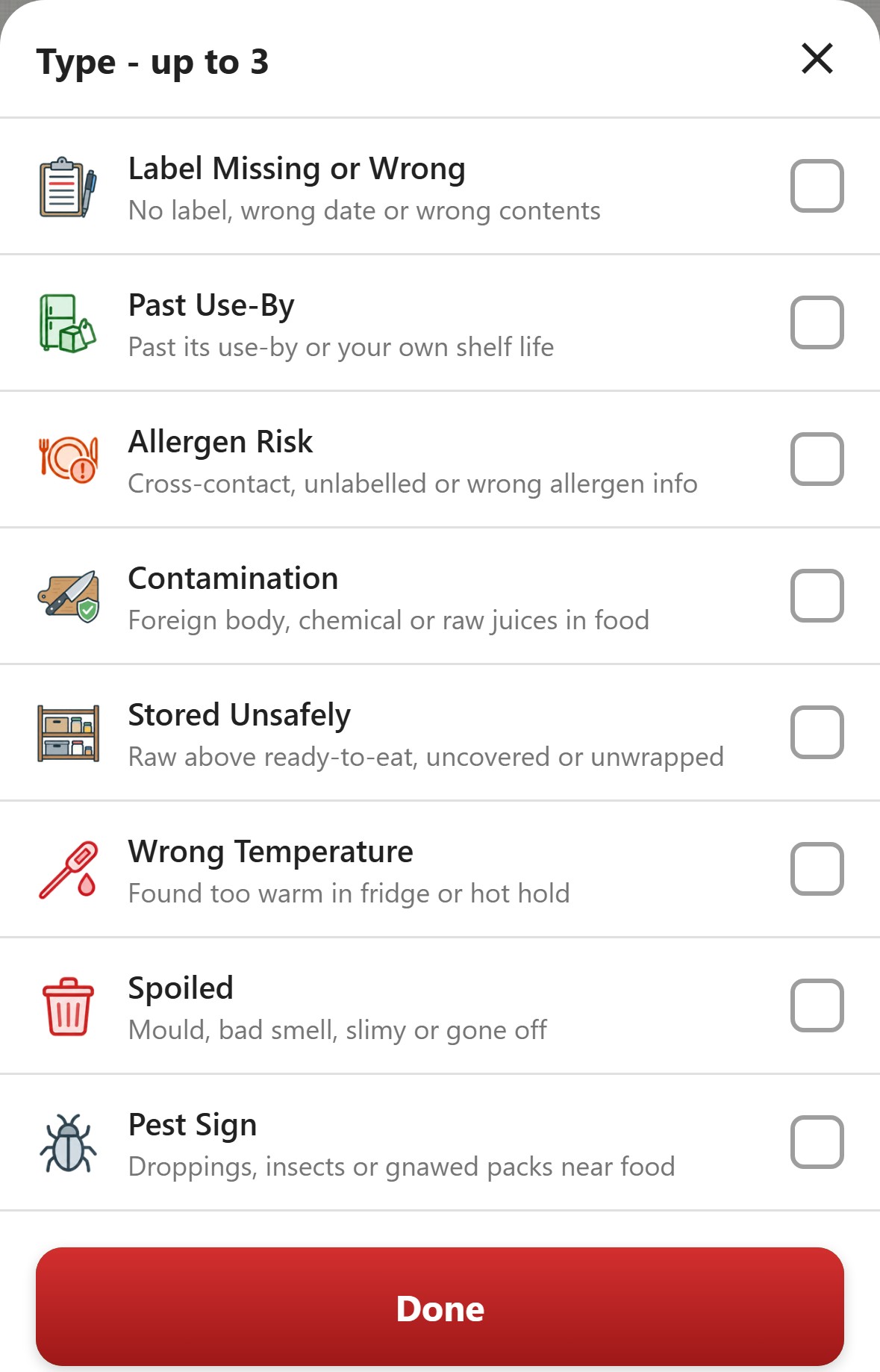
Pick the type. "Contamination" covers a foreign body in food; "Pest Sign" covers droppings and gnawed packs.
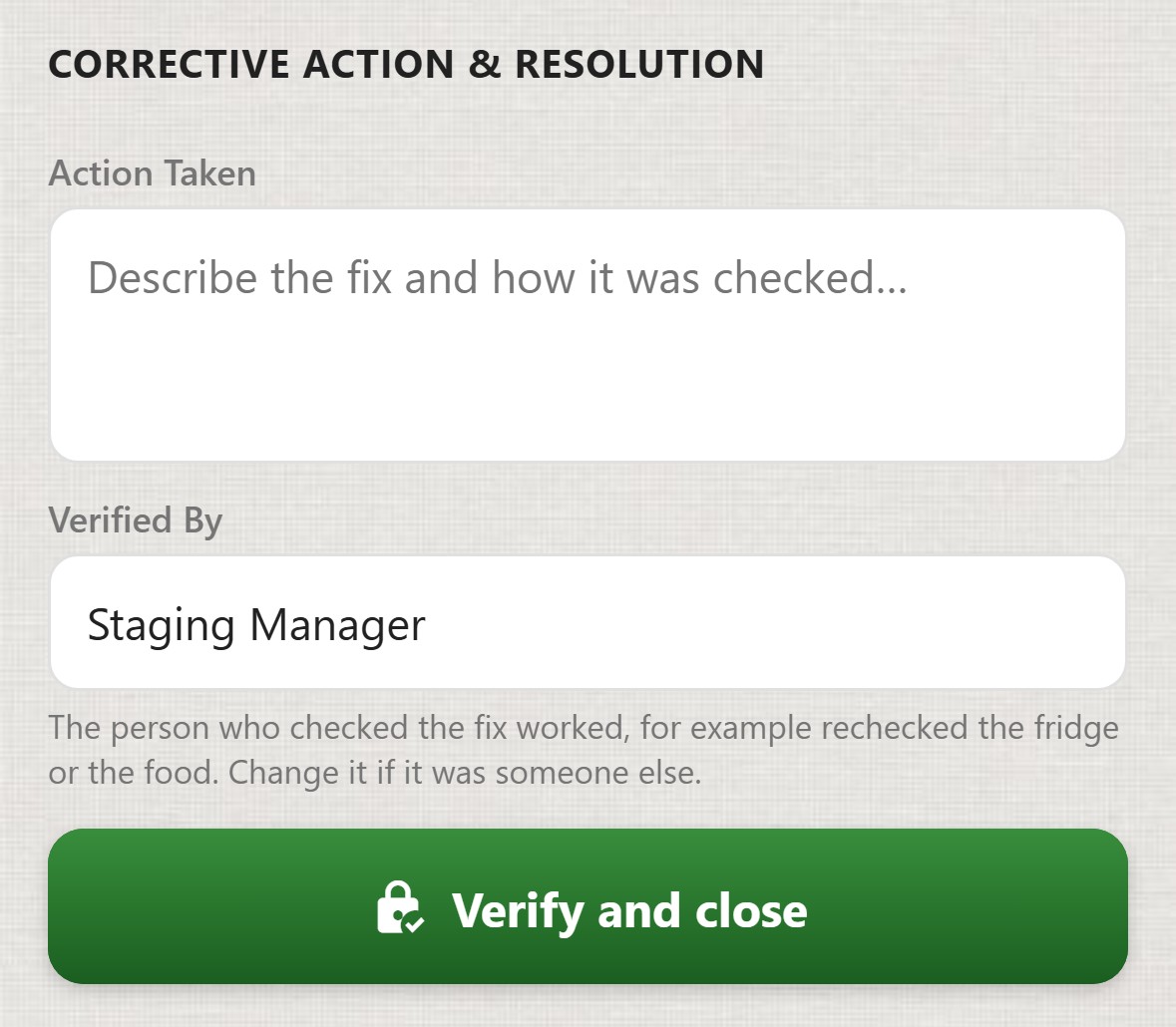
Close it when it is fixed. What was done, who checked it worked, then verify and close.
What it does not do today: it has no separate customer complaint form and no glass breakage log, and it does not decide whether to throw food away or tell your supplier or the council. Those decisions stay with you; the app keeps the record of them. A customer complaint can be logged as a Food incident, type "Contamination", with the details in the description.
Which plan. Food incidents are on every plan. Delivery incidents need Standard or Pro after the 14-day trial. Checklists and the Inspection Pack come with Standard and Pro, and are open in the trial.
Get ChefsRecords on the App Store (iPhone) ›
14 days free. No card required.
This page explains the law and the guidance in plain words, from the public sources below as published on 5 November 2026. It is general information, not legal advice, and it cannot cover every kitchen. For a question about your own business, ask the food safety team at your council. ChefsRecords is not part of, or endorsed by, the Food Standards Agency, Food Standards Scotland or your council.
A solid object in food that should not be there, such as glass, metal, plastic, hair, a plaster, packaging, a stone or a pest. It can injure the person eating the food, and some foreign bodies, such as droppings and hair, carry bacteria too.
A sliver of glass from a jar used as a scoop, a bolt from a mixer, string from a joint of meat, a staple from a box, a hair, a blue plaster, wire wool from a scourer, a piece of eggshell, a stone in lentils and flaking paint from a ceiling.
Courses teach biological, chemical, physical and allergenic. GOV.UK guidance uses three, biological, chemical and physical, and counts allergens as a chemical hazard.
Yes. A hair is a foreign body, and it can carry bacteria as well. Tie hair back and cover it, and wear work clothes that do not shed.
No. Guidance asks for a brightly coloured or easy-to-see waterproof dressing, and kitchens use blue because almost no food is blue. No law names a colour.
Look after the customer first: if they may have swallowed it, tell them to get medical help. Take the dish away, keep the glass if they agree (or photograph it), stop serving food from the same batch, and check the kitchen for the source. Write it all down, and tell your council's food team.
Tell the council when the object came in a supplier's product, when food that has left your kitchen may be affected, when a customer was served glass, metal or another sharp object, or when someone is hurt. The rule is the same in England, Wales, Northern Ireland and Scotland. If you are not sure, ring the council's food team.
Yes, if you can. Bag it and label it with the date and the food, with a photo. It helps you find the cause, make a claim against a supplier and show the council what happened. If the customer wants to keep it, that is their choice.
A bone is a natural foreign body. A customer can expect bones in a whole fish on the bone, not in a fillet or a fishcake sold as boneless. Check anything sold as boneless, shelled or stoned before it goes out.
The kitchen hygiene rules guide, the pest control guide, the food delivery checks guide, the kitchen cleaning schedule guide, the cross-contamination guide, the allergen matrix guide, the critical control points guide, the near miss guide and the EHO inspection guide.