
Updated 25 October 2026 - for UK restaurants, cafes, pubs, takeaways and other small catering businesses
No law sets how many days food you make can be kept. You decide the date, and you must be able to show it is safe. Write it in your food safety plan and label the food. In England and Wales, the FSA pack gives 3 days in total for high risk ready-to-eat food (the day it is made or opened, plus 2) and 1 day for cooked rice. The packs for Scotland and Northern Ireland give no number of days.
Law in all four nations The business that makes the food is responsible for it being safe. Article 14 of Regulation 178/2002: "Food shall not be placed on the market if it is unsafe." No law gives a number of days for food a kitchen makes.
Our advice In England and Wales, treat the FSA pack's 3 days in total, below, as the most you keep high risk ready-to-eat food, unless you have evidence for longer. Write the times you use into your food safety plan, so anyone can follow them and an inspector can see them.
Guidance in England and Wales The FSA pack: "High risk ready to eat foods should be kept for a maximum of 3 days in total (day of cook/opening + 2) unless you have evidence that it is safe to keep them for longer." Its definition: "Ready-to-eat food is food that will not be cooked or reheated before serving. This includes salads, cooked meats, smoked fish, desserts, sandwiches, cheese and food that you have cooked in advance to serve cold."
Our advice Use the earliest date in the dish. A sauce made with cream that goes out of date tomorrow is used by tomorrow.
How to cool rice: our cooling guide. Reheating it: our reheating guide.
None of the UK guidance packs for kitchens gives a number of days for cooked dishes you will reheat. The FSA pack's 3 days is for high risk ready-to-eat food, which is food that will not be cooked or reheated before serving.
Common target, not law Many kitchens use the same 3 days in total for these dishes. Our advice Write your time in your food safety plan, cool the dish quickly, and reheat it once, until steaming hot.
Guidance in England and Wales Cooked meat served cold is ready-to-eat food, so the FSA pack's 3 days in total applies unless you have evidence for longer.
For bought cooked ham, follow the "once opened, use within" time printed on the pack, and never go past its use-by date.
Guidance in Scotland Guidance in Northern Ireland CookSafe and Safe Catering give no number of days for cooked meat, so set your own in your food safety plan.
Guidance from some councils For home cooks, Coventry City Council's Christmas advice says leftovers "should be eaten or frozen within 2 days (one day for rice dishes)". We found no FSA or Food Standards Scotland advice for kitchens on cooked turkey or ham. Turkey, cooking ahead and leftovers at Christmas: our Christmas kitchen guide.
Our advice Defrost in the fridge, write the date it came out of the freezer, and use it within 24 hours unless your plan gives a reason for longer, and never longer than the days it had left when it was frozen. In Northern Ireland, Safe Catering says within one day. Advice on defrosted food differs, so if you are unsure, ask your council.
Vacuum packing does not make chilled food safe for longer on its own.
No law requires day dots. Common target, not law Coloured day dots are one way of labelling, and many kitchens use them. Our advice A written label says more than a colour.
Law in all four nations If you pack food before it is ordered and sell it from the same place, such as sandwiches in a grab-and-go fridge, the label must show the name of the food and a full ingredients list with the 14 allergens emphasised. This has applied since 1 October 2021.
The food information rules we read do not ask for a use-by date on these labels. The guidance packs still ask you to keep track of when food must be used, so many kitchens add the date to the same label. Ask your Trading Standards team if you are unsure. Our allergen matrix guide covers the 14 allergens.
Search for how long cooked chicken lasts and you will see 2 days, 3 days, 3 to 4 days and 7 days. They are answering different questions.
We found no FSA page that gives 3 to 4 days for cooked chicken.
Paper works: your times live in your food safety plan and the labels on the food. ChefsRecords is an iPhone app for the daily records:
What it does not do today: it does not print labels or day dots, does not work out a shelf life, and has no made-on, opened-on, frozen-on or defrosted-on date. Stock is not in the Inspection Pack, and a changed stock date or a deleted item leaves no record. Would you use a made-on date and printed labels in the app? Tell us.
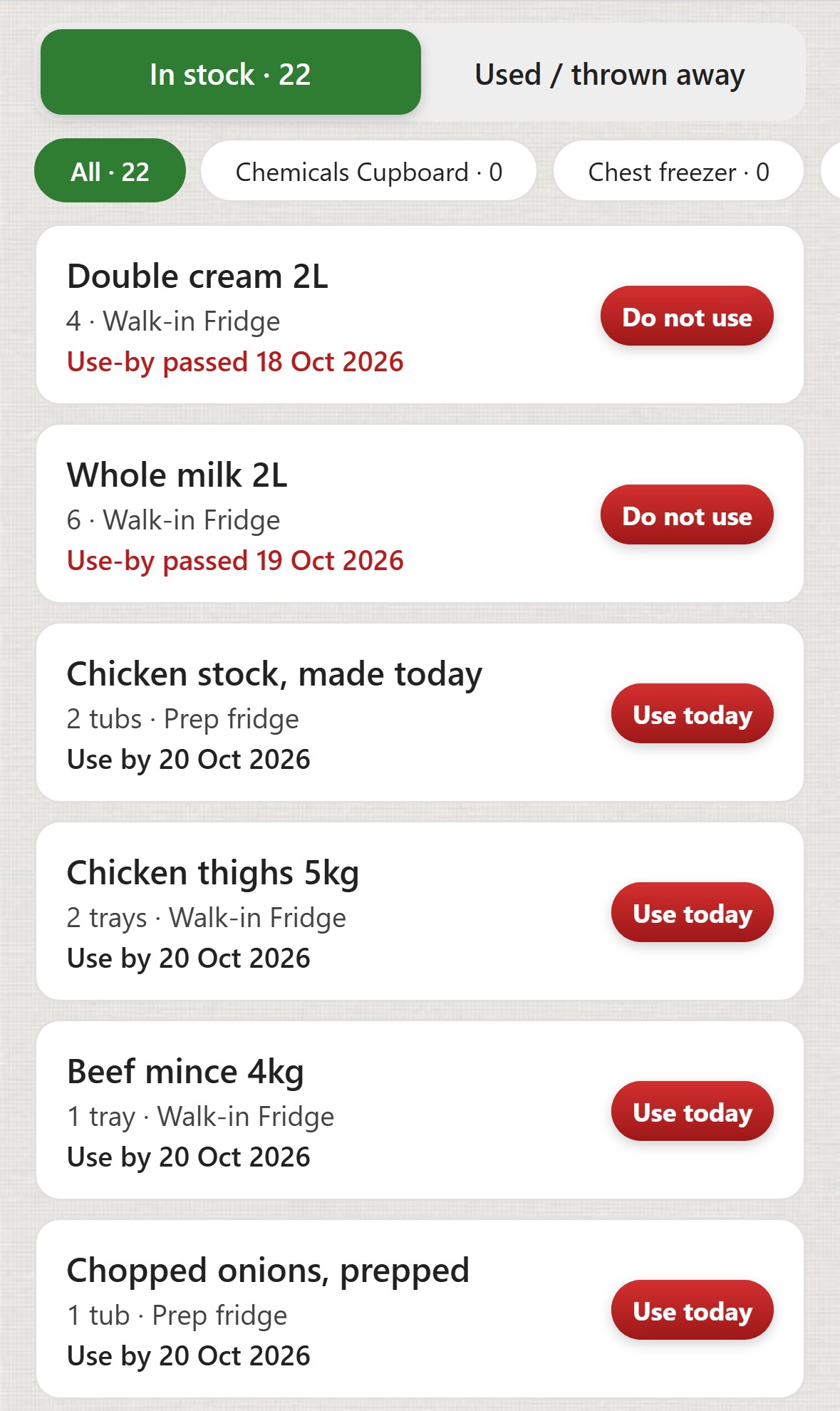
What to use today, and what not to use. The use-by date is the one you type in. The app does not work it out.
Which plan. Stock and checklists come with Standard and Pro, and are open during the 14-day free trial.
Get ChefsRecords on the App Store (iPhone) ›
14 days free. No card required.
This page explains the law and guidance in plain words, from the public sources below as published on 25 October 2026. It is not legal advice. Your council's food team can answer questions about your own kitchen. ChefsRecords is not part of, or endorsed by, the Food Standards Agency, Food Standards Scotland or your local council.
In England and Wales, the FSA pack says cooked rice "should only be kept for 1 day once prepared". GOV.UK's advice for home cooks is to cool it within an hour if possible and eat it within 24 hours. Food Standards Scotland's home advice is the same. Reheat it once only, until steaming hot.
Yes, if it was cooled quickly. Freeze it as soon as it has cooled. GOV.UK's home advice is to defrost it in the fridge and reheat it until steaming hot, and never reheat rice more than once. Rice has only a 1 day shelf life in the FSA pack, so use it the day it is defrosted.
In a kitchen in England and Wales, cooked chicken served cold is high risk ready-to-eat food. The FSA pack says a maximum of 3 days in total, the day it was cooked plus 2, unless you have evidence it is safe for longer. CookSafe and Safe Catering give no number of days, so set your own in your food safety plan. For home cooks, GOV.UK says leftovers within 48 hours.
No law sets a number of days. In England and Wales, the FSA pack gives 3 days in total for high risk ready-to-eat food, unless you have evidence for longer. In Scotland and Northern Ireland, the guidance packs give no number, so you set it in your food safety plan. Your council may tell you what it expects.
It is not law. The FSA pack, used in England and Wales, says high risk ready-to-eat food should be kept for a maximum of 3 days in total: the day it is cooked or opened, plus 2. A kitchen with evidence can set longer. CookSafe and Safe Catering do not use it.
Many of those pages are American, and their times come from US advice, not from the FSA. GOV.UK's home advice says 48 hours for leftovers. UK kitchen guidance in England and Wales says 3 days in total. We found no FSA page that gives 3 to 4 days for cooked chicken.
None of the UK guidance packs for kitchens gives a figure for cooked dishes you will reheat. Many kitchens use the same 3 days in total as the FSA pack gives for ready-to-eat food. Write your time in your food safety plan, cool the dish quickly, and reheat it once, until steaming hot.
Cooked meat served cold is ready-to-eat food. In England and Wales, the FSA pack says 3 days in total unless you have evidence for longer. For bought cooked ham, follow the "once opened, use within" time printed on the pack, and never go past its use-by date. For home cooks, Coventry City Council says leftovers should be eaten or frozen within 2 days, and one day for rice dishes.
The sources differ. The FSA pack says the shelf life depends on the days the food had left when it was frozen. Safe Catering, in Northern Ireland, says use it within one day. GOV.UK's home advice says within 24 hours of being fully defrosted. Defrost in the fridge, and label it with the date it came out.
Not food that has to stay frozen, such as ice cream, once it has started to defrost (FSA pack). Defrosted raw meat can be cooked until piping hot, then chilled or frozen straight away. GOV.UK's home advice says it can then be reheated only once.
You do. The law says food must not be unsafe and leaves the date to the business. CookSafe says to label high risk food prepared on the premises with an appropriate use-by date. The FSA pack gives 3 days in total for high risk ready-to-eat food unless you have evidence for longer. Write your times in your food safety plan, and ask your council if you are unsure.
Day dots are stickers, often coloured by day, that show when food was made or when it must be used. No law requires them. The FSA pack asks for stickers or another method of labelling, and Safe Catering calls them a good idea. A written label with the name, the dates and initials carries more, and inspectors may ask how you keep track.
Write what it is, the date it was made, the date to use it by, your initials, and for frozen food the date it was frozen. If you pack food before it is ordered and sell it from the same place, the law also requires the name and a full ingredients list with allergens emphasised. Our allergen matrix guide covers the 14 allergens.
Your food safety plan should describe what your kitchen really does. The free food safety plan builder takes you through safe methods based on the FSA pack, so you can write them in your own words, then prints your plan or saves it as a PDF. For small restaurants, cafes, pubs and takeaways in England and Wales.
The stock rotation guide, the cooling guide, the reheating guide, the danger zone guide, the eggs guide, the fridge temperature log guide and the Christmas kitchen guide.