Updated 25 October 2026 - for UK restaurants, cafes, pubs, takeaways and other small catering businesses
Use a disinfectant whose label shows BS EN 1276 or BS EN 13697, on a surface you have already cleaned, at the dilution on the label and for the contact time on the label. No UK law names either number, but guidance in every nation does. If the number is not on the label, ask the supplier for the product information that shows it.
Law in all four nations No. The law says equipment food touches must "be effectively cleaned and, where necessary, disinfected", and "Cleaning and disinfection are to take place at a frequency sufficient to avoid any risk of contamination." It also says "Cleaning agents and disinfectants are not to be stored in areas where food is handled." It does not name any disinfectant standard.
Guidance in every nation names the same two numbers:
Our advice Because every nation's guidance names them, an inspector may ask which standard your disinfectant meets and where that is written down.
Both are British and European laboratory tests of how well a chemical disinfectant works. They are sold by the British Standards Institution (BSI). We have not reproduced them; this is a plain description of what BSI's catalogue says they cover.
Guidance often shows older years, such as BS EN 1276:1997 or 2009, or BS EN 13697:2001. Those are earlier versions of the same standards. Guidance names either standard, so a product that shows one of them is enough.
Our advice BS EN 1276 is about bacteria. It is not a test against viruses such as flu. It is also not about COSHH (the Control of Substances Hazardous to Health Regulations), the health and safety law on using hazardous chemicals safely at work.
UK food hygiene guidance does not ask kitchens for BS EN 1650, BS EN 14476 or BS EN 17914. For surfaces it names BS EN 1276 or BS EN 13697. Guidance in England and Wales For hand washing, the FSA pack says antibacterial soap should "Ideally" meet BS EN 1499.
So you do not need a sanitiser and a disinfectant. Either clean with a detergent and then disinfect, or use a sanitiser twice.
Our advice American advice uses "sanitizing" for something else: a step after cleaning that reduces bacteria, which the US Environmental Protection Agency says "is not intended to kill viruses". If you read American advice, do not swap your disinfect stage for a lighter "sanitize" step. A sanitiser cannot do both jobs if its label does not show BS EN 1276 or BS EN 13697, if you use it once only, or on heavy grease, where a separate degreaser cleans better first.
Guidance in England and Wales The FSA pack: contact time is "how long a cleaning chemical needs to be left on the item you are cleaning. It is important to follow the manufacturer's instructions on contact time for the chemical to work effectively."
There is no single contact time for every product, and this guide does not give one. The time on your product's label is the one that counts.
Guidance in Northern Ireland Safe Catering on dilution: "If you add too much water then the cleaning chemical might not work effectively. Too little water may result in chemical contamination."
Our advice Measure; do not guess. If you dilute a product yourself, the contact time on the label is for that dilution. Unless the label says otherwise, keep the surface wet with the product for the whole contact time.
Guidance in England, Wales and Northern Ireland GOV.UK says to check the label for BS EN 1276 or BS EN 13697. Guidance in Scotland CookSafe: "Check the label of your existing products to see if they meet the BS EN standard." It also says to check the label "for dilution, contact time and to see if a rinse step is required."
Guidance in England and Wales The FSA pack: "Cleaning and disinfection needs to be carried out in two stages". First clean, to remove visible dirt, grease and debris. Then disinfect, "and leave on for the required contact time." Guidance in Northern Ireland Safe Catering describes the same two stages. Guidance in Scotland CookSafe describes them too.
Our kitchen cleaning schedule guide has the full method, step by step: the six steps in the FSA pack's worked example for a work surface, with an animation.
Our advice Keep one page with each product, its standard, its dilution, its contact time and whether to rinse, and file it with your cleaning schedule.
Separately, health and safety law expects you to manage the risks of hazardous cleaning chemicals to your staff, and suppliers of hazardous products must give you a safety data sheet. The Health and Safety Executive explains this in its guidance on safety data sheets.
Law in all four nations If you regularly prepare food at home to sell, the law has a chapter for home kitchens: surfaces that touch food must be easy to clean and, where necessary, to disinfect, and you must be able to clean and, where necessary, disinfect utensils and equipment.
Our advice The same two stages apply at home. Before each session, clear the worktop, clean it, then disinfect it with a product whose label shows BS EN 1276 or BS EN 13697, for its contact time. Keep cleaning products away from your ingredients. If you are unsure, ask your council's food team. More in our first food hygiene inspection guide.
Paper works: your cleaning schedule and product information can live in your folder. ChefsRecords is an iPhone app for the daily records. It does not check your products.
What it does not do today: there is no list of your products with their standard, dilution and contact time, no place to keep product information or safety data sheets, and no contact-time timer. Your product information and cleaning schedule stay in your own folder. Would you use a list of your cleaning products in the app? Tell us.
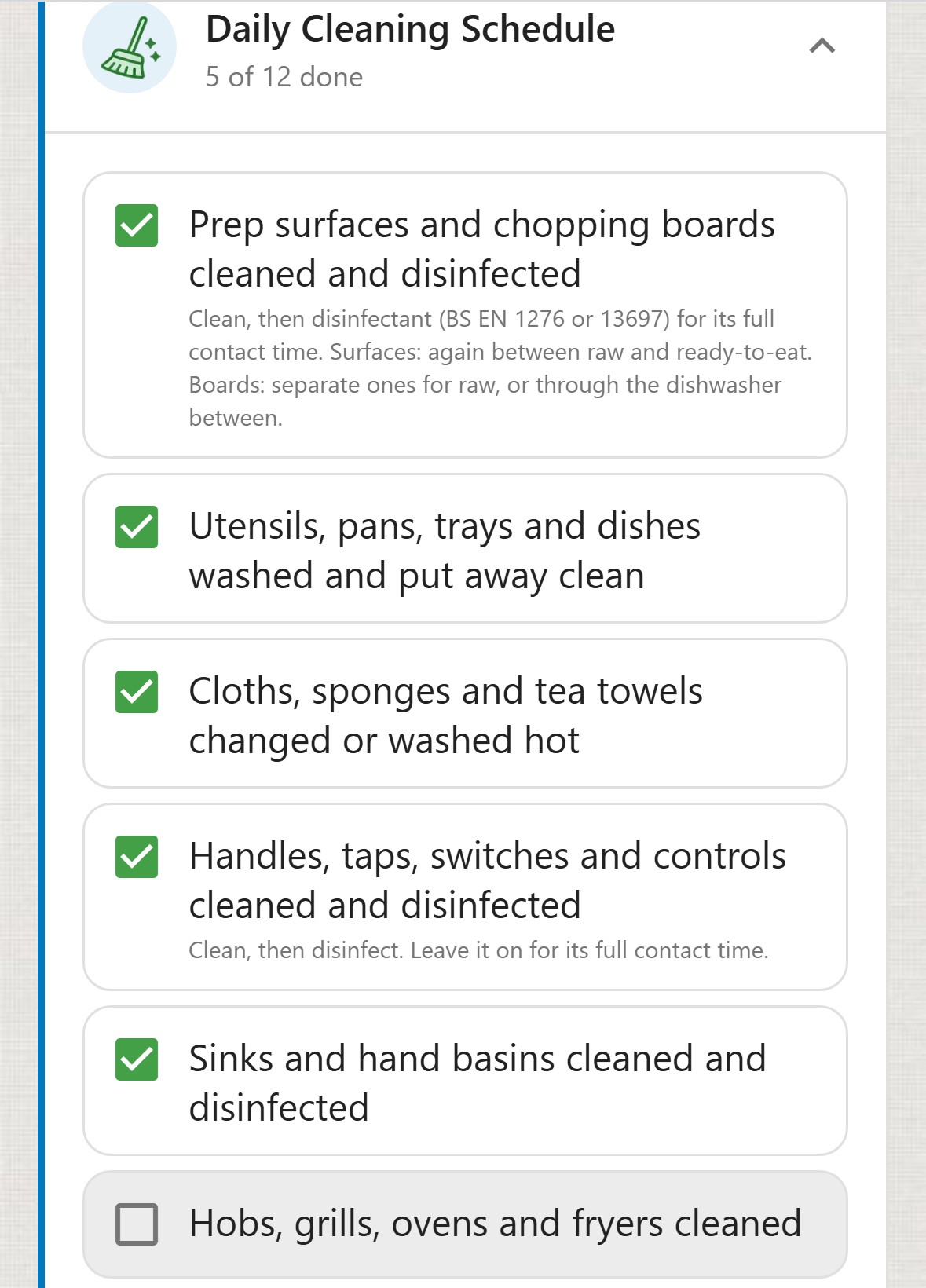
The day's cleaning, ticked off. The first line reminds staff which standard to use and to leave it on for its full contact time.
Which plan. Checklists come with Standard and Pro, and are open in the 14-day free trial.
Get ChefsRecords on the App Store (iPhone) ›
14 days free. No card required.
This page explains the law and guidance in plain words, from the public sources below as published on 24 October 2026. It is not legal advice. Your council's food team can answer questions about your own kitchen. ChefsRecords is not part of, or endorsed by, the Food Standards Agency, Food Standards Scotland or your local council.
It is a British and European laboratory test showing a disinfectant kills bacteria under set conditions. UK food hygiene guidance tells kitchens to use a disinfectant that meets it or BS EN 13697. The number is printed on the label or in the maker's product information.
BS EN 1276 tests the product mixed into a liquid with bacteria. BS EN 13697 tests it on a hard surface, and it can also cover yeasts and moulds. Guidance names either one, so a product that meets one of them is enough.
No law names it. The law says food surfaces must be cleaned and, where necessary, disinfected. Guidance in every nation names BS EN 1276 or BS EN 13697, and some of it, such as CookSafe in Scotland, says "must". Your inspector may ask what your disinfectant meets.
No. Either clean with a detergent and then disinfect, or use a sanitiser twice: once to clean, once to disinfect.
In UK guidance, a two-in-one product that cleans and disinfects. American advice uses "sanitizing" for something different, so do not mix the two.
It is how long the product must stay on the surface to work. It depends on the product, so follow the time on your label at the dilution it gives. No single time is right for every product.
Look for BS EN 1276 or BS EN 13697, that it can be used on food contact surfaces, the dilution, the contact time, and whether you need to rinse.
Ask the supplier or maker for the product information that shows the standard, and keep it with your cleaning schedule. If they cannot show it, choose a product that can.
You can, if its label shows BS EN 1276 or BS EN 13697 and says it is for food contact surfaces. "Antibacterial" on its own does not tell you that, so check for the number.
They can be, if the pack shows BS EN 1276 or BS EN 13697 and says it can be used on food surfaces. Wipe off visible food first, keep the surface wet for the contact time, and throw a wipe away once it is dirty or dry. The FSA pack says probe wipes that dry out will not disinfect properly. A wipe is never a reason to share a chopping board between raw and ready-to-eat food.
It is the maker's description, not a legal term. Check that the label says the product can be used on food contact surfaces and whether it needs rinsing.
UK food hygiene guidance names BS EN 1276 or BS EN 13697, which are about bacteria (and yeasts and moulds), not viruses. Some councils say chlorine-based disinfectants work better against viruses. After sickness or vomiting at work, ask your council's food team what to use.
A bleach product is treated like any other disinfectant: check the label for the standard, dilution, contact time and rinse. The FSA pack says bleach is not suitable for disinfecting cloths. No UK guidance we read covers vinegar, so do not use it as your disinfectant unless its label shows the standard.
No guidance we read asks for BS EN 1276 or BS EN 13697 on either. The FSA pack says antibacterial hand soap should ideally meet BS EN 1499, which is a hand standard. Floors need thorough cleaning, and usually not disinfection unless food could be contaminated.
Your food safety plan should describe what your kitchen really does. The free food safety plan builder takes you through safe methods based on the FSA pack, so you can write them in your own words, then prints your plan or saves it as a PDF. For small restaurants, cafes, pubs and takeaways in England and Wales.
The kitchen cleaning schedule guide, the cross-contamination guide, the opening and closing checks guide, the chopping board colours guide and the 4Cs of food hygiene guide. More guides: the kitchen cleaning schedule guide, the hand wash basins guide and the pest control guide.