Updated 1 November 2026 - for UK restaurants, cafes, pubs, takeaways, care homes and caterers
The law itself is short. Anyone working where food is handled has to keep "a high degree of personal cleanliness", wear clean protective clothing, and keep away from food when they have a bug that can spread through food. Everything else you have heard of, from hats to rings to blue plasters, is official guidance or a kitchen's own house rules. That does not make it optional in practice: an inspector will expect you to have rules like these and to stick to them.
Here for cleaning, cooking, chilling and cross-contamination? That is the 4Cs of food hygiene guide. This page is about the people.
Download the staff poster (PDF, one A4 page): Kitchen hygiene rules. The same nine rules in a few words each, for the staff room or the wall by the basin. It works in every UK nation, so there is one version. Free to print and use in your kitchen, no sign-up.

Law in all four nations Three things. Everyone who works where food is handled keeps "a high degree of personal cleanliness". They wear "suitable, clean and, where necessary, protective clothing". And the business must not let anyone near food, "in any capacity", if they have, or carry, an illness that could pass on through food, or something like an infected cut, a skin infection or diarrhoea, where food could be contaminated. Staff in that position have to tell the business at once.
Law in all four nations The law also asks for somewhere to change where that is needed, and for food handlers to be supervised and trained in hygiene to suit the job they do.
You will not find hats, rings, nails or plaster colours anywhere in the law. They come from the official guidance packs (the FSA pack in England and Wales, Safe Catering in Northern Ireland, CookSafe in Scotland), from GOV.UK and from councils. Think of them as how you prove the "high degree of personal cleanliness" the law asks for.
Guidance GOV.UK's list of when to wash comes down to this: before you touch food, and every time your hands have been somewhere dirty. That means raw meat, the bins, cleaning, your nose, face or hair, and anything the whole team touches, like the phone, the till, door handles and light switches. And always after the toilet. Guidance in Scotland CookSafe also wants a wash when you start the shift, when you come back from a break and after you have eaten or had a drink.
Guidance in Scotland CookSafe is clear that a pair of gloves never takes the place of a hand wash. Hands get washed before gloves go on, and a torn glove goes in the bin. Our advice Wash again when the gloves come off, and change them at every point where you would otherwise wash your hands.
The technique is in the hand washing section of our cross-contamination guide, gloves are in its gloves section, and what a basin needs is in our guide on how many sinks a commercial kitchen needs.
Law in all four nations Clothing has to be suitable, clean and protective where the job needs it. GOV.UK puts the duty on the business: it is your job to make sure staff are dressed for it.
Coming in on the bus in your whites is not against the law, but the FSA advises against wearing them outside the food areas. Our advice Change on site, keep coats and bags out of the kitchen, and keep spare whites in the building for the day a jacket gets splashed. On the stove, where raw goes on and cooked comes off all service, a throwaway apron for the raw work is the simple answer. Change it the moment raw food gets on it.
So no law makes you wear a hat, but every official pack expects hair to be under control. None of the sources we read says anything about beards. Our advice A beard snood where open food is prepped is common and cheap. Keep your hands off your hair during service, and wash them if you do touch it.
Jewellery is not against the law, and none of the official sources we read deals with sleepers, other piercings, religious items such as the Kara, or medical alert bracelets. Our advice Decide your own rule by asking two questions: could it drop into food, and could it hold dirt? Covering an item, taping it or keeping it under a sleeve are common answers. Not sure? Ask your council's food team. Religious items, such as a Kara or a head covering, need more care: banning them across the board can be unlawful discrimination unless you can show the rule is a proportionate way of keeping food safe. Talk it through with a human resources (HR) adviser before you set the rule.
The law is silent on nails, and so is the FSA and Food Standards Scotland guidance we read. Guidance from some councils Bromley council wants nails short and clean, and rules out varnish and every kind of false nail.
Our advice That is the house rule in most UK kitchens, and for good reason: varnish chips off into food, and dirt hides under long or false nails. A glove over the top does not solve it. Gloves split, and they never replace a hand wash.
Kitchens use blue because almost no food is blue, so a lost plaster stands out. Factories that run metal detectors go a step further with detectable plasters, which you will not need in a restaurant. Neither is a legal rule. Our advice Keep blue plasters in the first aid box, and put a glove over a plaster on your hand, changing it whenever you would wash your hands. An infected or weeping cut is a different matter: see cuts, sores and skin infections in our staff sickness guide. If a plaster does end up in food, our physical contamination guide covers what to do.
Our advice Give the team a place away from food to eat, drink and take a break. If you need to cough or sneeze, turn away from the food, use a tissue, bin it and wash your hands.
Law in all four nations Staff tell the business when they are ill, and anyone with an illness that can spread through food keeps away from it.
Guidance in England, Wales and Northern Ireland The fitness to work guidance wants to hear straight away about diarrhoea, vomiting, stomach pain, feeling sick, a temperature or yellowing skin, an infection of the skin, nose or throat, and anyone in their household being sick or having diarrhoea. After diarrhoea or vomiting, the usual rule is 48 hours clear of symptoms, without medicine to stop them, before coming back. Guidance in Scotland Food Standards Scotland uses the same 48 hours, and CookSafe's return-to-work questions also ask about anything coming from the eyes, ears or gums.
The 48 hours is guidance, and it is a starting point rather than a guarantee. A few infections, E. coli O157 and typhoid among them, need a doctor's clearance first, and the doctor, council or health protection team will say when they can come back. How to count the hours, what to ask on the first day back and what to write down are in our staff sickness and diarrhoea guide.
Law in all four nations The illness rule is not just for your own team. It covers anyone who comes into the kitchen for any reason: the fridge engineer, the delivery driver, an agency chef, the owner.
Guidance in England and Wales The FSA pack suggests keeping clean whites or throwaway aprons ready for visitors.
Our advice Before anyone comes through the door, ask whether they have been ill, send them to the basin, and hand them an apron and a hat. Agency and temporary chefs get the same rules and the same first-day talk as everyone else. There is no legal need for a visitor book.
Law in all four nations Food handlers have to be supervised and trained in hygiene to match their job. Guidance GOV.UK is clear that no certificate is required, but you have to be able to show the training fits the role.
Our advice Before a new starter touches open food, walk them through your hygiene rules:
Then watch them work, and note down what you covered and when. More in our food hygiene certificate guide.
Expect an inspector to watch the team at work: hands, whites, hair, jewellery and plasters. They may ask:
Have your house rules written into your food safety plan and your training records to hand. What else to have ready is in our EHO inspection guide.
Paper works: house rules on the wall, a tick on your opening checks, and training records in a folder. ChefsRecords is an iPhone app for the daily records:
What it does not do today: the app does not hold your house rules, and staff do not sign them in the app. There is no visitor log, no record of jewellery or uniform checks for each person, and the app does not work out the 48 hours. Keep your house rules in your food safety plan.
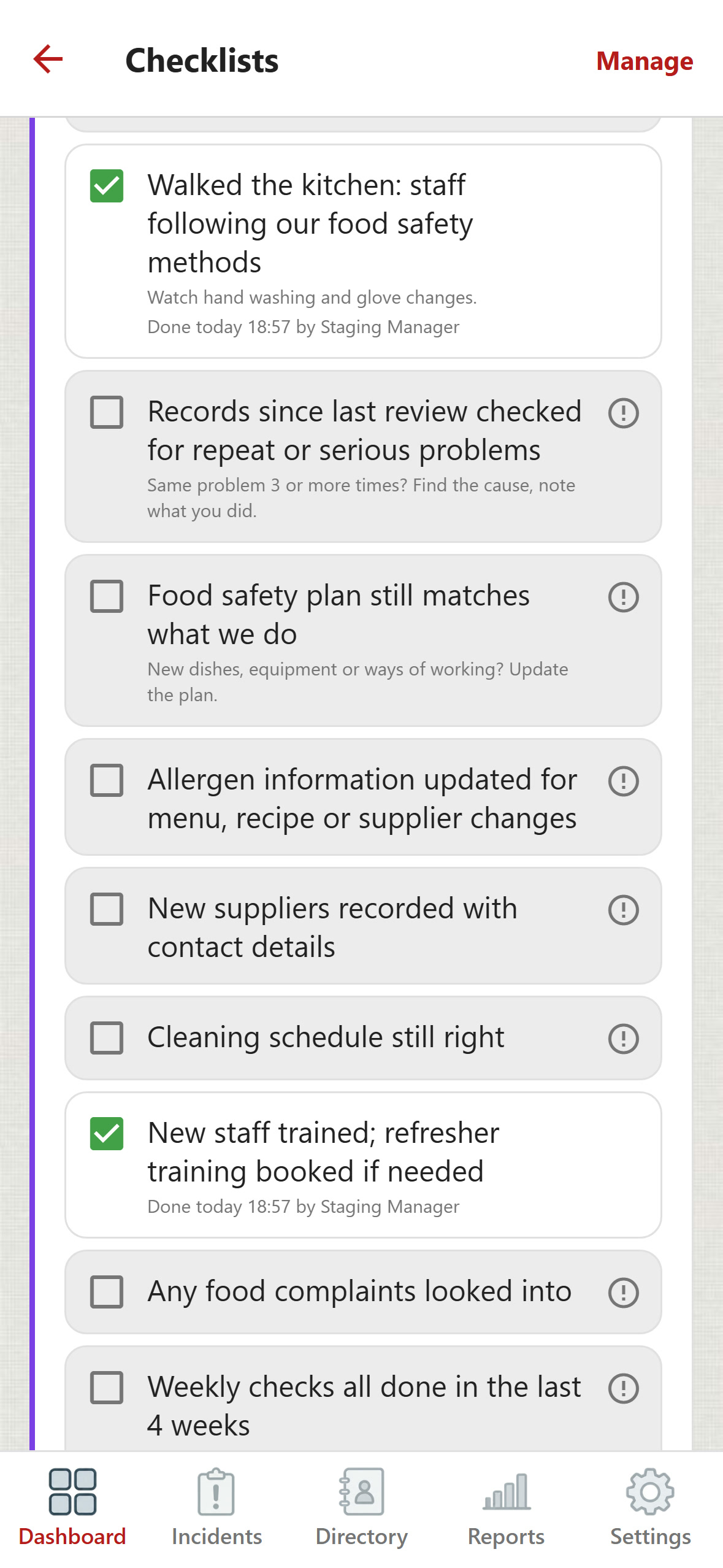
The Monthly Review, part done. The walk round the kitchen and the training check are ticked, each with who did it and when. The note under a line is this test kitchen's own wording. Any kitchen can edit, add or remove lines.
Which plan. Checklists come with Standard and Pro, and are open in the 14-day free trial. Incidents can be logged on every plan. Training records and return-to-work interviews are part of Pro, and return-to-work interviews are not in the trial.
Get ChefsRecords on the App Store (iPhone) ›
14 days free. No card required.
This page explains the law and guidance in plain words, from the public sources below as published on 1 November 2026. It is not legal advice. Your council's food team can answer questions about your own kitchen. ChefsRecords is not part of, or endorsed by, the Food Standards Agency, Food Standards Scotland, GOV.UK or any council.
Tell the chef in charge if you are ill before your shift, and stay off until 48 hours after a stomach bug clears. Wash your hands often. Change into clean whites at work and wear a clean apron. Hair back and under a hat. Rings and watches off, apart from a plain wedding band if your house rules allow it. Short, clean nails. Cuts covered with a blue plaster. No eating, drinking, smoking, vaping or gum at the prep bench.
No. Those numbered lists come from training companies and websites, and a lot of them are American. UK law asks for a high standard of personal cleanliness, clean protective clothing and illness reporting, and the FSA pack, CookSafe and Safe Catering fill in the detail. Our nine rules at the top of this page are built from those.
Because people are the easiest way for germs to reach a plate. A cook who is ill, or has only just got better, can pass on bugs like salmonella or norovirus through the food they touch. So ill staff stay at home. And things fall off people: hair, rings, chipped varnish, plasters.
A plain wedding band, usually yes. A watch, no. That is the FSA pack and GOV.UK advice, and CookSafe in Scotland simply asks for as little jewellery as possible. It is guidance rather than law, so your kitchen's house rules have the final say. If you are unsure about something specific, ask your council's food team.
There is no law on it, and the FSA and CookSafe guidance we read does not mention nails. Councils such as Bromley rule out varnish and false nails, and most kitchens have the same house rule. Putting gloves on over them does not get round it.
Not by law. But the FSA pack calls it good practice, GOV.UK asks for a hat, hair net or other head covering, and CookSafe wants hair tied back and covered where possible. Where open food is prepped, an inspector will expect hair to be under control.
Almost no food is blue, so a plaster that falls in is easy to spot. The FSA pack asks for a bright, waterproof dressing and CookSafe for a waterproof one that is easy to see. No law says it has to be blue. If a plaster ends up in food, bin the food.
Not while working with food. The FSA pack rules out eating, drinking, smoking, vaping and gum, and GOV.UK adds spitting and sneezing. Smoking inside a workplace is already banned in every UK nation; vaping is a house rule for now. Give the team somewhere away from food for breaks, and a hand wash when they come back.
The law does not stop it, but the FSA pack's ideal is to change at work and keep whites inside the food areas. Most kitchens ask staff to change on site, and not to wear whites on the way in, on a smoke break or down to the shop.
No. GOV.UK says a certificate is not required. The law asks for supervision and training that suits the job, and you need to be able to show it. See our food hygiene certificate guide.
Cleaning, cooking, chilling and avoiding cross-contamination. They are about the food and the kitchen rather than the people. See our 4Cs of food hygiene guide.
Your food safety plan should describe what your kitchen really does, and that includes your hygiene house rules. The free food safety plan builder takes you through safe methods based on the FSA pack, so you can write them in your own words, then prints your plan or saves it as a PDF. For small restaurants, cafes, pubs and takeaways in England and Wales.
The cross-contamination guide, the hand wash basins guide, the staff sickness guide, the food hygiene certificate guide, the opening and closing checks guide, the 4Cs of food hygiene guide and the EHO inspection guide.