Updated 25 October 2026 - for UK restaurants, cafes, pubs, takeaways and other small catering businesses
Cross-contamination is when bacteria spread from raw food, dirty hands, surfaces, cloths or equipment to food that will not be cooked again. You stop it by keeping raw and ready-to-eat food apart at every step, by cleaning and disinfecting, and by washing your hands.
Free wall chart: chopping board colours
Cooking kills most harmful bacteria. Ready-to-eat food, such as salad, cooked meat, sandwiches, desserts and bread, is not cooked again before it is eaten. Cross-contamination is when bacteria reach that food from somewhere else. It happens in three main ways:
The FSA's guidance is built around E. coli O157, which can be found in raw meat, raw milk and soil on vegetables, and can cause serious illness, including kidney failure. The same steps protect against other bacteria too.
Allergen cross-contact is a different hazard: an allergen getting into a dish that should not have it. Cleaning to kill bacteria does not prove an allergen has gone. Our allergen matrix guide covers it.
Our advice What it looks like on a real shift:
Law in all four nations The law says food must be protected against any contamination likely to make it unfit or harmful, at every stage. Everything food touches must be effectively cleaned and, where necessary, disinfected, often enough to avoid any risk of contamination. You need enough hand basins in the right places. Food handlers must keep themselves clean, wear clean, suitable clothing, and be supervised and instructed or trained. The law also asks for food safety procedures based on HACCP, with records that fit the size of your business.
These enforce Regulation (EC) 852/2004 as it applies in the UK. The law does not say how to keep raw and ready-to-eat food apart. The guidance below does, and your inspector may use it when looking at your kitchen.
Keep raw and ready-to-eat food apart at every step: delivery, storage, defrosting, preparation, cooking and serving, in this order of preference:
Guidance in England, Wales and Northern Ireland This is the order the FSA's E. coli guidance sets out. It calls separating by time the hardest to achieve.
When you separate by time, put food on a board or in a container, never straight on the worktop.
Guidance Do not wash raw meat or poultry. It splashes bacteria around the sink and onto anything near it.
Separate fridges for raw and ready-to-eat food are best. In a shared fridge, keep raw meat, poultry, fish and eggs covered and below ready-to-eat food, so nothing can drip onto it (eggs in detail: our eggs guide). Keep unwashed fruit and vegetables apart from ready-to-eat food and above raw meat.
Defrost raw food covered, at the bottom of the fridge below ready-to-eat food, or in a separate area away from other food.
Have separate boards, knives, tongs and containers for raw and ready-to-eat food that staff can tell apart at a glance, and store and wash them separately. Our chopping board colours guide has a free wall chart.
Slicers, mincers and vacuum packers. Keep separate machines for raw and ready-to-eat food.
How to clean them: our cleaning schedule guide.
Guidance Washing your hands properly, at the right times, is one of the best ways to stop bacteria getting from raw food to ready-to-eat food.
Law in all four nations Everyone working where food is handled must keep themselves very clean. You need enough hand basins, in the right places, kept for washing hands. Each needs hot and cold running water, soap or another way to clean hands, and a hygienic way to dry them. Where needed, food must be washed somewhere else, not in the hand basin. Food vans, market stalls, marquees and kitchens at home have a shorter rule: "appropriate facilities" for "the hygienic washing and drying of hands". Our hand wash basins guide covers both.
Guidance Wash your hands:
This list brings together the FSA's guidance for England, Wales and Northern Ireland and CookSafe's in Scotland.
Guidance in England, Wales and Northern Ireland The FSA's method, also used in Northern Ireland's Safe Catering:
Guidance in Scotland CookSafe uses the same rubbing steps and adds: if your hands are not visibly clean after washing, wash them again.
Guidance No food safety guidance we read gives a number of seconds. The FSA says effective hand washing takes time. The NHS's everyday advice is about 20 seconds, as long as it takes to sing Happy Birthday twice.
Guidance in England, Wales and Northern Ireland Dry your hands thoroughly, because bacteria spread more easily from wet or damp hands. The FSA recommends single-use paper towels and does not recommend reusable towels. Taps can carry bacteria, so turn them off with your paper towel, not your clean hands. The FSA calls taps you do not work by hand, such as sensor, elbow or foot taps, good practice. Short lever taps you can push with the back of your hand are a good alternative.
Guidance in Scotland CookSafe also says to dry your hands on a single-use towel and turn the tap off with it, and to consider fitting taps you do not work by hand.
Law in all four nations A hand basin is for washing hands.
Guidance in England and Wales The FSA's Safer Food, Better Business pack says hand basins should be convenient, with plenty of soap and disposable towels, and asks you to check and refill them often.
Our advice Keep the basin clear. Never wash food, equipment or cloths in it. Check the soap and paper towels during service, not just at opening. How many basins, where, and what vans and home kitchens need: our hand wash basins guide.
Guidance Hand gel can add protection after washing. It never replaces washing, and it does not remove visible dirt. If you use gel, the FSA and CookSafe say to choose one that meets BS EN 1500. For extra protection they recommend a liquid antibacterial hand wash that meets BS EN 1499. These two standards are for hands. The disinfectant standards for surfaces, BS EN 1276 and BS EN 13697, are different.
Guidance in Scotland CookSafe recommends hand gel after washing when the risk is higher, for example after handling raw food.
Law in all four nations The law does not require food handlers to wear gloves. It requires them to keep themselves very clean and wear suitable, clean and, where necessary, protective clothing.
Guidance Gloves do not replace hand washing. Gloves pick up bacteria just as hands do. If you use disposable gloves:
Guidance For ready-to-eat food, handle it as little as possible and use clean tongs or other utensils where you can. Gloves, used correctly, are another option. The FSA and Food Standards Scotland say separate gloves for different jobs, for example a different colour for raw food, might help. No guidance we read sets a glove colour.
Our advice Many kitchens use blue gloves because a torn piece is easier to see in food.
Guidance in England, Wales and Northern Ireland The FSA calls door handles, light switches and similar items "hand contact points". Hands touch them between raw and ready-to-eat food, so they can carry bacteria from one to the other. The FSA says they should be on your cleaning checklist and schedule.
Guidance In a kitchen they include:
Guidance Two things keep them from spreading bacteria:
Our advice Clean and disinfect hand contact points every shift, and straight away if someone touches one with raw food on their hands or gloves.
Guidance If one sink is used for both raw and ready-to-eat equipment, clean and disinfect the sink, taps and fittings between uses.
Guidance in Northern Ireland Safe Catering recommends pedal bins, so nobody has to touch the lid.
Guidance No guidance we read bans phones in the kitchen. They count as hand contact points: wash your hands after using one, and keep it on your cleaning schedule.
Our advice That includes the phone or tablet you record your checks on, ChefsRecords included. Wipe it with your other contact points. If you are wearing gloves, change them after using it, before you touch ready-to-eat food.
Our advice Change your apron after preparing raw food, before you work with ready-to-eat food, and whenever it gets dirty. A chef at the stove or grill, putting raw food on and taking cooked food off, does not need a new apron each time unless it gets dirty.
Guidance in England, Wales and Northern Ireland Take off watches and jewellery before preparing food, apart from a plain wedding band.
Guidance in Scotland CookSafe says to keep jewellery to a minimum.
Guidance Tell your manager about any cut or sore. Cover it completely with a brightly coloured waterproof dressing, such as a blue plaster, so it is easy to spot if it falls into food.
Our advice Keep nails short and clean.
Clean and disinfect the probe before and after each use. A separate probe for ready-to-eat food is best.
Checking that your probe reads correctly is a different job: see our probe calibration check guide.
Guidance Clean first, then disinfect. Disinfectant only works on a surface that is already clean. Use a disinfectant or sanitiser that meets BS EN 1276 or BS EN 13697, at the dilution and for the contact time on its label. A sanitiser cleans and disinfects, so use it twice: once to clean, once to disinfect.
Guidance in England and Wales The FSA pack calls a dishwasher "a good way to clean equipment and kill bacteria (disinfect)". Guidance in Northern Ireland Safe Catering calls a dishwasher "one of the most reliable ways to clean equipment and kill harmful bacteria such as E.coli O157", and says steam cleaning and sterilising sinks "can also be effective methods for disinfecting using heat in some circumstances but should be used with care".
Guidance Use disposable cloths where you can and throw them away after each task. Keep separate cloths for raw food areas. Soaking cloths in bleach is not an effective way to disinfect them.
The full method is in our cleaning schedule guide. What to look for on a disinfectant label: our disinfectants guide.
Ask for raw food to arrive apart from ready-to-eat food where you can. If it comes together, check it was kept separate and the packaging is not damaged or leaking. Take off outer packaging before food goes into the kitchen, and never put a box that held raw meat on a prep surface.
Guidance in England and Wales The FSA's Safer Food, Better Business pack says raw and ready-to-eat food delivered together must be kept separate.
More in our delivery checks guide.
Guidance If ready-to-eat food may have touched raw food or its juices, throw it away. Wash, disinfect and dry anything the raw food touched.
Guidance in England, Wales and Northern Ireland The FSA's E. coli guidance lists what to write down: what went wrong, when, which control failed, what you did to correct it, who you told and when, and what you changed so it does not happen again.
Our advice There is no published list. The FSA's E. coli guidance is written for inspectors as well as businesses, so these are questions we would expect:
In Scotland, an officer may also swab a surface to check your cleaning.
ChefsRecords helps you keep a daily record of the checks that show raw and ready-to-eat food are kept apart, with who completed each checklist and when:
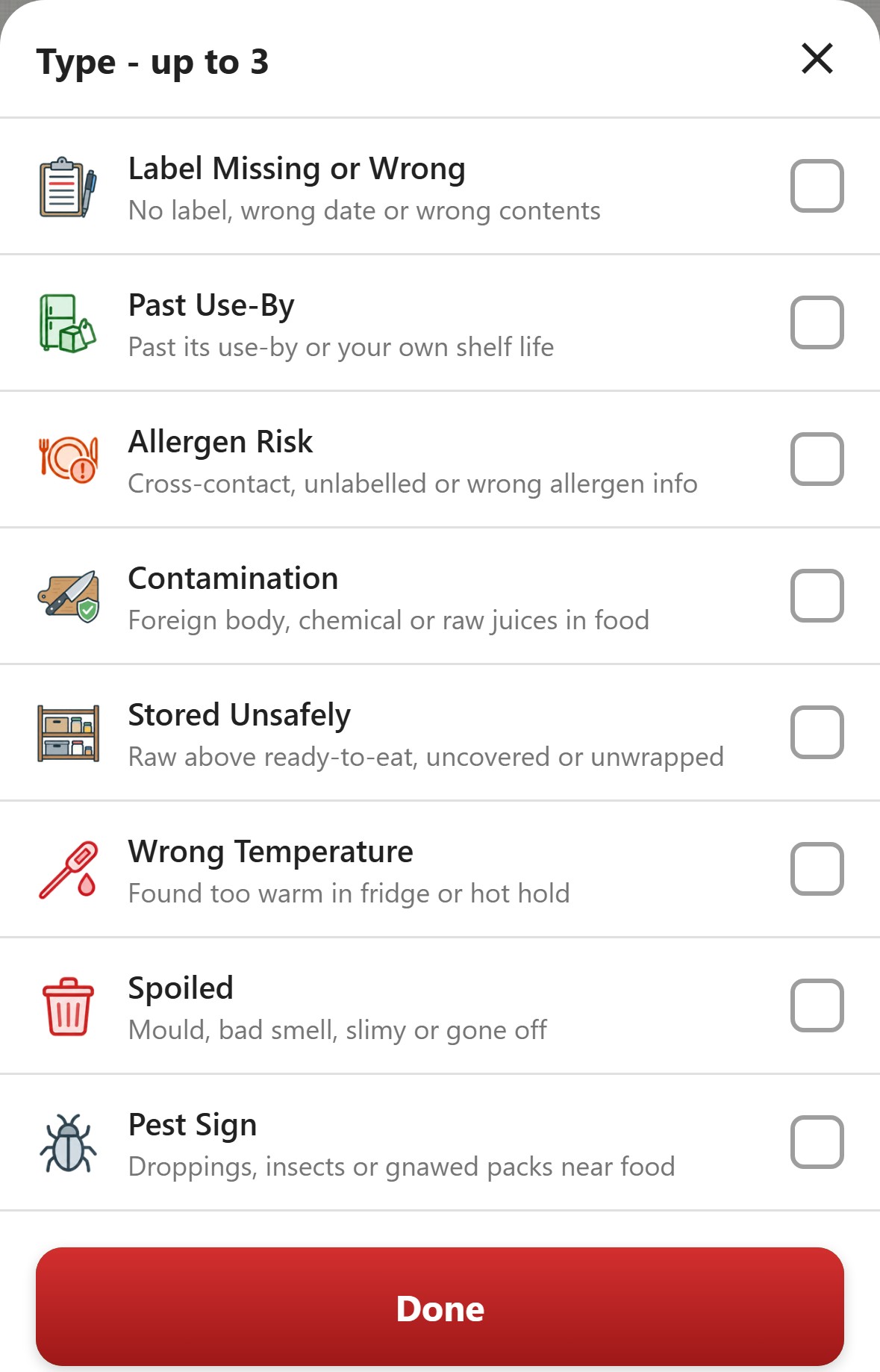
"Contamination" covers raw juices in food. "Stored Unsafely" covers raw food above ready-to-eat food. Each can be a near miss or an incident, with a photo.
Not yet: a place to set your board colours, a delivery question about raw and ready-to-eat food arriving apart, or a check that hand basins are clear and used only for hands. Tell us if you would use them.
Which plan. Incidents and near misses are on every plan. Checklists and the Inspection Pack come with Standard and Pro and are open in the 14-day trial.
Get ChefsRecords on the App Store (iPhone) ›
14 days free. No card required.
This page explains the law and guidance in plain words, from the public sources below as published on 24 October 2026. It is not legal advice. Your council's food team can answer questions about your own kitchen. ChefsRecords is not part of, or endorsed by, the Food Standards Agency, Food Standards Scotland or your local council.
Bacteria spreading from raw food, hands, surfaces, cloths or equipment to food that will not be cooked again, such as salad, cooked meat or desserts.
Direct, when raw food touches ready-to-eat food; through something in between, such as hands, boards, knives or cloths; and drips, when raw juices fall onto food below.
Keep raw and ready-to-eat food apart at every step, use separate boards and utensils that are easy to tell apart, clean and then disinfect, wash your hands after touching raw food, and store raw food below ready-to-eat food.
No. The law says food must be protected from contamination. Colour coded boards are one common way to do it, recommended in guidance in all four nations.
Keep separate machines. The FSA says a slicer should only be used for both if it is fully taken apart and disinfected in between, which cannot be done properly during a normal working day.
No. The law does not require gloves. If you use them, wash your hands before putting them on and after taking them off, use each pair for one task, and change them whenever you would wash your hands. Gloves do not replace hand washing.
No guidance sets a time. The FSA says hand contact points should be on your cleaning schedule and cleaned and disinfected regularly. Many kitchens do them every shift, and straight away if someone touches one with raw food on their hands.
No. Wash your hands with soap and water. Gel can be used after washing for extra protection, but it does not replace washing and does not remove visible dirt.
No guidance we read bans it. Treat a phone as a hand contact point: wash your hands after using it, before you touch food, and clean it with your other contact points.
No. Washing raw meat or poultry splashes bacteria around the sink. Cooking it properly kills the bacteria.
No. Cross-contamination is about bacteria. Allergen cross-contact is an allergen getting into food that should not have it, and cleaning to kill bacteria does not prove an allergen has gone.
The law is the same, in Scotland's own regulations. The guidance is from Food Standards Scotland and CookSafe, and it is stricter on sharing: it says boards, utensils and containers should never be shared between raw and ready-to-eat food.
The chopping board colours guide, the kitchen cleaning schedule guide, the delivery checks guide, the allergen matrix guide, the staff sickness guide, the near miss guide, the EHO inspection guide and the 4Cs of food hygiene guide. In England and Wales, our free food safety plan builder has a cross-contamination section. More guides: the hand wash basins guide, the disinfectants guide and the eggs guide.