Updated 25 October 2026 - for UK restaurants, cafes, pubs, takeaways and other small catering businesses
Use a different colour of chopping board for each kind of food, so germs from raw food are less likely to reach food that will not be cooked again. No law sets the colours. The usual UK scheme is red for raw meat, blue for raw fish, yellow for cooked meat, green for salad and fruit, brown for vegetables and white for bread and dairy. Our free wall chart shows it, in two versions.
Download the wall chart (PDF, A4): six colours or six colours with purple
Our chopping board colour chart is one A4 page to print and put on the wall by your prep area. Each colour is drawn as a board with its name written on it, so it still works on a black and white printer and for anyone who finds some colours hard to tell apart. Under the colours are six short rules for looking after boards.
Download the wall chart (PDF): six colours, the scheme the FSA's guidance shows as an example, or six colours with purple, for kitchens that keep a purple board for allergy orders (see section 5). It is free to print and use in your kitchen. No sign-up.

This is the usual scheme in UK kitchens, and many suppliers sell boards and knife handles in these colours. Guidance in England, Wales and Northern Ireland The FSA's E. coli guidance shows it as "an example of a colour coding system".
| Colour | Use it for | For example |
|---|---|---|
| Red | Raw meat and poultry | Raw chicken, beef, pork, lamb, sausages and burgers |
| Blue | Raw fish | Raw fish fillets and whole fish |
| Yellow | Cooked meat and poultry | Cooked ham, roast chicken and cooked bacon for sandwiches |
| Green | Salad and fruit | Lettuce, tomatoes, cucumber, herbs and fruit |
| Brown | Vegetables, including unwashed and root vegetables | Potatoes, carrots and onions, especially with soil on |
| White | Bread, bakery and dairy | Bread, cakes and cheese |
Other schemes exist, and some use a colour for a different food. Our advice Any scheme works if everyone in the kitchen knows it. Use one scheme only, write it in your food safety plan, and put the chart where boards are picked up.
Law in all four nations No. No law in England, Wales, Scotland or Northern Ireland sets chopping board colours. The law says food must be protected against any contamination likely to make it unfit or harmful, and everything food touches must be effectively cleaned and, where necessary, disinfected, often enough to avoid any risk of contamination. How you keep raw and ready-to-eat food apart is for you to decide, write down and show your inspector.
Keeping separate boards for raw and ready-to-eat food is the safe choice everywhere. Where a kitchen does share one, the guidance differs by nation:
Our advice Wiping a board with sanitiser between raw chicken and salad is not enough, even if you do it twice. Use another board.
Our advice Some kitchens keep a purple board, often with a purple knife, for orders for customers with a food allergy. Purple is not part of the FSA's example scheme, and the FSA, Food Standards Scotland and Safe Catering guidance does not name it. A board kept only for allergy orders can lower the risk, because it is not used for everyday prep. It is still shared between allergy orders, which may contain different allergens, so wash it well before each one and store it apart.
It does not make a dish free from an allergen. Allergens also reach food from hands, knives, tongs, worktops, shared fryers and the ingredients themselves, and washing does not prove an allergen has gone. Only tell a customer a dish is free from an allergen if you can be sure, because that is a promise. Our allergen matrix guide covers allergen cross-contact.
Guidance in England, Wales and Northern Ireland The FSA's factsheet for caterers says utensils should be kept for either raw or ready-to-eat food and colour coded, or otherwise easy to identify: "This includes chopping boards, tongs, containers etc." Many kitchens buy knives with handles in the same colours as the boards.
Guidance in England, Wales and Northern Ireland For cloths, the FSA recommends disposable cloths, thrown away after each task. If you use reusable cloths, keep separate ones for raw food areas, for example colour coded cloths, and wash them on a hot 90°C cycle.
Guidance Soaking cloths in bleach is not an effective way to disinfect them. More on cloths in our cleaning schedule guide.
Guidance in England, Wales and Northern Ireland The FSA's E. coli guidance says: "Chopping boards that have deep scores from repeated use should be replaced".
Our advice Boards wear quickly in a busy kitchen. Check them every week. Replace a board with deep cuts or scores, one that has warped and no longer sits flat, or one with stains or a smell that will not wash out. Germs hide in the grooves, where a cloth and disinfectant cannot reach. Budget for new boards as a running cost, not a one-off.
Our advice There is no published list. The FSA's E. coli guidance is written for inspectors as well as businesses, so these are questions we would expect:
In Scotland, an officer may also swab a surface to check your cleaning.
Does ChefsRecords have a board colour chart or a place to set your colours? Not yet. Keep the wall chart on the wall and your scheme in your food safety plan. Here is what the app does today:
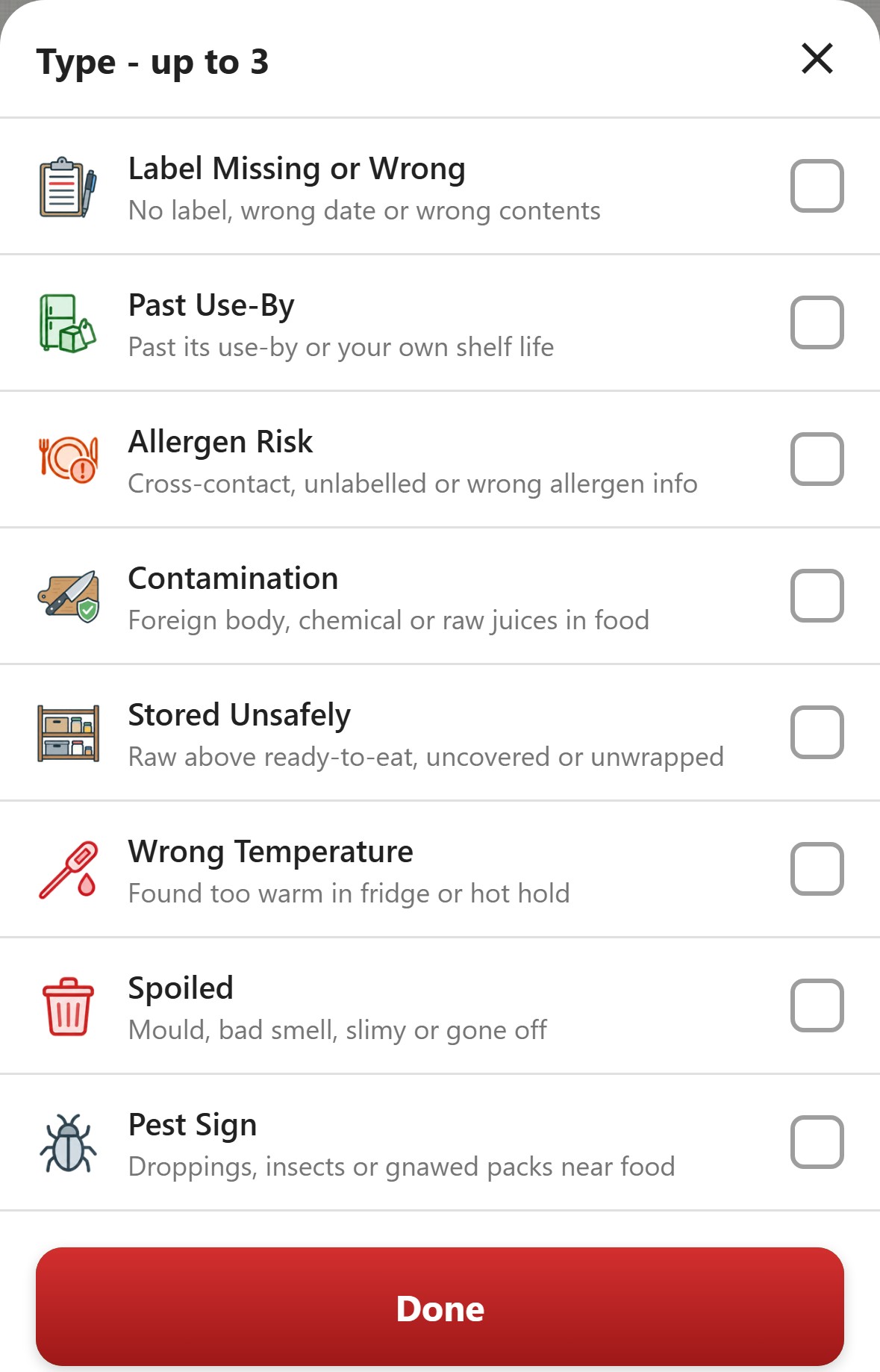
"Contamination" covers raw juices in food. "Stored Unsafely" covers raw food above ready-to-eat food. Each can be a near miss or an incident, with a photo.
Which plan. Incidents and near misses are on every plan. Checklists come with Standard and Pro and are open in the 14-day trial.
Would you use a board colour setting in the app? Tell us. Every reply helps us decide what to build next.
Get ChefsRecords on the App Store (iPhone) ›
14 days free. No card required.
This page explains the law and guidance in plain words, from the public sources below as published on 24 October 2026. It is not legal advice. Your council's food team can answer questions about your own kitchen. ChefsRecords is not part of, or endorsed by, the Food Standards Agency, Food Standards Scotland or your local council.
Yellow, in the usual UK scheme and in the FSA's example. Red is for raw meat and poultry.
Red, for raw meat and poultry, in the usual UK scheme. Keep it away from ready-to-eat food.
Brown for vegetables, especially unwashed and root vegetables with soil on. Green is for salad and fruit that will be eaten raw.
White, for bread, bakery and dairy, such as cakes and cheese.
Blue, for raw fish.
No. No UK law sets colours. The law says you must protect food from contamination. Colour coded boards are one of the clearest ways to show you keep raw and ready-to-eat food apart, and the FSA, Food Standards Scotland and Safe Catering all recommend them.
In England, Wales and Northern Ireland the FSA says a shared board should go through a full dishwasher cycle, or another form of heat disinfection, between raw and ready-to-eat use. In Scotland, CookSafe says boards should never be shared. Separate boards are the safe choice everywhere.
Some kitchens keep a purple board for allergy orders. It is not part of the FSA's example scheme. It does not make a dish free from an allergen on its own.
No rule sets a time. The FSA says boards with deep scores should be replaced. Boards wear quickly in a busy kitchen, so check them every week and replace any with deep cuts, warping, or stains that will not wash out.
Your food safety plan should describe what your kitchen really does. The free food safety plan builder takes you through safe methods based on the FSA pack, so you can write them in your own words, then prints your plan or saves it as a PDF. For small restaurants, cafes, pubs and takeaways in England and Wales.
The cross-contamination guide, the kitchen cleaning schedule guide, the allergen matrix guide, the opening and closing checks guide and the near miss guide. More free printables on our free tools page. More guides: the 4Cs of food hygiene guide, the disinfectants guide and the hand wash basins guide.