Updated 13 October 2026 - for UK restaurants, cafes, pubs, takeaways and other catering businesses
Two FSA publications on GOV.UK use the phrase. "Cooking your food" says: "When food is at a temperature of between 8 - 63°C, this is called The Danger Zone." The FSA's chilling and defrosting guide says: "Defrost food in the fridge to prevent it sitting in between 8 - 63°C, which is the Danger Zone. ... Between these temperatures the bacteria may grow and make you ill." GOV.UK's guidance for food businesses gives the same range without the name: "Bacteria can grow if defrosting food is kept between 8°C and 63°C."
So in England, Wales and Northern Ireland, the official figure is 8°C to 63°C. We could not find the term in Food Standards Scotland guidance. It lines up with the two legal limits below.
| Range you will see | Where it comes from |
|---|---|
| 8°C to 63°C | FSA guidance (England, Wales and Northern Ireland). The official figure there. |
| 8°C to 60°C | Often credited to the FSA online, but we could not find it on any FSA page. The FSA's own pages say 8 to 63°C. |
| 5°C to 60°C | Food Standards Australia New Zealand. |
| 40°F to 140°F (about 4 to 60°C) | The US Department of Agriculture. |
| 5°C to 63°C | Pairs the recommended fridge setting (5°C) with the hot holding figure (63°C). We could not find it as a range in FSA or Food Standards Scotland guidance. |
If you work in a UK kitchen, use the UK figures: 8°C and 63°C as the legal limits in England, Wales and Northern Ireland, and 5°C as the recommended fridge setting.
| What | England, Wales and Northern Ireland | Scotland |
|---|---|---|
| Chilled food | 8°C or below (law) | In a fridge, chill room or cool ventilated place; no number in law. 8°C recommended |
| Hot holding | 63°C or above (law, with defences - see below) | Above 63°C (law, with some exemptions) |
| Reheating | No number in law. Steaming hot all the way through (FSA) | 82°C or above (law, unless that would spoil the food) |
| Cooking | No number in law. 70°C for 2 minutes or equivalent (guidance) | No number in law. CookSafe: 75°C or above destroys almost all bacteria |
| Cooling | "As quickly as possible" (law, all four nations). No time set | |
Behind all of this is a general rule in food hygiene law: food must not be kept at temperatures that might result in a risk to health, and the cold chain must not be interrupted, with limited periods allowed for the practicalities of preparing, displaying and serving food.
There is no single UK time limit. In England, Wales and Northern Ireland there are two time-limited legal defences for food on display or for service:
Both are defences the business has to be able to show, so write down when food went out, or label it with the time (SFBB). Neither applies in Scotland, where the law has different exemptions, for example for food on display for sale. The "2-hour / 4-hour rule" you may read about is Australian: it adds up all the time food spends between 5°C and 60°C, and it is not UK law.
Cooling is where food spends longest in the danger zone. The law says cool it as quickly as possible. SFBB says the same: "chill it down as quickly as possible and then put it in the fridge." SFBB's options:
Probe the food just after cooking and again at regular intervals to see how fast your method works. If food has not been chilled down safely, SFBB says re-cook it if appropriate, or throw it away. Rice needs extra care.
What about 90 minutes? Many kitchens aim to get cooked food to 8°C or below within 90 minutes. It is a common target, and a good one, but it is not in UK law or in SFBB.
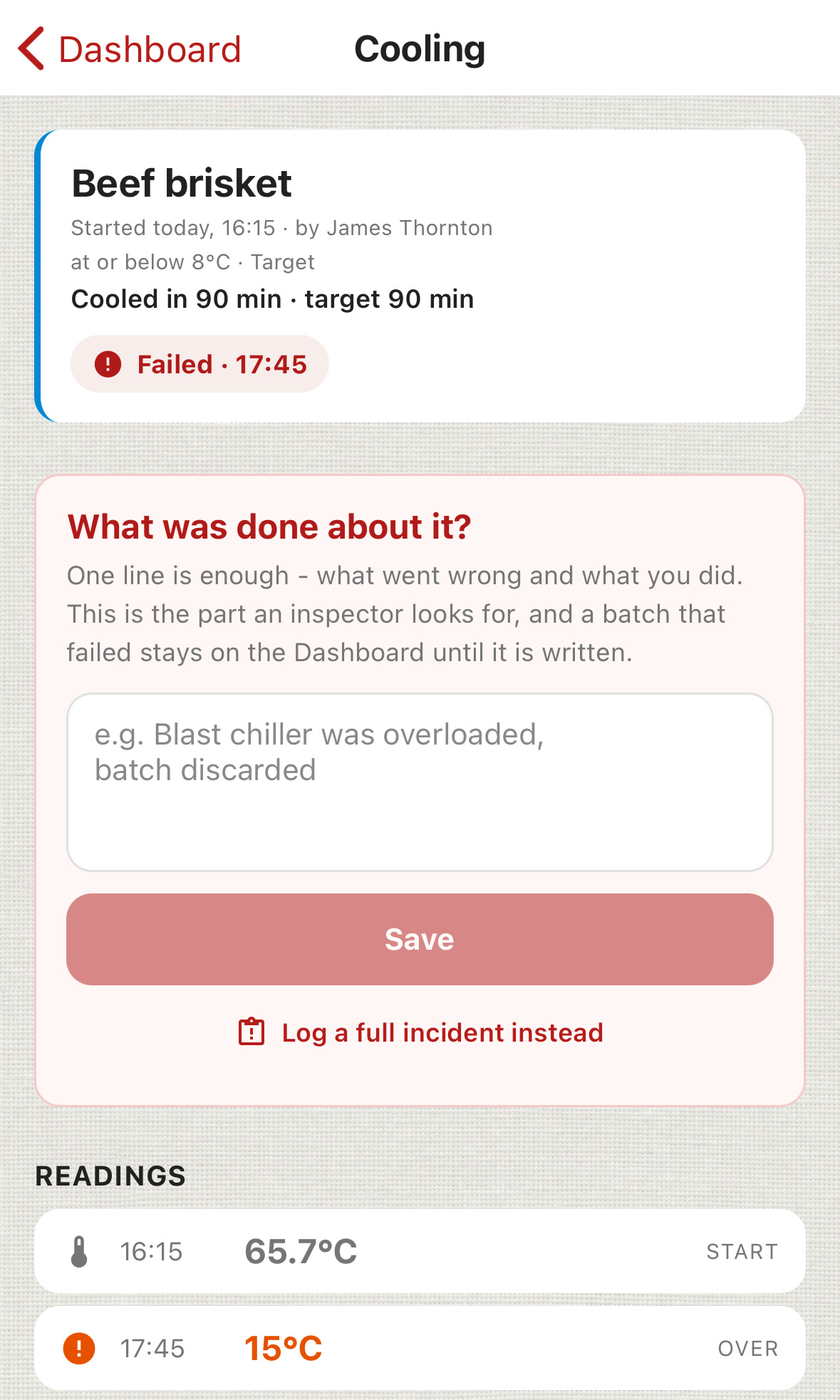
A batch that did not cool in time. At the check, 15°C is over the kitchen's 8°C target, so the batch fails and the app asks what was done: re-cooked, or thrown away.
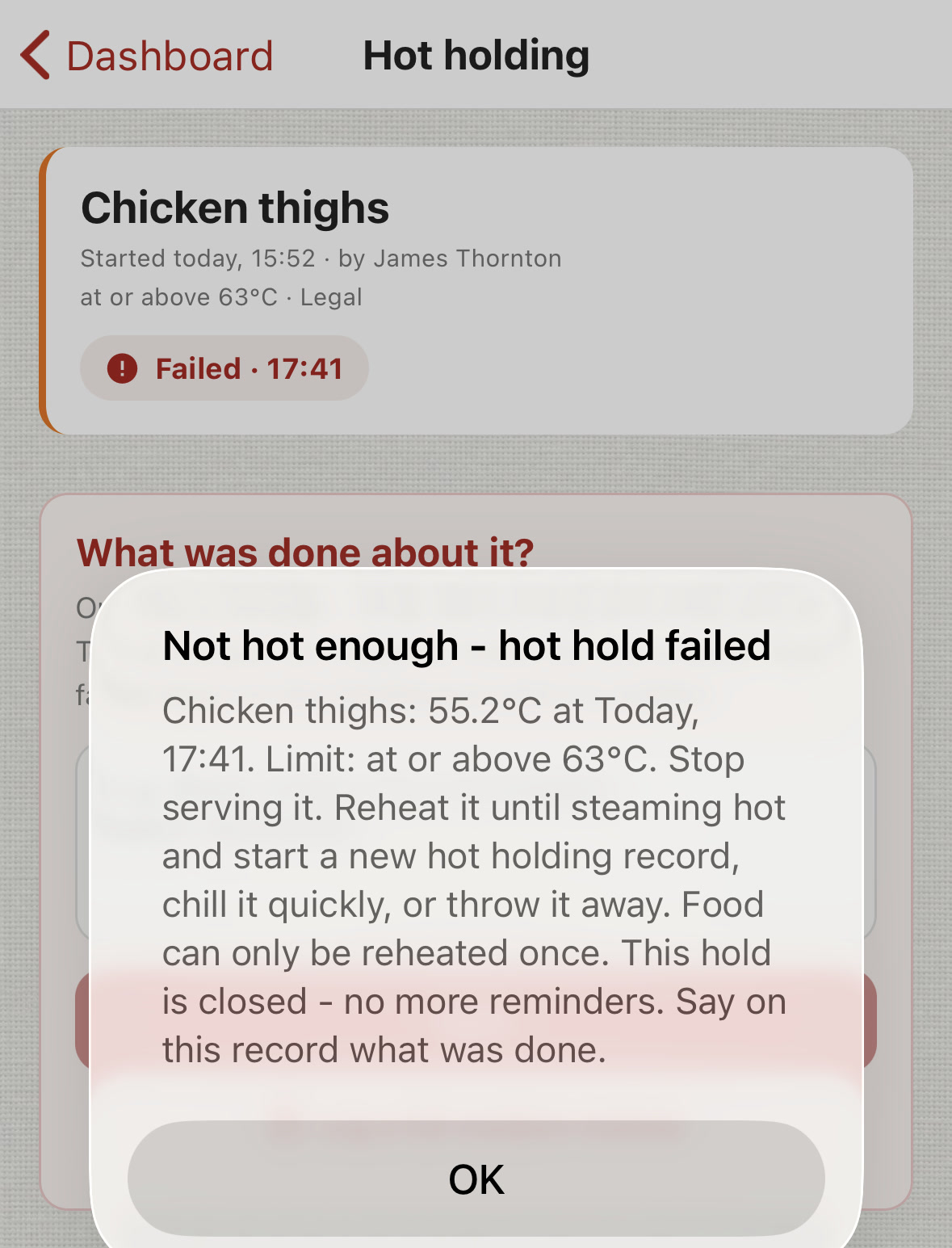
Hot food that dropped into the zone. At 55.2°C the app tells you to stop serving it and what your options are, then asks what was done.
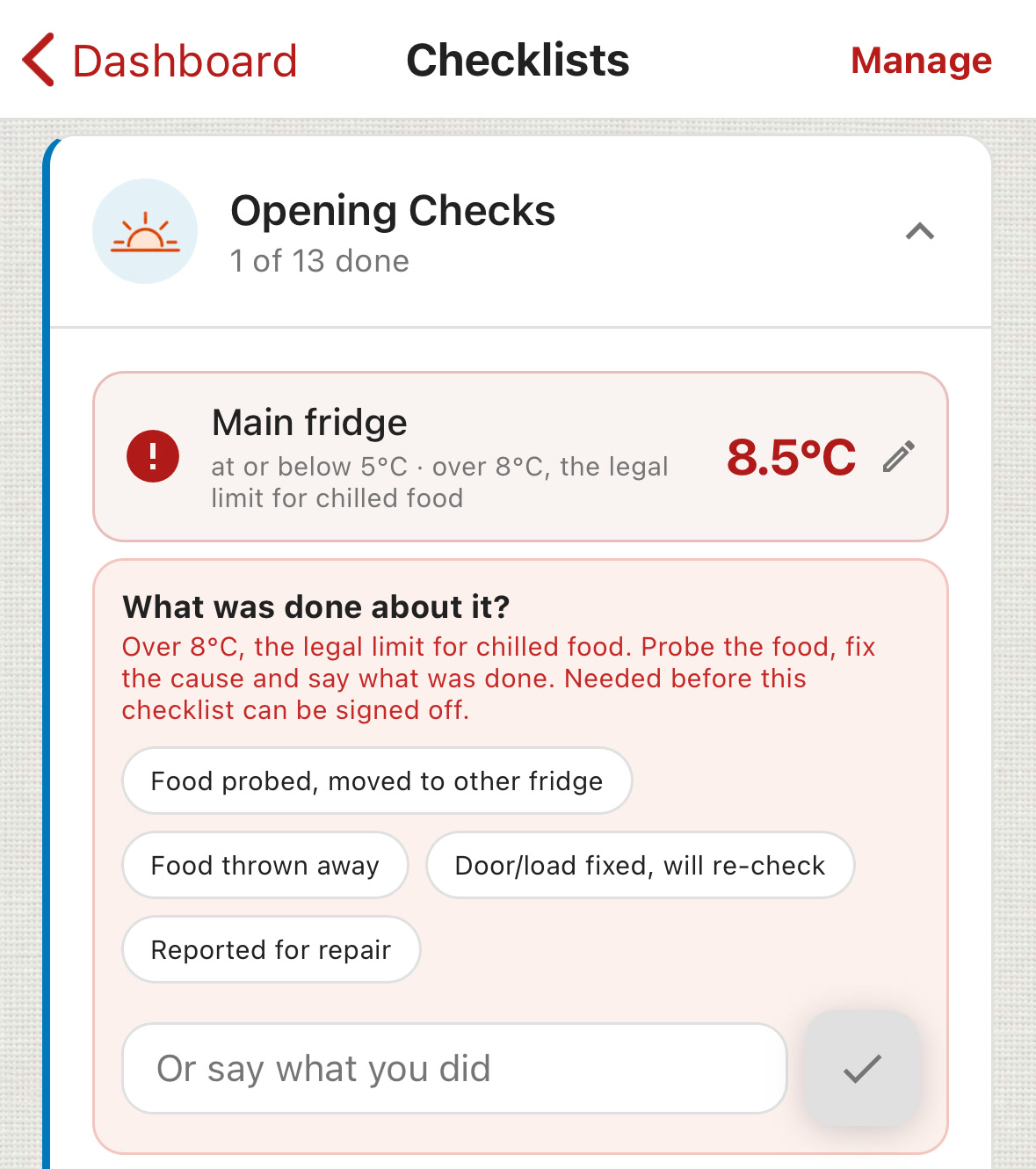
A fridge over 8°C. The reading turns red and the app asks what was done. An answer is needed before the checklist can be signed off.
| Record | Why it matters |
|---|---|
| Cooling: start time and temperature, and each check | Shows how fast food left the danger zone. |
| Hot holding: each check with the time | Shows food stayed at 63°C or above. |
| Time food went out on display, if you use the two or four hours | The defences depend on being able to show it. |
| Fridge and delivery readings | Shows the cold end held. |
| Who took each reading, and who signed off the action | Shows someone was responsible. An unsigned record is weak evidence. |
| What you did when a reading was out | Re-cooked, reheated, chilled, thrown away. The action matters as much as the number. |
Paper works, and SFBB, Safe Catering and CookSafe are free. An app helps when several people take readings, or when a cooling check is easy to forget in a busy service.
In ChefsRecords, cooling is its own record. Probe the food as it comes off the heat and press Start: the app reminds you when your cooling time is up (90 minutes unless your kitchen sets its own, a common target, not a UK rule) and judges the batch on where it finished. Hot holding, reheating, cooking and deliveries each have their own record. Each reading is judged against the legal limit, a guidance figure or, where there is neither (reheating outside Scotland), the app's own starting point, and labelled as which. Fridge checks sit on your checklists, and a reading over 8°C is marked red and needs an answer. Every reading is saved with the time and who took it, and anything that fails asks what was done.
The app does not time food left out on the side. If food is out of the fridge or the hot cupboard, write down when it went out.
Recording cooking, cooling, hot holding, reheating and deliveries is free on every plan, including after the 14-day trial. Checklists (and so fridge checks) and reports are part of the Standard and Pro plans, and open during the trial. See what else it does.
This is general guidance for UK kitchens, written from the official sources below as published on 13 October 2026. It is not legal advice and does not replace your own food safety management system. If you are unsure, ask your local authority's food safety team.
The FSA describes 8°C to 63°C as the danger zone, where bacteria may grow. It is FSA guidance for England, Wales and Northern Ireland, not a legal definition.
Not in the UK. We could not find any FSA page that gives 60°C as the top of the danger zone. The FSA says 8 to 63°C. 60°C is the US and Australian hot figure.
No. The law in England, Wales and Northern Ireland is 8°C or below. 5°C or below is the recommended setting, for headroom. Scotland sets no number in law.
There is no single UK limit. In England, Wales and Northern Ireland, chilled food on display for less than four hours and hot food out of hot holding for less than two hours are once-only legal defences. Scotland has neither; its law has different exemptions.
As quickly as possible. No UK rule sets a time. Many kitchens aim for 8°C or below within 90 minutes.
No. Cold slows bacteria down. It does not kill them.
Yes in England, Wales and Northern Ireland, where the law says 63°C or above. No in Scotland, where it says above 63°C.