Updated 25 October 2026 - for UK restaurants, cafes, pubs, takeaways and other small catering businesses
The 4 Cs of food hygiene, also called the 4 Cs of food safety, are cleaning, cooking, chilling and avoiding cross-contamination. They are a short way to remember the basics, used by the FSA and Food Standards Scotland in their advice to food businesses. They are good practice, not law, but some of the figures inside them are law, and they differ by nation.
Free staff poster (PDF, A4): England, Wales and Northern Ireland or Scotland
Our 4 Cs poster is one A4 page for the staff room or the wall by the pass: the four Cs, each with four short lines and an icon, and a reminder about allergens. The temperatures differ between the nations, so there are two versions.
Download the poster (PDF): England, Wales and Northern Ireland or Scotland. It is free to print and use in your kitchen. No sign-up.

Guidance The 4 Cs of food hygiene are cleaning, cooking, chilling and avoiding cross-contamination. The FSA and Food Standards Scotland both use them in their advice to food businesses, as a short way to remember the basics. GOV.UK says that to make sure your food is hygienic, you should follow best practice around the 4 Cs.
Each C below has a short summary and a link to our full guide, with the figures for each nation. There is no set order; we use the one in the FSA's community cooking guidance: cleaning, cooking, chilling, cross-contamination.
Guidance No. The 4 Cs are a way to remember good practice. They are not a law in England, Wales, Northern Ireland or Scotland.
Law in all four nations What the law asks is that every food business has food safety procedures based on HACCP. You work out what could go wrong, set your own limits, check them, put things right when something is not under control, and keep records that fit the size of your business.
Some figures inside the 4 Cs are law, and they differ by nation.
Guidance Cooking temperatures, fridge settings and cooling times are guidance.
Our advice The 4 Cs are not a food safety management system on their own. Your system also needs your checks, your records and what you do when something goes wrong. See our food safety management system guide.
Law in all four nations Everything food touches must be effectively cleaned and, where necessary, disinfected, often enough to avoid any risk of contamination.
Guidance Clean first, then disinfect: a disinfectant only works on a clean surface, and it needs the contact time on its label. Use one that shows BS EN 1276 or BS EN 13697 (our disinfectants guide explains the label). Clean and disinfect anything raw food has touched. Clear and clean as you go, and keep a cleaning schedule that says what is cleaned, how often and with which product.
Full guide: kitchen cleaning schedule, including two-stage cleaning.
Law in all four nations No UK law sets a cooking temperature.
Our advice Probe the thickest part. One reading of 70°C does not show 2 minutes.
Full guides: cooking temperatures, reheating and hot holding.
Guidance Set fridges at 5°C or below for a margin, and keep freezers at -18°C or below. Defrost food in the fridge.
Law in England, Wales and Northern Ireland Chilled food on service or display for less than 4 hours is a defence, once only. The FSA pack says to throw it away after 4 hours. Law in Scotland There is no four-hour defence, but the law has its own exemptions, including food "exposed for sale".
Law in all four nations Cool cooked food as quickly as possible. No law sets a time.
Common target, not law Many kitchens aim for 90 minutes.
Full guides: fridge temperature log, cooling food and the danger zone.
Law in all four nations Food must be protected against any contamination likely to make it unfit or harmful.
Guidance in England, Wales and Northern Ireland Keep raw meat, fish and poultry apart from ready-to-eat food at every step. Use separate chopping boards and utensils for raw food, that staff can tell apart. In a shared fridge, keep raw food covered and below ready-to-eat food. Wash your hands between tasks, especially before and after handling raw food. Do not wash raw meat or poultry.
Guidance in Scotland CookSafe says boards and utensils should never be shared between raw and ready-to-eat food.
Full guides: cross-contamination and chopping board colours, with a free wall chart.
Allergens are not one of the 4 Cs, but they matter just as much. Guidance in England, Wales and Northern Ireland GOV.UK's cross-contamination advice says you should also avoid cross-contamination from food that contains allergens.
Law in all four nations Giving customers correct allergen information is the law. Our allergen matrix guide covers it, with a free printable matrix.
Our advice We could not find a fifth C from the FSA or Food Standards Scotland. Some trainers add one, and their lists differ.
Not UK - United States American advice uses four steps: clean, separate, cook and chill. That is not UK guidance, and its temperatures are not UK figures.
Our advice Many new staff meet the 4 Cs on a food hygiene course. In your kitchen, make them real on day one:
Training records: our food hygiene certificate guide.
Our advice There is no published list. An inspector may ask how you keep raw and ready-to-eat food apart, which cleaning products you use and for how long, what temperature you cook to and how you check it, how you cool food, and to see your fridge records and what you did when something went wrong. Our EHO inspection guide covers the visit.
ChefsRecords keeps the daily record for each C, with who completed each checklist and when:
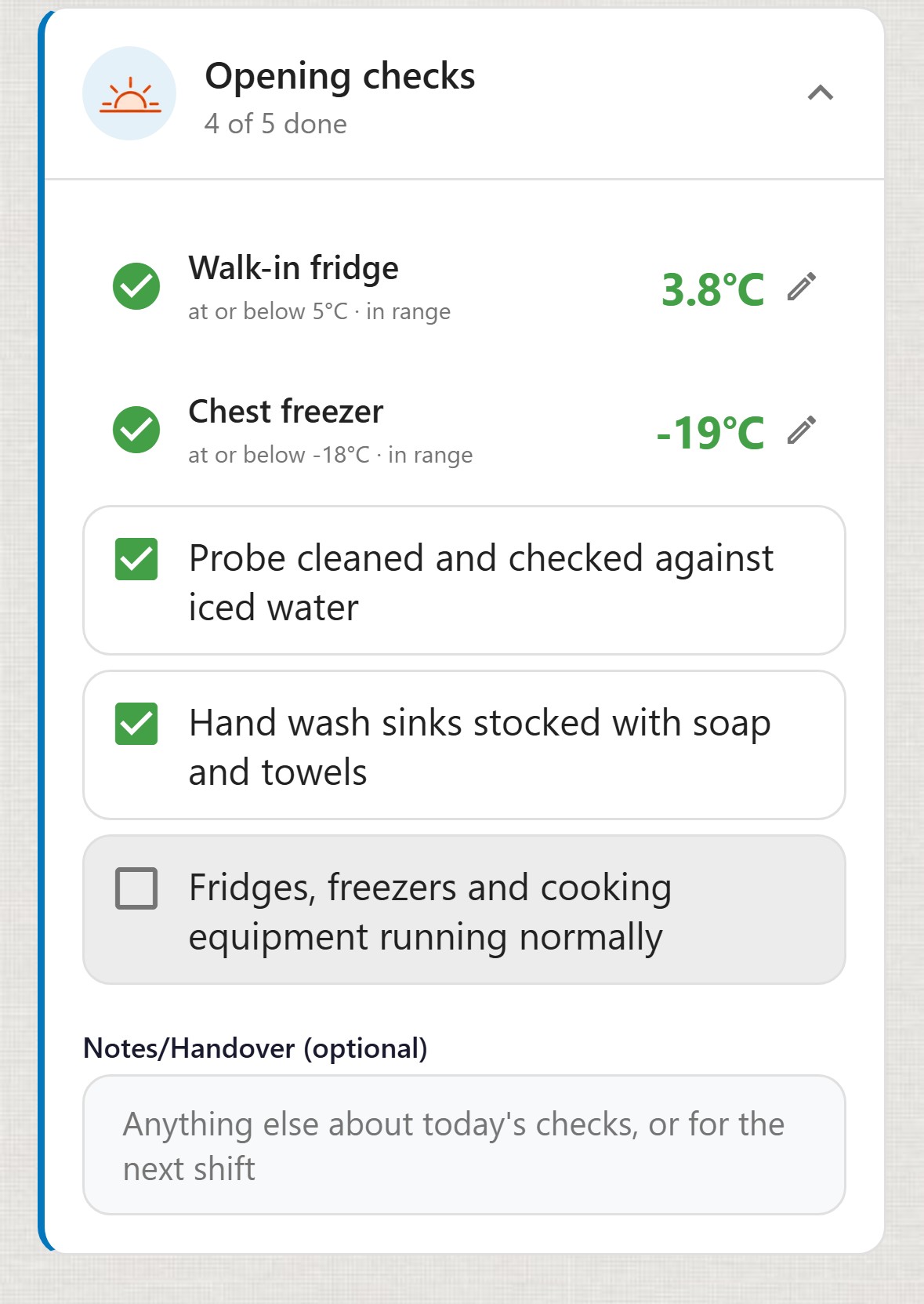
Opening checks, part done. Fridge and freezer readings are saved against their limits, and each check is ticked as the shift runs.
Which plan. Cooking, cooling, hot-holding, reheating and delivery records, and incidents and near misses, stay free after the trial for one login, the kitchen's billing Manager (up to 20 incidents on free). Checklists (where the fridge and freezer readings are), reports and the Inspection Pack come with Standard and Pro and are open in the 14-day trial.
Get ChefsRecords on the App Store (iPhone) ›
14 days free. No card required.
This page explains the law and guidance in plain words, from the public sources below as published on 24 October 2026. It is not legal advice. Your council's food team can answer questions about your own kitchen. ChefsRecords is not part of, or endorsed by, the Food Standards Agency, Food Standards Scotland or your local council.
Cleaning, cooking, chilling and avoiding cross-contamination. The FSA and Food Standards Scotland use them as a short way to remember the basics of food hygiene.
Yes. Both names are used for the same four: cleaning, cooking, chilling and avoiding cross-contamination.
No. They are good practice. The law asks for food safety procedures based on HACCP, and some temperatures inside the 4 Cs are law, such as 8°C for chilled food in England, Wales and Northern Ireland.
Not from the FSA or Food Standards Scotland. Some trainers add one, and their lists differ. Allergens are not a fifth C, but they matter just as much.
No. They are the basics your system has to cover. Your system also needs your own checks, records and what you do when something goes wrong.
No. In Scotland hot food must be kept above 63°C and reheated food raised to 82°C or above, and the law sets no temperature for chilled food; CookSafe recommends running fridges at 5°C or below. Our poster has a Scotland version.
The law asks for food safety procedures based on HACCP: you work out what could go wrong at each step, how you control it, how you check it and what you do when it goes wrong, and you keep records. Cleaning, cooking, chilling and avoiding cross-contamination are among the everyday controls those procedures use, alongside others such as allergens, personal hygiene and pest control.
The kitchen cleaning schedule guide, the cooking temperatures guide, the cooling food guide, the fridge temperature log guide, the cross-contamination guide, the food safety management system guide and the food safety records guide. In England and Wales, our free food safety plan builder helps you write your plan. More free printables on our free tools page. More guides: the hand wash basins guide, the chopping board colours guide and the danger zone guide.