
Updated 5 November 2026 - for owners, managers and head chefs of restaurants, cafes, pubs, takeaways, canteens, care home and school kitchens, food vans and market stalls in England, Wales, Northern Ireland and Scotland
A phone call, an email or a one-star review says someone was ill after eating your food. Stay calm. Many single complaints never become a formal investigation, and the meal you served may not be the cause. Whatever happens next, what you do in the first hour is what you will be judged on.
The first person to hear about it is often whoever picks up the phone or opens the delivery app. Give every member of staff one rule: take a name and a number, say the manager will call back, and do not discuss the cause. Then the manager, or one person you name in your plan, makes the call.
Our advice What to say:
Saying sorry someone is unwell is not the same as saying your food caused it. In England and Wales, and in Scotland, the law says an apology on its own does not count as admitting fault in a claim for compensation. Northern Ireland has no general law like this, so everywhere keep to being sorry they are unwell, and do not say what caused it. Check your insurance policy too: many say what you can and cannot agree to.
Law in all four nations A food business must not prevent or discourage anyone from cooperating with the authorities where this may prevent, reduce or remove a risk from food. So never ask a customer not to report you, and never make a refund or a voucher depend on them keeping quiet, signing something or changing a review.
Our advice What to ask, and write down:
Health details are special category data under UK GDPR, so write down only what you need, tell them you may share it with the council or your insurer, and keep it in one place only the manager can open. Not the staff group chat, not a note on the pass. Staff should not offer a diagnosis or an opinion on how long food poisoning takes.
Our advice Before you put up the phone, check the till for others who ate the same dish at the same time, and whether anyone else has been in touch. One call is a complaint. Two people who do not know each other, ill after the same dish, is a very different picture (section 6).
Our advice If any of that dish, its batch or its ingredients is still in the kitchen:
Law in all four nations A council officer can serve a notice saying food must not be used or moved, and knowingly breaking that notice is an offence: section 9 of the Food Safety Act 1990 in England, Wales and Scotland, and Article 8 of the Food Safety (Northern Ireland) Order 1991.
No UK law asks a restaurant to keep a sample of every dish it serves. Some caterers do it for large events, as their own choice.
Keep cleaning as you normally would. The law asks you to keep the kitchen clean, and if norovirus is possible a thorough clean is the right thing to do. What you keep back is the suspect food, its packaging and your records, not the dirt.
Our advice Pull the records for the day of the meal and the days before it, while everyone still remembers the shift. These are what an environmental health officer (EHO) is likely to ask for:
Law in all four nations You must be able to say which business supplied each food you use. Your invoices and delivery notes usually do this, and the council will ask.
Our advice Never change or tidy a record after a complaint. If something is missing or wrong, add a new note, dated today, saying so. A record altered after the event can be worse than a gap: it makes every other record harder to believe.
If you find a fault on the day, such as a missed cooling record, a fridge running warm or an ingredient past its date, write down what you found and what you have done about it, and read section 4.
Law in all four nations A food business must immediately tell the authorities if it considers, or has reason to believe, that food it has placed on the market may be harmful to health, and tell them what it has done to protect people. This applies to every food business, including restaurants, takeaways and other caterers: food law counts holding food for sale, and selling it, as placing it on the market. In Northern Ireland the EU version of the same law applies, with the same duty. Not doing so is an offence in all four nations.
The law turns on "reason to believe". It does not say you must report every call, and it does not say one call never counts. No government page gives a restaurant example. Our advice This is how we would read it. It is our reading, not a rule from the law, the FSA or Food Standards Scotland. If you are not sure, ring your council's food team.
| What you know | What we would do |
|---|---|
| One call, nobody else ill, and your records for that day look right | Keep the food, keep the records, and ring your council's food team to ask whether they want to hear about it. |
| A complaint and a fault found in that food or that day: a food handler who was ill, a cooling record missed or failed, an ingredient past its use-by date, a fridge that failed | Treat it as reason to believe. Tell your council the same day, and say what you have done. |
| Two or more people who do not know each other, ill after the same food | Treat it as reason to believe. Tell your council the same day. |
| Food from the same batch has left your premises (takeaway, delivery, catering, food supplied to other businesses), and a fault or a second case points at it | Tell your council the same day. Food law then requires you to start withdrawing it and, if it may have reached people, tell them and recall it where needed. |
| The cause may be a supplier's product | Keep the product and its labels, tell your council and contact the supplier. The same product may be on sale elsewhere. |
In every case, take any portions left from the same batch out of use straight away. Telling the council early, in your own words, is better than the council hearing it first from the customer.
Guidance in England, Wales and Northern Ireland GOV.UK says to tell the food safety team at your council, which tells the Food Standards Agency (FSA). You can also tell the FSA's incidents team yourself if the food has reached consumers. Take the incident team's contact details on the day from the GOV.UK page Report a food safety incident: the way to report changed on 17 November 2025 and some pages still show older details.
Guidance in Scotland Food Standards Scotland tells businesses to report a food incident to their council, and also takes reports on the 24-hour incidents line on its report a food or feed problem page. It tells members of the public to take a complaint about a business to their council.
Find your council's food team on GOV.UK's find your local food safety team page. Our physical contamination guide covers the same duty for a foreign body.
Guidance in England, Wales and Northern Ireland A customer reports suspected food poisoning to the food team at the council where your business is, using GOV.UK's finder and your full postcode. The council decides what to do with it. For a complaint about taste, service or a refund, a customer goes back to you or the delivery app, not the council.
Guidance from some councils Many councils do not open a formal investigation into a single case unless the person has seen a GP and given a stool sample, and some wait until a laboratory has found a food poisoning organism. At the councils we checked, most action is informal: a phone call, advice, or a visit. Councils also say plainly that the council does not arrange compensation.
Guidance In England, the Food Law Code of Practice asks councils to have a procedure for food complaints that includes telling the business concerned. Wales, Scotland and Northern Ireland have their own codes. In practice, the council will usually tell you a complaint has come in.
Our advice If the council rings or visits:
A prosecution needs enough evidence, and the law gives a defence if you took all reasonable precautions (section 13). If the council invites you to an interview under caution, it is part of a possible prosecution. You can have a solicitor with you: get one before the interview, not after, and tell your insurer. Our EHO inspection guide covers what an inspector looks at on any visit.
Guidance Public health teams call two or more cases linked in time and place an outbreak. A single case with no link to anyone else is a sporadic case. Most complaints a kitchen hears are single cases.
Doctors and laboratories report some illnesses to the public health authorities, so a council can hear about a case linked to your business without the customer ever phoning you. Two customers who never met, both with the same organism, can be linked this way.
In an outbreak the council works with the public health body for your nation (section 8). Our advice If you are contacted about an outbreak, you may be asked for your menu and recipes, your supplier list, your staff list and rota, and who was off sick. Officers may take food and surface samples, ask staff for stool samples, or ask someone to stay off work for longer. Food may be held under a notice. This is the moment to tell your insurer, and to speak to your insurer or a solicitor.
Guidance The NHS gives a wide window: symptoms can start hours or days after the meal, and for some infections weeks later. So the last meal someone ate is not always the cause, and it is not always innocent either. UK Health Security Agency (UKHSA) figures for three common causes:
| Cause | Symptoms usually start |
|---|---|
| Norovirus | 12 to 48 hours after |
| Salmonella | 12 to 72 hours after |
| Campylobacter | 2 to 5 days after |
These are typical times, not limits, and the sources we read give slightly different figures. Norovirus, one of the most common causes of a stomach bug, passes between people in a home, so a family can be ill together without the food being the cause.
Our advice Use the timings to help you and the council think about which meals matter. Never use them to tell a customer they are wrong. That is the council's and the doctors' job, with test results.
The first steps in the kitchen are the same everywhere. Who reports what, and who joins the council in an outbreak, differ:
| England | Wales | Scotland | Northern Ireland | |
|---|---|---|---|---|
| The food side | Council environmental health | Council environmental health | Council environmental health | District council environmental health |
| The public health side | UKHSA health protection team | Public Health Wales | NHS health board, with Public Health Scotland | Public Health Agency |
| Do doctors report suspected food poisoning? | Yes, to the council | Yes | Not as "food poisoning". Doctors report listed diseases to the health board, and laboratories report organisms such as Salmonella, Campylobacter and norovirus | Yes |
| A business reports a food incident to | The council, which tells the FSA | The council, which tells the FSA in Wales | The council, or Food Standards Scotland | The district council, which tells the FSA in Northern Ireland |
In England, local arrangements between councils and UKHSA vary, so do not expect one fixed lead. In Scotland, outbreaks are managed by incident teams usually led by the NHS health board, working with the council, under guidance from Food Standards Scotland and Public Health Scotland.
An allergic reaction is a different case. It can start within minutes and can kill.
Guidance If someone may be having a severe reaction (anaphylaxis), the NHS says: use their adrenaline pen straight away if they have one, ring 999 and say you think it is anaphylaxis, and lie them down (if they are struggling to breathe, sit them up slowly). Do not let them stand up or walk, even if they feel better. If they are no better after 5 minutes, use a second pen if there is one. Our advice Follow what the 999 call handler tells you, and send someone outside to meet the ambulance.
Our advice Afterwards:
Food with an allergen in it that the customer was told was not there can count as unsafe food in law, so treat it as reason to believe and tell the council (section 4). Wrong or missing allergen information is also something a customer can report to the council. If another team in your area handles allergen information, the council will pass it on. See our allergen matrix guide.
Law in all four nations Anyone working with food who has diarrhoea, an illness that can pass through food, or infected wounds, skin infections or sores must tell the business straight away. They must not handle food or go into a food area if there is any chance of contaminating food. The law does not set a number of hours.
Guidance in England, Wales and Northern Ireland The FSA says a food handler with vomiting or diarrhoea should normally stay off work until 48 hours after the symptoms stop. Guidance in Scotland Food Standards Scotland also says to stay off food work until 48 hours after the symptoms stop.
After a complaint, check the rota: who was at work on that day and the days before, and whether anyone had been ill, at home or at work. If someone was, tell the council, because it changes the picture. The council or health protection team may ask staff for a sample, or ask someone to stay off for longer. Our staff sickness and return to work guide has the full rules and the questions to ask before someone comes back.
Our advice Reply publicly once, briefly and kindly, and then take it private. Something like: "We are sorry to hear you were unwell. We take this seriously and are looking into it. Please contact us at [your email] so we can talk."
Never make a refund or an offer depend on a customer not posting, removing or changing a review. It can break the food law rule in section 1, and it hides the truth from other customers. If you show reviews on your own website, consumer law also says you must not hide the bad ones while showing the good. If a review or a post threatens your business, speak to a solicitor rather than replying.
A message through a delivery app is still a complaint about your food. Ask the platform for the customer's order details, and deal with it as you would a phone call.
Which insurance. If you employ staff, employers' liability insurance is a legal requirement in England, Wales and Scotland, and under separate law in Northern Ireland, with some exceptions, for example if you only employ close family members. It covers your staff, not your customers. Public liability and product liability insurance are not required by law, but they are what usually responds when a customer says your food made them ill.
Tell your insurer early. Many policies ask you to tell the insurer quickly, and not to admit fault or agree money without their consent. Read your own policy, and ring your insurer or broker as soon as a complaint looks serious.
Claim letters. A letter from a solicitor or a claims firm often says the food was not of satisfactory quality, or that you did not use reasonable care and skill, which the Consumer Rights Act 2015 requires, and it comes with strict deadlines to reply. Do not ignore it, and do not answer it yourself. Send it to your insurer the same day.
Speak to your insurer or a solicitor when:
Law in all four nations If a business is prosecuted for a food offence, it has a defence if it can show it took all reasonable precautions and exercised all due diligence to avoid the offence: section 21 of the Food Safety Act 1990 in England, Wales and Scotland, and Article 20 of the Food Safety (Northern Ireland) Order 1991. Each nation's food hygiene regulations have the same kind of defence.
That defence is for a criminal charge. It is not a defence to a customer's claim for compensation, which is a separate private matter. A court looks at whether your food probably caused the illness. Some claims, such as a claim that the food was not of satisfactory quality, do not need the customer to show you were careless.
Your records matter in both, because they show what you actually did on the day, written down at the time. They help you make your case; they cannot promise it will succeed. Whether a defence works is for a court. Our food safety records guide explains due diligence and the records that support it.
Law in all four nations No law sets a number of months for kitchen food safety records. The law says to keep them for an appropriate period. Each nation's pack words its own advice, set out in our food safety records guide.
A complaint changes that. Our advice Keep the records for that day and the days before it, the kept food details, your notes of every call, and everything else about the complaint, until your insurer or solicitor says you can let them go.
In England, Wales, Scotland and Northern Ireland the usual time limit for a personal injury claim is three years, but it can start later than the meal, and it runs much longer for a child, and a court can sometimes allow a claim later still. So a claim can arrive years after the day. Do not treat three years as a safe date to throw records away: ask your insurer or a solicitor.
The customer's own details are different. Keep them only as long as you need them for the complaint and any claim, and then delete them.
Whatever the outcome, a complaint is a reason to look again at how you work.
Our advice If you do not have one, write a short house rule for next time into your food safety plan:
Not always. Food poisoning can take hours or days to start (section 7). The reverse is just as wrong: timings never prove it was not your food.
Many single cases are never linked to anyone else, and one portion can differ from the rest of a batch.
The law turns on reason to believe your food may be harmful (section 4). If you are not sure, ring and ask.
Also wrong. One complaint with a fault found on the day can be reason to believe, and we would treat it that way.
Clean as normal, and fix and record any fault. Keep the suspect food, its packaging and the records as they are.
Paper works: on the day of a complaint, what matters is that the records for that day exist, were written at the time and can be found. ChefsRecords is an iPhone app for the daily records. Where it helps when a customer says they were ill:
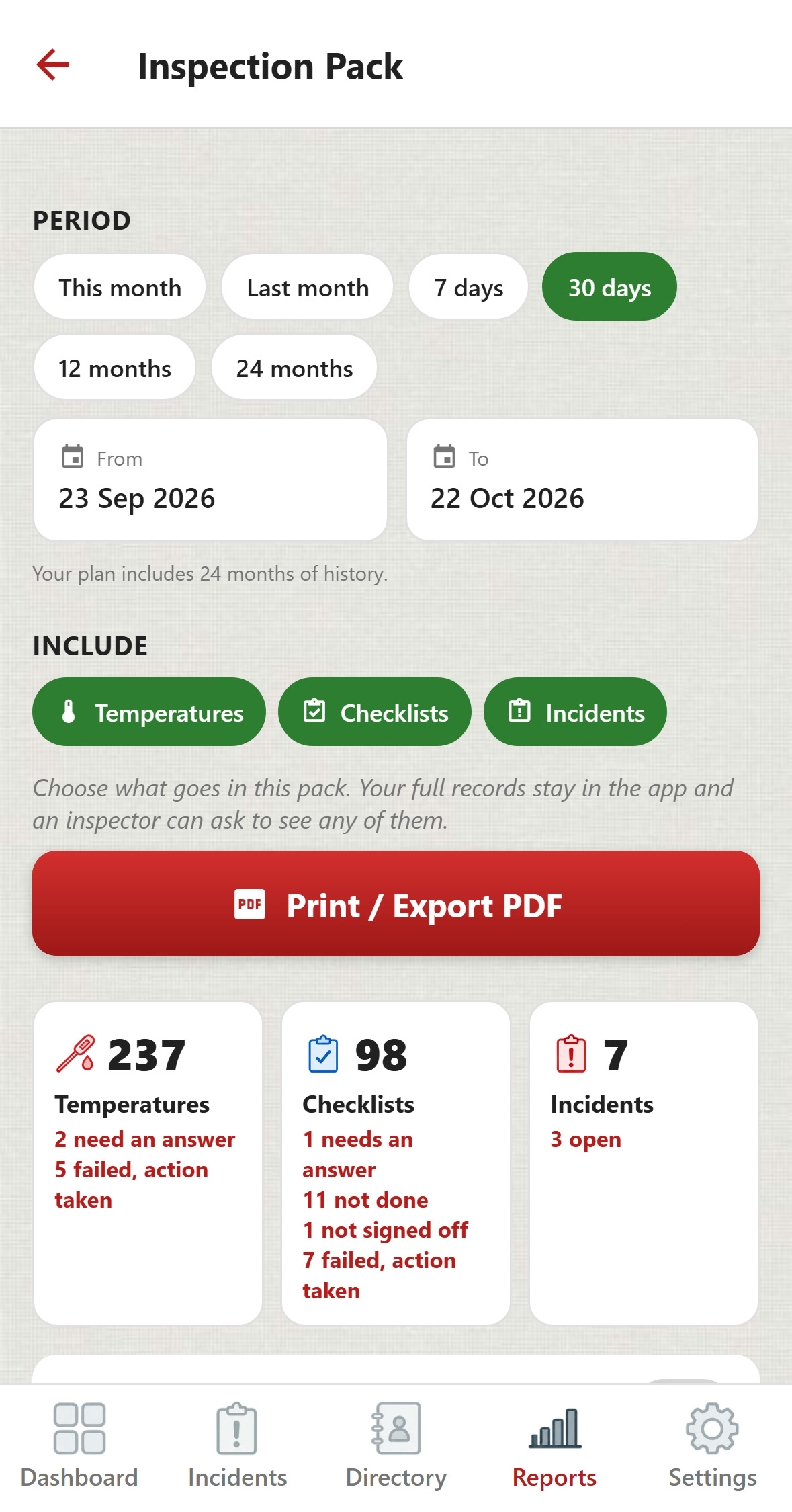
The Inspection Pack puts the temperatures, checklists and incidents for a period together, and shows what still needs an answer.
What it does not do: there is no customer complaint or customer illness record in the app, and we would not put one there: the customer's symptoms, linked to their name, are health data, and belong in your own complaint file that only the manager can open, not in incident notes the team can read. The app does not record batch codes, kept samples, laboratory results or which customer ate which batch. It does not tell you whether to report, and it does not report anything to the council, the FSA, Food Standards Scotland or a health protection team. It does not say whether your food caused the illness. Records help show what you did; whether a defence works is for a court.
Which plan. Incidents are on every plan. Checklists, the reports and the Inspection Pack come with Standard and Pro, and are open in the 14-day trial. Reports look back 12 months on Standard and 24 months on Pro. Return-to-work interviews are part of Pro.
Get ChefsRecords on the App Store (iPhone) ›
14 days free. No card required.
This page explains the law and the guidance in plain words, from the public sources below as published on 5 November 2026. It is general information, not legal advice, and it cannot cover every kitchen or every complaint. For a question about your own business, ask the food safety team at your council, or your insurer or a solicitor. ChefsRecords is not part of, or endorsed by, the Food Standards Agency, Food Standards Scotland or your council.
Say you are sorry they are unwell, take their details and what they ate and when, and do not argue or guess at the cause. Take the rest of that batch out of use and keep it chilled, pull your records for that day, check whether any staff were ill, and ring your council's food team if there is reason to think the food was unsafe. Tell your insurer if it looks serious.
The law says you must tell the authorities straight away if you have reason to believe food you supplied may be harmful. We would treat a complaint with a fault found on the day, or two unconnected people ill after the same food, as reason to believe. For one call with nothing else found, ring your council's food team and ask.
Not always. Many councils do not formally investigate a single case without a GP visit and a stool sample, and most action is a phone call or advice. The council will usually tell you a complaint has come in, and it may visit, especially if more than one person is ill.
Yes, as a goodwill gesture, freely given. Never make it depend on the customer not reporting you, signing something or changing a review. If they ask for compensation beyond a refund, speak to your insurer first.
Usually from a few hours to a few days, and sometimes weeks. UKHSA gives 12 to 48 hours for norovirus, 12 to 72 hours for Salmonella and 2 to 5 days for Campylobacter. So the last meal is not always the cause, and it is not always innocent.
Two or more cases linked in time and place. The council works with the public health body for your nation: UKHSA in England, Public Health Wales, the NHS health board and Public Health Scotland, or the Public Health Agency in Northern Ireland.
They can bring a claim, and whether it succeeds is for a court. Tell your insurer, send any solicitor's letter to them the same day, and speak to your insurer or a solicitor before you reply in writing.
For a severe reaction, help them use their adrenaline pen straight away, ring 999 and say you think it is anaphylaxis, lie them down and do not let them stand or walk. Afterwards keep the dish and the ingredient labels, check the recipe and what the customer was told, and tell the council: an allergen the customer was not told about can make the food unsafe in law.
The first steps in the kitchen are the same. Doctors do not report "food poisoning" as such in Scotland: they report listed diseases to the NHS health board, and laboratories report organisms such as Salmonella. Outbreaks are usually led by the health board with the council, and CookSafe names a customer complaint as a reason to review your system.
The near miss guide, the EHO inspection guide, the food safety records guide, the staff sickness and return to work guide, the physical contamination guide, the allergen matrix guide, the food safety diary guide and the cooling food guide.