ChefsRecords
ChefsRecords

Christmas in a UK kitchen: turkey, cooking ahead, buffets and temporary staff

Updated 25 October 2026 - for UK restaurants, pubs, hotels, caterers and cafes

The short answer

No UK law sets a temperature for cooking a turkey. Our advice Probe the thickest part, between the leg and the breast, and make sure it reaches one of the time and temperature pairs, such as 75°C for 30 seconds or 70°C for 2 minutes. Defrost it fully, ideally in the fridge, cook stuffing separately, cool anything cooked ahead fast in portions, reheat it once until steaming hot (82°C in Scotland, where it is law), and keep the carvery hot. Give allergen information for every dish, and instruct and supervise your Christmas staff from their first shift.

  • The law: Law in all four nations No UK nation sets a cooking temperature in law. The law sets the cold and hot holding temperatures, and in Scotland a reheating temperature of 82°C.
  • England and Wales: Guidance in England and Wales The FSA pack: check whole birds in the thickest area, "between the leg and breast". "The meat should not be pink or red and the juices should be clear."
  • Northern Ireland and Scotland: Guidance in Northern Ireland Safe Catering: "Cook to 75°C or hotter." Guidance in Scotland CookSafe: "for example 75°C or above".

Defrosting a turkey

  • Guidance in England and Wales The FSA pack: "Food should be thoroughly defrosted before cooking (unless the manufacturer's instructions tell you to cook from frozen or you have a proven safe method)." "Ideally, plan ahead to leave enough time and space to defrost small amounts of food in the fridge." Check for ice crystals "using your hand or a skewer", and "With birds, check the joints are flexible."
  • Guidance in England and Wales "Raw meat and poultry (including large joints and whole birds), should not be defrosted under cold running water unless they are in a sealed container."
  • Guidance in Northern Ireland Safe Catering adds a probe to the ice check, and says: "Once food has been defrosted you should use it within one day."
  • Guidance in Scotland CookSafe: "Thoroughly defrost all frozen foods in a chill, refrigerator or cool area".

How long? For home cooks, GOV.UK says to allow "around 10-12 hours per kg" in a fridge, and that a 6 to 7 kg bird "could take as much as 4 days". No guidance for kitchens gives a time per kg, so follow the packaging, plan the fridge space, and check it is fully defrosted.

Our advice Defrost it covered, on the bottom shelf, below ready-to-eat food, and write on it when it came out of the freezer. Do not wash raw turkey. The guidance for kitchens does not mention it, but GOV.UK and Food Standards Scotland both tell home cooks not to, because it spreads germs onto hands, worktops and utensils.

Back to sections

Cooking turkey and other birds

Law in all four nations No UK nation sets a cooking temperature in law.

  • Guidance in England and Wales The FSA pack: "Check whole birds are cooked to a safe temperature in the thickest [area] which is between the leg and breast. (see 'Prove it'). The meat should not be pink or red and the juices should be clear." Its examples of safe time and temperature combinations: "80°C for at least 6 seconds, 75°C for at least 30 seconds, 70°C for at least 2 minutes, 65°C for at least 10 minutes, 60°C for at least 45 minutes." "If you are cooking a large dish or batch, check in several places."
  • Guidance in England, Wales and Northern Ireland GOV.UK's guidance for businesses: "Standard advice is to cook food until it has reached a core temperature of 70°C for 2 minutes".
  • Guidance in Northern Ireland Safe Catering: "Cook to 75°C or hotter." "Poultry is fully cooked in thickest part of leg", with no pink or red meat or juices.
  • Guidance in Scotland CookSafe: "ensure the centre reaches a suitably high temperature for example 75°C or above".
Where to probe a turkeyFrom the FSA pack and GOV.UK
1Thickest part: between the leg and the breast.
2Tip in the meat, not touching the bone.
3Held for a pair: 75°C for 30 seconds, 70°C for 2 minutes or 65°C for 10 minutes.
4No pink or red meat, and the juices clear.
5Several birds: probe each one.
6Stuffing in its own tin.
The pairs are from the FSA pack and GOV.UK. Avoiding the bone and cooking stuffing separately are GOV.UK's advice for home cooks.

Why websites give 63, 65, 70, 74 or 75°C. Cooking is a temperature held for a time. 63°C is the UK hot holding figure, not a cooking temperature for poultry. 65°C is safe only if held for at least 10 minutes, and 70°C only if held for at least 2 minutes. 74°C is the American figure for poultry. 75°C is Safe Catering's figure, CookSafe's example, and, held for at least 30 seconds, one of the FSA pack's pairs.

Resting, or taking it out early. Our advice Resting is not a cooking method in any UK guidance. If you rely on the rest, leave the probe in the thickest part and record that it held one of the pairs, such as 65°C for 10 minutes. If you cannot show that, cook it until it reaches the pair in the oven. The FSA pack's Prove it method says: "If you do a different check then you will need to prove it is safe." Your council can tell you what it expects.

More on the pairs: our cooking temperatures guide.

Back to sections

Stuffing, crowns and joints

  • Stuffing: the guidance for kitchens does not cover it. GOV.UK's advice for home cooks: "Cook the stuffing in a separate roasting tin, not inside the turkey. A stuffed turkey will take longer to cook and may not cook thoroughly". Our advice Cook it separately. If you do stuff a bird, probe the centre of the stuffing as well as the thickest part of the meat, and both must reach a pair.
  • Crowns: follow the maker's instructions for defrosting and cooking. A crown is still poultry: cook it all the way through and probe the thickest part.
  • Pork, gammon and rolled joints: Guidance in England and Wales The FSA pack: "Check pork joints or rolled meat joints are cooked to a safe temperature in the centre (see 'Prove it'). The juices should not have any pink or red in them." Guidance in England, Wales and Northern Ireland GOV.UK: "Rolled joints must be cooked all the way through." Guidance in Scotland CookSafe: "large pieces of meat or poultry should be probed at the thickest part".

Back to sections

Cooking ahead: cooling, carving and storing

  • Guidance in England and Wales The FSA pack: "Avoid cooking large quantities of food in advance, unless you need to. Large quantities of food are more difficult to chill down quickly, especially solid food." "Divide food into smaller portions." "Cut joints of meat in half."
  • Guidance Public health guidance on Clostridium perfringens: "Food poisoning most often occurs when food (usually meat) is prepared in advance and kept warm for several hours before serving." "Spores of C. perfringens survive cooking and, during slow cooling and unrefrigerated storage, germinate".
  • Guidance in Northern Ireland Safe Catering: cool food and "put it in the fridge/freezer within two hours. For larger joints and whole birds, a longer initial cooling period may be required."
  • Guidance in Scotland CookSafe: "If possible, cool food in small portions or in shallow containers".

Our advice Do not cool a whole cooked bird. Take the meat off the bone, or carve it, with clean utensils and a board for cooked food only, spread it in shallow trays, cover it and chill it fast. Probe it and record the time it went in the fridge. The cooling time you work to is your own target: 90 minutes is a common target, not law, and it is not in the FSA pack. More in our cooling guide.

Law in England, Wales and Northern Ireland Once it is in the fridge, it must be kept at 8°C or below. Law in Scotland It must be kept in a fridge or a cool ventilated place; the law sets no temperature. Guidance in Scotland CookSafe: "It is recommended practice to operate refrigerators and chills at 5°C or below."

Cooking the day before is allowed: no law forbids it. Cook to a pair, cool it fast in portions, keep it chilled, label it, and reheat it once until steaming hot. In Scotland the law says 82°C.

Back to sections

Reheating

  • Guidance Reheat once only. The FSA pack, Safe Catering and CookSafe all say so.
  • Guidance in England, Wales and Northern Ireland GOV.UK: "Reheat food until it is steaming hot all the way through."
  • Guidance in England and Wales The FSA pack: "Remember, reheating means cooking again, not just warming up. Always reheat food thoroughly until it reaches a safe temperature in the centre". "Do not put food into hot holding without reheating it properly first."
  • Law in Scotland Reheat to 82°C or above, unless the business can show the food would deteriorate at that heat.
  • Law in England, Wales and Northern Ireland No reheating temperature in law. Guidance in Northern Ireland Safe Catering gives "75°C or hotter".

More in our reheating guide.

Back to sections

Carvery and hot buffets

  • Law in England, Wales and Northern Ireland Hot food must be kept at 63°C or above. Less than two hours below 63°C on service or display is a defence, once only, and you must be able to show it.
  • Guidance in England and Wales The FSA pack: on a buffet, use hot holding equipment "to keep it above 63°C. If this is not possible, you can take food out of hot holding to display it for up to two hours, but you can only do this once." Food not used within those two hours should be reheated until steaming hot and put back in hot holding, or chilled as quickly as possible to 8°C or below. "If it has been out for more than two hours throw it away." Do not "mix new food with the food that is already on display". "Hot holding equipment is for hot holding only."
  • Guidance in Northern Ireland Safe Catering: "If food is kept on display for more than 2 hours measure the temperature every two hours." Use "sneeze guards or covers", and "Encourage customers to use tongs or other utensils." Its advice for quality: "reduce the length of time you keep food hot - not the temperature".
  • Law in Scotland Food must be kept in a fridge or a cool ventilated place, or above 63°C. There is no two-hour defence, but the law has its own exemptions, including food "exposed for sale", and your council can tell you how they apply to a carvery. Guidance in Scotland CookSafe: "you may set a maximum time limit on the display", use "sneeze guards and/or covers", and buffet temperatures are "best measured by probing the foods".

Our advice Probe the joint, not the lamp: a heat lamp warms the surface. More in our hot holding guide.

Back to sections

Cold buffets

  • Law in England, Wales and Northern Ireland Under four hours out of the fridge for service or display is a defence, once only.
  • Guidance in England and Wales The FSA pack: "Food which has been displayed for less than four hours can be put back in the fridge and kept at 8°C or below until it is used. If it has been out for more than four hours it must be thrown away." Label it "with the time" it came out.
  • Law in Scotland Chilled food must be kept in a fridge or a cool ventilated place. There is no four-hour defence, but the law has its own exemptions, including food "exposed for sale". Guidance in Scotland CookSafe: "Chilled foods being served cold should be kept under refrigeration at your specified temperature for example 5°C or below".

Back to sections

Leftovers, freezing and how long it keeps

  • Guidance in England and Wales Cooked turkey or ham served cold is high risk ready-to-eat food. The FSA pack says a maximum of 3 days in total, the day it was cooked plus 2, unless you have evidence it is safe for longer.
  • Guidance in Northern Ireland Guidance in Scotland Safe Catering and CookSafe give no number of days, so set yours in your food safety plan.
  • For home cooks, GOV.UK says "Eat leftovers within 48 hours or freeze them", and Food Standards Scotland says within 2 days. The "3 to 4 days" on many websites is American advice.
  • Freezing: freezing does not reset the date, so label it with the date it was cooked and the date it was frozen. Guidance in England and Wales The FSA pack: "Freeze hot food as soon as it has been properly chilled down", and make sure frozen food "is clearly labelled with the date it is frozen".
  • After freezing: defrost it in the fridge, use it quickly and reheat it once, until steaming hot (82°C in Scotland, where it is law). For home cooks, GOV.UK says within 24 hours, and do not refreeze. Guidance in Northern Ireland Safe Catering: "Once food has been defrosted you should use it within one day."

More in our guide to how long food you make keeps.

Back to sections

Allergens on the Christmas menu

Law in all four nations If any of the 14 allergens is in a dish you sell loose, you must make that information available.

  • Guidance in England, Wales and Northern Ireland GOV.UK: on a buffet, "you need to provide allergen information for each food item separately." "You should not provide it for the buffet as a whole." "Food businesses must make sure that staff receive training on allergens."
  • Guidance in Scotland CookSafe: "each of the foods in the buffet should be labelled to show any allergenic ingredients", and "Any substitution or change in ingredients must be recorded with ingredient and allergen information reviewed and updated accordingly."
  • Guidance in England and Wales The FSA pack: "If your menu changes, make sure you change the list of ingredients with allergens", and check deliveries for the correct order and labelling information.

Stuffing, gravy, Christmas pudding and mince pies are often made with ingredients that can contain several of the 14 allergens - bread or flour, stock, sausage meat, dried fruit, butter, suet, nuts or alcohol - so check every label and recipe.

Chestnuts are not one of the nuts named in the 14 allergens (Regulation 1169/2011, Annex II). That does not mean they are safe for someone with a nut allergy: ask the customer and tell them exactly what is in the dish.

Our advice A Christmas menu, a new supplier or a substitute product means a new allergen check that day. Our allergen matrix guide has a free matrix to print.

Back to sections

Temporary Christmas staff

Law in all four nations Food handlers must be "supervised and instructed and/or trained in food hygiene matters commensurate with their work activity".

  • Guidance in England and Wales The FSA pack: train staff in the safe methods for their job, supervise them, and note it on the staff training record.
  • Guidance in Northern Ireland Safe Catering: "All food handlers should receive instruction on basic hygiene rules before starting work."

Our advice On day one, show them hand washing, how to use the probe, the allergen process and who to ask. A food hygiene certificate is not required by law: more in our food hygiene certificate guide.

Back to sections

Illness in winter

Law in all four nations No one with diarrhoea, or another illness likely to be passed on through food, may handle food or enter a food area if there is any likelihood of contamination, and staff must report symptoms straight away.

Guidance After diarrhoea or vomiting, the FSA pack, Safe Catering and CookSafe all say to stay off work until there have been no symptoms for 48 hours. The UK Health Security Agency says norovirus is "commonly known as the winter vomiting bug", and that "Alcohol-based hand sanitisers don't kill norovirus", so wash hands with soap and water. More in our staff sickness guide.

A Christmas service checklistOur summary of the sections above
1Defrosted: no ice crystals, joints flexible.
2Probed to a pair, and recorded.
3Cooked ahead? Cooled fast in portions, into the fridge.
4Reheated once, steaming hot (82°C in Scotland).
5Hot hold at 63°C or above (above 63°C in Scotland), probed every 2 hours.
6Cold buffet out under 4 hours, with the time written (England, Wales and Northern Ireland); in Scotland, kept under refrigeration.
7Allergen information for every dish.
8New staff shown hand washing and the allergen process.
9No one back at work until 48 hours after vomiting or diarrhoea has stopped.
Law in each nation and guidance are set out in the sections above. This list is our advice.

Back to sections

Paper or ChefsRecords App?

Paper works. ChefsRecords is an iPhone app for the daily records:

  • The turkey: record the probe reading as a cooking record. Type "turkey" and the app treats it as poultry, against 75°C or 70°C held for 2 minutes, or your kitchen's own target, with your name and the time.
  • Cooking ahead: start a cooling record when the carved meat goes in to chill, and the app reminds you when the check is due (90 minutes unless your kitchen sets its own time).
  • The carvery: start a hot holding record and it asks for a check every 2 hours. In Scotland it holds to above 63°C and 82°C for reheating.
  • Problems: a failed reading asks what was done, and a hot hold under 63°C for over 2 hours can only be recorded as thrown away.

What it does not do today: there is no defrosting record, no cold buffet four-hour record, no allergen matrix, and no hold for 65°C for 10 minutes or 60°C for 45 minutes. Would you use a defrosting record? Tell us.
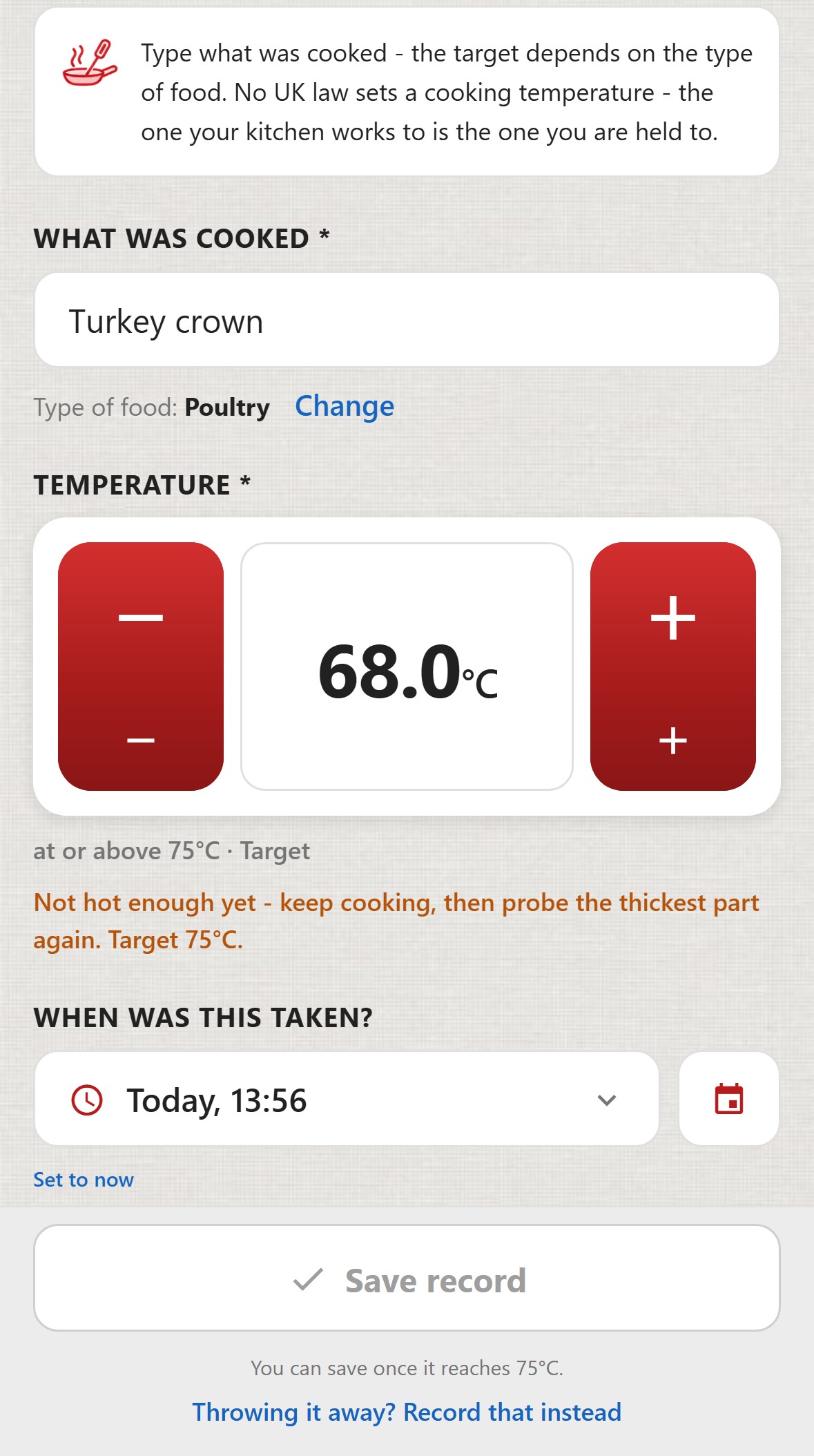
ChefsRecords, Cooking. What was cooked: Turkey crown. Type of food: Poultry. Temperature 68.0°C, at or above 75°C, Target. Not hot enough yet - keep cooking, then probe the thickest part again. Target 75°C. When was this taken: Today, 13:56. The Save record button is greyed out. You can save once it reaches 75°C. A link: Throwing it away? Record that instead.

A turkey crown cooking record. Not hot enough yet: keep cooking, then probe the thickest part again.

A real screen from the ChefsRecords app on an iPhone-sized screen, in a test kitchen set up for these screenshots.

Which plan. Cooking, cooling, hot holding and reheating records stay free after the 14-day trial for one login, the kitchen's billing Manager. Checklists, and the Inspection Pack that brings temperature records, checklists and incidents together, come with Standard and Pro and are open in the trial. Training records are part of Pro.

Get ChefsRecords on the App Store (iPhone) ›
14 days free. No card required.

This page explains the law and guidance in plain words, from the public sources below as published on 25 October 2026. It is not legal advice. Your council's food team can answer questions about your own kitchen. ChefsRecords is not part of, or endorsed by, the Food Standards Agency, Food Standards Scotland or your local council.

Back to sections

Questions people ask

What temperature should turkey be cooked to in a UK kitchen?

No UK law sets one. Probe the thickest part, between the leg and the breast. It needs to reach one of the time and temperature pairs in the FSA's Safer Food, Better Business pack, such as 75°C for 30 seconds or 70°C for 2 minutes. GOV.UK calls 70°C for 2 minutes the standard advice. Safe Catering in Northern Ireland gives 75°C as its figure, and CookSafe in Scotland as its example.

Is 75°C the law for turkey?

No. No UK nation sets a cooking temperature in law. 75°C is a common target, Safe Catering's figure and CookSafe's example. The only temperature law for heating food is Scotland's 82°C, and that is for reheating, not the first cook.

Where do you probe a turkey?

In the thickest part, between the leg and the breast, with the tip in the meat. GOV.UK's advice for home cooks says to avoid the bones, and we advise the same: bone can give a false reading. If you cook several birds, probe each one, as the FSA pack says to check a large batch in several places. Clean the probe before and after.

Is "the juices run clear" enough to know it is cooked?

Not on its own. The FSA pack and Safe Catering ask for no pink or red meat and clear juices, and all the UK kitchen guidance uses a probe. Clear juices are a visual check. The probe reading is what shows your method works.

Can I take the turkey out at 65°C and let it rest?

No UK guidance describes resting as a cooking method. 65°C counts only if it is held for at least 10 minutes. If you rely on the rest, leave the probe in the thickest part and record that it held one of the pairs. If you cannot show that, keep cooking. Write the method in your food safety plan, and your council can tell you what it expects.

How long does a turkey take to defrost in the fridge?

GOV.UK's advice for home cooks is around 10 to 12 hours per kg, and a 6 to 7 kg bird can take up to 4 days. No guidance for kitchens gives a time per kg, so follow the packaging and plan the fridge space. Before cooking, check there are no ice crystals and the joints move freely.

Should you wash a turkey before cooking it?

No. GOV.UK's and Food Standards Scotland's advice for home cooks both say not to wash raw turkey, because it spreads germs onto hands, worktops and utensils. The guidance for kitchens does not mention it, and we advise the same. Cooking it properly is what kills the bacteria.

Can stuffing go inside the turkey?

GOV.UK's advice for home cooks is to cook the stuffing in a separate tin, because a stuffed bird takes longer and may not cook through. The guidance for kitchens does not cover stuffing. If you do stuff a bird, probe the centre of the stuffing as well as the meat.

Can a kitchen cook the turkey the day before?

Yes, no law forbids it. The FSA pack says to avoid cooking large amounts in advance unless you need to, because big, solid food is slow to cool. Take the meat off the bone or carve it, cool it fast in shallow trays, keep it chilled, label it, and reheat it once until steaming hot. In Scotland the law says 82°C.

How long does cooked turkey or ham keep in the fridge?

No law sets a number of days. In England and Wales, the FSA pack says high risk ready-to-eat food, such as cold turkey or ham, should be kept for a maximum of 3 days in total, the day it was cooked plus 2, unless you have evidence for longer. In Scotland and Northern Ireland, set your own days in your plan. The 3 to 4 days on many websites is American advice.

Can you freeze cooked turkey and reheat it?

Yes. Freeze it as soon as it has cooled properly, and label it with the date. Defrost it in the fridge and use it quickly: Safe Catering says within one day, and GOV.UK's home advice says within 24 hours. Reheat it once only, until steaming hot. In Scotland the law says 82°C.

How long can a carvery or hot buffet stay out?

In England, Wales and Northern Ireland, hot food must be kept at 63°C or above. Less than two hours below that is a defence, once only, if you can show the time. The FSA pack says food not used within the two hours should be reheated until steaming hot and put back in hot holding, or chilled quickly to 8°C or below, and food out for more than two hours is thrown away. In Scotland, hot food must be kept above 63°C. There is no two-hour rule, but the law has its own exemptions, including food exposed for sale; your council can tell you how they apply to a carvery. Probe the food, not the lamp, and inspectors may ask how you know.

Are chestnuts a nut allergen?

Chestnuts are not one of the nuts named in the UK's 14 allergens. The list names almonds, hazelnuts, walnuts, cashews, pecans, Brazil nuts, pistachios and macadamia nuts. Someone can still be allergic to chestnuts, so if a customer asks, tell them exactly what is in the dish.

Back to sections

Put it in your food safety plan

Your food safety plan should describe what your kitchen really does. The free food safety plan builder takes you through safe methods based on the FSA pack, so you can write them in your own words, then prints your plan or saves it as a PDF. For small restaurants, cafes, pubs and takeaways in England and Wales.

Sources