
Updated 25 October 2026 - for UK restaurants, cafes, pubs, takeaways and breakfast kitchens
Buy UK hen eggs from a supplier who can say where they came from. Keep them somewhere cool, dry and steady, ideally the fridge, away from ready-to-eat food. Do not wash them, and do not use cracked, dirty or out-of-date eggs. Keep pooled egg in the fridge, use it the same day and never top it up. For runny eggs, fresh mayonnaise or mousse, use British Lion or Laid in Britain eggs, or pasteurised egg; older packs in Scotland and Northern Ireland say pasteurised egg. Cook duck, goose and quail eggs thoroughly.
Why inspectors may differ. Our advice The sources use different words: "cool, dry place" (the FSA pack), "ideally keep refrigerated" (the FSA, 2026) and "keep refrigerated" (Food Standards Scotland, 2026). We found no law that says a kitchen must keep eggs in the fridge. An inspector may still expect it, because the newest advice leans that way. Choose one place, keep it cool, dry and steady, write it in your food safety plan, and keep to it.
Why shops do not chill eggs. Guidance in England and Wales APHA's guidance on the egg marketing law for England and Wales says Class A eggs should not be chilled below 5°C while they are being sold, apart from short spells in transport and in shops, because a cold egg moved somewhere warmer can get wet with condensation. Those rules are written for selling eggs; the FSA's and Food Standards Scotland's advice above is written for kitchens.
The 4°C and 20°C figures you may see online. We found no UK source for a 4°C rule for eggs. Common target, not law An industry code and an FSA supply-chain risk profile mention keeping eggs below 20°C. Neither the FSA nor Food Standards Scotland gives caterers a number.
Our advice Keep eggs in their box or tray, or in their own container. The box shows the best-before date and who packed them, and the code on each shell is what a recall uses.
No egg is certain to be free of Salmonella, whatever the source or brand, so good hygiene still applies to every egg.
Scotland and Northern Ireland have their own egg marketing rules. Using eggs from your own hens is a question for your council's food team, and in England and Wales for APHA's egg marketing inspectors.
More on what to check and what to write down: our food delivery checks guide.
Guidance in England, Wales and Northern Ireland The FSA says:
Guidance in England and Wales The FSA pack: "If ready-to-eat food has been prepared on a work surface or with a knife that has been used for raw meat, poultry, fish, eggs or unwashed fruit and vegetables, throw the food away."
Our advice Crack eggs in your raw food area, or on a cleaned area away from ready-to-eat food, then clean and disinfect it before anything else goes there. Our disinfectants guide explains what to use.
Guidance in England, Wales and Northern Ireland The FSA: "If eggs are cracked for later use, keep the liquid egg refrigerated, take out small amounts as needed, and use it as soon as possible." "Use all 'pooled' liquid egg on the same day and don't add new eggs to top it up." Guidance in Scotland Food Standards Scotland says the same.
Our advice For a big breakfast service:
Background: Salmonella outbreaks linked to eggs in catering led to a UK study of 2,104 kitchens in 2003, and Food Standards Scotland repeated the pooled egg advice during an outbreak in 2018.
Scrambled egg on the hot plate: no egg-specific rule; our hot holding guide has the details. Law in England, Wales and Northern Ireland Hot food must be kept at 63°C or above, with limited exceptions. Law in Scotland Above 63°C, with limited exceptions.
The FSA's and Food Standards Scotland's advice does not cover people with a severely weakened immune system on a medically supervised diet. The FSA says medical advice should always be sought for them; Food Standards Scotland says "all eggs should be cooked thoroughly for these individuals".
Our advice The older packs in Scotland and Northern Ireland are stricter than the 2026 advice, and an inspector may work from either. Hollandaise and béarnaise are not named in any source; we would treat them as lightly cooked egg dishes.
Guidance in England, Wales and Northern Ireland The FSA: "Pasteurised egg products are suitable for foods that will not be cooked or will only be lightly cooked." They come as chilled liquid whole egg, egg white or egg yolk, and as frozen and powdered egg. "Commercially produced mayonnaise and similar products are often made using pasteurised egg."
Guidance in England, Wales and Northern Ireland The FSA: "Eggs from species other than chickens carry a higher risk of Salmonella and should not be used in raw or lightly cooked dishes." "They should always be cooked thoroughly before being served." Guidance in Scotland Food Standards Scotland says the same.
More on dates: our stock rotation guide and our guide to how long food you make keeps.
Guidance in England, Wales and Northern Ireland The FSA's egg advice for caterers does not cover washing, but its Food Fact Check blog for the public (August 2026) says: "don't wash eggs. Shells are porous, washing eggs allows bacteria on the outside of the shell to enter the egg." Hens lay eggs with a natural protective coating. Guidance in England and Wales Under the egg marketing law, as APHA's guidance explains it, Class A eggs are not washed before they are sold, with no exceptions in the UK.
Our advice A dirty egg goes in the bin. Do not wash it and use it.
Checked 24 October 2026. GOV.UK's outbreak update (UK Health Security Agency, last updated 17 September 2026) says three Salmonella Enteritidis clusters are being investigated, that "Our investigation to date indicates links to imported eggs", that cases are linked to eating at food outlets including small cafés, restaurants and takeaways, and that "There is no evidence that UK-produced eggs are affected."
On 10 October 2026 the FSA, for England, Wales and Northern Ireland, and Food Standards Scotland asked businesses to withdraw and recall eggs from one business in Ukraine, stamped 3UA1012066 on the shell.
Guidance in England, Wales and Northern Ireland The FSA: "Eggs that are thoroughly cooked and handled hygienically should not present a food safety risk."
More in our October food alerts post.
Law in all four nations Egg is one of the 14 allergens you must tell customers about. Our allergen matrix guide has a free one to print.
Our advice An inspector may ask:
Paper works. ChefsRecords is an iPhone app for the daily records, and it keeps the evidence:
Some of these need a Standard or Pro plan after the 14-day trial.
What it does not do today: there is no place to record an egg scheme or shell code against a supplier, no starter checklist line for pooled egg, and stock dates are all shown as use-by dates, even for eggs, which carry a best-before date. Would you use an egg line on your breakfast checklist? Tell us.
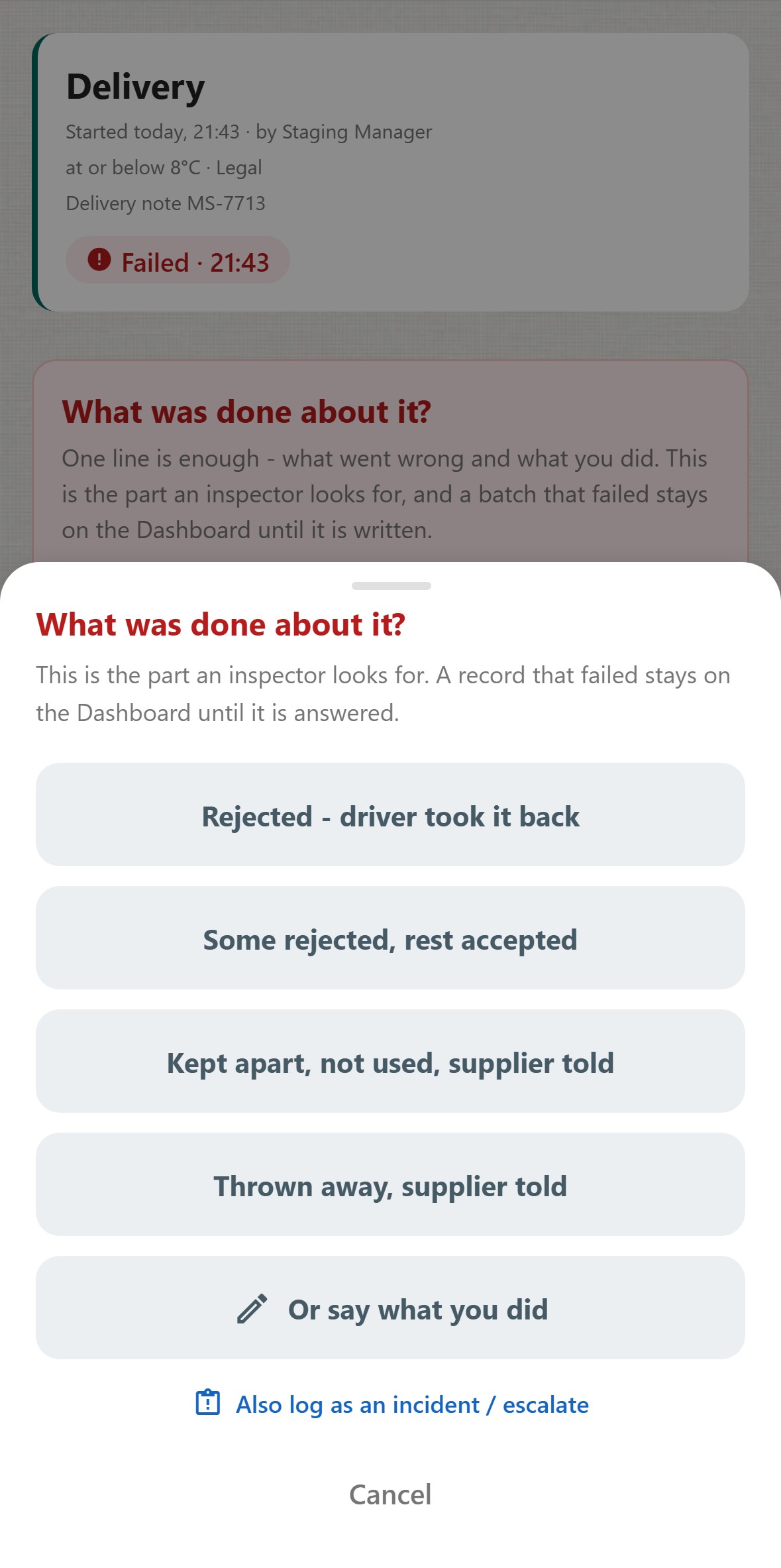
A failed delivery. This one is a warm chilled delivery. An ambient delivery, such as eggs, has no temperature to take: it is marked Accepted or Rejected, and a rejection asks the same question, with its own answers such as "Damaged - sent back with the driver".
Get ChefsRecords on the App Store (iPhone) ›
14 days free. No card required.
This page explains the law and guidance in plain words, from the public sources below as published on 24 October 2026. It is not legal advice. Your council's food team can answer questions about your own kitchen. ChefsRecords is not part of, or endorsed by, the Food Standards Agency, Food Standards Scotland or your local council.
The FSA's egg advice for caterers says to store eggs in a cool, dry place, "ideally" in the fridge. Food Standards Scotland says to keep them refrigerated until use. We found no law that says a kitchen must refrigerate eggs, but an inspector may expect it, because the newest advice leans that way. Whichever you choose, keep the temperature steady and write it in your food safety plan.
Egg marketing rules say Class A eggs should not be chilled below 5°C while they are being sold. Short spells in transport and in shops are allowed. The worry is condensation: a cold egg moved somewhere warm gets wet, and that can help germs get through the shell. Those rules are about selling eggs, not about how a kitchen stores them.
Neither the FSA nor Food Standards Scotland gives a number for caterers. They say a cool, dry place away from big temperature changes. An industry code and an FSA supply-chain risk profile mention below 20°C, but that is a common target, not law.
The egg was produced under the British Lion code. The FSA and Food Standards Scotland treat eggs from that scheme, and from the Laid in Britain scheme, as "very low risk" of Salmonella. Very low does not mean none: no egg is certain to be free of Salmonella, whatever the source or brand.
The FSA says pregnant people, young children, older adults and people with a health condition can safely eat raw or lightly cooked hen eggs if they carry the British Lion mark or come from the Laid in Britain scheme. If you cannot check where your eggs come from, cook them thoroughly or use pasteurised egg. This does not cover people with a severely weakened immune system on a medically supervised diet.
In England and Wales, a kitchen may only receive packed and labelled Class A eggs. A farm can supply you if it grades and stamps its eggs as an authorised packing centre, so ask. Scotland and Northern Ireland have their own egg marketing rules, so check with your council.
The FSA names fresh mayonnaise, mousses and soufflés as dishes that need extra care. If anyone you serve may be vulnerable, use British Lion or Laid in Britain eggs, or pasteurised egg. The older packs in Scotland and Northern Ireland lean towards pasteurised egg, so your inspector may ask about it. Hollandaise is not named in the sources, but we would treat it the same way.
Pooled egg is eggs cracked into one container to use later, as many kitchens do for breakfast. The FSA and Food Standards Scotland say to keep it in the fridge, take out small amounts as you need them, use it all on the same day, and never top it up with new eggs.
No. The FSA says do not wash eggs: shells are porous, and washing can let germs on the outside get in. A dirty egg should not be used at all.
No. The FSA and Food Standards Scotland both say not to use cracked, damaged or dirty eggs, and to reject them on delivery, because dirt or bacteria may have got inside.
Using food past its best-before date is not an offence by itself, but eggs are the exception in the guidance. The FSA, Food Standards Scotland, the FSA pack and Safe Catering all say not to use eggs past their best-before date.
No. The FSA and Food Standards Scotland say eggs from birds other than hens carry a higher risk of Salmonella. Do not use them raw or lightly cooked. Always cook them thoroughly.
No. The FSA says to keep eggs away from other foods, in the shell and once cracked, and the FSA pack puts eggs with raw meat, poultry and fish, below ready-to-eat food. Wash your hands and clean surfaces after handling eggs, shells and egg boxes.
GOV.UK says the investigation points to imported eggs and that there is no evidence UK-produced eggs are affected. The FSA also says eggs that are thoroughly cooked and handled hygienically should not present a food safety risk. Buy from a supplier who can tell you where the eggs came from, and check the code on the shell against any food alert.
Your food safety plan should describe what your kitchen really does. The free food safety plan builder takes you through safe methods based on the FSA pack, so you can write them in your own words, then prints your plan or saves it as a PDF. For small restaurants, cafes, pubs and takeaways in England and Wales.
The cross-contamination guide, the food delivery checks guide, the cooking temperatures guide, the hot holding guide, the stock rotation guide, the fridge temperature log guide, the allergen matrix guide and the food shelf life guide.