Updated 4 November 2026 - for UK restaurants, cafes, pubs, takeaways and food vans
A critical control point (CCP) is a step in your kitchen where control is essential: if it goes wrong, nothing later in the process will make the food safe again. In most kitchens those steps are cooking, cooling, chilled storage of ready-to-eat food, hot holding and reheating. At each one you set a critical limit, check it, and know what to do when a reading misses it.
HACCP stands for Hazard Analysis and Critical Control Point. A hazard is something in or on the food that could hurt the person who eats it: bacteria, an allergen, a piece of glass. A critical control point is the step where you stop that hazard, and where a mistake cannot be put right further down the line.
Law in all four nations Article 5 of Regulation 852/2004 asks every food business to identify "the critical control points at the step or steps at which control is essential to prevent or eliminate a hazard or to reduce it to acceptable levels", to set critical limits there, to monitor them, and to put things right when a check shows a step is not under control. Our food safety management system guide sets out all seven HACCP principles.
Think of a roast chicken. Raw chicken can carry Salmonella and Campylobacter. Cooking is the step that kills them. If the chicken comes out undercooked, there is no later step that fixes it: it goes on the plate. That makes cooking a critical control point.
Every kitchen controls dozens of things: stock rotation, labels, cleaning, pest checks, chopping board colours. Each of those is a control point, a place where you keep a hazard in check. Only some of them are critical.
Guidance in Scotland CookSafe's examples come down to one question: is there a later step that removes the hazard? One of its examples is a delivery. A chilled delivery of ready-to-eat food is a critical control point, because nothing after it kills bacteria that grew in a warm van. A delivery of raw chicken that you will cook is not, because cooking comes later.
| Step | Usually | Why |
|---|---|---|
| Cooking raw chicken | Critical control point | The last step that kills the bacteria. |
| Keeping raw chicken in the fridge before cooking | Control point | Cooking comes later and deals with the bacteria. The fridge still matters. |
| Keeping cooked ham or a dessert in the fridge | Critical control point | It is eaten as it is. Nothing later makes it safe. |
| Defrosting | Control point | Thorough cooking normally follows. |
| Cleaning and keeping raw and ready-to-eat food apart | Controlled at every step | All three packs treat it as essential. CookSafe lists it in most of its charts as well as in its House Rules. See the cross-contamination guide. |
Our advice "Not critical" never means "does not matter". A control point that fails often still causes food poisoning. The difference is only that a later step gives you a second chance.
No list fits every kitchen, because your critical control points depend on what you cook and how. For a restaurant, cafe, pub or takeaway that cooks, cools and reheats food, these five come up again and again:
Some kitchens have more. A chilled delivery of ready-to-eat food can be one, as CookSafe says. Fish served raw usually has to be frozen first to kill parasites, by you or your supplier, and that freezing step is critical (see is freezing a critical control point?). Allergen control is the other one people forget: a step where the wrong ingredient goes in, or the wrong information goes out, cannot be put right once the plate has gone.
If someone asks "what are the 7 critical control points?", they usually mean the seven HACCP principles, not seven steps. A kitchen can have three critical control points or ten.
Most small kitchens build their system on a free pack. The three packs cover the same ground in different words.
| Pack | Says "critical control point"? | Where the limits and actions are |
|---|---|---|
| The FSA pack (England and Wales) | No. It is based on HACCP but leaves the jargon out. | Each safe method has a safety point, a "Why?", "What to do if things go wrong" and "How to stop this happening again". Some add a "Check it" box. The "Prove it" safe method shows how to check your methods with a probe. The daily diary and the 4-weekly review are your records and checks. |
| CookSafe (Scotland) | Yes. Its HACCP charts deal only with hazards at critical control points. | 15 charts, from buying and delivery through to service. Each sets out the hazard, how you control it and the limit, how you check it and write it down, and what to do when it goes wrong. House Rules cover the rest. |
| Safe Catering (Northern Ireland) | Yes. It lists the seven HACCP steps, including setting critical limits at each one. | Each step page sets out the hazards, the limits, how to check them, and what to do when something goes wrong. |
Guidance in England and Wales The FSA pack never marks a step as critical. Its "Prove it" safe method asks you to check cooking and reheating, hot holding, chilling hot food down, chilled storage and freezing with a probe or thermometer. Most of those are the steps the other packs call critical control points. Freezing usually is not (see below).
Guidance in Scotland CookSafe has already picked out the hazards at critical control points in its 15 charts. You tick the steps your kitchen carries out on its flow diagram and use the charts for those steps. The "is there a later step?" question explains why each one is there.
Guidance in Northern Ireland Safe Catering was republished on GOV.UK in June 2026 for Northern Ireland. The guide inside is Issue 7, from April 2019.
Law in all four nations No law asks for a "HACCP plan" or a "CCP table" by name. The law asks for procedures based on the HACCP principles, with documents and records that fit "the nature and size of the food business", and you must be able to show them to your council in the way it asks. The regulation's own introduction says the HACCP rules should be flexible enough to work in small businesses, and that in some businesses it is not possible to identify critical control points at all.
If you have filled in your nation's pack, you follow it, and it matches what your kitchen really does, the pack is your HACCP-based system. You do not need a second table for what the pack already covers.
The exceptions are the processes the packs leave out. Guidance in England and Wales The FSA pack names vacuum packing, sous vide and other low-temperature cooking, fermenting, smoking and curing, sushi and sashimi, carpaccio and tartare, kebabs, liver parfait, and burgers served less than thoroughly cooked. If you do any of those, you must be able to show you do them safely, and the pack says to talk to your council. A written HACCP plan for that one process is the usual answer.
Guidance in England, Wales and Northern Ireland GOV.UK says your local food safety team "might advise" a HACCP plan for a bigger business, or one whose food carries more risk. Your council's food team decides what your kitchen needs, so ask them if you are not sure.
Law in all four nations In the law's words, critical limits "separate acceptability from unacceptability". In plain words, a critical limit is the line your plan draws between safe and not safe at that step.
A good critical limit is:
Most figures kitchens use are guidance, not law. Only a few temperatures are set in law, and they differ by nation:
| Step | England, Wales and Northern Ireland | Scotland |
|---|---|---|
| Cooking | No figure in law. Guidance: 70°C for 2 minutes, 75°C for 30 seconds or 80°C for 6 seconds. Safe Catering: 75°C or hotter. | No figure in law. CookSafe: 75°C or above, or a lower pair such as 70°C for 2 minutes. |
| Cooling | Law: as quickly as possible. No time in law. Safe Catering: into the fridge within 2 hours. | Law: as quickly as possible. CookSafe says you could set a time limit. |
| Chilled storage | Law: 8°C or below for food that needs chilling. The FSA pack and Safe Catering recommend setting fridges at 5°C or below. | No figure in law. CookSafe: 8°C or below, with 5°C or below as recommended practice. |
| Hot holding | Law: 63°C or above. | Law: above 63°C. 63°C itself is not enough. |
| Reheating | No figure in law. The FSA pack: steaming hot. Safe Catering: 75°C. | Law: at least 82°C, unless you can show that heating it to 82°C would spoil it. |
Guidance from some councils Some councils' advice says cool food "ideally within 90 minutes", then refrigerate it. Many kitchens use 8°C or below within 90 minutes as their target. It is not in the law, the FSA pack or CookSafe, but it is a sensible critical limit to write into your plan.
Our advice When a figure is guidance, say so in your plan, and write the number you actually work to. If you choose 5°C for your fridges, that is your critical limit, even though the law in England, Wales and Northern Ireland says 8°C. Pick one cooking target and use it every time.
Five critical control points, set out the way a critical control point table would show them. Use the figures for your nation, and write your own method in your own words.
This is the corrective action: the HACCP principle that says what you do when a check shows a step is not under control. Every critical control point needs one written down before it is needed, so the person on shift does not have to guess.
Guidance in Scotland CookSafe asks you to record the problem and the action you took. Our advice If you are not sure the food is safe, throw it away. A ruined batch costs less than a food poisoning case.
Monitoring is how you know each critical control point is under control, and the record is how you show it later.
Law in all four nations No law sets the layout of these records. They must fit the size and type of your business. What to keep, and for how long, is in the food safety records guide.
Usually not. Freezing stops bacteria growing, but it does not kill them, and the food will normally be cooked later. So frozen storage is a control point in most kitchens. Keep the freezer at the figure your plan sets, commonly -18°C, and record it with your fridges.
Law in all four nations The exception is fish served raw or almost raw, such as sushi or ceviche, and some cold-smoked, cured or marinated fish. It must be frozen to kill parasites: every part at -20°C or colder for at least 24 hours, or -35°C or colder for at least 15 hours, unless the fish is exempt, as most farmed Atlantic salmon is. A normal kitchen freezer at -18°C does not do this. Nothing later in the process kills the parasites, so that freeze is a true critical control point. Your supplier may have frozen the fish already: ask, and keep their paperwork. If the freezing happens before the fish reaches you, your critical control point becomes checking that paperwork when the fish arrives. Details are in the freezer temperature guide.
Defrosting is usually a control point too: thorough cooking comes after it.
Every council works a little differently. Our EHO inspection guide covers the visit itself.
Paper works: the packs come with their own record sheets and diary. ChefsRecords is an iPhone app for the daily records at your critical control points. It keeps records. It does not do the hazard analysis, it does not decide which steps are your critical control points, and it does not write your HACCP plan. It is not HACCP software. Those stay in your plan.
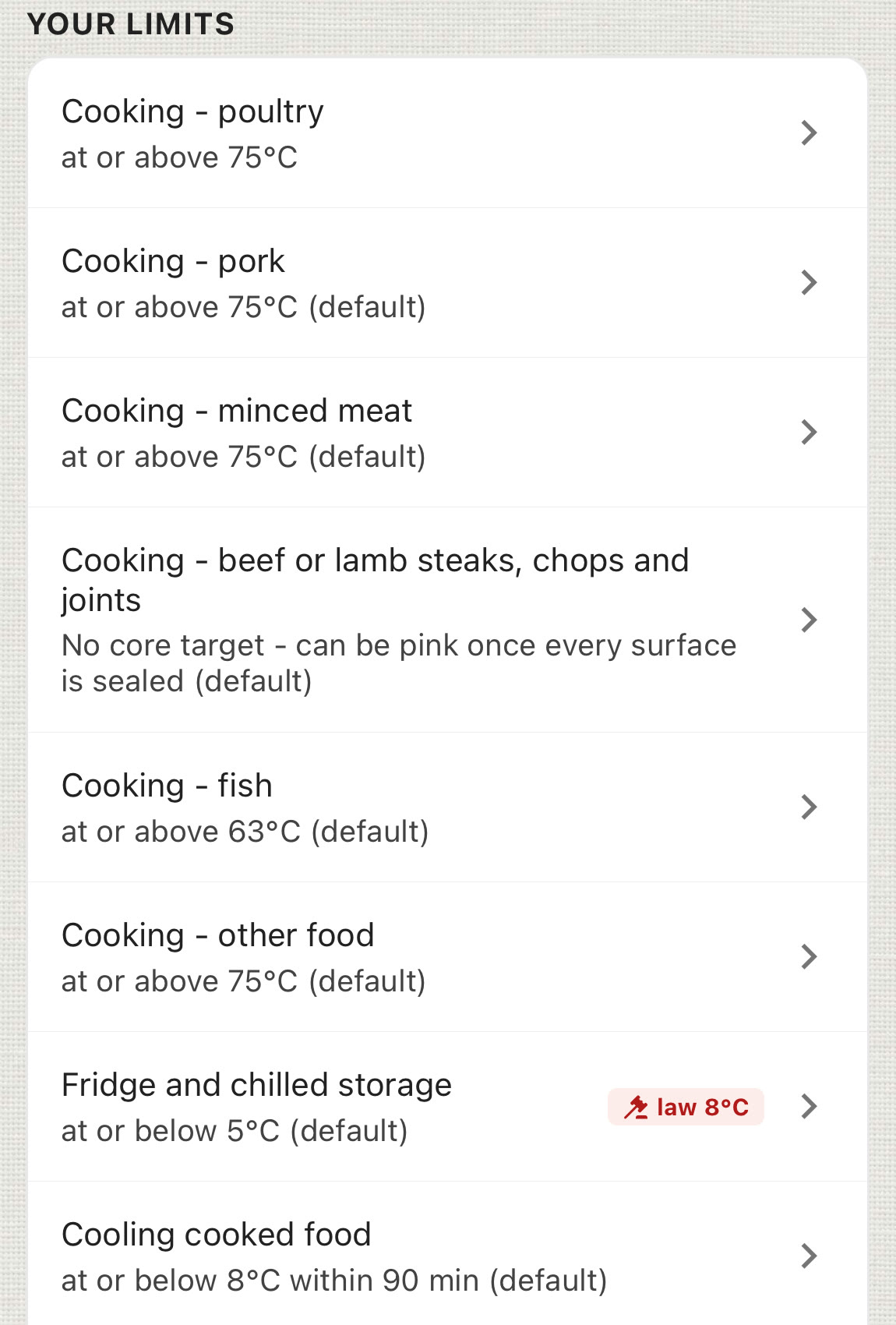
Your limits, written down. The kitchen's own limits for each step, with the legal one marked.
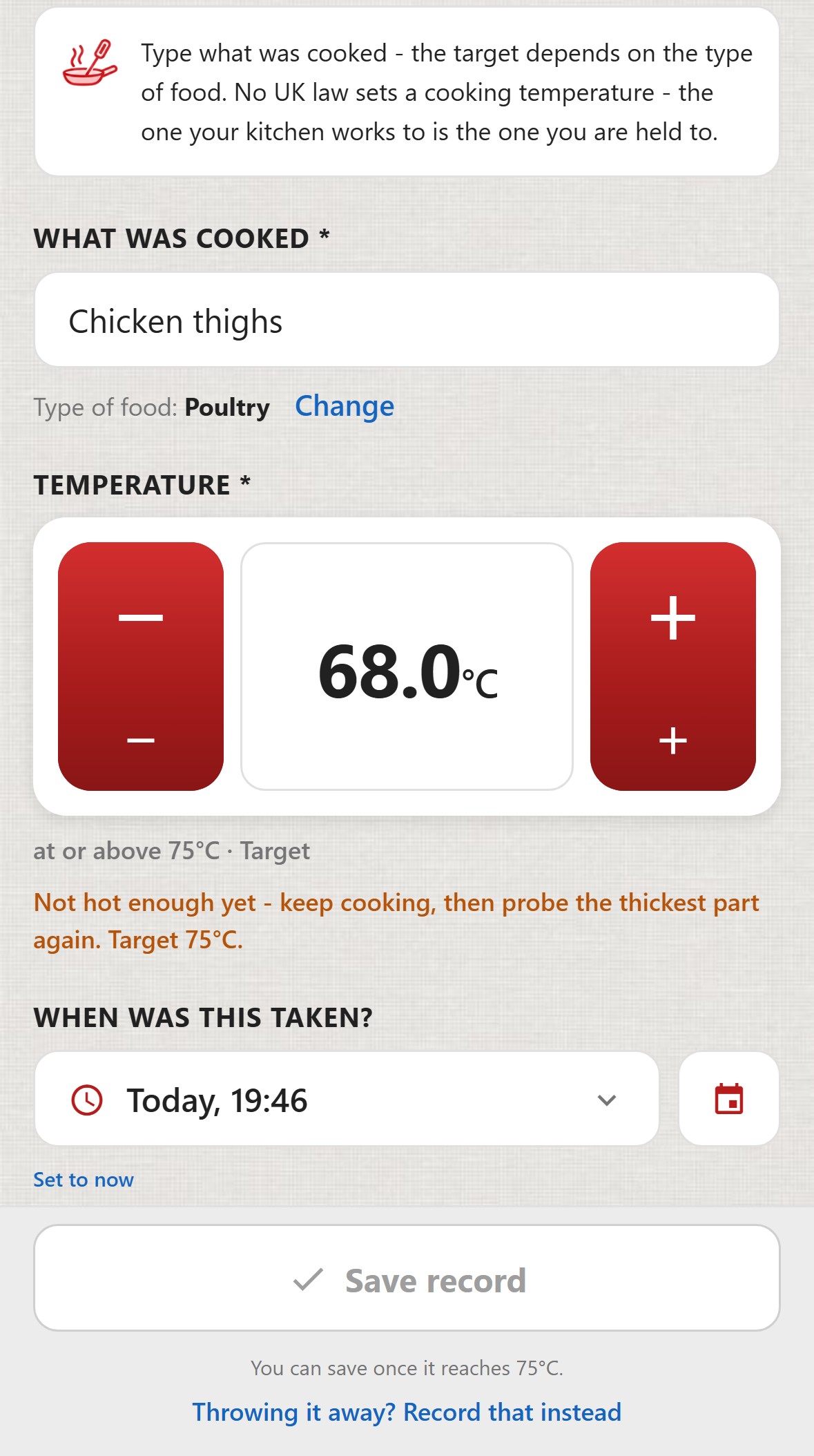
Cooking below the limit. Not hot enough yet: keep cooking and probe again.
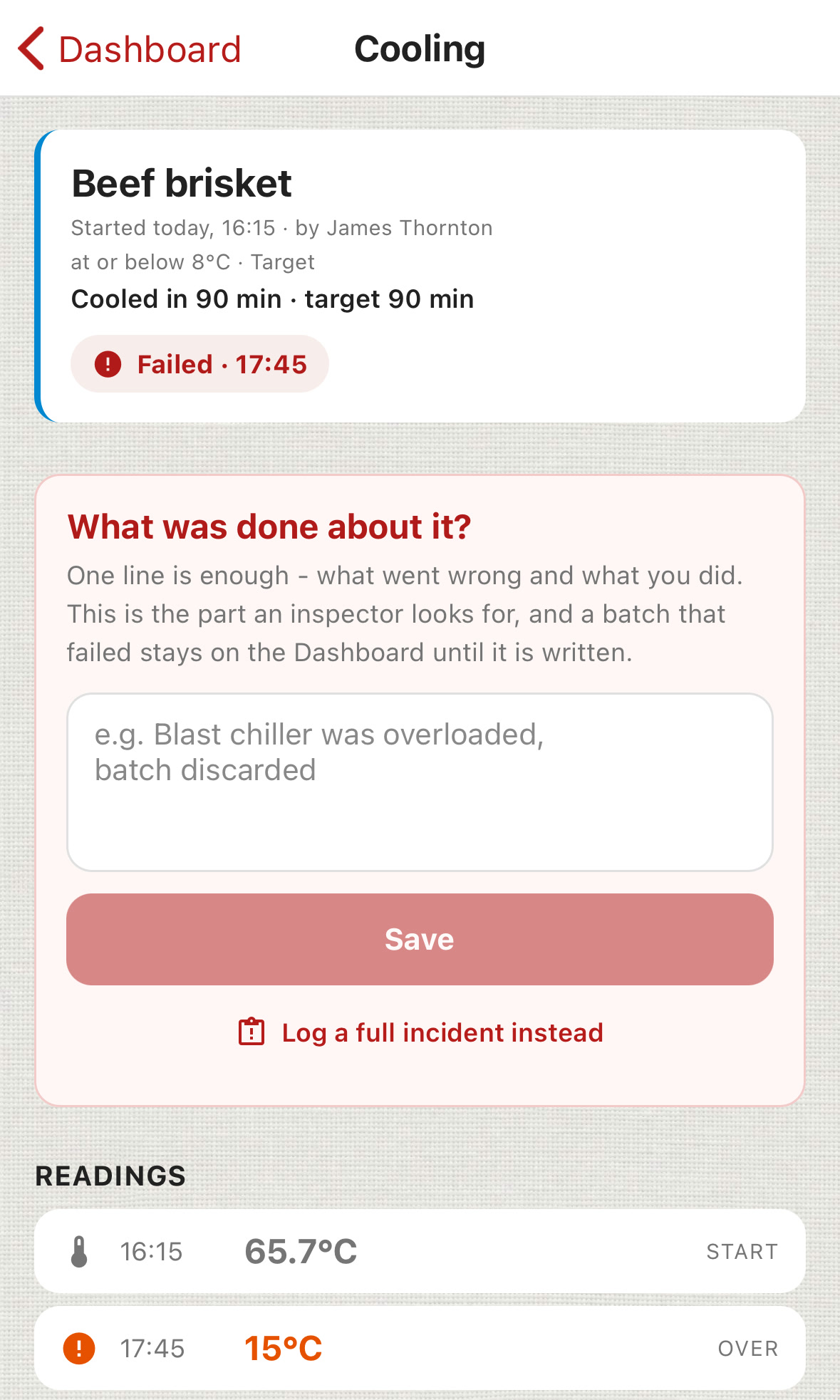
Cooling that missed. The failed reading is kept, and the app asks what was done about it.
What it does not do today: it has no critical control point table, no hazard analysis and no flow chart of your kitchen. It does not record freezing fish for parasites as its own step. Would a list of your critical control points in the app help you? Tell us.
Which plan. Cooking, cooling, hot holding, reheating and delivery temperatures can be recorded on every plan. Checklists, which hold the fridge and freezer checks, and PDF reports come with Standard and Pro, and are open in the 14-day free trial.
Get ChefsRecords on the App Store (iPhone) ›
14 days free. No card required.
This page explains the law and guidance in plain words, from the public sources below as published on 4 November 2026. It is not legal advice. Your council's food team can answer questions about your own kitchen. ChefsRecords is not part of, or endorsed by, the Food Standards Agency, Food Standards Scotland or your local council.
A step in your kitchen where control is essential to stop a hazard, and where a mistake cannot be fixed by a later step. Cooking raw chicken is the classic example: if it is undercooked, nothing after it makes it safe.
Cooking, cooling, chilled storage of ready-to-eat food, hot holding and reheating. Some kitchens add chilled deliveries of ready-to-eat food, freezing fish that is served raw, and allergen control.
Cooking chicken to the core temperature your plan sets, for example 75°C, and keeping soup in a bain-marie at 63°C or above (above 63°C in Scotland).
List each step from delivery to service, and the hazards at each one. Then ask: is there a later step that removes this hazard? If not, the step is critical. CookSafe in Scotland uses this test.
There is no fixed list of seven. The question usually means the seven HACCP principles: identify hazards, identify the critical control points, set critical limits, monitor them, put things right when a check fails, check the system works, and keep records. A kitchen can have more or fewer than seven critical control points.
The line your plan draws between safe and not safe at a critical control point, such as a core temperature. A few figures are law: 8°C or below for chilled food and 63°C or above for hot holding in England, Wales and Northern Ireland, and above 63°C for hot holding and at least 82°C for reheating in Scotland. Most others, such as 75°C for cooking, are guidance. Once your plan sets a limit, work to it.
A control point is any step where you keep a hazard in check, such as stock rotation or keeping raw meat in the fridge. A critical control point is one where nothing later can put a mistake right, such as cooking.
Usually not: freezing stops bacteria growing but does not kill them, and the food is normally cooked later. The exception is fish served raw or almost raw, which by law must be frozen to kill parasites unless it is exempt, such as most farmed Atlantic salmon. That freeze is critical, whether you or your supplier do it. A normal kitchen freezer at -18°C is not cold enough.
You take the corrective action your plan sets: deal with the food (keep cooking, reheat, chill or throw away), fix the cause, and record the reading and the action you took. If it keeps happening, change the method.
Often enough to catch a problem before the food is served: for cooking, cooling and reheating, every batch, or a proven method with regular probe checks, as your plan sets; at least once a day for fridges (the FSA pack); and at regular times for hot holding. Safe Catering in Northern Ireland says to measure hot food every two hours if it is on display for more than 2 hours.
Not by name. The FSA pack for England and Wales is based on HACCP but leaves the jargon out. Its safe methods, "Prove it" checks and "What to do if things go wrong" do the same job. CookSafe in Scotland and Safe Catering in Northern Ireland use the term openly.
Not by that name. The law asks for procedures based on HACCP, with records that fit the business. A filled-in pack that you really follow does that for what it covers. Processes the pack leaves out, such as sous vide or vacuum packing, need their own plan. Ask your council if you are not sure.
No. It keeps the daily records at your critical control points: temperatures, what was done when a reading missed, who checked and when. It does not do the hazard analysis, decide your critical control points or write your plan.
Your critical control points and limits belong in your food safety plan. The free food safety plan builder takes you through safe methods based on the FSA pack, so you can write them in your own words, then prints your plan or saves it as a PDF. For small restaurants, cafes, pubs and takeaways in England and Wales.
The food safety management system guide, the cooking temperatures guide, the cooling food guide, the fridge temperature log guide, the hot holding guide, the reheating food guide, the probe check guide, the food safety records guide and the danger zone guide.