Updated 1 November 2026 - for UK restaurants, cafes, pubs, takeaways, care homes and caterers
Run a kitchen freezer at -18°C or colder, and check it every day. Food hygiene law gives no figure for freezers. The -18°C you will find in law sits in the rules for quick-frozen food. A freezer stops bacteria growing but does not kill them, so when a freezer fails, it is the state of the food that decides what you do with it, not the number on the display.
Food hygiene law does not set one. Across England, Wales, Scotland and Northern Ireland, it asks you to keep food at temperatures that do not put health at risk, but gives no number for a freezer.
Our advice Treat -18°C or colder as your working figure and write it into your food safety plan. A freezer kept at -18°C or colder keeps the food at the guidance figure, and at the quick-frozen figure too.
Guidance The FSA likens a freezer to pressing pause. Bacteria stop growing while the food is frozen, but they are still there, and they wake up again as the food defrosts.
So freezing is a way to keep food, never a way to make it safe. Food that went into the freezer contaminated comes out contaminated. What you freeze, and how you defrost it, matters as much as the freezer temperature.
Guidance in England and Wales The FSA pack accepts the number on the freezer's own display, or on a dial thermometer, read at opening. An infra-red gun only reads the surface; if its number looks high, check again with a probe.
No law sets how often to check. Once a day at opening is what the guidance packs expect. Our advice Check again at closing too, so a freezer that fails in the evening is spotted before it has all night to warm up.
How to set up a daily cold storage record, and what to write down, is in our fridge temperature log guide.
A single warm reading after the door has been open is common. A freezer that stays warm, or is climbing, is a problem. Start with the food, not the display: the FSA pack's freezing method sorts frozen food by how it feels, because that tells you how far it has defrosted.
No UK source we read sets a temperature for throwing away food from a failed freezer. The "refreeze if it is below 40°F" rule you may read online is American.
Our advice If in doubt, throw it out. Make a list of what you moved, cooked and threw away, with the time and who did it: that is your record for the inspector and for any insurance claim.
How long food can stay frozen is about quality, not safety. GOV.UK's home advice suggests 2 to 3 months for meat and 3 to 4 months for baked goods, fruit and vegetables. Freezer burn, the dry, pale patches on badly wrapped food, spoils the eating but does not make food unsafe. Our advice Pick your own times for each kind of food, write them in your food safety plan, and rotate the freezer like any other store: oldest at the front.
Our advice A blast chiller makes cooling before freezing much quicker, but no UK law or guidance requires one. How to cool food fast without one is in our cooling food guide, and how long cooked food keeps is in our food shelf life guide.
Law in all four nations Food has to be defrosted in a way that keeps the chance of harmful bacteria growing, or toxins forming, as low as possible. The law does not say how.
Guidance in England and Wales The FSA pack's order of preference:
Our advice In the fridge, defrost on the bottom shelf in a tray, below ready-to-eat food. Food defrosted in the microwave should be cooked straight away.
Before cooking, check there is no ice left in the middle: feel it, or push a skewer through. A whole bird's legs should move freely. Cook from frozen only where the maker says you can, or you have a method you have proved works. More on defrosting and the fridge in our danger zone guide. Each method in detail, how long defrosted food keeps and when it can be refrozen are in our defrosting food guide.
Home freezers carry stars instead of a temperature: three or four stars means -18°C. Those are appliance ratings, not food safety rules, and a commercial freezer is set by its controller, so read the temperature, not the stars.
Law in all four nations Fish that will be eaten raw or barely cooked, such as sushi or ceviche, has to be frozen to kill parasites, and so does cold-smoked, cured or marinated fish unless the process itself kills them: every part of the fish at -20°C or colder for at least 24 hours, or -35°C or colder for at least 15 hours. Farmed Atlantic salmon is usually exempt. Wild fish is not.
A normal kitchen freezer running at -18°C does not meet this. Ask your supplier whether the fish has already been treated, and check with your council before you do it yourself.
Have your readings and your answers written down. What else to have ready is in our EHO inspection guide.
Paper works: a line for each freezer on your daily checks, and a note in the diary when something goes wrong. ChefsRecords is an iPhone app for the daily records:
What it does not do today: the app has no record of food defrosted, no date-frozen field on stock, no sensor that reads the freezer for you, and no ready-made list for sorting stock after a failure. Write what you moved, cooked and threw away in the incident.
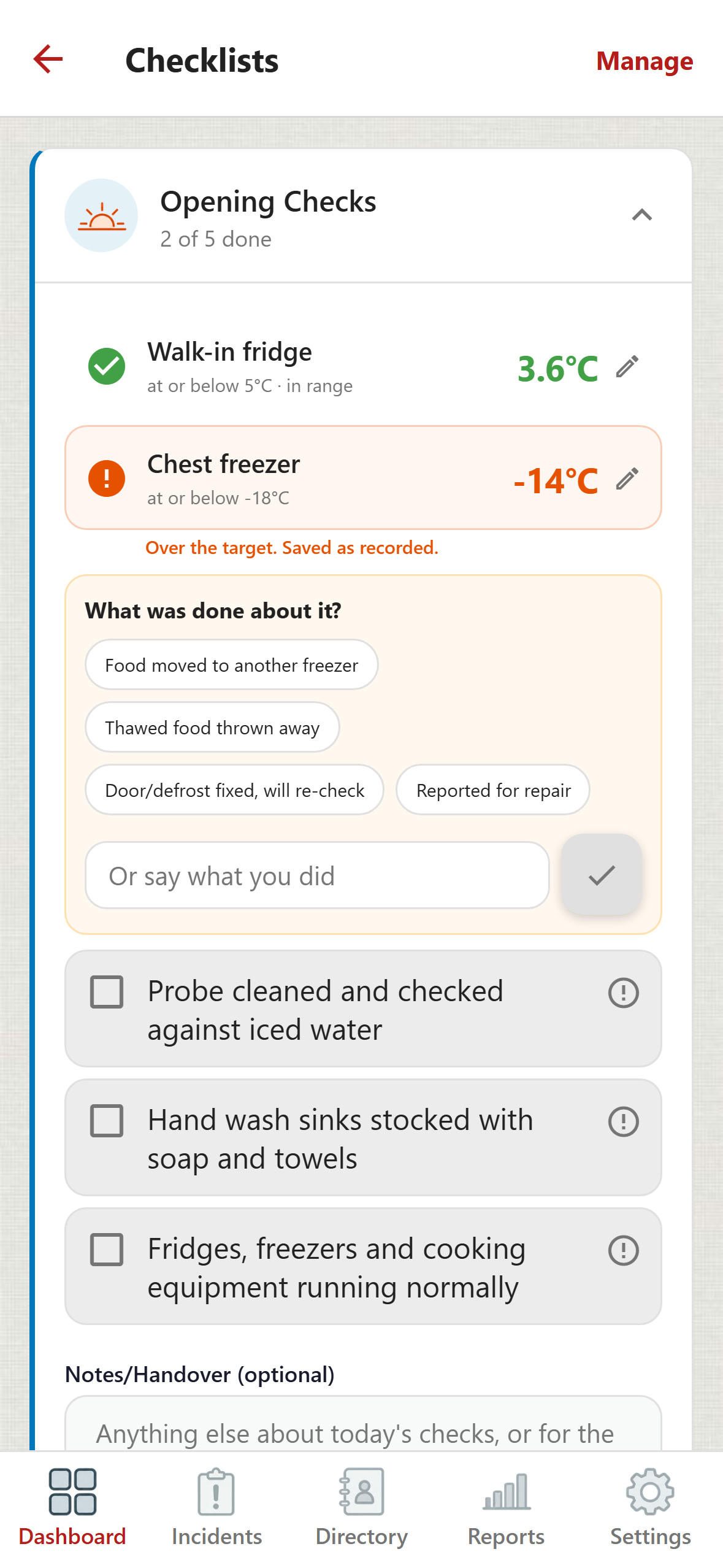
A freezer reading over the target. The reading is saved as it was taken, and the app asks what was done about it.
Which plan. Checklists come with Standard and Pro, and are open in the 14-day free trial. Incidents can be logged on every plan; the trial and the free plan keep up to 20.
Get ChefsRecords on the App Store (iPhone) ›
14 days free. No card required.
This page explains the law and guidance in plain words, from the public sources below as published on 1 November 2026. It is not legal advice. Your council's food team can answer questions about your own kitchen. ChefsRecords is not part of, or endorsed by, the Food Standards Agency, Food Standards Scotland, GOV.UK or any council.
-18°C or colder. That is the FSA pack's figure for frozen food, and the figure in the quick-frozen food rules. No food hygiene law sets a temperature for a kitchen freezer, so write -18°C into your food safety plan and check it every day.
Food hygiene law sets no freezer temperature. The legal -18°C is in the rules for quick-frozen food, and whether they cover a kitchen's own storage is a question for your council. A freezer at -18°C or colder keeps food at both figures.
Not as a running temperature. The quick-frozen rules allow short rises to -15°C in transport, and shop display freezers can run up to -12°C, but neither is a figure for a kitchen freezer. Aim for -18°C or colder, and get a freezer that will not hold it looked at.
No. It stops them growing, and they start again as the food defrosts. Freezing keeps food; it does not make unsafe food safe.
No law sets it. The guidance packs expect a check every day as part of opening. We suggest a second check at closing, so a freezer failing in the evening is spotted before the night.
Raw food that has fully defrosted can be cooked and then frozen again once it has cooled. Food still frozen hard can go straight into another freezer. Food that has started to soften carries on defrosting in the fridge and does not go back in the freezer. Food that has to stay frozen, such as ice cream, cannot go back once it starts to defrost. Refreezing raw food that has fully defrosted, without cooking it first, is not what the FSA pack suggests.
The FSA and Food Standards Scotland tell home cooks up to about 48 hours for a full freezer and about 24 hours for a half-full one, if the door stays shut, and say these are estimates. In a kitchen, decide by the state of the food when the power returns: still frozen hard, starting to soften, or soft all through.
Frozen food stays safe a long time, but it loses quality. GOV.UK's home advice suggests 2 to 3 months for meat and 3 to 4 months for baked goods, fruit and vegetables. Set your own times in your food safety plan and label everything with the date it was frozen.
They are for home appliances. One star is -6°C, two stars -12°C, and three or four stars -18°C; four stars also means it can freeze fresh food. They are not food safety rules. In a kitchen, go by the temperature.
No law asks for a particular form, but you need to be able to show your freezers are kept cold, and a daily reading is how most kitchens do it. Write the reading on your opening checks, or record it in an app, with who took it and what was done when it was warm.
Your food safety plan should say what your kitchen really does, and that includes your freezer temperature, how often you check it and what you do when it fails. The free food safety plan builder takes you through safe methods based on the FSA pack, so you can write them in your own words, then prints your plan or saves it as a PDF. For small restaurants, cafes, pubs and takeaways in England and Wales.
The fridge temperature log guide, the danger zone guide, the food shelf life guide, the cooling food guide, the delivery checks guide, the stock rotation guide and the probe check guide.