Updated 14 November 2026 - for people opening, taking over or adding food to a pub, takeaway, fast food shop or pop-up kitchen in England, Wales, Northern Ireland or Scotland
Usually not. You register your food business with the council instead, free, at least 28 days before you start. You need a licence to sell alcohol, and to sell food late at night.
People say "food licence" when they mean food business registration. Registration is not a permission: nothing comes back to frame on the wall, and it simply tells the council you exist so it can plan an inspection.
Law in all four nations Every food business operator registers every site it runs with the council, keeps the details up to date and tells the council when it closes. Drink counts as food, so a bar, a coffee shop and a kebab shop all register.
Guidance in England, Wales and Northern Ireland GOV.UK says registration is free, cannot be refused, and should be done at least 28 days before you start trading. Already trading without it? Register straight away.
Guidance in Scotland Food Standards Scotland says registration with the council's environmental health service is free, should be done at least 28 days before you open, and as soon as possible if you are already trading.
Law in all four nations The exception is approval. A business that makes or handles meat, fish, egg or dairy products and supplies them to other businesses may need approval from the council instead of registration, for example a pub kitchen making sausages or burgers for other pubs and shops. Approval comes after a visit, and you cannot start that trade until you have it. A small, local and limited supply to other shops, pubs, cafes or caterers can be left out: your council decides, so ask before you start.
How to register, what the form asks and where to send it are in our register a food business guide.
The food side is the same everywhere: you register. The licences change by nation.
| You want to | England and Wales | Scotland | Northern Ireland |
|---|---|---|---|
| Cook or serve food | Register with the council | Register with the council | Register with the council |
| Sell alcohol | Premises licence from the council, and a designated premises supervisor with a personal licence | Premises licence from the Licensing Board, and a premises manager with a personal licence | Liquor licence from the county court |
| Sell food between 11pm and 5am | Hot food or hot drinks: late night refreshment on a premises licence, unless exempt | Any food: a late hours catering licence, only where the council has adopted it. Not needed while you are open under an alcohol licence | Ask your district council about opening late |
Our advice Ring the council's licensing team and its food team before you sign a lease. They are different teams, and each only answers for its own part.
This is when the food itself can need a licence, and it catches takeaways, chip shops, kebab shops and burger bars that stay open late.
Law in England and Wales Under the Licensing Act 2003, selling hot food or hot drinks to the public between 11pm and 5am, to eat in or take away, is "late night refreshment" and needs a premises licence that covers it. Hot means heated so it is eaten hotter than the room, and still above room temperature when you sell it, whoever heated it. It also covers food customers can heat on your premises after they buy it, such as in a microwave you put out for them. You apply to the council's licensing team, and the fee is set by law, by the rateable value of the premises.
Law in England and Wales Some supplies are left out, such as food given away free, hot drinks from a coin machine, and food served only to hotel guests staying the night or club members when nobody else is served. Councils can also exempt some areas, types of premises or times, so ask yours.
Law in Scotland Under the Civic Government (Scotland) Act 1982, a late hours catering licence is needed to sell food to the public, or let the public eat there, between 11pm and 5am, but only where the council has chosen to use that part of the Act. It covers any food, not only hot food. Premises open under a licence to sell alcohol, or under a public entertainment licence, do not need one. Ask your council whether it applies in your area.
Our advice In Northern Ireland, ask your district council before you open late.
Our advice If you run a pub, check the hours your premises licence allows for late night refreshment before you keep the kitchen open past 11pm.
Alcohol licensing is a subject of its own. In short:
Law in all four nations Registration belongs to the operator, not the building, so a new operator registers even if the pub was registered before.
Our advice In a managed pub, the pub company is usually the operator and registers. If you take a tenancy or a lease and run the business yourself, you are the operator, so you register.
Guidance in England, Wales and Northern Ireland GOV.UK says that when you take over an existing business you must register. FSA guidance says the old food hygiene rating is not valid, and the council can list the business as awaiting inspection until it rates you.
Law in Northern Ireland A food hygiene rating stops being valid when the business changes owner.
Guidance in Scotland Food Standards Scotland says a business with a new owner has no inspection result until the council inspects it.
Our advice Before and on handover day:
Law in all four nations The same hygiene law already covers the bar: clean glasses and ice, and allergen information for drinks served loose (most beers are made with barley or wheat, which contain gluten, and many wines and ciders contain sulphites). If the pub is not registered, register now. When you start serving food, tell the council: it is a big change to what you do.
The council may then want to visit sooner.
Law in all four nations Once you cook, the law asks much more of you:
Law in all four nations Sandwiches, salads or anything else you pack on the premises before the customer orders need a label with the name of the food and the full ingredients list, with the allergens picked out. See our Natasha's Law guide.
Our advice Before you fit out a kitchen behind the bar, show the council's food team the plan. A hand basin is far cheaper to add on paper than after the tiles are up. Bar staff who take food orders need the allergen information as much as the chef does.
Our advice Crisps, nuts and pork scratchings in their bags are low risk. Toasties, pies in a hot cabinet and a Sunday roast all mean preparing hot food, so you need the full plan.
Many pubs now let the kitchen to a chef or a street food business that runs it under its own name.
Law in all four nations Each food business operator registers each place it runs. A separate business running the kitchen registers its own food business with the council for that address. The pub registers its own business too, for the drinks and any food it serves itself.
Our advice Expect each business to be inspected and rated in its own name: the pub's rating is not the kitchen's, and the kitchen's is not the pub's. Ask your council how it lists the two of you.
Our advice Put the split in writing before the first service:
A pop-up for one weekend usually still registers. Ring the pub's council before you book it.
None of these is about food safety, but each can stop you trading.
Once you are registered you can trade while you wait, unless you need approval. The council decides when to visit, by risk, and it may be several months. Officers usually arrive without an appointment. At the first inspection, the officer looks at three things:
Guidance in England, Wales and Northern Ireland Together, the three set your food hygiene rating, from 0 to 5. To get a 5, you must do well in all three.
Guidance in Scotland The result is Pass or Improvement Required, not a number.
Showing your rating at the door is law in Wales and Northern Ireland, and your choice in England and Scotland.
Law in Wales A takeaway's menus and leaflets that customers can order from without visiting must also carry a statement, in Welsh and English, pointing to the food hygiene ratings website.
More in our first food hygiene inspection guide and our EHO inspection guide.
Law in all four nations The law asks for a food safety plan based on HACCP principles, and records that fit the kind and size of the business. It does not list the records: your plan decides which checks you write down.
Our advice Most small pub and takeaway kitchens write down:
Law in England, Wales and Northern Ireland Food that needs chilling is kept at 8°C or below. Hot food you hold for service is kept at 63°C or above; the law allows one single period of less than 2 hours below that. See our hot holding guide.
Law in Scotland Hot food is held above 63°C, and food you reheat must reach at least 82°C, unless that would spoil it.
Our advice Start on your first trading day. A week of honest records, with the problems written in, tells an officer more than a perfect folder nobody has touched. Our food safety records guide lists what to keep and for how long.
Registration and licences are done with the council, the Licensing Board or the court. ChefsRecords is an iPhone and Android app for what comes after: the daily records from your first service. Paper works for those too.
It does not write your food safety plan: that stays your own document.
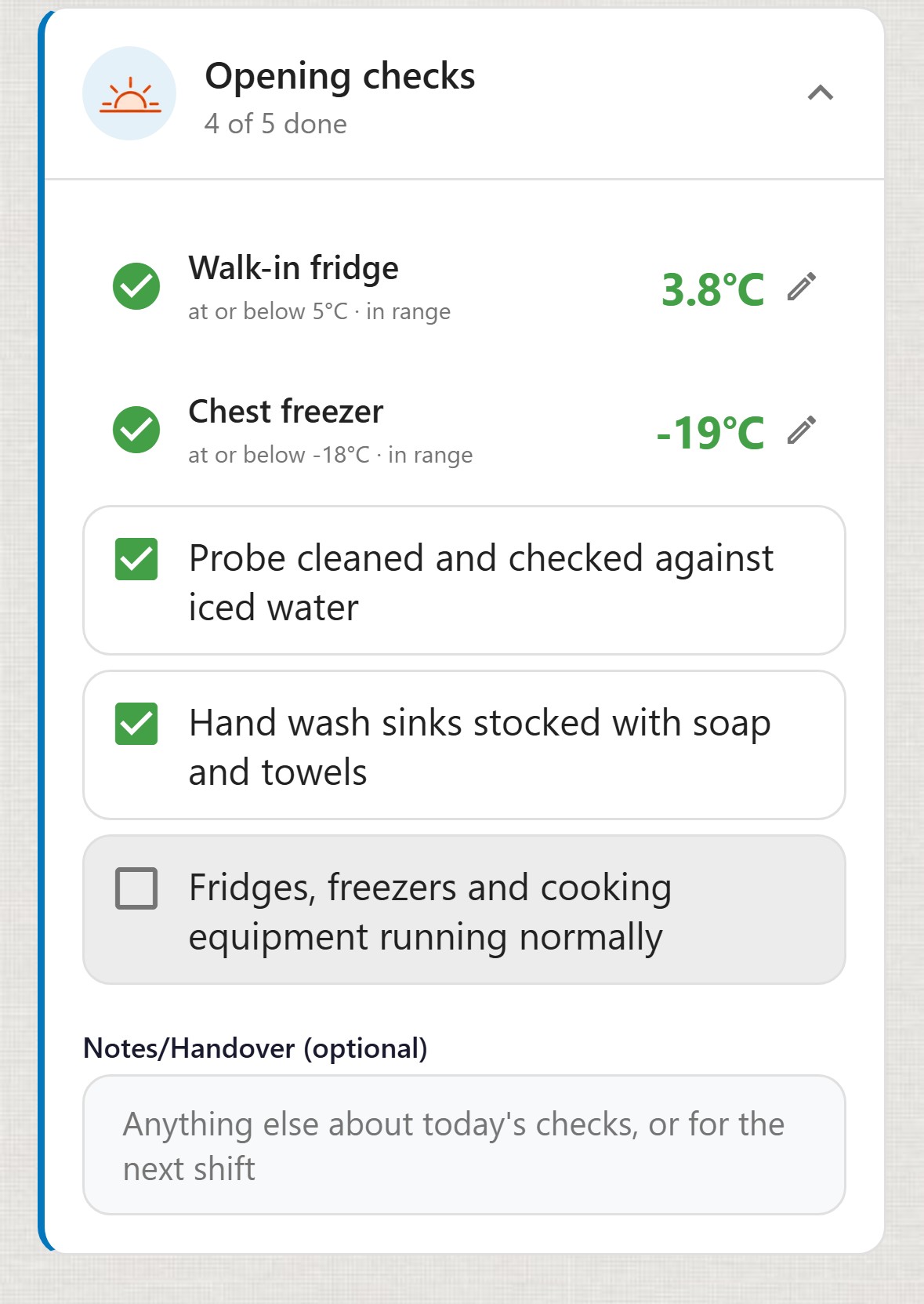
Opening checks, part done. A starter checklist after its lines were changed to fit the kitchen.
Which plan. The 14-day free trial opens checklists, reports and the Inspection Pack. Training and certificate records are part of Pro and are not in the trial. After the trial, cooking, cooling, hot-holding, reheating and delivery temperatures, and up to 20 incidents and near misses (not delivery problems), stay free for one login, the kitchen's billing Manager. Fridge and freezer checks are on checklists, so they need Standard or Pro, as do reports and the Inspection Pack.
Get ChefsRecords on the App Store (iPhone) ›
14 days free. No card required.
Get ChefsRecords on Google Play (Android) ›
14 days free. No card required.
This page explains the law and guidance in plain words, from the public sources below as published on 14 November 2026. It is not legal advice. Your council's licensing and food teams can answer questions about your own business. ChefsRecords is not part of, or endorsed by, the Food Standards Agency, Food Standards Scotland or your local council.
Usually not: you register with the council, for free. You need a licence to sell alcohol, and to sell food late at night: hot food or hot drinks between 11pm and 5am in England and Wales, and any food in those hours in Scottish council areas that license late hours catering.
No. The pub registers as a food business with the council, even if it only sells drinks. Its alcohol licence is a separate thing.
Only if you open late. In England and Wales, hot food or hot drinks sold between 11pm and 5am need a premises licence for late night refreshment. In Scotland, some councils need a late hours catering licence for any food sold in those hours. Before 11pm, registering is enough for the food; check planning too, and an alcohol licence if you sell drinks.
It depends on the rateable value of the premises, which is on your business rates bill. In England and Wales late night refreshment is part of a premises licence, and the fee is set by law. If you already hold a premises licence, adding late night refreshment means changing it, which has its own fee. Ask the council's licensing team for your figure.
No. In England and Wales a premises licence is for alcohol, entertainment and late night refreshment, and in Scotland it is for alcohol. The kitchen is covered by your food business registration and the hygiene law every kitchen works to.
No. The rating belonged to the last operator. You register as the new operator, and the council can list the business as awaiting inspection until it rates you.
Both of you. The chef's business registers for the kitchen, and the pub stays registered for its own trade. Agree in writing who looks after the shared areas.
No. GOV.UK says registration cannot be refused in England, Wales and Northern Ireland. Approval is different: the council visits first, and it can say no.
No, no law asks for one. Food handlers must be trained or shown how to do their job safely, and supervised; a certificate is a common way to show the training.
Not usually. You can trade once you are registered, and the council decides when to inspect, by risk. It may be several months.
The register a food business guide, the first food hygiene inspection guide, the EHO inspection guide, the food safety management system guide, the opening and closing checks guide, the food vans and market stalls guide and the new kitchen starter kit.
Register with the council at least 28 days before you start. Opening late or selling alcohol? Ring the council's licensing team next.
Read next: How to register a food business, nation by nation