Updated 4 November 2026 - for cafes, restaurants, pubs, takeaways, delis, bakeries, canteens, food vans and market stalls in England, Wales, Northern Ireland and Scotland
PPDS stands for prepacked for direct sale. It is food your own business packs before a customer chooses or orders it, and sells from the same place: a sandwich boxed in the morning for the chiller, a salad pot, a cake wrapped in film on the counter. Since 1 October 2021, every PPDS item in England, Wales, Northern Ireland and Scotland needs a label on the pack with the name of the food and a full ingredients list, with the 14 allergens emphasised. This is the change people call Natasha's Law.
PPDS is short for "prepacked for direct sale". Food labelling law treats packed food in three ways, and which one your food falls into decides what the label needs:
Guidance in England, Wales and Northern Ireland The FSA describes PPDS as "Food that is packed before being offered for sale by the same food business to the final consumer". In its guidance, "the same place" includes the same building or the same site, such as two counters a business runs in one airport terminal or shopping centre, and the business's own market stall, food van or marquee when it packs the food somewhere else.
Guidance in Scotland Food Standards Scotland gives the same meaning, with examples such as sandwiches packed and sold on the same premises, wrapped cheese and cooked meats from a deli counter, and boxed salads on a chilled shelf.
Law in all four nations Food is "packed" when its packaging fully or partly encloses it and it cannot be changed without opening or changing the packaging. Our advice If the customer would have to open, unfold, untwist or tear something to get at the food, treat it as packed.
Guidance in England, Wales and Northern Ireland On 3 November 2026 the FSA added a short check to the start of its PPDS guidance. A food is PPDS only when the answer to all three questions is yes. We have drawn the check as a chart; the three questions are the FSA's own words.
These come from the FSA's guides for takeaways, bakers, mobile sellers and schools, colleges and nurseries, and from Food Standards Scotland. Where the guidance does not name a case, the table says so.
| Food | PPDS? | Why |
|---|---|---|
| Sandwiches, salads and pasta pots packed in the morning for the chiller | Yes | Packed by you, before anyone orders, sold from the same place. |
| Burgers or boxed chicken and chips wrapped before the lunch rush and kept under a heat lamp | Yes | The FSA says food packed in anticipation of orders needs a PPDS label. |
| The same burger made and wrapped after the customer orders | No | Packed after the order, so it is loose food. |
| A packed item that matches a loose one on display | Yes | The FSA: "Even if the consumer bases their choice on similar loose food that is on display, the packaged food will require PPDS labelling." |
| A whole cake wrapped in cling film, or bread in a bag folded or twisted shut | Yes | The packaging encloses the food before sale. |
| A cake on an open tray, or a baguette in an open paper sleeve | No | The food can be taken out without opening anything. |
| A slice of cake boxed when the customer asks for it | No | Packed at the customer's request. |
| A slice of cake in a closed box on the counter, packed before it was chosen | Yes, in our reading | Not named in the guidance. It passes all three FSA questions, like the FSA's small cake sold under its dome. |
| Cheese or cooked meat weighed and wrapped before the customer chooses | Yes | Named by the FSA and by Food Standards Scotland. Cut and wrapped while the customer waits, it is not PPDS. |
| Burgers and sausages a butcher makes and packs in the shop | Yes | Packed and sold by the same business on the same premises. |
| Drinks poured and lidded before an expected rush | Yes | Named in the FSA's guide for mobile sellers. A hot drink made to order is not PPDS. |
| Free samples packed on site | Yes | The FSA says the rules apply whether the food is paid for or free. |
| Fruit pots or breakfast pots packed in a school or nursery kitchen | Yes | Named in the FSA's guide for schools, colleges and nurseries. |
| Food you make and pack at home, then sell on your own market stall | Yes | The FSA counts your own stall or van as the same place. |
| Cakes you bake at home and sell to a cafe that sells them on | No: prepacked | Packed by one business and sold by another, so the full label is needed. |
| Sandwiches from your own central kitchen sent to your other branches | No: prepacked | The FSA's takeaway guide says food packed at a different site is prepacked, so it needs the full label. Branches in the same building complex are the exception. |
| A buffet | Usually not | Not named in the guidance. Open dishes are loose food. Items you wrap one by one before service, where you serve them, would be PPDS. |
Not sure about one of yours? Ask the trading standards or environmental health team at your council before you sell it.
A sandwich made while the customer waits, a burger wrapped after the order, a slice of cake boxed on request: none of these is PPDS, even if it goes into a box or a bag. It is loose food. Law in all four nations You must still be able to tell the customer which of the 14 allergens it contains. Our allergen matrix guide covers how kitchens keep that information.
A sealed sandwich, a bottled drink or a wrapped biscuit from a supplier is prepacked food, and its label is the packer's job. Sell it in its packaging, as it came. If you open it, split a multipack or repack it, the labelling becomes your job. Guidance in England, Wales and Northern Ireland The FSA says not to sell single items from a split multipack unless each one is labelled. At the door, check the labels match what you ordered: our food delivery checks guide covers substitutions.
Food on an open tray, behind glass or in a hot cupboard, served on a plate or on an open cardboard tray, or picked from a counter into a bag after the customer chooses it, is loose food. The allergen rules for loose food apply, not the PPDS label.
Food your business packs in one place and sells from another fixed shop is prepacked food, not PPDS. It needs the full label for prepacked food, which asks for more than a PPDS label, such as a date mark and the name and address of the business. The exceptions are your own market stall, van or marquee, and units in the same building complex.
Law in all four nations Every PPDS item needs, on the pack itself or on a label stuck to it:
Law in all four nations The ingredients list must be easy to read: the lower-case letters at least 1.2 millimetres high, or at least 0.9 millimetres where the biggest surface of the pack is smaller than 80 square centimetres. Our advice Use the same size for the name, so the whole label reads well.
Law in all four nations Where it applies, a meat product also needs its meat content as a percentage. This does not apply to sandwiches, filled rolls, pizzas, soups or ready-to-eat food sold by a caterer such as a cafe, restaurant, takeaway, canteen or food van. It does apply, for example, to a butcher's own sausages.
Guidance in England, Wales and Northern Ireland The FSA says:
Our advice A QR code can sit beside the label, but never instead of it: the law asks for the ingredients list on the pack.
The PPDS rules do not ask for a use-by date, storage instructions, a weight or your business name and address. Our advice Add a use-by date and "Keep refrigerated" to chilled food anyway: your own shelf-life control depends on it. Our food shelf life guide covers how long kitchen food keeps.
"May contain" is not required either. Guidance in England, Wales and Northern Ireland The FSA says to use it only when a real risk of cross-contact has been found and cannot be removed, and that using it without one could be misleading.
This is an example of the kind of label the guidance describes, for a sandwich made in the morning and put in the chiller. The recipe is made up. Yours will have different ingredients, and your suppliers' labels decide what goes in each bracket.
Chicken, mayonnaise and lettuce sandwich
Ingredients: malted bread (wheat flour (wheat flour, calcium carbonate, iron, niacin, thiamin, folic acid), water, malted barley flakes, wheat protein, yeast, salt, rapeseed oil, soya flour), cooked chicken (chicken breast, salt), mayonnaise (rapeseed oil, water, pasteurised free-range egg yolk, spirit vinegar, sugar, salt, mustard flour, lemon juice concentrate), lettuce.
Use by: 5 November. Keep refrigerated. (Not required by the PPDS rules: our advice for chilled food.)
Law in all four nations The PPDS label rules do not cover food sold online, by phone or by mail order. The allergen rules still do: the customer must be able to get allergen information before they buy, and again when the food arrives.
Guidance in England, Wales and Northern Ireland The FSA says the information must be available free of charge before the customer buys, and at the moment of delivery. For delivery it suggests stickers on containers, a menu sent with the order, or telling the customer when they order by phone.
A pizza boxed after a phone order is not PPDS: it was packed after the order. A pizza boxed in the morning and sold over the counter is.
Our advice If the pack already carries a full PPDS label, the allergen information travels with the food. Make sure your website or delivery app listing matches the label.
Guidance in England and Wales Your council enforces the PPDS rules, usually through its trading standards team, sometimes through environmental health. Guidance in Northern Ireland In Northern Ireland it is the district council's environmental health team. Guidance in Scotland Food Standards Scotland says councils enforce the rules there. Trading standards' own business guide says food labelling in Scotland is usually enforced by environmental health.
Law in all four nations Missing or wrong allergen information on a PPDS label is a criminal offence. Other faults, such as a missing ingredients list, can lead to an improvement notice, or to prosecution and a fine. Ignoring an improvement notice is an offence.
An officer at a food hygiene inspection may also ask how you manage allergens. Our EHO inspection guide covers what officers look at.
Guidance in England, Wales and Northern Ireland The FSA says the business that packs the food is responsible for its labels. It asks you to build labels from your suppliers' information, and to have a way to update them when a supplier or a recipe changes. It also suggests keeping spare printed labels for when the printer fails. Guidance in England and Wales The allergen page of the FSA's Safer Food, Better Business pack asks when you update your labels, and says to check the allergen information whenever you substitute an ingredient.
Our advice A routine that keeps labels true:
This is a list to copy into your own routine. No law asks for a written label-check log, but a dated note of checks and changes shows an officer the system works. Training notes fit with your other training records: see our food hygiene certificate guide.
Each of these goes against a point in the FSA's guidance:
In July 2016, Natasha Ednan-Laperouse, a teenager, died after an allergic reaction to sesame in a baguette bought at an airport. The sesame was in the bread. At that time, food made and packed where it was sold did not need a written ingredients list. After her inquest, the coroner issued a report to prevent future deaths in October 2018.
The rules for England were made in 2019. Wales and Northern Ireland followed in 2020 and Scotland in 2021, and all four started on 1 October 2021. Natasha's parents, Nadim and Tanya Ednan-Laperouse, campaigned for the change, and the rules are widely known by her name. The charity they founded is Natasha's Foundation.
ChefsRecords does not make, print or check labels, and it has no PPDS feature. Your labels come from your own printer, stickers or a pen, built from your recipe sheets. Where the app helps is around the labels:
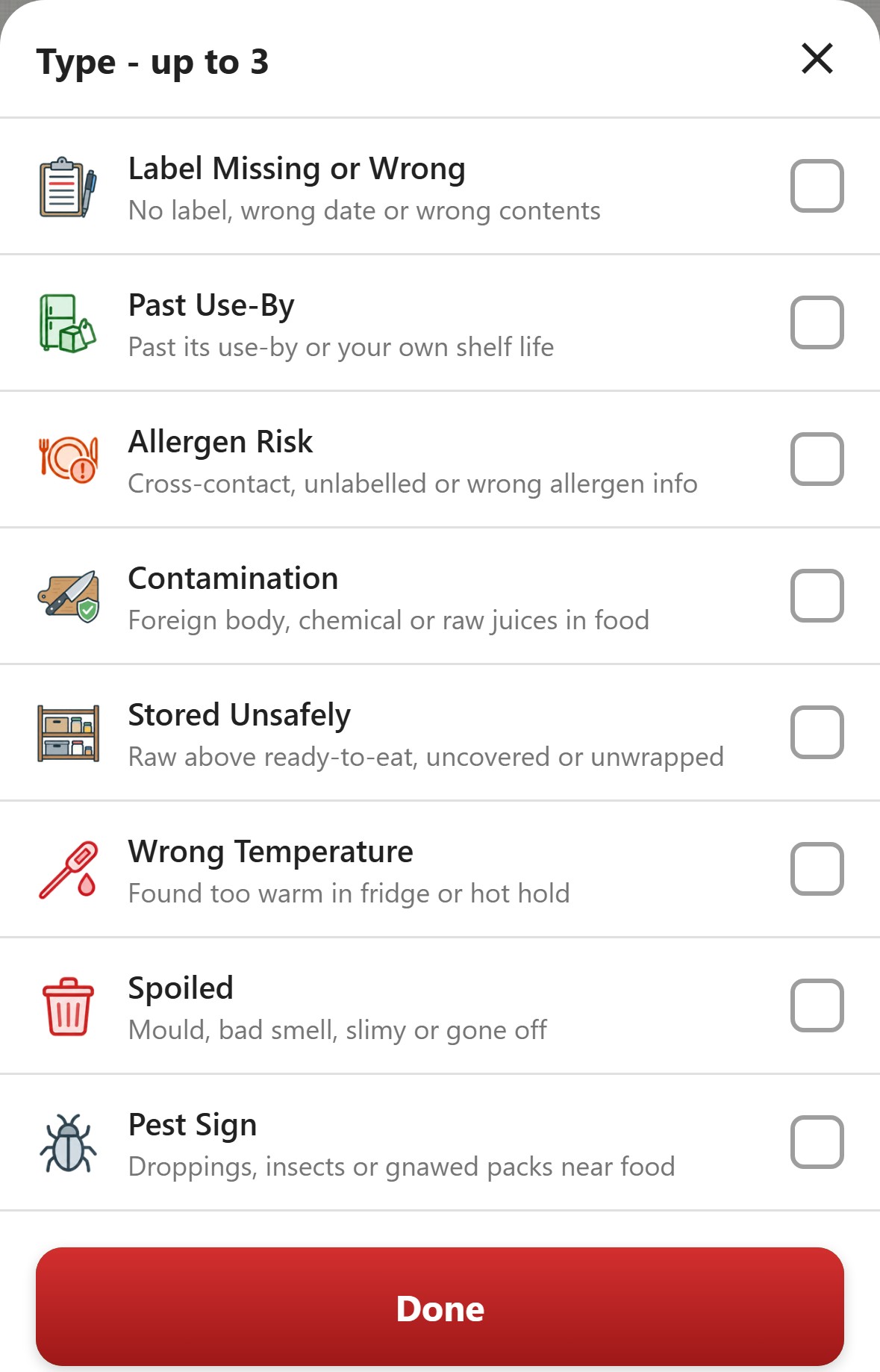
"Label Missing or Wrong" and "Allergen Risk" are two of the food incident types.
Which plan. Incidents are on every plan. Checklists and the Inspection Pack come with Standard and Pro and are open in the 14-day trial. Training records are part of Pro and are not in the trial.
Get ChefsRecords on the App Store (iPhone) ›
14 days free. No card required.
This page explains the law and the guidance in plain words, from the public sources below as published on 4 November 2026. It is general information, not legal advice, and it cannot cover every food or every kitchen. Your own recipe and your suppliers' labels decide what goes on your label. For a question about your own food, ask the trading standards or environmental health team at your council. If your business has a Primary Authority partnership, ask your primary authority. ChefsRecords is not part of, or endorsed by, the Food Standards Agency, Food Standards Scotland, your council or Natasha's Foundation.
Prepacked for direct sale: food a business packs before the customer chooses or orders it, and sells from the same place. Since 1 October 2021 it needs a label with the name of the food and a full ingredients list, with the 14 allergens emphasised.
A sandwich packed this morning and put in your chiller is PPDS. A sandwich made while the customer waits is not, and nor is a sandwich bought in from a supplier with its own label. A cake wrapped in film on the counter is PPDS. A slice cut and boxed when the customer asks is not.
No. Food packed after the customer orders is loose food. You must still be able to tell the customer which of the 14 allergens it contains.
No. The FSA says an allergen sheet on display does not replace the label. A matrix helps with loose food: see our allergen matrix guide.
Not under the PPDS rules, which ask for the name and the ingredients list with allergens emphasised. We advise adding a use-by date and "Keep refrigerated" to chilled food anyway, because your own shelf-life control depends on it.
Yes. The FSA says handwritten labels are fine as long as the writing meets the minimum size: lower-case letters at least 1.2 millimetres high, or 0.9 millimetres where the biggest surface of the pack is smaller than 80 square centimetres.
Yes, if you pack them before they are handed out. The FSA says the rules apply whether food is paid for or free.
No. Packed by you and sold by the cafe is prepacked food, which needs the full label, including a date mark and your name and address. Cakes you pack and sell yourself, at your own stall, are PPDS. Your home kitchen also has to be registered with the council: see our guide to registering a food business.
Yes. Scotland has its own regulations, from 2021, with the same label content and the same start date of 1 October 2021. The guidance comes from Food Standards Scotland.
No. Emphasise the cereal, such as wheat, barley, rye or oats. Adding "gluten" in brackets is optional.
The allergen matrix guide, the food shelf life guide, the food delivery checks guide, the EHO inspection guide, the food hygiene certificate guide and the guide to registering a food business.