Updated 2 November 2026 - for people starting or taking over a restaurant, cafe, pub, takeaway, home kitchen business, food van or stall in England, Wales, Northern Ireland or Scotland
Every food business has to register with the local council for each place it works from. It costs nothing. Do it at least 28 days before you start, and if you are already trading without it, do it now. Registration is not a licence, a food hygiene certificate or a rating: it simply tells the council you exist, so it can plan your first inspection.
Law in all four nations The law puts the duty on the business: each establishment under your control has to be notified to the council and registered. A business that needs approval (section 8) is approved instead of registered.
Registering is not just for restaurants and cafes. It covers, for example:
Guidance in England, Wales and Northern Ireland GOV.UK names home, mobile, temporary and online-only businesses, and office-based food brokers and distributors. FSA guidance on community and charity events says food given away can count too, while a very small and occasional activity may not need registering. The council decides which side you fall on, so ask it.
Guidance in England, Wales and Northern Ireland In England, a childminder registered with Ofsted or a childminder agency does not register separately with the council. Wales and Northern Ireland have different rules for childminders, so ask your council.
Guidance in Scotland In Scotland, a childminder may need to register with the council, depending on the food they give children. Ask the council's environmental health service.
Working from home? Our guide to running a food business from home covers your kitchen, labels, records and other permissions.
Guidance in England, Wales and Northern Ireland Use the Food Standards Agency's register a food business service. You do not register with the Food Standards Agency itself: the service sends your registration to the council for the address you give. It works in English and Welsh. Many councils also accept their own paper or online form, so if your council's website sends you somewhere else, follow it.
Two words on the form are worth knowing first:
Guidance in Scotland Register with the environmental health service of the council where your premises are. Food Standards Scotland points every business there. Each council runs its own form: some take it online, others ask you to download it and send it back by email or post. Search your council's website for "register a food business", or ask its environmental health team.
Guidance in Scotland Food Standards Scotland says registration is free, should be done at least 28 days before you open, and should be done as soon as possible if you are already trading.
Guidance from some councils Many councils use the same model registration form. The online service and your council's form may word the questions differently, but you will usually be asked for:
Guidance from some councils One council's copy of the model form warns that knowingly putting false details on the form is an offence.
This is a list to have ready before you start the form. It is not a form to send.
Guidance in England, Wales and Northern Ireland Guidance in Scotland GOV.UK and Food Standards Scotland both ask for at least 28 days' notice before you start trading. GOV.UK also advises against registering too early, so wait until your plans are firm: the premises, the opening date and what you will sell.
Law in all four nations The duty to register is law. Trading without registering is an offence. If you are already trading, register straight away.
No government source we checked gives a time for registration to be processed. Guidance in England, Wales and Northern Ireland GOV.UK says registration cannot be refused.
Guidance from some councils Some councils write or email to confirm they have your registration. Others send nothing. If you are not sure it went through, ask your council.
Each place is registered on its own, with the council for that address. If you have premises in two council areas, you register with both councils.
Guidance from some councils One council's notes on the model form treat every separate food outlet as its own registration, even on a shared site, and that includes a business run by someone else inside yours, such as a pizza counter in a pub. The vehicles you use from registered premises go on that one registration, and a form sent to the wrong council only counts once the right council has it.
Guidance from some councils A van, trailer or stall with no fixed premises registers with the council where it is kept overnight, such as a yard or a garage at home. That council usually gives your rating (in Scotland, your inspection result). Councils where you trade may also inspect you. If you have no fixed base, or you have premises as well, ask your council which address to register. Ratings on the van, water, hand washing and cold storage on the move are in our food vans and market stalls guide.
Our advice Selling at a market what you make at home? Register with your home council, and ask the market organiser what else they need from you.
Law in all four nations You must keep the council's details up to date, including any big change in what you do, and tell it when you close.
Guidance from some councils Registration belongs to the operator, not the building. If you buy or take over a cafe, pub or takeaway, you register as the new operator: the old owner's registration does not pass to you. One council's copy of the model form says the new operator fills in a new form.
Tell your council, too, when:
Guidance from some councils One council's form asks for changes within 28 days. Ask your own council how it wants to hear about them.
Law in all four nations The law asks you to register once and keep your details up to date. There is no yearly renewal.
Law in all four nations Some businesses that make or handle foods of animal origin, such as meat, fish, eggs or dairy, and supply them to other businesses need approval, usually from the council, instead of registration. Unlike registration, approval comes after the council checks the premises, and you cannot start until you have it. Most restaurants, cafes and takeaways selling straight to the public do not need approval.
Law in all four nations Running a business that needs approval without it is an offence. The approval rules leave out a small, local and limited supply to other shops or caterers. Your council decides whether that is you, so ask before you start.
Licences are separate again. Selling alcohol, or trading on the street, usually needs a separate licence. Registering your food business does not give you either. Ask your council which licences apply to you and who issues them where you are.
Registration is not a training certificate either. No law says you must hold a food hygiene certificate to register, but you must make sure food handlers are supervised and trained for their work. More in our food hygiene certificate guide.
Guidance from some councils One council's copy of the model form says the register of business addresses and types of business is open to the public. Your personal details, such as your phone number, are not on the public register. Your trading name, your result and your address (for a home address, see below) appear on the food hygiene ratings website once you are inspected.
Guidance in England, Wales and Northern Ireland Once you are rated, a business registered at a home address shows only the first part of the postcode on the food hygiene ratings website.
Guidance in Scotland Scotland has its own hygiene information scheme. Ask your council how it shows a business run from a home address.
Once you are registered you can trade while you wait for your first inspection, unless your business needs approval. The council decides when to visit, by risk, and it may be several months.
Registering is done with the council, on paper or online, not in any app. ChefsRecords does not register you, check whether you need to, or remind you to. Where it helps is the next step: the records to start on day one. Paper works for those, and so does your nation's pack kept on a device. ChefsRecords is an iPhone app for the daily records:
What it does not do today: it does not help you register, your written food safety plan and allergen matrix are not in the app, it does not deal with approval or licences, and there is no starter checklist for a business run from home.
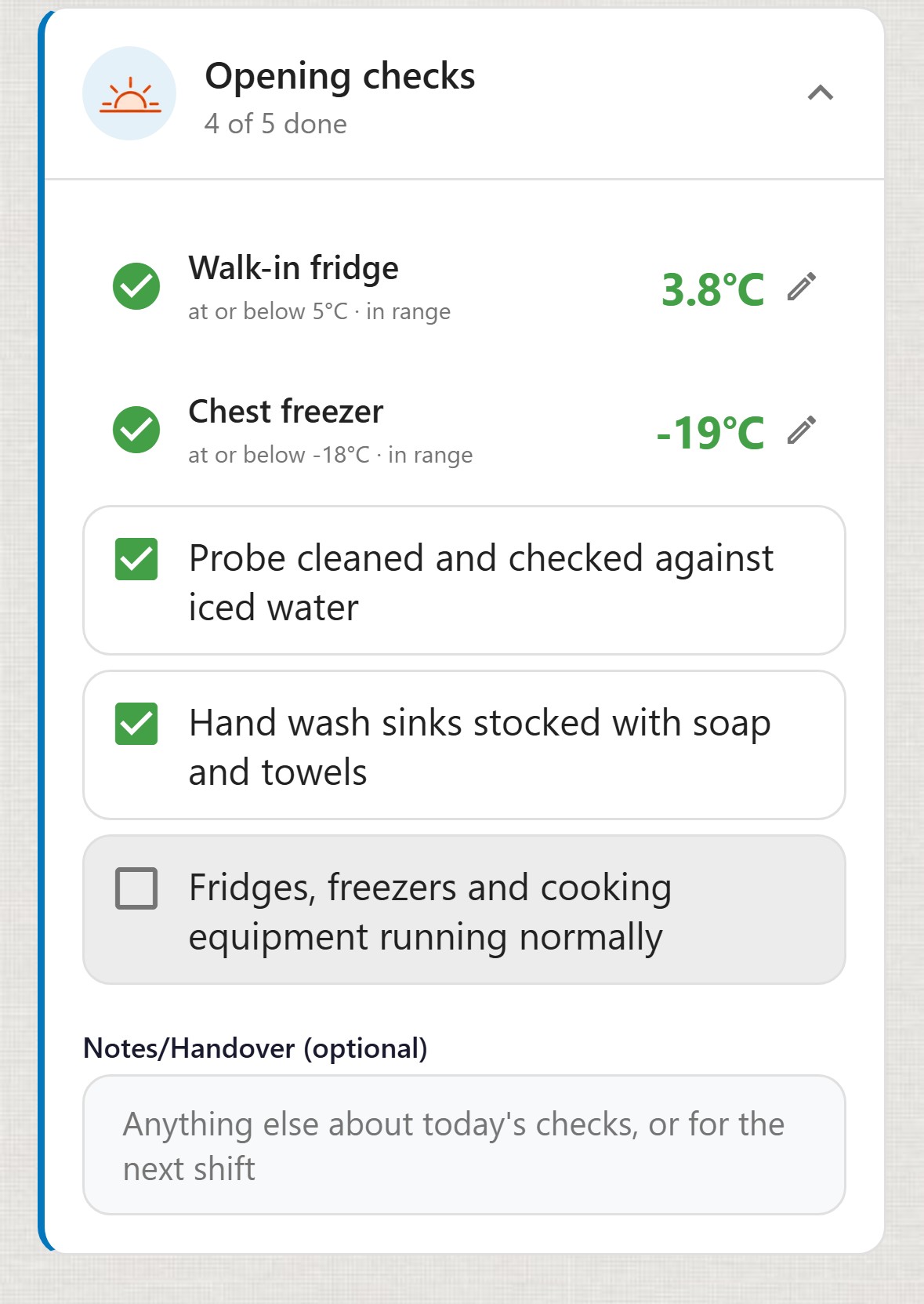
Opening checks, part done. A starter checklist after its lines were changed to fit the kitchen.
Which plan. The 14-day free trial opens checklists, reports and the Inspection Pack. Training and certificate records are part of Pro and are not in the trial. After the trial, cooking, cooling, hot-holding, reheating and delivery temperatures, and up to 20 incidents and near misses (not delivery problems), stay free for one login, the kitchen's billing Manager. Fridge and freezer checks are on checklists, so they need Standard or Pro, as do reports and the Inspection Pack.
Get ChefsRecords on the App Store (iPhone) ›
14 days free. No card required.
This page explains the law and guidance in plain words, from the public sources below as published on 2 November 2026. It is not legal advice. Your council's food team can answer questions about your own business. ChefsRecords is not part of, or endorsed by, the Food Standards Agency, Food Standards Scotland or your local council.
Yes. GOV.UK and Food Standards Scotland both say there is no charge, so registration costs nothing in England, Wales, Northern Ireland and Scotland.
In England, Wales and Northern Ireland, GOV.UK says it cannot. Approval is different: the council checks first, and it can say no.
Registering is not a licence, and most food businesses do not need a licence just to sell food. Some need approval (section 8), and selling alcohol or trading on the street usually needs a separate licence. Ask your council who issues it where you are.
Trading without registering is an offence in all four nations. If you have already started, register straight away.
Yes. The registration belongs to the operator, not the premises, so the new operator registers. The old owner's registration does not pass to you.
No government source we checked gives a time. Register at least 28 days before you open. Your first inspection may come weeks or months later: see what happens after you register.
In England, Wales and Northern Ireland, a business at a home address shows only the first part of its postcode on the food hygiene ratings website. In Scotland, ask your council how it shows a home address.
No. No law asks for a certificate to register. Training is a separate duty: food handlers must be supervised and trained for their work. See our food hygiene certificate guide.
With the council where the van is kept overnight, unless it works from premises you already register. Ask your council if you have no fixed base.
No, you register with your council. In England, Wales and Northern Ireland the Food Standards Agency runs the online service that passes your registration to the council. In Scotland you go to the council direct.
The first food hygiene inspection guide, the food business from home guide, the new kitchen starter kit, the EHO inspection guide, the food safety management system guide, the food safety records guide and the food hygiene certificate guide.