
Updated 18 November 2026 - for owners, managers and head chefs of restaurants, cafes, pubs, takeaways, canteens, care home and school kitchens, food vans and market stalls in England, Wales, Northern Ireland and Scotland
Make the food safe, stop using the broken kit, report the fault in writing, and write down each step with the date and time.
A fault that was found, made safe, reported and written down is a very different picture from one that is still in use or that nobody mentioned.
It might. A logged fault can still cost marks, but how you handled it counts too. The officer scores what they find on the day, and that includes the food, the kit and your record of what you did.
Guidance in England, Wales and Northern Ireland The officer gives a score to each of three areas, and a low score is good:
In the FSA's scoring guide for councils, the structure score gets worse as repairs pile up, and confidence in management looks at your track record and whether you act on advice. One weak area holds the whole rating down, however good the other two are. Our EHO inspection guide shows how the scores turn into a rating from 0 to 5.
Guidance in Scotland Scotland gives Pass or Improvement Required instead of a number. A Pass means the business broadly met food hygiene law on the day, so the same question applies: was food safe, and was the problem under control?
Our advice What usually makes the difference is not the fault but what the officer sees around it:
| What the officer finds | How it is likely to look |
|---|---|
| Fridge broken this week, empty, a sign on the door, food moved and checked, engineer booked, all written down | A repair still to do. The records show a kitchen that found it and acted. |
| Fridge running at 11°C with food still in it, no reading taken today | A food safety problem, not just a repair. It touches all three areas. |
| A fault reported months ago, nothing since, the kit still in use | A record that a problem was known and left. That weakens confidence in management. |
| A fault nobody mentioned, found by the officer | The officer has no way to know you were on top of it. |
Law in all four nations Premises must be kept clean and in good repair, and equipment that food touches must be kept in good order, repair and condition. If equipment is an imminent risk to health, an officer can serve a notice that stops it being used; each nation has its own version of that power.
Guidance in England, Wales and Northern Ireland Based on the FSA pack:
Law in England, Wales and Northern Ireland Chilled food that could support harmful bacteria must be kept at 8°C or below. If the fridge broke down suddenly and the food was over 8°C only for a short time that kept it safe, the law allows for that, but you have to be able to show it. A fridge you knew was failing and kept using is unlikely to count. Keep the times and readings. Law in Scotland The law sets no number; food must be kept chilled and never at a temperature that could put health at risk, and there is no breakdown allowance or time, so ring your council if you are not sure about the food. CookSafe recommends running fridges at 5°C or below.
Our advice Probe the food, not just the display, and write both readings down. Work out when the fridge was last known to be right: the last reading in your log. If that was last night's close, you do not know how long it has been off. Food that probes 8°C or below can be moved and used. Food above 8°C when you cannot say for how long: throw it away, or ring the council. A hired or borrowed fridge is fine once it is holding temperature: probe it before you fill it. Our fridge temperature log guide has the full steps.
Guidance in England, Wales and Northern Ireland Anything still frozen solid can go into another freezer. Once it has gone soft, let it thaw out in the fridge, then cook it or bin it. Ice cream and anything else served frozen goes in the bin once it has started to melt: it cannot go back in. Our freezer temperature guide goes through a freezer failure step by step.
Law in England, Wales and Northern Ireland Hot food on display or for service must be kept at 63°C or above. It can be below 63°C for one single period of under two hours, and you must be able to show the time it came out. Guidance in England, Wales and Northern Ireland Within that time, the FSA pack says to reheat it once until steaming hot and put it back, or chill it safely, or throw it away. Our advice If it has been below 63°C for two hours or more, or nobody knows how long, throw it away. Official guidance also allows chilling it quickly at that point, but binning is simpler and safer. Law in Scotland Hot food must be kept above 63°C, with some exemptions, and there is no two-hour allowance. Our hot holding guide has the steps.
Our advice Wash by hand until it is fixed: hot soapy water, rinse, then the disinfectant your plan names at its contact time, then air-dry. Use a sink set aside for washing equipment, never the hand basin. Wash raw kit separately, and keep separate kit for ready-to-eat food until the machine is back. If you cannot keep up with the plates and pans by hand, cut the menu down for the day rather than reuse anything half-clean. Our disinfectants guide covers contact times.
Law in all four nations Hand basins must have hot and cold running water, soap and a way to dry hands, and there must be hot and cold water for cleaning equipment. Our advice This is the fault most likely to stop service: without hot water nobody can wash their hands or the kit properly. If there is no hot water anywhere, do not open until it is back, and ring your council's food team if you are not sure. If one basin is out, put a sign on it, make sure staff can reach a working one from where they handle food, and get it fixed that day. Food vans and stalls have a shorter rule, but still need a way to wash and dry hands: ask your council what that means for you. Our hand wash basins guide has the rules.
Our advice If food can still be cooked safely on other kit, do that and probe it. If a piece of the oven has cracked or chipped, such as a pizza stone or a tile, take it out before it puts grit or chips in food, and cook on something else. If it is the fixed floor of a deck or wood-fired oven, stop using that deck or oven and call the engineer. A broken probe means no reading you can trust: use your spare, and if you have none, buy one today and test it before use. Until then, do not serve food that needs a probed temperature. Our probe check guide covers testing a replacement.
Guidance in England, Wales and Northern Ireland The FSA pack's maintenance method comes down to this: work on other kit while the fault is open, get the maker or your contractor in, look at anything that sounds or looks wrong the same day instead of waiting for it to stop, and note each repair in the diary.
Our advice A fault is only under control when nobody can use the kit by mistake:
Law in all four nations Your food safety procedures must include what to do when a check goes wrong, and records that fit the size of the business. No law sets out a fault form. Our advice A record that answers these is enough:
| Write down | Example |
|---|---|
| What broke, and which one | "Walk-in fridge 2, not cooling" |
| When it was found, and when it was last known to be right | "Found 07:10 Tuesday. Last reading 4°C at close Monday, 22:30." |
| Readings, air and food | "Display 12°C. Cooked ham probed at 9°C." |
| What you did with the food | "Dairy and meat moved to fridge 1. Ham and opened sauces thrown away." |
| That it was taken out of use | "Emptied, sign on the door, told the lunch team." |
| Who you told, how and when | "Rang the refrigeration engineer 07:25. Emailed the landlord 07:40." |
| The answer, and the date given | "Engineer booked Thursday morning." |
| When it was fixed, and by whom | "Thursday 10:15, new fan motor, job sheet kept." |
| How you checked it worked, and who checked | "Ran empty 2 hours, 3°C, then 4°C at close. Checked by the head chef." |
Our advice Keep the engineer's job sheet or invoice with the record, and a photo of the fault if it shows something a sentence cannot. Write it as it happens. A tidy page written up the night before a visit shows nothing, and if something is missing, add a note dated today saying so rather than changing what was written.
Our advice Say it before they find it. In the first few minutes, tell the officer what is out of use and why, then show them:
Ask the officer what they want to see before they leave, and write down what they said.
In a rented unit, a pub tenancy or a contract catering kitchen, the repair is often someone else's job and someone else's bill.
Law in all four nations Food law puts the main responsibility for food safety on the food business operator: the business running the kitchen. It also says the premises must be kept in good repair.
Our advice The duty stays with whoever runs the kitchen, so the officer can still score a broken walk-in or a broken floor, even if you have asked for it to be fixed a dozen times. What helps:
Our advice If the walk-in fails while the officer is there, do what you would do any other day: probe the food, move it, take the kit out of use and write it down. Doing it well in front of them shows the system works. If the engineer turns up and fixes something halfway through, say so and show the record. If you think the score does not match what was in front of them, use the right to reply or an appeal (section 8).
Guidance in England, Wales and Northern Ireland You are told your rating and why in writing, at the visit or within 14 days. If the repair is in the letter, the letter says what to do and by when. Then you have three different routes:
| England | Wales | Northern Ireland | Scotland | |
|---|---|---|---|---|
| Result | Rating 0 to 5 | Rating 0 to 5, set in law | Rating 0 to 5, set in law | Pass or Improvement Required |
| Appeal | 21 days, in writing to the council | 21 days, in writing to the council | 21 days, in writing to the council | 14 days, to the council's lead officer for food |
| Right to reply | Any time until the next inspection | Any time until the next inspection | Any time until the next inspection | In writing to the officer, published online |
| Re-rating or revisit | Free in some councils: one per inspection, not usually in the first 3 months, but sooner can be allowed when only a repair or new equipment was needed. Where the council charges: no wait, visit within 3 months | All councils charge. Visit within 3 months | All councils charge. Visit within 3 months | Free at the moment. One revisit between inspections, no deadline to ask. You cannot set the date |
Our advice Pick the right route. If the officer saw the fault handled well and still scored it as if it had been ignored, that is an appeal, and your dated records are the evidence. If the repair simply was not done yet on the day, the rating was probably fair: fix it, then ask for a re-rating with the job sheet, and add a right to reply in the meantime.
A hygiene improvement notice is a different thing, with its own appeal to the court. Our EHO inspection guide covers notices.
The fridge is still broken. The record shows you are in control while it is, which is what the officer is weighing.
An officer who finds a fault you did not mention has no reason to think you knew about it.
Paper works: a page in your diary with the date, what broke and what you did is a real record. ChefsRecords is an iPhone and Android app for the daily records. Where it helps when kit breaks:
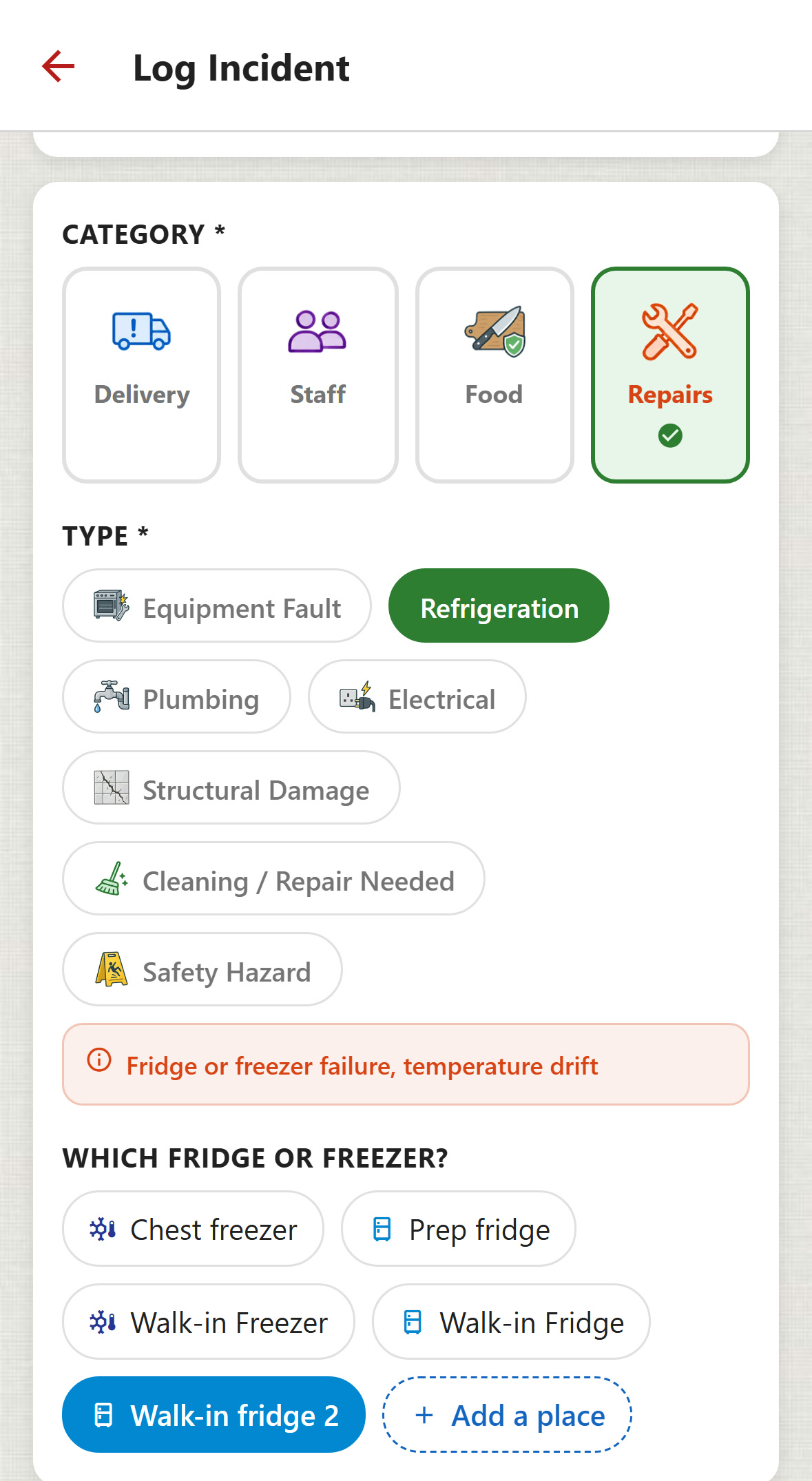
Logged against the fridge. Choose Repairs, then Refrigeration, then the fridge it is about.
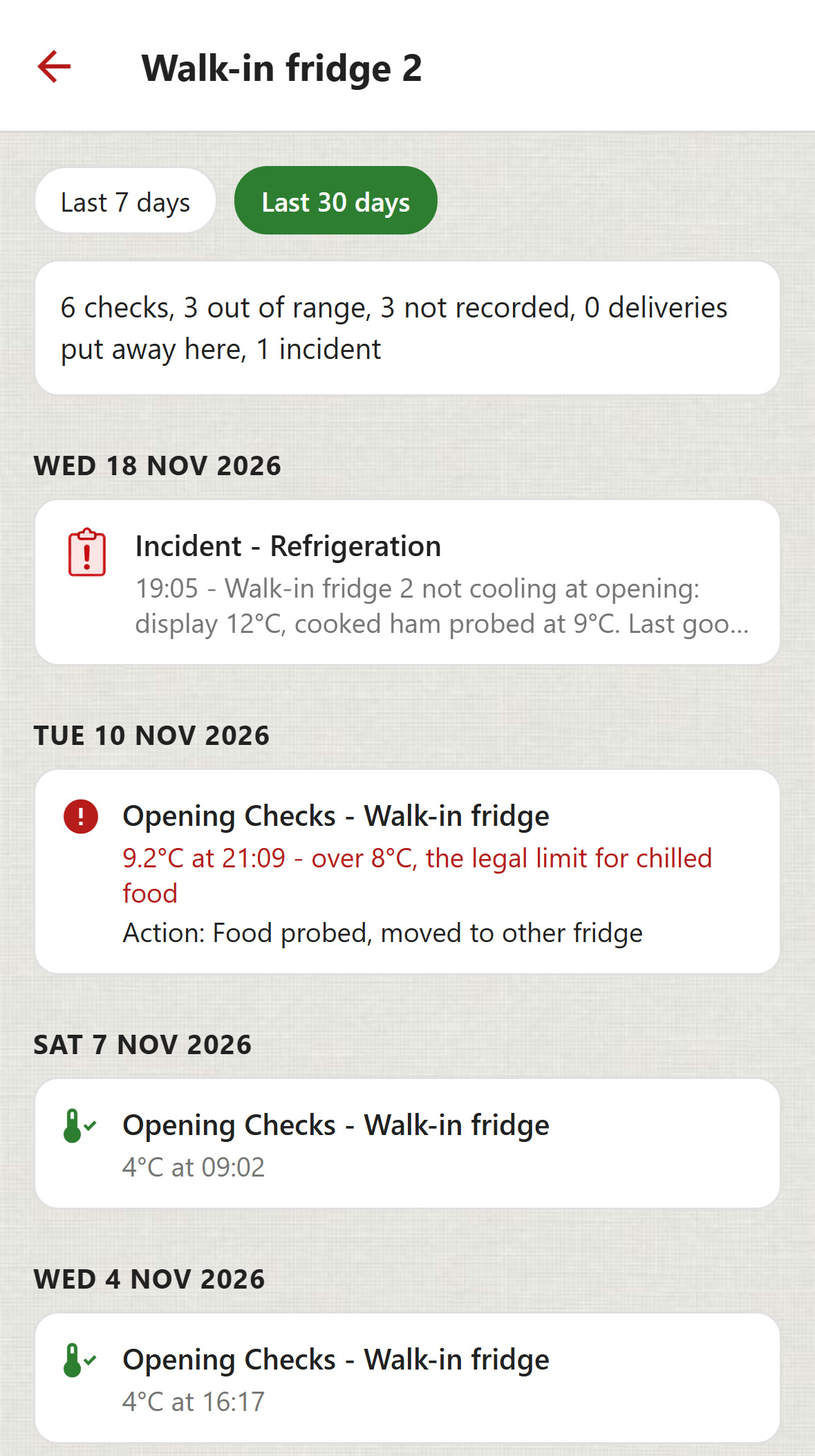
The fridge's own history. The open repair sits on top of that fridge's readings, with the warm one earlier in the month and what was done about it.
Waiting for the engineer? Keep it Open. Write who you told and when, and the date the engineer gave you, in the description, and set the due date to match. Add to the description as things happen rather than rewriting what is there. Every edit is kept in the incident's change history: who changed what, and when.
Which plan. Incidents are on every plan, and the free plan keeps up to 20. Fridge checks, the reports and the Inspection Pack come with Standard and Pro, and are open in the 14-day trial.
Get ChefsRecords on the App Store (iPhone) ›
14 days free. No card required.
Get ChefsRecords on Google Play (Android) ›
14 days free. No card required.
This page explains the law and the guidance in plain words, from the public sources below as published on 18 November 2026. It is general information, not legal advice. For a question about your own kitchen, ask the food safety team at your council. ChefsRecords is not part of, or endorsed by, the Food Standards Agency, Food Standards Scotland or your council.
It depends on what the officer finds. A fridge that is empty and out of use, with the food moved and checked, the engineer booked and all of it written down, shows a kitchen in control. A broken fridge with food still in it is a food safety problem and can pull the rating down in more than one area.
It helps a lot, but the repair still counts until it is done. Keep the kit out of use, keep the food safe without it, and show the officer the record and the engineer's date. The officer will look at the building and kit score as well as your records.
Move it to a working fridge. In England, Wales and Northern Ireland, the FSA says chilled food that has been out of chilled conditions for more than 4 hours goes in the bin. If you do not know how long the fridge has been off, or you are in Scotland, ring your council's environmental health team for advice. Probe the food, and write down the readings and what you did.
Take it out and cook on something else until the new one is fitted. If it is the fixed floor of the oven, stop using that oven or deck until the engineer has seen it. A cracked stone can drop grit or chips into food. Write down when it cracked, that it came out of use and when the new one went in.
The repair may be the landlord's, but keeping food safe around it is yours. Report it in writing each time, keep the replies, show what you are doing in the meantime, and show the officer your dated record. If the council's letter names the repair, send the landlord a copy.
What broke, when it was found and when it was last known to be right, the readings, what you did with the food, that it was taken out of use, who you told and when, when it was fixed, and how you checked the fix worked.
In England, Wales and Northern Ireland you have 21 days to appeal in writing to the council, if you think the rating was wrong for what was found on the day. In Scotland you have 14 days. If the repair just was not done yet on the day, a right to reply and a re-rating visit suit better.
Ask the council in writing and send proof of the repair, such as the engineer's job sheet. In Wales and Northern Ireland councils charge, and some English councils do. In England, Wales and Northern Ireland the new rating can go up, stay the same or go down. In Scotland a revisit after Improvement Required is free at the moment, and the result stays the same or becomes a Pass.
Scotland gives Pass or Improvement Required instead of 0 to 5. The appeal window is 14 days, a revisit is free at the moment, and a right to reply goes in writing to the officer. The steps in the kitchen are the same.
The EHO inspection guide, the food hygiene inspection checklist, the fridge temperature log guide, the freezer temperature guide, the hot holding guide, the near miss guide and the food safety diary guide.
Walk the kitchen today and list anything that is broken, cracked or waiting for a part. Log each one as a repair in ChefsRecords, with who you told and when.
Get ChefsRecords on the App Store (iPhone) ›
14 days free. No card required.
Get ChefsRecords on Google Play (Android) ›
14 days free. No card required.
Separate offer for founding kitchens: Pro free for 3 months if you apply by 31 March 2027. See the offer.
Read next: Food hygiene inspection checklist